
风力发电

Search documents
全球排名第三!风电齿轮箱龙头企业德力佳冲刺IPO
Mei Ri Jing Ji Xin Wen· 2025-07-29 04:08
Group 1 - The Shanghai Stock Exchange's Listing Review Committee will hold its 27th meeting on July 31, 2025, to review the IPO of Delijia Transmission Technology (Jiangsu) Co., Ltd. [1] - Delijia specializes in the R&D, production, and sales of high-speed heavy-load precision gear transmission products, primarily for wind power generation, with its core product being the wind turbine main gearbox [1]. - Since its establishment in 2017, Delijia has developed a comprehensive business chain from design to mass production and operation services, with R&D and production capabilities for products ranging from 1.5MW to 22MW [1]. Group 2 - The company’s products are characterized by equal strength, stiffness, lightweight, modular platforms, high power density, high transmission efficiency, and high reliability, suitable for various geographical and climatic conditions [1]. - Wind turbine gearboxes are critical components of wind power systems, with their reliability and quality directly impacting overall performance and long-term stability [1]. - Delijia has established strong partnerships with leading clients such as Goldwind Technology, Envision Energy, Mingyang Smart Energy, and SANY Heavy Energy, leveraging its stable product quality and delivery capabilities [2]. Group 3 - The company has seen growth in business scale and market share due to the rapid development of China's wind power industry, achieving a global market share of 10.36% in 2024, ranking third globally, and a 16.22% share in China, ranking second [2]. - Delijia has received multiple honors, including "Jiangsu Province 2024 Unicorn Enterprise" and "2022 Jiangsu Province Level Enterprise Technology Center," reflecting its industry recognition and capabilities [2].
公用环保202507第4期:国内首台百万千瓦四代商用快堆初步设计完成,2025Q2公用环保板块基金持仓梳理-20250728
Guoxin Securities· 2025-07-28 09:23
Investment Rating - The report maintains an "Outperform" rating for the public utility and environmental sectors [1][10]. Core Views - The completion of the preliminary design for China's first 1 million kilowatt fourth-generation commercial fast reactor marks significant progress in the country's nuclear energy strategy [2][16]. - The public utility sector saw a 7.64% increase in the total market value of fund holdings, reaching 63.28 billion yuan in Q2 2025, with a focus on hydropower companies [3][17]. - The report emphasizes the importance of coal and electricity prices moving downward, which is expected to maintain reasonable profitability for thermal power companies [4][25]. Summary by Sections Market Review - The Shanghai Composite Index rose by 1.69%, while the public utility index fell by 0.27% and the environmental index increased by 1.66% [1][15]. - Within the power sector, thermal power decreased by 0.29%, hydropower by 1.31%, while new energy generation rose by 1.24% [1][28]. Important Events - The preliminary design of the CFR1000 fast reactor has been completed, which is crucial for energy security and sustainable development in China [2][16]. - In August 2025, the electricity trading price in Jiangsu was 393.8 yuan per megawatt-hour, with a total transaction volume of 12.353 billion kilowatt-hours [2][16]. Investment Strategy - Recommendations include major thermal power companies like Huadian International and Shanghai Electric, as well as leading new energy firms such as Longyuan Power and Three Gorges Energy [4][25]. - The report suggests focusing on high-dividend hydropower stocks like Yangtze Power for their defensive attributes [4][25]. Fund Holdings - In Q2 2025, the total market value of fund holdings in the public utility sector was 63.28 billion yuan, with a notable increase in hydropower and gas sectors, while thermal power saw a decrease [3][19]. - The environmental sector's fund holdings totaled 7.352 billion yuan, showing a slight decline from the previous quarter [21][22]. Key Company Recommendations - The report recommends several companies across different sectors, including: - Huadian International and Shanghai Electric in thermal power [4][25]. - Longyuan Power and Three Gorges Energy in new energy [4][25]. - Yangtze Power in hydropower [4][25]. - Guangxi Energy and Funiu Co. in offshore wind energy [4][25]. - Light Environmental and Zhongshan Public Utility in the environmental sector [26].
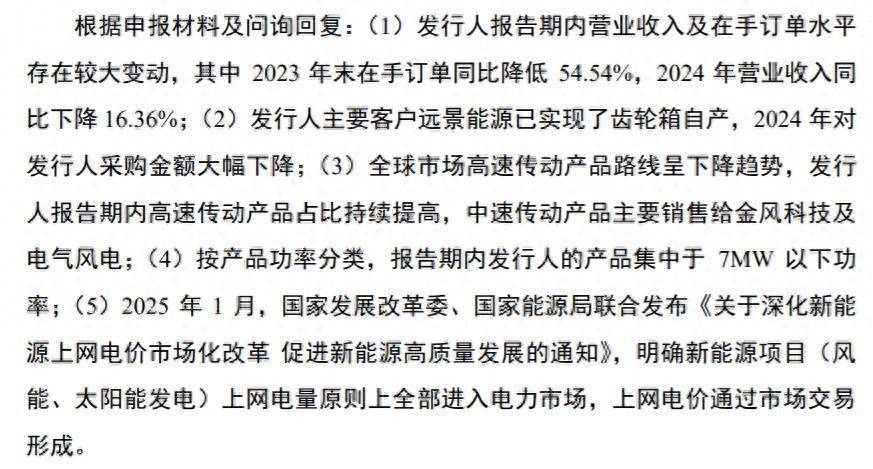
德力佳在手订单连续两年下滑,经营业绩稳定情况遭问询
Sou Hu Cai Jing· 2025-07-25 07:13
Core Viewpoint - Delijia Transmission Technology (Jiangsu) Co., Ltd. is facing significant challenges in its business performance, with a notable decline in orders and revenue due to market dynamics and client shifts towards self-sourcing gearboxes [2][3]. Group 1: Business Performance - The company reported a 54.54% year-on-year decrease in orders by the end of 2023 and a 16.36% decline in revenue for 2024 [2]. - The main client, Envision Energy, has started producing gearboxes in-house, leading to a substantial reduction in procurement from Delijia in 2024 [2]. - The company's product focus has shifted towards high-speed transmission products, which have seen an increasing share, while mid-speed products are primarily sold to Goldwind Technology and Electric Wind Power [2]. Group 2: Market Trends and Policy Impact - The National Development and Reform Commission and the National Energy Administration have issued a notice promoting market-oriented pricing for renewable energy, which may impact future revenue streams [2]. - The wind power industry is experiencing a recovery in 2023 due to favorable policies, with Delijia's sales growth aligning with industry trends, although it lagged behind the average growth due to the impact of Envision Energy's self-production [4][5]. Group 3: Competitive Landscape - Delijia's sales to Goldwind Technology accounted for 59.04% of its total sales in 2022, which helped the company achieve a 121.44% increase in sales despite an overall industry decline [4]. - The company has seen a slight increase in gross margin due to falling material prices, although revenue and profit are expected to decline in 2024 due to reduced sales prices and slower growth [5]. - By the end of 2024, Delijia anticipates a recovery in order volume and value, returning to levels seen at the end of 2022, driven by increased orders from Goldwind Technology and other clients [5].

节能风电: 北京市天元律师事务所关于中节能风力发电股份有限公司2025年第三次临时股东会的法律意见
Zheng Quan Zhi Xing· 2025-07-24 16:21
Core Points - The company held its third extraordinary general meeting of shareholders on July 24, 2025, using a combination of on-site and online voting methods [1][3] - The legal opinion provided by the law firm confirms that the meeting's procedures, participant qualifications, and voting results comply with relevant laws and regulations [2][5] Group 1: Meeting Procedures - The board of directors resolved to convene the meeting on July 8, 2025, and the notice was published on July 9, 2025, detailing the time, location, agenda, voting methods, and attendees [2][3] - The meeting was held at the designated location in Beijing, with specific time slots for online voting [3][4] Group 2: Participant Qualifications - A total of 560 participants attended the meeting, holding 3,185,723,336 shares, which is 49.2125% of the total voting shares [4] - Among the attendees, one participant represented 3,123,284,215 shares (48.2480%), while 559 participants voting online held 62,439,121 shares (0.9645%) [4][5] Group 3: Voting Procedures and Results - The meeting utilized a cumulative voting system for the election of directors, with all agenda items being voted on without any postponements [5][6] - The election of non-independent directors resulted in a total of 3,171,277,512 votes in favor, with 47,993,297 votes from minority investors [6][7] - The election of independent directors also received significant support, with 3,171,149,516 votes in favor, including 47,865,301 votes from minority investors [7] Group 4: Legal Conclusion - The law firm concluded that the meeting's procedures, participant qualifications, and voting results were all legally valid and compliant with applicable regulations [5][7]

行业周报(7.14-7.20):雅鲁藏布江下游水电工程开工,6月全国用电量同比+5.4%-20250723
Great Wall Securities· 2025-07-23 05:34
Investment Rating - The report maintains an "Outperform" rating for the industry, indicating expectations for the industry to perform better than the market in the next six months [4][63]. Core Insights - The national electricity consumption in June 2025 increased by 5.4% year-on-year, with total consumption reaching 867 billion kilowatt-hours [3][36]. - The Yarlung Tsangpo River downstream hydropower project has commenced, with a total investment of approximately 1.2 trillion yuan [3][37]. - The national power load reached a historical high of 1.5 billion kilowatts on July 16, 2025, marking a significant increase compared to previous records [3][38]. Market Performance - The Shenwan Public Utilities Index fell by 1.37% during the week of July 14-20, 2025, underperforming compared to the Shanghai Composite Index by 2.06 percentage points [2][12]. - The industry valuation as of July 18, 2025, shows a Price-to-Earnings (PE) ratio of 17.2, down from 17.43 the previous week, and a Price-to-Book (PB) ratio of 1.73, down from 1.75 [1][23][26]. Stock Performance - Top-performing stocks for the week included Mindong Electric (+6.75%), Jiufeng Energy (+5.52%), and Langfang Development (+4.79%) [2][29]. - Underperforming stocks included Wanqing Energy (-9.25%), Shaoneng Shares (-7.04%), and Huayin Electric (-6.53%) [2][29]. Industry Dynamics - The report highlights the ongoing trend of stable coal prices, with the Qinhuangdao Shanxi mixed coal price at 634 yuan per ton, reflecting a week-on-week increase of 1.6% [3][42]. - The report also notes the significant trading volumes in green certificates, with a total of 17.42 thousand wind power and 6.43 thousand photovoltaic power certificates traded from July 14 to July 20, 2025 [3][45]. Recommendations - For thermal power, the report suggests a long-term view on demand-side supply and peak regulation, with expectations for stable profit margins [7]. - For hydropower, it recommends positioning in relatively undervalued leading stocks during times of reduced risk appetite [8]. - In the green energy sector, the report advises focusing on leading companies and regions with declining electricity prices [8].



奥克斯重启港交所IPO,新能源充电桩巨头挚达科技三度递表港交所
Sou Hu Cai Jing· 2025-07-21 12:22
Group 1: New Listings - On July 14-20, one company listed on the Shanghai Stock Exchange main board, while no companies listed on the Shenzhen Stock Exchange [2] - China Huadian New Energy, focused on wind and solar power generation, saw its stock price rise over 125.79% on its first trading day, closing at 7.56 CNY per share, a 137.74% increase from the issue price of 3.18 CNY, with a total market capitalization of approximately 309.7 billion CNY [3] Group 2: Companies Passing Review - One company passed the review on the Shanghai Stock Exchange's Sci-Tech Innovation Board during the same period, while no companies passed on the Shenzhen Stock Exchange [4] - Shenzhen Beixin Life Technology Co., Ltd. specializes in innovative medical devices for cardiovascular disease diagnosis and treatment [5] Group 3: Terminated Listing Reviews - No companies terminated their listing reviews on the Shanghai Stock Exchange during this period, while one company on the Shenzhen Stock Exchange main board and one on the ChiNext did [7] - Guangdong Zhengyang Sensor Technology Co., Ltd. in the automotive manufacturing industry and Guizhou Duocai New Media Co., Ltd. in telecommunications both terminated their listing reviews [8] Group 4: Hong Kong Stock Exchange Activities - No new companies listed on the Hong Kong Stock Exchange during July 14-20 [9] - Three companies submitted applications for main board listings: Hunan Maijizhi Biotechnology Co., Ltd., Aux Electric Co., Ltd., and Shanghai Zhida Technology Development Co., Ltd. [12][13] - Hunan Maijizhi is a clinical-stage biopharmaceutical company focused on innovative biological agents for allergic and autoimmune diseases [14] - Aux Electric is one of the top five air conditioning providers globally, with a market share of 7.1% as of 2024 [16] - Shanghai Zhida Technology is the largest supplier of home electric vehicle charging solutions globally [19] Group 5: Financial Data and Fundraising - Hunan Maijizhi reported revenues of 8.72 million CNY and a net loss of 253 million CNY for 2023, with projections for 2024 showing a revenue of 2.4 million CNY and a net loss of 178 million CNY [14] - Aux Electric's revenues are projected to grow from 19.528 billion CNY in 2022 to 29.759 billion CNY in 2024, with net profits increasing from 1.442 billion CNY to 2.910 billion CNY [16] - Shanghai Zhida's revenues are expected to decline from 697 million CNY in 2022 to 593 million CNY in 2024, with net losses increasing from 25.147 million CNY to 236 million CNY [21]

立新能源: 新疆立新能源股份有限公司2023年度向特定对象发行股票并在主板上市募集说明书(修订稿)
Zheng Quan Zhi Xing· 2025-07-18 11:28
Core Viewpoint - Xinjiang Lixin Energy Co., LTD. is preparing for a public offering, highlighting the potential risks and opportunities associated with the renewable energy sector in China, particularly in the context of market reforms and subsidy changes [1][2][3]. Company Overview - The company is located in Urumqi, Xinjiang, and is focused on renewable energy projects, including wind and solar power [1]. - The company has a significant number of projects that are eligible for renewable energy subsidies, with 15 projects currently under review for compliance [5][6]. Financial Performance - The company's revenue for the reporting period was 881.78 million yuan, 989.77 million yuan, 970.68 million yuan, and 216.79 million yuan, with net profits showing a declining trend [7][8]. - The net profit attributable to shareholders decreased significantly, with a drop of 62.89% year-on-year in the latest quarter [7][8]. Market Environment - The renewable energy sector is undergoing significant policy changes, with a shift towards market-based pricing for electricity, which may lead to lower selling prices for the company's electricity [2][3]. - The company’s participation in market transactions has increased, with the proportion of market-based trading rising from 22.27% to 41.55% over the reporting periods [3][4]. Risks and Challenges - The company faces risks related to policy changes that could affect electricity pricing, particularly as subsidies are reduced and market competition increases [2][3]. - The average selling price of electricity is expected to decline, impacting overall revenue if the company does not adapt its sales strategies effectively [3][4]. - The company has experienced longer collection periods for subsidy payments, which could strain cash flow and increase accounts receivable [5][6]. Investment and Funding - The company plans to raise approximately 1.83 billion yuan through a public offering, with funds allocated primarily for new renewable energy projects [18]. - The funding will support the development of a 200,000 kW/800,000 kWh energy storage project and an 80,000 kW wind power project [18]. Regulatory Approvals - The offering has received necessary approvals from various regulatory bodies, including the Xinjiang State-owned Assets Supervision and Administration Commission [13][14]. - The company is required to adhere to specific regulations regarding the issuance of new shares and the management of investor relations [14][16].
7月17日电,北欧可再生能源公司维斯塔斯风力技术系统在美国市场获得527 MW订单。
news flash· 2025-07-17 15:53
Core Viewpoint - Vestas Wind Systems has secured a significant order of 527 MW in the U.S. market, indicating strong demand for renewable energy solutions in the region [1] Company Summary - Vestas Wind Systems is a leading player in the renewable energy sector, particularly in wind energy technology [1] - The recent order reflects the company's ongoing expansion and commitment to the U.S. market, which is crucial for its growth strategy [1] Industry Summary - The renewable energy industry, particularly wind energy, is experiencing robust growth in the U.S., driven by increasing investments and demand for sustainable energy solutions [1] - The order from Vestas highlights the competitive landscape and the potential for further opportunities within the renewable energy sector [1]
北欧可再生能源公司维斯塔斯风力技术系统在美国市场获得527 MW订单。
news flash· 2025-07-17 15:46
Core Insights - Vestas Wind Systems has secured a significant order of 527 MW in the U.S. market [1] Company Summary - Vestas Wind Systems is a leading player in the renewable energy sector, particularly in wind energy [1] - The recent order reflects the company's strong position and demand for wind energy solutions in the U.S. [1] Industry Summary - The renewable energy industry, especially wind power, continues to grow, with increasing orders indicating robust market demand [1] - The U.S. market remains a critical area for expansion and investment in renewable energy technologies [1]