
卫星互联网

Search documents
【大涨解读】卫星互联网:发射任务密集,低轨卫星整体节奏正式进入快车道,未来还有太空算力新想象空间
Xuan Gu Bao· 2025-08-08 03:13
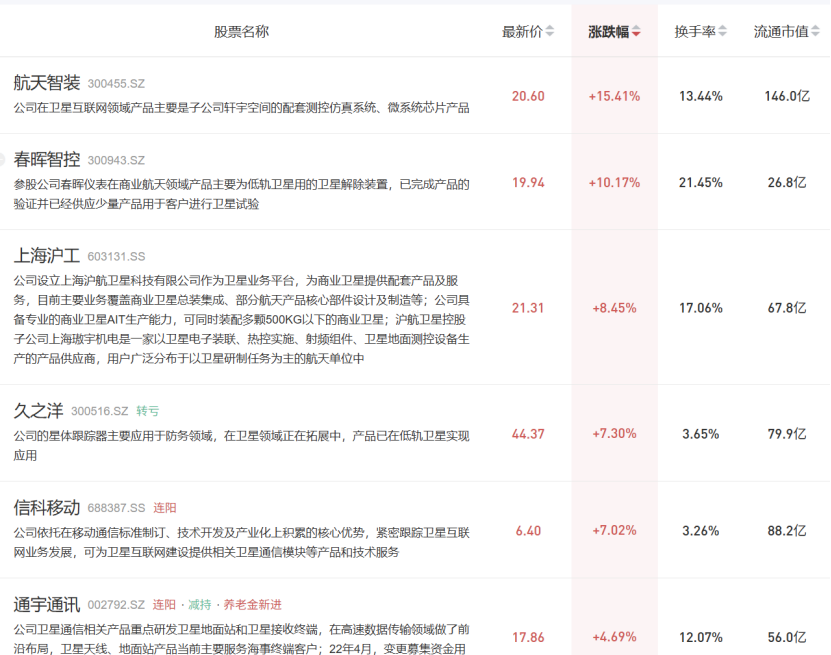
Market Review - On August 8, satellite internet stocks surged, with Aerospace Zhizhuang rising by 15.41%, Chunhui Zhikong by 10.17%, and Shanghai Huguang and Jiuzhiyang following suit [1] - Aerospace Zhizhuang's latest price is 20.60, with a market cap of 14.6 billion [1] - Chunhui Zhikong's latest price is 19.94, with a market cap of 2.68 billion [1] - Shanghai Huguang's latest price is 21.31, with a market cap of 6.78 billion [1] - Jiuzhiyang's latest price is 44.37, with a market cap of 7.99 billion [1] - Xinkemobile's latest price is 6.40, with a market cap of 8.82 billion [1] - Yiyu Communications' latest price is 17.86, with a market cap of 5.6 billion [1] Events - On August 4, China successfully launched the low Earth orbit satellite internet group 07 using the Long March 12 rocket [2] - On July 30, China successfully launched the low Earth orbit satellite internet group 06 using the Long March 8 rocket [2] - The GW constellation plans to launch a total of 12,992 satellites, with 10% expected to be launched by 2030 [2] Institutional Insights - The GW constellation has completed the deployment of seven satellite groups, while the Qianfan constellation has completed five launches, reaching 90 satellites in orbit [3] - The rapid pace of low Earth orbit satellite launches is confirmed by the recent successful launches of groups 06 and 07 [4] - The demand for FPGA in low Earth orbit satellites is increasing, which is expected to boost the industry [4] - Space computing is evolving towards a collaborative model, enhancing data processing capabilities in orbit [5] - New satellite constellations for remote sensing, computing, and relay are being developed, promoting diverse applications in the industry [5]




“卫星”点火起飞 导航板块异动
Mei Ri Shang Bao· 2025-08-08 01:37
Group 1 - The satellite navigation sector is experiencing significant activity due to an accelerated satellite launch schedule, with companies like China Satellite and China Satcom seeing notable stock movements [1][2] - The upcoming launch of the "Jili Constellation 04 Group" consisting of 11 satellites aims to provide high-precision positioning and satellite communication support for brands under Geely [2][3] - The GW constellation has increased its launch frequency, with intervals reduced to 3-5 days, indicating a rapid network deployment phase for China's satellite internet [2][4] Group 2 - The total market capitalization of the satellite navigation sector has reached 2.32 trillion yuan, reflecting strong investor interest [3] - Several companies, including Shuo Bei De and Jia Yuan Technology, have seen significant stock price increases, with some hitting the daily limit [3] - The construction and operation of the "Qianfan Constellation" is expected to accelerate, with plans for multiple rocket launches to support its development [3][5] Group 3 - Companies are increasing investments in satellite internet infrastructure, with Guangdian Jiliang planning to invest 344 million yuan in a quality assurance platform [5] - Zhenyou Technology is set to invest 709 million yuan in satellite internet communication product development, focusing on core network systems and satellite terminals [6] - The development of satellite internet technology is expected to create substantial demand, with projections indicating the global space economy could exceed one trillion dollars by 2040 [7]





午评:沪指窄幅震荡涨0.12% 芯片板块集体爆发
Zhong Guo Jin Rong Xin Xi Wang· 2025-08-07 04:09
Market Performance - A-shares showed mixed performance on August 7, with the Shanghai Composite Index up 0.12% to 3638.40 points and a trading volume of 478.8 billion yuan [1] - The Shenzhen Component Index fell 0.13% to 11163.36 points with a trading volume of 710 billion yuan, while the ChiNext Index decreased by 0.52% to 2346.59 points with a trading volume of 366.4 billion yuan [1] Sector Performance - Semiconductor stocks surged, with companies like Jinghua Micro and Fuman Micro hitting the daily limit [1] - Medical device stocks showed strength, with companies like Lide Man also reaching the daily limit [2] - The IP economy sector rebounded, highlighted by Jin Hong Group's daily limit increase [1] - Conversely, innovative drug stocks faced adjustments, with Qianhong Pharmaceutical hitting the daily limit down [1][2] Institutional Insights - CITIC Securities noted a significant increase in the launch frequency of China's GW satellite constellation, indicating a rapid development phase in the satellite internet sector [3] - Huatai Securities suggested that the real estate sector is building a foundation for stabilization, with policy directions focusing on stabilizing housing prices and activating demand [3] - CITIC Securities also highlighted the growing demand for liquid cooling solutions in AI server designs, predicting a substantial market expansion for domestic liquid cooling companies [3] Trade Data - China's goods trade saw a year-on-year increase of 3.5% in the first seven months of the year, with a total trade value of 25.7 trillion yuan [5] - In July, the total trade value reached 3.91 trillion yuan, marking a 6.7% increase, with exports at 2.31 trillion yuan (up 8%) and imports at 1.6 trillion yuan (up 4.8%) [5] Education Policy - The Ministry of Finance announced that it will soon allocate funds for free preschool education, indicating a commitment to implementing this policy [4]
ETF甄选 | 三大指数继续收涨,机器人、军工、航空航天等相关ETF表现亮眼!
Xin Lang Cai Jing· 2025-08-06 08:25
Market Overview - The market experienced a day of fluctuations with all three major indices closing higher: Shanghai Composite Index up 0.45%, Shenzhen Component Index up 0.64%, and ChiNext Index up 0.66% [1] Sector Performance - Shipbuilding, electric machinery, and gaming sectors showed the highest gains, while traditional Chinese medicine, pharmaceutical commerce, and chemical pharmaceuticals faced declines [1] Investment Opportunities - The Shanghai Municipal Government released a plan to develop the embodied intelligent industry, offering incentives for companies involved in the sales or leasing of embodied intelligent robots, with rewards up to 5% and a maximum of 5 million yuan [2] - CITIC Securities forecasts 2025 as the year of mass production for embodied intelligent robots, highlighting the integration of AI and physical applications as a significant opportunity for the industry over the next decade [2] - The defense and military sector is expected to see a recovery in performance, with increased demand driven by the implementation of the "14th Five-Year Plan" and rising global military expenditures due to geopolitical tensions [2][3] Industry Trends - The satellite internet industry is gaining momentum, with significant advancements in satellite deployment and technology, paving the way for commercial space ventures [3] - The development of satellite internet is supported by innovations in manufacturing and the use of reusable rocket technology, which will lower launch costs and enhance capacity [3] Related ETFs - ETFs related to robotics include: Robot 50 ETF (159559), E Fund Robot ETF (159530), Robot Industry ETF (159551), and Southern Robot ETF (159258) [2] - ETFs related to military and defense include: Military ETF Leader (512680), Military ETF (512660), and National Defense Military ETF (512810) [3] - ETFs related to aerospace include: Aerospace ETF (159267), Tianhong Aerospace ETF (159241), and General Aviation ETF (159255) [4]

中信建投:我国卫星互联网进入高密度发射期 重视商业航天投资机会
Zhi Tong Cai Jing· 2025-08-06 06:21
Core Insights - The frequency of satellite launches in China has significantly increased, indicating a rapid acceleration in the construction of the GW satellite constellation [1][2] - The construction of the Qianfan constellation is expected to gradually speed up, with recent procurement announcements for multiple rocket launch services [3] - The Hainan commercial launch site has resolved bottlenecks in launch facilities, enabling the upcoming maiden flights of large private liquid rockets [4][5] - Several large-capacity private liquid rockets are set to make their first flights in the second half of 2025, which may play a crucial role in the development of China's low Earth orbit satellite internet [6] - Blue Arrow Aerospace has initiated its IPO process, aiming for a listing on the Sci-Tech Innovation Board [7] Launch Frequency and Network Construction - The GW constellation consists of 12,992 satellites, with a notable increase in launch frequency from 2024, where the interval between launches for groups 01-05 was at least one month, while for groups 05-07, it has reduced to approximately 3-5 days [2] Qianfan Constellation Progress - The Qianfan constellation has completed applications for 1,296 and 13,904 satellites, with five "one rocket, 18 satellites" launches conducted recently, although subsequent launches have not yet commenced [3] Hainan Commercial Launch Site Development - The Hainan commercial launch site has completed the construction of the first two launch pads and plans to add two more, enhancing its capacity for high-frequency, high-capacity, and low-cost launches [4] Upcoming Rocket Launches - Multiple large-capacity private liquid rockets, including Blue Arrow's Zhuque-3 and Tianbing Technology's Tianlong-3, are expected to conduct their maiden flights in late 2025, which will help reduce launch costs significantly [6] Investment Opportunities - Companies to watch in the satellite manufacturing segment include Aerospace Electronics, Zhenlei Technology, and China Satellite, while in the rocket launch segment, attention should be given to Plater, Srey New Materials, and Huazhu High-Tech [8]

卫星互联网建设提速,多家上市公司加码布局
Shang Hai Zheng Quan Bao· 2025-08-05 14:17
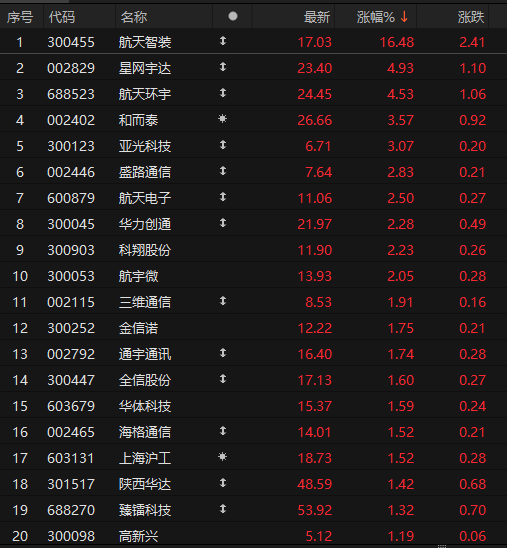
Core Viewpoint - The successful launch of the low Earth orbit satellite internet group 07 by the Long March 12 rocket marks a significant acceleration in China's satellite internet deployment, with multiple launches occurring within a short timeframe [1][4]. Group 1: Satellite Launches and Developments - The satellite internet low Earth orbit groups 01 to 07 are part of China's "National Network Constellation," which aims to deploy approximately 1,300 satellites by 2029 and around 13,000 by 2035 [4]. - The recent launches demonstrate the capabilities of the Hainan commercial space launch site, achieving high-density launches successfully for the first time [4]. - The 07 group satellites were developed by the private company Galaxy Space, marking the first batch production of such satellites by a private firm in China [4][6]. Group 2: Stock Market Response - Following the successful launch, over thirty companies in the A-share satellite internet sector saw stock price increases, with notable gains from companies like Aerospace Zhizhuang and Xingwang Yuda [1][2]. - Specific stock performance included Aerospace Zhizhuang rising by 17.03% and Xingwang Yuda by 4.93% [2]. Group 3: Investment and Business Expansion - Several listed companies are increasing their investments in the satellite internet sector, with significant projects announced, such as a 344 million yuan investment by Guangdian Measurement for a satellite internet quality assurance platform [8]. - Zhenyou Technology plans to invest 709 million yuan in satellite internet communication product development, focusing on core network systems and satellite terminal devices [8]. - Tongyu Communication has positioned itself advantageously in the national satellite constellation launch plans, indicating a strong future in the satellite internet market [9].


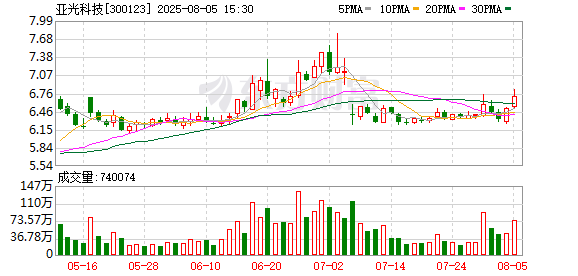
亚光科技:卫星互联网领域和通讯领域,公司微波信道类产品可实现配套
Zheng Quan Ri Bao· 2025-08-05 14:13
Core Insights - The company, Yaguang Technology, has indicated its capabilities in the satellite internet and communications sectors, specifically through its microwave channel products [2] Group 1: Product Offerings - The company offers a range of microwave channel products that can support applications in satellite internet and communications, including low-noise amplifiers, mixers, power dividers, filters, and signal detection circuits [2] - Additionally, the company provides composite functional microwave module components, such as TR components, which can also be utilized in these sectors [2]

国泰海通 · 晨报0806|电子、家电
国泰海通证券研究· 2025-08-05 13:56
Group 1: Low Earth Orbit Satellites and FPGA Industry - The successful launch of the low Earth orbit satellite group 07 on August 4 indicates a rapid acceleration in satellite deployment, with two launches occurring within four days [3] - The demand for FPGA in space electronic devices is increasing, with a significant example being the use of 149 FPGAs in the European Space Agency's Sentinel-2 satellite, which constitutes over 50% of its chips [3] - The growth in low Earth orbit satellite deployment is expected to boost the FPGA industry's overall market sentiment and demand [4] Group 2: Robotics Industry and World Robot Conference - The 2025 World Robot Conference will take place from August 8 to 12 in Beijing, featuring over 1,500 exhibits from more than 200 domestic and international robot companies, with a focus on humanoid robots [7] - Humanoid robots are achieving breakthroughs in mobility and dexterity, which are crucial for applications in home services, manufacturing, and logistics [8] - The development of high-performance embodied intelligent models is expected to enhance the fine manipulation capabilities of humanoid robots, accelerating their commercialization [9] Group 3: Lawn Mowing Robot Industry - The lawn mowing robot industry is experiencing a technological revolution, with smart robots offering significant advantages over traditional gas-powered mowers, including lower operational costs and higher efficiency [12] - The global market for lawn mowers is substantial, with a sales volume of approximately $8.292 billion, yet the penetration rate of smart lawn mowing robots remains low, particularly in the U.S. at under 5% [13] - The market is characterized by diverse participants, including traditional giants and tech-driven companies, with significant growth potential for those with technological advantages [14][15]

民生证券:海南发射场“双工位”接力 卫星互联网加速发射
智通财经网· 2025-08-05 08:11
Core Viewpoint - The successful launch of the low Earth orbit satellite group 07 by the Long March 12 rocket from the Hainan commercial space launch site marks a significant milestone in China's commercial space industry, indicating the validation of high-frequency launch capabilities at the country's first commercial launch site [1][2]. Group 1: Satellite Internet Development - The GW constellation has completed the deployment of seven satellite groups, with a total of 12,992 satellites planned, including 6,080 in the GW-A59 sub-constellation and 6,912 in the GW-A2 sub-constellation [3]. - The launch frequency has increased significantly, with three satellite groups successfully launched within nine days, signaling the onset of a high-density launch era for satellite internet [2][3]. - The development path of the satellite internet industry is becoming increasingly clear, supported by technological innovations in manufacturing and the operationalization of commercial launch sites [6][7]. Group 2: Hainan Commercial Launch Site - The Hainan commercial launch site has successfully completed four launches, demonstrating its capability for high-frequency launches through a dual-position "relay" launch system [4]. - The second phase of the Hainan commercial launch site project has commenced, which includes the construction of two additional launch positions, aiming for an annual launch capacity of 16 [4]. Group 3: Qianfan Constellation Progress - The Qianfan constellation has completed five launches, with a total of 90 satellites in orbit, showcasing the successful collaboration between commercial satellite constellations and launch facilities [5]. - The Qianfan constellation employs a "one rocket, multiple satellites" technology, indicating the maturity of China's satellite stacking and launch capabilities [5]. Group 4: Investment Opportunities - Companies to watch in the satellite sector include Shaanxi Huada (301517.SZ), New Ray Energy (300593.SZ), and China Satellite (600118.SH), among others [8]. - In the rocket sector, notable companies include Zhongtian Rocket (003009.SZ) and Srey New Materials (688102.SH) [8]. - Ground and operational companies of interest include Alliance Electronics (688311.SH) and China Satcom (601698.SH) [8].
卫星互联网产业趋势解析
2025-08-05 03:15
Summary of Satellite Internet Industry Conference Call Industry Overview - The satellite internet industry is experiencing a slowdown in satellite deployment in the first half of 2025, but a concentrated launch is expected in the second half, with overall launch volumes remaining within last year's expectations [1][2] - Key bottlenecks include rocket capacity, costs, electric propulsion technology, and laser networking technology, with future development focused on small-scale constellation deployment and technology validation [1][2] Key Points and Arguments - **Satellite Deployment and Challenges**: The deployment progress in the first half of 2025 has been slow, with anticipated concentrated satellite launches in the second half. Current limitations include rocket capacity and costs, as well as challenges in electric propulsion and laser networking technologies [2][3] - **Demand for Computing Constellations**: There is an increasing demand for CPUs, GPUs, and large-scale storage devices, necessitating considerations for radiation resistance and reliability. Satellite platforms continue to use traditional equipment, focusing on new computing and processing devices to meet space environment requirements [1][4] - **Reliability vs. Cost in Commercial Space**: The initial use of commercial-grade components in commercial space has led to reliability issues. Future standards may be developed to balance low costs with reliability, with FPGA chip prices expected to range from several thousand to tens of thousands of yuan [1][5] - **Industrial Component Upgrades**: Industrial-grade components are currently used in low-cost satellite manufacturing but require optimization. During the mass networking phase, industry standards will be established to ensure a balance between cost and reliability [1][6] - **Rocket Capacity Bottlenecks**: Current rocket models struggle to meet the demand for dense launches. The Long March 5 rocket is costly, and commercial rockets lack stable mass launch capabilities. Completing the planned launch of one to two hundred satellites in the second half of the year is considered optimistic [1][6] Emerging Trends and Applications - **Terminal Applications**: Current terminal applications are focused on specialized terminals for government, military, and remote shipping scenarios where ground network coverage is poor. Low Earth orbit (LEO) direct mobile connections are seen as the future direction, although commercial demand is not yet strong [3][7] - **Government Support for Commercial Space**: Local governments are increasingly supportive of the commercial space industry, with regions like Wuxi and Zhuzhou providing favorable policies and significant financing support [3][15] - **5G and Satellite Communication Standards**: The establishment of the 3GPP NTO standard is seen as a trend for future development, although each country has its own innovations and technical ideas. The standard's impact on the industry is still being evaluated [7][8] Competitive Landscape - **State-Owned vs. Private Enterprises**: The initial commercialization of satellite internet relied heavily on state-owned enterprises. While many commercial companies are emerging, most bidding projects are still dominated by state-owned firms, although some private companies are being included to foster development [8][20] - **Comparison with SpaceX**: China's satellite internet development is more cautious compared to SpaceX, with more complex single-satellite designs driven by government and military needs. This complexity results in higher costs, while SpaceX reduces costs through large-scale user services [8][20] Future Outlook - **User Base and Satellite Planning**: The user base for satellite internet in China is expected to remain small in the short term, primarily targeting specialized applications. Initial satellite constellation plans involve a few hundred satellites, with total investment expected to be in the tens of billions [9][10] - **Manufacturing Costs**: Current satellite manufacturing costs in China are high, with individual satellites costing around tens of millions. Reducing costs will require technological maturity and mass production [10][12] - **Ground Station and Data Transmission**: Insufficient ground station construction in China may affect data transmission latency after large-scale networking. New network designs aim to minimize the need for global ground stations [11][12] Conclusion - The satellite internet industry is at a critical juncture, facing both challenges and opportunities. The balance between cost and reliability, government support, and technological advancements will play a significant role in shaping the future of this sector.