农药

Search documents
基础化工2025三季报综述:盈利企稳,静待向上拐点
Changjiang Securities· 2025-11-09 09:16
Investment Rating - The report maintains a "Positive" investment rating for the chemical industry [11] Core Insights - The chemical industry achieved a revenue of 1,947.86 billion yuan in Q1-Q3 2025, representing a year-on-year growth of 2.1%, while net profit attributable to shareholders was 115.78 billion yuan, up 4.4% year-on-year [2][18] - In Q1-Q3 2025, 50.0% of the 30 chemical sub-industries reported year-on-year growth, increasing to 56.7% in Q3 2025 [2][28] - The report highlights a gradual recovery in the industry, with capital expenditures declining by 16.9% and 2.7% in 2024 and 2025 respectively, indicating a slowdown in expansion cycles [2][18] Summary by Sections Overall Operations - The chemical industry experienced a slight revenue increase with a profit growth rate surpassing revenue growth [18] - The gross profit margin for the industry was 16.8%, a year-on-year increase of 0.2 percentage points [18] - The report notes a continued downturn in the domestic real estate market and a slow recovery in consumption [2][18] Key Sub-Industries - **Fluorochemical**: Revenue reached 32.53 billion yuan in Q1-Q3 2025, with a year-on-year increase of 19.7% and net profit up 155.6% [9][41] - **Phosphate Chemical**: Revenue was 82.38 billion yuan, down 4.0% year-on-year, but net profit increased by 8.0% to 7.55 billion yuan [49][50] - **Potash Fertilizer**: Revenue grew by 13.1% to 20.77 billion yuan, with net profit rising 57.6% to 9.44 billion yuan [9] - **Pesticides**: Revenue reached 124.65 billion yuan, up 5.6%, with net profit increasing by 131.2% to 6.38 billion yuan [9] - **Soda Ash**: Revenue fell by 15.7% to 30.16 billion yuan, with net profit down 71.5% to 0.99 billion yuan [9] - **Polyurethane**: Revenue decreased by 1.9% to 163.35 billion yuan, with net profit down 16.5% to 9.51 billion yuan [9] - **Titanium Dioxide**: Revenue was 32.92 billion yuan, down 4.2%, with net profit down 46.3% to 1.74 billion yuan [9] - **Polyester Filament**: Revenue decreased by 5.0% to 118.94 billion yuan, but net profit increased by 38.0% to 2.42 billion yuan [9] - **Additives**: Revenue grew by 3.8% to 89.06 billion yuan, with net profit up 30.0% to 12.35 billion yuan [9] - **Civil Explosives**: Revenue increased by 16.6% to 48.83 billion yuan, with net profit up 8.2% to 3.60 billion yuan [9] - **Tires**: Revenue grew by 10.7% to 119.98 billion yuan, but net profit decreased by 17.3% to 9.89 billion yuan [9] - **Electronic Chemicals**: Revenue reached 52.97 billion yuan, up 13.1%, with net profit increasing by 22.4% to 6.05 billion yuan [9] Investment Recommendations - The report suggests actively positioning in the chemical sector, highlighting cyclical recovery and potential growth in various sub-industries [10][39]
新农股份:生产的乙基氯化物是合成有机磷类杀虫剂的关键中间体
Zheng Quan Ri Bao Wang· 2025-11-07 10:39
Group 1 - The company stated that ethyl chloride produced is a key intermediate for synthesizing organophosphorus insecticides [1] - N-(1-ethylpropyl)-3,4-dimethyl aniline is identified as a key intermediate for synthesizing herbicides [1] - Both products mentioned do not belong to the category of aromatic amines [1]
长青股份:麦草畏产能为8000吨/年,基本都为出口
Zheng Quan Ri Bao Wang· 2025-11-07 07:50
Group 1 - The core point of the article is that Changqing Co., Ltd. (002391) has confirmed its annual production capacity of glyphosate is 8,000 tons, primarily for export [1]

涉稀土永磁、集成电路等,一批国家标准发布
Shang Hai Zheng Quan Bao· 2025-11-07 05:04
Summary of Key Points Core Viewpoint - The National Market Regulation Administration has approved a series of important national standards aimed at enhancing quality of life, ensuring safety, and promoting sustainable development across various sectors. Emerging Fields - A total of 167 national standards have been released for new materials such as rare earth permanent magnet materials, fine ceramics, and carbon fiber composites, facilitating technology iteration and industry standardization [1] - Four national standards related to intelligent computing have been established, focusing on terminology, reference architecture, and testing methods to support AI-driven industrial upgrades [1] - Fourteen national standards concerning semiconductor equipment and materials have been introduced, which include electronic components and integrated circuit packaging testing, promoting healthy development in the semiconductor industry [1] Transportation and Green Low-Carbon - Three national standards for urban rail transit vehicles have been published to enhance public transportation safety [2] - Thirty national standards have been released for unmanned aerial vehicles, road traffic signs, and gas vehicles, contributing to the safety of transportation systems [2] - Twenty-two national standards related to waste treatment and greenhouse gas management have been established to improve the green low-carbon standard system [2] - A total of 199 national standards for high-end equipment technology upgrades have been introduced, promoting sustainable development in manufacturing [2] Safety Production - Twenty-two national standards for gas distribution equipment and pressure pipelines have been published to ensure the safety and stability of infrastructure [2] - Mandatory national standards for fireworks safety and quality have been established to enhance product safety requirements [2] - Eleven mandatory national standards for key fire safety products have been updated to improve performance and reliability in fire prevention [2] Economic and Trade Services - Three national standards for cross-border e-commerce and transaction information have been released to guide risk prevention and management for e-commerce platforms [3] - Five logistics and multimodal transport national standards have been introduced to enhance the standardization of logistics documentation and service contracts [3] - National standards for the Chinese translation of geographical names from Nordic and ASEAN countries have been published to support economic and cultural exchanges [3] Agriculture and Rural Development - Thirty national standards for feed, pesticides, and animal health have been established to ensure agricultural production safety [3] - Forty-six national standards for grain, tobacco, and biomass materials have been released to support high-quality agricultural product supply [3] - Seven national standards related to water conservation and agricultural trade have been introduced to enhance standardization in agriculture [3] Daily Life - Ten national standards for smart home appliances have been published to promote the intelligence, greenness, and safety of household products [3] - Thirteen national standards for textiles and footwear have been established to guide production and enhance consumer experience [3] - Six national standards related to health care, including iodine deficiency elimination, have been released to strengthen medical service guarantees [3] Additional Standards - The National Market Regulation Administration has also published standards related to smart manufacturing, semiconductor equipment, and enterprise safety management [4]
农药概念震荡拉升,蓝丰生化涨停
Mei Ri Jing Ji Xin Wen· 2025-11-07 02:33
Core Viewpoint - The pesticide sector experienced a significant rally on November 7, with notable stocks such as Bluefeng Biochemical hitting the daily limit up, while other companies like Lianhua Technology, Xin'an Chemical, Yangnong Chemical, Guokang Biochemical, and Limin Co. also saw increases in their stock prices [1]. Group 1 - The pesticide concept showed strong fluctuations and a notable rise in stock prices [1]. - Bluefeng Biochemical reached the daily limit up, indicating strong investor interest and confidence [1]. - Other companies in the sector, including Lianhua Technology, Xin'an Chemical, Yangnong Chemical, Guokang Biochemical, and Limin Co., also experienced stock price increases, reflecting a broader positive trend in the industry [1].

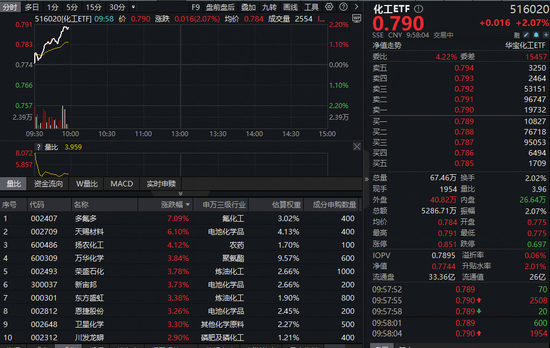
化工板块大涨,锂电猛攻!化工ETF(516020)单边上行,盘中涨超2%!机构高呼:化工板块配置或正当时!
Xin Lang Ji Jin· 2025-11-07 02:05
Group 1 - The chemical sector continues to show strong performance, with the chemical ETF (516020) rising by 2.07% as of the latest update [1][2] - Key stocks in the sector include lithium battery, fluorochemical, and pesticide companies, with significant gains observed in stocks like Duofluoride (up over 7%), Tianci Materials (up over 6%), and Yangnong Chemical (up over 4%) [1][2] - The lithium battery sector is experiencing rapid demand growth, with a projected 30% year-on-year increase in net profits for the lithium battery industry chain in the first half of 2025, reversing the downward trend of the past two years [1][3] Group 2 - The chemical ETF (516020) is currently at a relatively low valuation, with a price-to-book ratio of 2.29, indicating a favorable long-term investment opportunity [3][4] - The chemical sector is expected to benefit from rising oil prices and ongoing efforts to reduce "involution" competition, which may enhance the competitiveness of leading companies in the industry [4][5] - The ETF tracks the CSI Sub-Industry Chemical Index, covering various sub-sectors within the chemical industry, with nearly 50% of its holdings concentrated in leading companies like Wanhua Chemical and Salt Lake Industry [5][6]



安道麦A涨2.13%,成交额1697.51万元,主力资金净流入46.89万元
Xin Lang Zheng Quan· 2025-11-07 02:02
Core Viewpoint - The stock of Andermatt A has shown a slight increase in price and trading activity, indicating a stable market presence despite recent fluctuations in revenue and profit margins [1][2]. Financial Performance - For the period from January to September 2025, Andermatt A achieved a revenue of 21.678 billion yuan, reflecting a year-on-year growth of 0.72% [2]. - The company reported a net profit attributable to shareholders of -423 million yuan, which represents a significant year-on-year increase of 77% [2]. Stock Market Activity - As of November 7, Andermatt A's stock price rose by 2.13% to 6.70 yuan per share, with a total market capitalization of 15.610 billion yuan [1]. - The stock has experienced a year-to-date increase of 0.30%, a 5-day increase of 4.36%, a 20-day increase of 2.29%, and a 60-day decrease of 2.76% [1]. Shareholder Information - As of September 30, the number of shareholders for Andermatt A decreased by 3.69% to 36,200 [2]. - The average number of circulating shares per shareholder increased by 4.37% to 87,654 shares [2]. Dividend Distribution - Since its listing, Andermatt A has distributed a total of 9.64 billion yuan in dividends, with 62.905 million yuan distributed over the past three years [3]. Major Shareholders - As of September 30, 2025, Hong Kong Central Clearing Limited is the fourth largest circulating shareholder, holding 14.4147 million shares, a decrease of 3.8769 million shares from the previous period [3].

国信证券晨会纪要-20251107
Guoxin Securities· 2025-11-07 01:15
Macro and Strategy - The macroeconomic environment shows a recovery in upstream sectors, while midstream sectors exhibit a mixed recovery, with the coal industry maintaining stability and the petrochemical sector continuing to face challenges [9] - The manufacturing sector, particularly in the new energy chain, is showing improvement, with demand for machinery and automotive sectors gradually recovering [9] - Consumer sectors are experiencing a divergence, with home appliances and food and beverage sectors showing positive trends, while the pharmaceutical sector faces increasing price pressures [9] Industry and Company Analysis Textile and Apparel Industry - Adidas reported a 12% increase in revenue for Q3 2025, with management raising the full-year guidance due to strong brand momentum and better-than-expected performance [10][11] - The company achieved a net profit of €485 million in Q3, with all regions and channels showing double-digit growth, except for North America, which was impacted by a decline in accessory sales [10][11] - The management has adjusted the full-year revenue growth expectation to approximately 9%, with an operating profit target raised to about €2 billion [10][11] Agricultural Chemicals Industry - The potassium fertilizer market is experiencing a tight supply-demand balance, with domestic production expected to decrease by 2.7% in 2024, while imports are projected to increase by 9.1% [12][13] - The average price of potassium chloride in October was reported at ¥3228 per ton, reflecting a year-on-year increase of 28.3% [12] - The demand for lithium iron phosphate is rising, with production capacity reaching 5.92 million tons per year, and prices increasing by 7% in October [13] Livestock and Agriculture - The investment strategy for November 2025 recommends focusing on Hong Kong-listed dairy farming stocks, with expectations for beef prices to accelerate [17] - The report highlights a potential turning point in the domestic beef cycle, with optimism for both domestic and international markets [17] - The prices of live pigs and poultry are showing upward trends, with live pig prices increasing by 6% month-on-month [18] Medical Devices - Mindray Medical's international business is growing steadily, with Q3 revenue expected to accelerate compared to Q2 [26] - The company reported a revenue of ¥258.34 billion for the first three quarters of 2025, with a net profit of ¥75.70 billion, despite facing price pressures in the domestic market [26][27] - The company is focusing on enhancing its global supply chain and local production capabilities, with international revenue accounting for over 50% of total revenue [26] Pharmaceutical Industry - The report on Baicheng Pharmaceutical indicates a significant decline in revenue and net profit for the first three quarters of 2025, attributed to intensified competition in the generic drug market [28][29] - The company is transitioning towards innovative drug development, with over 15 projects in the pipeline, focusing on neurology, autoimmune diseases, and oncology [29] - The production capacity utilization is expected to improve as the company secures contracts for multiple drug varieties [29] Orthopedic Devices - Weigao Orthopedics reported a 10% increase in revenue for Q3 2025, driven by sales model integration and refined management practices [31] - The company is focusing on optimizing its sales structure and enhancing clinical service levels, which has led to increased revenue and volume across multiple product lines [31][32] - The net profit margin has improved significantly, reflecting effective cost control and operational efficiency [32]
山东中农联合生物科技股份有限公司 关于为全资子公司开展融资租赁业务提供担保的进展公告
Zhong Guo Zheng Quan Bao - Zhong Zheng Wang· 2025-11-06 23:21
Core Viewpoint - The company, Shandong Zhongnong United Biotechnology Co., Ltd., has engaged in financing leasing and provided guarantees for its wholly-owned subsidiary, Shandong United Pesticide Industry Co., Ltd., to optimize its financing structure and expand financing channels [2][4]. Summary by Sections Financing and Guarantee Overview - The company signed a financing lease contract with Supply and Marketing Group (Tianjin) International Leasing Co., Ltd. for a total amount of RMB 30 million, with a lease term of 36 months, and provided joint liability guarantee for this financing [2][4]. - The total guarantee amount provided by the company and its wholly-owned subsidiaries exceeds 50% of the company's latest audited net assets, amounting to RMB 99 million [3][11]. Approval Process - The company held board and shareholder meetings to approve the guarantee matters, including a guarantee limit of RMB 22 million for Shandong United and RMB 77 million for the company itself, allowing for rolling use within the authorized period [3][4]. Subsidiary Information - Shandong United Pesticide Industry Co., Ltd. was established on July 31, 1995, with a registered capital of RMB 55 million and operates in pesticide production and related activities [5][6]. Contract Details - The guarantee amount for the financing lease is RMB 30 million, with a guarantee period extending three years beyond the debt fulfillment deadline [9][10]. - The financing lease involves leasing production equipment, with a total cost of RMB 30 million and a maximum interest rate of 3.4% over three years [4][11]. Guarantee Status - As of the announcement date, the total external guarantee balance is RMB 67.81 million, which accounts for 50.04% of the company's latest audited net assets, with no overdue guarantees or litigation issues reported [11][12].
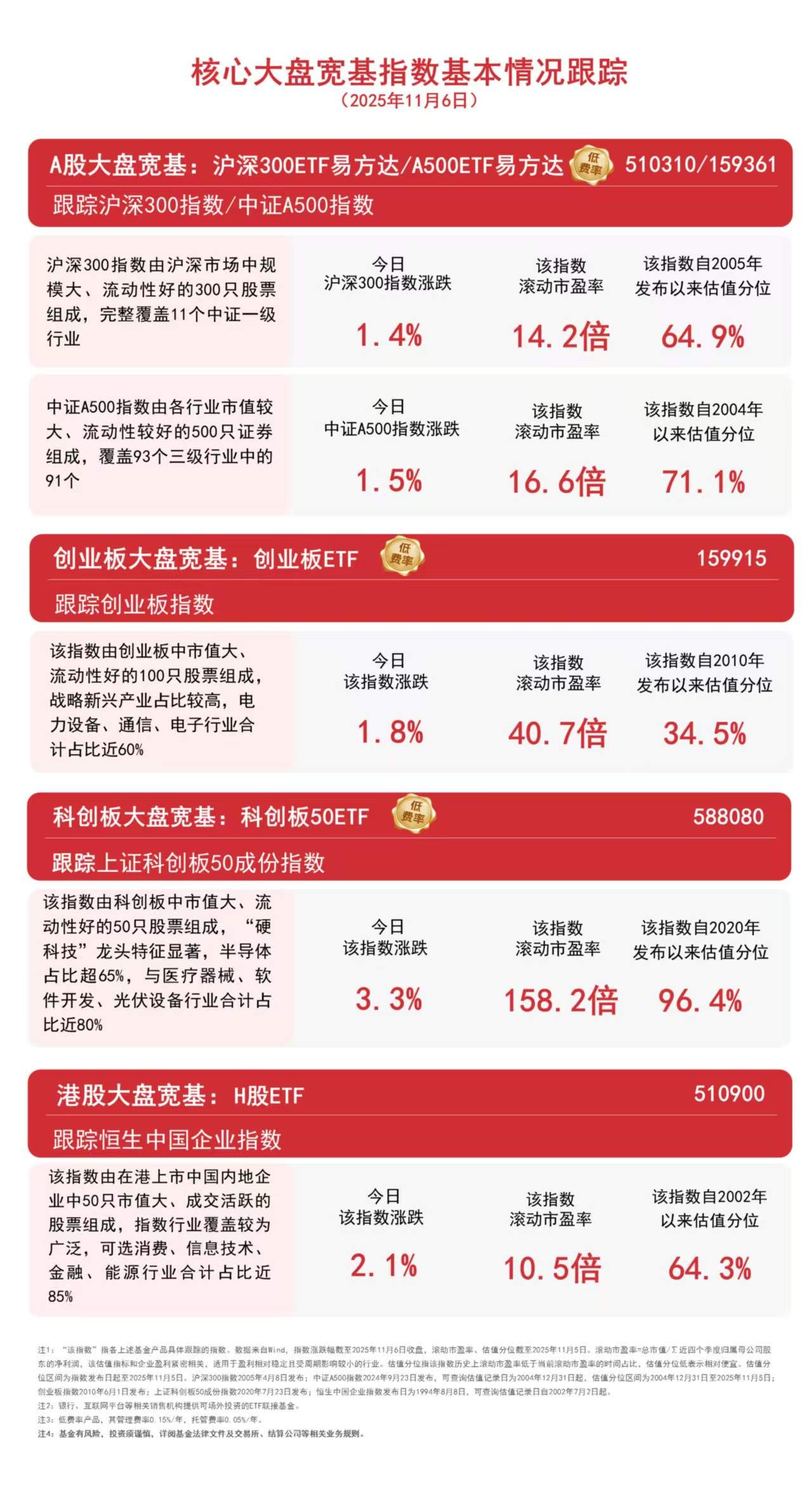
沪指放量涨近1%收复4000点,关注A500ETF易方达(159361)、沪深300ETF易方达(510310)配置价值
Mei Ri Jing Ji Xin Wen· 2025-11-06 21:22
Market Performance - The A-share market indices opened high and continued to rise, with the Shanghai Composite Index increasing nearly 1% to reclaim the 4000-point mark. The total market turnover reached 20,759 billion, an increase of 1,816 billion compared to the previous day [1] - The CSI A500 Index rose by 1.5%, the CSI 300 Index increased by 1.4%, the ChiNext Index gained 1.8%, and the STAR Market 50 Index surged by 3.3%. The Hang Seng China Enterprises Index also saw a rise of 2.1% [1] Sector Performance - The leading sectors in terms of gains included phosphorus chemical, aluminum metal, storage chips, pesticides, CPO, and power equipment [1] - Conversely, the sectors that experienced declines were the Hainan Free Trade Zone, ice and snow industry, short drama games, retail, and port shipping [1] Index Details - The CSI 300 Index consists of 300 stocks from the Shanghai and Shenzhen markets, covering 11 primary industries, with a rolling P/E ratio of 14.2 times [3] - The CSI A500 Index is composed of 500 securities with larger market capitalization and better liquidity, covering 91 out of 93 tertiary industries, with a rolling P/E ratio of 16.6 times [3] Technology Sector Insights - The technology sector shows a significant concentration, with over 65% representation from semiconductor companies, alongside medical devices, software development, and photovoltaic equipment, which together account for nearly 80% [5]