芯片设计

Search documents
个股异动 | 端侧算力龙头瑞芯微涨停 20家外资机构调研公司
Shang Hai Zheng Quan Bao· 2025-09-18 06:04
Group 1 - The core viewpoint of the article highlights the strong performance of Ruixin Microelectronics in the AIoT chip market, with significant revenue and profit growth in the first half of 2025 [1] - The company achieved a revenue of 2.046 billion yuan, representing a year-on-year increase of 64%, and a net profit of 531 million yuan, reflecting a 191% year-on-year growth [1] - Ruixin Microelectronics is recognized as a leading AIoT chip design enterprise in China, focusing on smart application processors SoC and related chip design, research, and sales [1] Group 2 - The AIoT market continues to grow, driven by the demand for AI applications at the edge, with flagship products like RK3588 and newer products like RK3576 contributing to the rapid growth across various product lines [1] - The company is expanding in key areas such as automotive electronics, industrial applications, machine vision, and various types of robotics [1] - There is increasing interest from foreign institutions in Chinese chip companies, with 20 foreign institutions conducting research on Ruixin Microelectronics, indicating a favorable investment climate in the "hard technology" sector in China [1]

湘财证券晨会纪要-20250918
Xiangcai Securities· 2025-09-18 01:56
Group 1: ETF Market Overview - As of September 12, 2025, there are 1,292 ETFs in the Shanghai and Shenzhen markets, with a total asset management scale of 52,387.73 billion [2] - The breakdown of ETFs includes 1,029 stock ETFs (35,315.17 billion), 39 bond ETFs (5,718.88 billion), 27 money market ETFs (1,564.76 billion), 17 commodity ETFs (1,611.53 billion), 173 cross-border ETFs (8,120.58 billion), and 6 unlisted ETFs (52.32 billion) [2] - In the week from September 8 to September 12, 2025, four new stock ETFs were launched, including two fintech-themed ETFs, with a total issuance scale of 5.682 billion [3][4] Group 2: ETF Performance Analysis - The median weekly return for stock ETFs was 1.97%, with the best-performing ETF being the China United Asset Management's Sci-Tech Chip Design ETF, which rose by 10.14% [3][4] - Conversely, the worst performer was the Guotai Junan Sci-Tech Innovation Drug ETF, which fell by 3.12% [4] - The average share change for stock ETFs was an increase of 6.6576 million shares, with the chemical ETF seeing the largest increase of 2.968 billion shares [4] Group 3: PB-ROE Framework and ETF Rotation Strategy - The PB-ROE framework categorizes industries into six quadrants, focusing on high PB and high ROE industries in the third quadrant and low PB and medium ROE industries in the fifth quadrant [5] - Backtesting from 2017 to February 2024 shows that only the third and fifth quadrants achieved excess returns, with annualized excess returns of 4.27% and 1.55%, respectively [5] - The combined PB-ROE rotation strategy yielded an annualized return of 11.93% and an annualized excess return of 13.22% [6] Group 4: Investment Recommendations - The report recommends focusing on the automotive, transportation, and public utilities sectors, corresponding to their respective industry ETFs [8]
19亿元可转债重注未来!南芯科技发力AI、汽车、工业三大赛道
Mei Ri Jing Ji Xin Wen· 2025-09-17 10:43
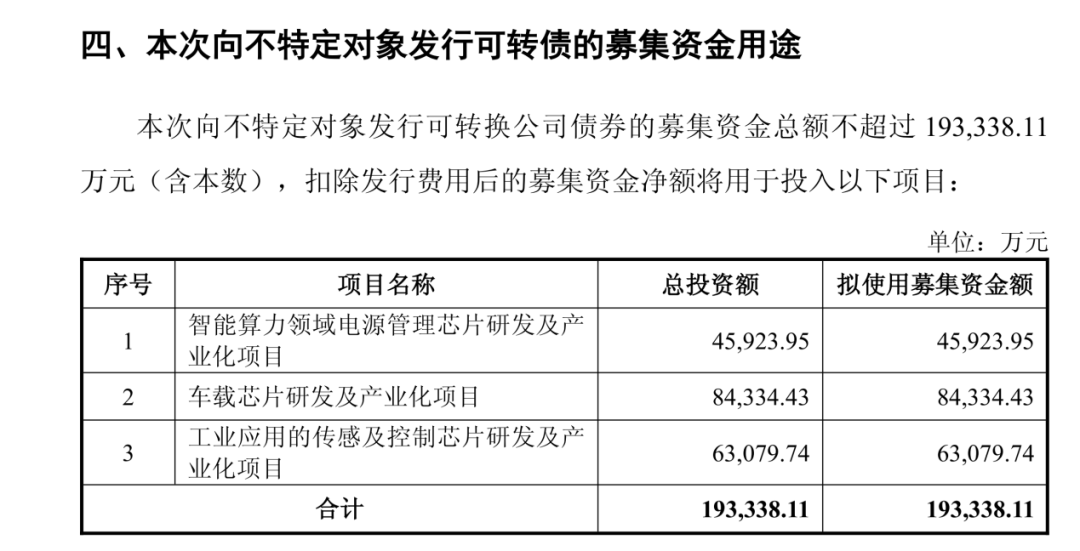
Core Viewpoint - Nanchip Technology plans to raise 1.933 billion yuan through convertible bonds to invest in three high-growth areas: smart computing power, automotive chips, and industrial sensors, aiming for strategic expansion and technological advancement [1][2][6]. Group 1: Investment Projects - The total investment for the three projects is approximately 4.592 billion yuan for smart computing power chips, 8.433 billion yuan for automotive chips, and 6.318 billion yuan for industrial sensor chips, summing up to 19.333 billion yuan [2][4]. - The smart computing power project focuses on developing multi-phase controllers and DrMOS chips to enhance the company's position in the PC, data center, and edge computing sectors [3][4]. - The automotive chip project addresses the low domestic chip localization rate, aiming to provide domestic alternatives to enhance supply chain security [4][5]. Group 2: Financial Performance - Nanchip Technology has shown robust growth, with revenue increasing from 1.301 billion yuan in 2022 to 2.567 billion yuan in 2024, and net profit rising from 246 million yuan to 307 million yuan during the same period [5]. - In the first half of 2025, the company achieved a revenue of 1.470 billion yuan, reflecting a year-on-year growth of 17.6% [5]. Group 3: Research and Development - The company invested 282 million yuan in R&D in the first half of 2025, a significant increase of 54.62% year-on-year, with 68.35% of its workforce dedicated to R&D [5][6]. - Nanchip Technology has developed key technologies such as multi-phase control technology for smart computing and high-side driver technology for automotive applications, positioning itself strongly in these markets [7][8]. Group 4: Market Position and Strategy - The company has established deep partnerships with leading brands in consumer electronics, such as Xiaomi and OPPO, and has entered the supply chains of several automotive manufacturers, facilitating quicker product validation and integration [8][9]. - The funding from the convertible bonds is expected to accelerate the implementation of these projects, potentially initiating a new growth cycle for the company [9].


芯旺微电子:车规级MCU出货超1.6亿颗,全链条布局筑牢车规芯片供应链安全
Zhong Guo Qi Che Bao Wang· 2025-09-17 09:12
Core Insights - The "2025 China Automotive Chip Supply Handbook" has been officially released, led by the China Automotive Chip Industry Innovation Strategic Alliance, with participation from nearly a hundred chip design companies, providing support for chip selection, promotion of domestic chips, and industry standard formulation [1] Group 1: Chip Categories - ChipWang Microelectronics has developed a diverse chip matrix covering three core categories: control chips, driver chips, and communication chips, with nearly a hundred product models based on the self-developed KungFu core [2] - Control chips have been applied in over 200 vehicle models, providing computational support for core automotive control scenarios [2] - Driver chips focus on chassis braking, air suspension, and valve control, featuring high integration and reliability, and have already been mass-produced for vehicles [2] - Communication chips excel in RF performance for scenarios like keyless entry and tire pressure monitoring, designed for low power consumption and flexible communication protocol configuration [2] Group 2: System Coverage - ChipWang's chips penetrate four major automotive systems: chassis power, body systems, cockpit systems, and intelligent driving systems, facilitating technological transformation in the industry [4] - Recommended chips for chassis power include KF32A136 and KF32A158 MCUs, along with the SMC6008AF dedicated braking chip [4] - For body systems, recommended chips include KF8A100 and KF32A136 MCUs, as well as the SRT1200 RF chip [4] - Cockpit systems also utilize KF8A100 and KF32A136 MCUs, while intelligent driving systems recommend KF32A136 and KF32A151 MCUs [4] Group 3: Market Performance - ChipWang has achieved significant market performance with over 160 million automotive-grade MCUs shipped, and the self-developed KungFu MCU has surpassed 1 billion units shipped [6] - The application of KungFu MCUs in high-safety systems like steering and braking exceeds 10 million units, demonstrating the product's penetration and reliability in the automotive sector [6] Group 4: Supply Chain Security - ChipWang has implemented four key measures to ensure supply chain security, including self-developed core technology, domestic industrial chain coverage, and self-developed toolchains for MCU development [7] - The company has adopted a "virtual IDM model" to enhance its capabilities in chip design, wafer manufacturing, and testing, thereby strengthening its autonomous capabilities [8] - Through a comprehensive layout, ChipWang aims to inject momentum into the domestic automotive chip industry, supporting the transition of the automotive sector towards high-end and intelligent development [8]

豪威集团确认进入英伟达供应链 境外营收占81%
Chang Jiang Shang Bao· 2025-09-17 07:48
Core Viewpoint - Company has successfully entered NVIDIA's supply chain, enhancing its position in the smart driving automotive sector and potentially increasing overseas revenue [1][2][3] Group 1: Financial Performance - In 2024, company achieved operating revenue of 25.731 billion yuan, a year-on-year increase of 22.41%, and net profit attributable to shareholders of 3.323 billion yuan, up 498.11% [2] - For the first half of 2025, company reported operating revenue of 13.956 billion yuan, a 15.42% increase, and net profit of 2.028 billion yuan, growing by 48.34% [4] - The semiconductor design business contributed 11.572 billion yuan in revenue, accounting for 83.01% of total revenue, with a year-on-year growth of 11.08% [5] Group 2: Market Expansion - Company’s overseas revenue reached 20.961 billion yuan in 2024, a 14.35% increase, making up over 81% of total revenue [2] - Company is accelerating international development and has submitted an IPO application to the Hong Kong Stock Exchange [3] Group 3: Business Segments - Image sensor solutions are the core business, contributing 10.346 billion yuan in revenue, which is 74.21% of the main business revenue, with an increase of 11.10% year-on-year [6] - Revenue from IoT image sensors surged by 249.42% to 1.173 billion yuan, while automotive-related revenue reached 3.789 billion yuan, up 30.04% [6] Group 4: Research and Development - Company’s R&D expenses have been increasing annually, reaching 1.365 billion yuan in the first half of 2025, a growth of 8.7% [6]


FORTIOR午前涨超11% 公司为BLDC电机驱动控制芯片供应商 传感器产品打开第二成长曲线
Zhi Tong Cai Jing· 2025-09-17 05:40
Core Viewpoint - FORTIOR (峰岹科技) has seen a significant stock price increase, reaching a new high of 197.8 HKD, reflecting strong market interest and potential growth in the BLDC motor driver chip sector [1] Company Overview - FORTIOR is a chip design company specializing in the design and development of BLDC motor driver control chips [1] - The company is the first in China to focus on BLDC motor driver control chip design and holds a 4.8% market share in China's BLDC motor main control and driver chip market as of December 31, 2023, ranking sixth [1] Market Position - FORTIOR is the only Chinese company among the top ten enterprises in the BLDC motor driver chip market [1] - The company is positioned to benefit from growth in high-demand sectors such as AI servers and robotics, with potential expansion into sensor products opening a second growth curve [1] Product Development - In the first half of 2025, FORTIOR launched sensor products, diversifying its product offerings [1] - The introduction of sensor products is expected to drive future growth for the company as it enters new market segments [1]
董事长被拘,转型未见成效,老牌房企万通发展如何破局
Xin Lang Cai Jing· 2025-09-16 23:40
Core Viewpoint - The recent investment by Wanto Development in Shuduo Technology is a significant step towards its strategic transformation into the digital technology sector, despite the challenges posed by the detention of its chairman, Wang Yihui [1][6][9]. Investment Details - Wanto Development announced an investment of 854 million yuan to acquire a 62.98% stake in Shuduo Technology, which specializes in high-speed interconnect chip design and ASIC chip customization [1][2]. - Shuduo Technology has been operating at a loss, with projected losses of 62.57 million yuan in 2023 and 138 million yuan in 2024, and a loss of 35.98 million yuan reported in the first half of this year [2][3]. Management Changes - Following the detention of chairman Wang Yihui, the board appointed CEO Qian Jinzhu to assume the responsibilities of the chairman and other key roles until Wang's return or a new appointment is made [1][3]. - Qian Jinzhu, aged 40, has a background in digital transformation and technology, but it remains to be seen if he can effectively lead the company through this transition [5][9]. Strategic Transformation - Wanto Development has been strategically shifting away from traditional real estate towards technology and digital sectors, with a history of investments in AI and telecommunications [6][7]. - The company has faced challenges in its transformation efforts, with ongoing losses and a heavy reliance on its real estate business, which accounted for over 99% of its revenue in 2024 [9]. Market Reaction - The announcement of the investment in Shuduo Technology initially led to a surge in Wanto Development's stock price, indicating market optimism about the company's strategic direction [2][3]. - However, the subsequent news of the chairman's detention raised concerns about the potential impact on the company's operations and future investments [1][9].

688766,一则公告20cm涨停!
Di Yi Cai Jing Zi Xun· 2025-09-16 14:35
Core Viewpoint - The stock price of Puran Co., Ltd. surged significantly following the announcement of its intention to acquire control of Zhuhai Noah Changtian Storage Technology Co., Ltd., aiming to enhance its competitiveness in the memory chip sector and expand its product line [1][2]. Company Summary - Puran Co., Ltd. is a chip design company, with its storage series chips being the core business, generating revenue of 673 million yuan in the first half of the year, accounting for 74.23% of total revenue, although this represented a year-on-year decline of 6.98% [3]. - The company reported total revenue of 907 million yuan, a year-on-year increase of 1.2%, but net profit attributable to shareholders fell by 70% to 40.73 million yuan, with a significant drop in non-recurring net profit by 82.4% to 26.65 million yuan [3]. - The company primarily operates in the NOR Flash and EEPROM markets, which are relatively smaller segments within the broader memory chip market dominated by DRAM and NAND Flash [3]. Industry Summary - The acquisition of SHM, which specializes in high-performance 2D NAND and derivative memory products, is seen as a strategic move to enter the NAND Flash segment and diversify the product offerings [4]. - The demand for high-performance storage chips is expected to grow significantly due to the rise of AI applications, with AI servers requiring DRAM and NAND at rates significantly higher than traditional servers [4]. - The 2D NAND technology, while less advanced than the mainstream 3D NAND, offers lower manufacturing costs and could allow Puran to capture market share in traditional sectors as larger companies shift focus to higher-margin products [5].

一则收购公告,这家芯片设计厂商20cm涨停
Di Yi Cai Jing· 2025-09-16 12:28
Core Viewpoint - The stock price of Puran Co., Ltd. (688766.SH) surged significantly following the announcement of its intention to acquire control of Zhuhai Noah Changtian Storage Technology Co., Ltd., aiming to enhance its competitiveness in the memory chip sector and expand its product line [1][2]. Company Overview - Puran Co., Ltd. is a chip design company, with its storage series chips being the core business. In the first half of the year, the storage series chips generated revenue of 673 million yuan, accounting for 74.23% of total revenue, although this represented a year-on-year decline of 6.98% [4]. - The overall revenue for Puran Co., Ltd. in the first half was 907 million yuan, reflecting a year-on-year growth of 1.2%. However, the net profit attributable to shareholders decreased by 70% to 40.73 million yuan, with the net profit after deducting non-recurring items dropping by 82.4% to 26.65 million yuan [4]. Acquisition Details - Puran Co., Ltd. currently holds a 20% stake in Noah Changtian and plans to acquire additional shares from existing shareholders to gain control. The valuation of Noah Changtian will be determined through audits and negotiations [2]. - The acquisition will also include SkyHigh Memory Limited (SHM), a semiconductor company specializing in high-performance 2D NAND and derivative memory products, which is fully owned by Noah Changtian [2]. Market Context - The storage chip market consists of segments including DRAM, NAND Flash, NOR Flash, and EEPROM, with DRAM and NAND Flash dominating the market. Puran Co., Ltd. primarily operates in the smaller NOR Flash and EEPROM segments [4]. - SHM focuses on mid-to-high-end 2D NAND and its derivative products, which are widely used in industrial control, home security, wearables, and smart terminals [4]. Strategic Implications - The acquisition aims to allow Puran Co., Ltd. to enter the NAND Flash segment, specifically targeting the 2D NAND market, which is currently not part of its product matrix. This move is seen as a strategy to enhance its product offerings in response to the growing demand for high-performance storage chips driven by AI applications [5]. - Despite the potential benefits, the 2D NAND market is not the mainstream segment of NAND flash technology, as 3D NAND has become the market leader due to its higher performance and storage density [5][6]. Industry Trends - The demand for NAND flash memory is expected to grow significantly due to AI applications, with AI servers requiring up to 8 times more DRAM and 3 times more NAND than standard servers [5]. - The transition from 2D NAND to 3D NAND represents a significant technological leap, with 3D NAND facing challenges related to stacking layers and cost, while 2D NAND remains a simpler and lower-cost alternative [6].

一则收购公告,这家芯片设计厂商20cm涨停
第一财经· 2025-09-16 12:18
Core Viewpoint - The article discusses the significant stock price increase of Puran Co., Ltd. (688766.SH) following its announcement to acquire control of Zhuhai Noah Changtian Storage Technology Co., Ltd. This move aims to enhance its competitiveness in the memory chip sector and expand its product line [2][4]. Company Overview - Puran Co., Ltd. is a semiconductor design firm, with its core business focused on storage series chips. In the first half of the year, the storage chip business generated revenue of 673 million yuan, accounting for 74.23% of total revenue, which saw a year-on-year decline of 6.98% [4]. - The overall revenue for Puran in the first half was 907 million yuan, reflecting a year-on-year growth of 1.2%. However, the net profit attributable to shareholders dropped by 70% to 40.73 million yuan, with a significant decline in non-recurring net profit by 82.4% to 26.65 million yuan [4]. Acquisition Details - Puran currently holds a 20% stake in Noah Changtian and plans to acquire additional shares from existing shareholders to gain control. The valuation of Noah Changtian will be determined through audits and negotiations [3][4]. - The acquisition will include SkyHigh Memory Limited (SHM), a Hong Kong-registered semiconductor company specializing in high-performance 2D NAND and derivative memory products [3][4]. Market Context - The storage chip market consists of various segments, with DRAM and NAND Flash dominating. Puran primarily operates in the smaller NOR Flash and EEPROM markets [4]. - SHM's products are targeted at mid-to-high-end markets and are used in various applications, including industrial control and smart devices [4]. Strategic Implications - The acquisition of SHM is seen as a strategic move for Puran to enter the NAND Flash segment, particularly 2D NAND, which is currently not part of its product matrix. This is expected to enhance its product offerings in response to the growing demand for high-performance storage chips driven by AI applications [5][6]. - Despite the potential benefits, the 2D NAND market is not the mainstream segment of NAND technology, as 3D NAND has become the market leader due to its higher performance and storage density [5][6].