智能手机

Search documents
中国手机厂商撑起全球六成市场,海外出货结构进入重构期
Di Yi Cai Jing· 2026-01-14 12:41
Core Insights - The overseas expansion of Chinese manufacturers continues, but the competitive strategies and target price segments are undergoing significant changes [1][2][4] - The global smartphone industry is entering a new structural adjustment cycle, driven by rising storage chip prices and supply chain costs [1][6] Market Trends - According to IDC, global smartphone shipments are projected to grow by 2.3% year-on-year in Q4 2025, reaching 1.26 billion units, with an annual growth of 1.9% [1] - The growth is primarily driven by high-end models, foldable phones, and consumers' anticipation of future price increases [1][2] - Apple and Samsung are the fastest-growing manufacturers among the top five, with year-on-year growth rates of 6.3% and 7.9%, respectively, increasing their combined market share to 39% from 37% in 2024 [2] Competitive Landscape - Chinese manufacturers are facing structural pressures as the market shifts towards higher price segments, which have traditionally been their stronghold in overseas markets [2][4] - Honor is noted as the fastest-growing Chinese manufacturer overseas, with a year-on-year growth of approximately 55% in the first three quarters of 2025, focusing on the $300 to $500 price range [4][5] - Other Chinese brands like OPPO and Xiaomi are also adjusting their strategies to target mid-range markets, with OPPO moving from entry-level products to more mid-range offerings [5] Cost and Supply Chain Challenges - The uncertainty in 2026 is largely centered around costs and supply chain issues, particularly the volatility in storage prices [6][7] - Counterpoint Research predicts a 40% to 50% increase in storage chip prices in Q1 2026, with further increases expected in Q2 [6] - The rising costs of components are significantly impacting the pricing and sales of low-end models, making the business model for sub-$100 devices increasingly fragile [7]


驶入阿拉木图:满街的中国品牌,与一场正在发生的认知变革
2 1 Shi Ji Jing Ji Bao Dao· 2026-01-14 12:15
Core Insights - Chinese brands have established a strong presence in Kazakhstan, becoming a significant part of the local market with a wide range of products from automobiles to electronics [1][2][3] - The trade relationship between China and Central Asia has seen substantial growth, with trade volume expected to reach $60.7 billion from 2017 to 2024, marking a 150% increase [1] - Kazakhstan is emerging as a key hub for Chinese companies looking to expand overseas, with over 9,000 Chinese enterprises operating in the region [1][3] Trade and Investment - By 2024, China's direct investment and loans to Central Asia are projected to exceed $24 billion, with bilateral trade between China and Kazakhstan reaching a historic high of $43.8 billion [3][4] - The market share of Chinese automotive manufacturers in Kazakhstan has surged from approximately 2% in 2020 to 38% in 2024, indicating a rapid acceptance of Chinese vehicles [3][4] Market Dynamics - The local market in Kazakhstan is characterized by a young population, with 95% owning smartphones, making it an attractive target for internet and technology companies [1][2] - The presence of Chinese brands is evident in various sectors, including home appliances, automobiles, and mobile phones, with local production of Chinese vehicles already underway [4][5] Consumer Behavior - There is a notable shift in consumer perception of Chinese products, moving from low-cost options to recognizing their reliability and technological advancements [5][6] - The acceptance of new technologies and experiences by the young population in Kazakhstan provides fertile ground for the introduction of innovative products [5][6] E-commerce and Marketing Strategies - The e-commerce market in Central Asia is projected to reach $14.7 billion by 2024, with Kazakhstan's market alone estimated at $6 billion [6][7] - Companies are advised to adopt a dual approach in marketing: utilizing mainstream e-commerce platforms for quick consumer access while also developing direct-to-consumer (D2C) channels to build brand identity [7][8] Localization Challenges - Entering the Central Asian market requires a nuanced understanding of local languages and consumer habits, as each country has distinct preferences and regulatory environments [8][9] - Companies often underestimate the complexity of the market, leading to potential pitfalls if they do not conduct thorough market research and engage local partners [9]
驶入阿拉木图:满街的中国品牌 与一场正在发生的认知变革
2 1 Shi Ji Jing Ji Bao Dao· 2026-01-14 12:13
Core Insights - Chinese brands have established a strong presence in Kazakhstan, becoming a significant part of the local market with a wide range of products from automobiles to electronics [1][5] - The trade relationship between China and Central Asia has rapidly expanded, with trade volume expected to reach $60.7 billion from 2017 to 2024, marking a 150% increase [1] - Kazakhstan is emerging as a key hub for Chinese companies looking to expand overseas, with over 9,000 Chinese enterprises operating in the region [1] Market Dynamics - The market in Kazakhstan is characterized by a young population, with 95% owning smartphones, making it attractive for internet and technology companies [1][6] - The bilateral trade between China and Kazakhstan is projected to reach $43.8 billion in 2024, setting a historical record [5] - Chinese automotive brands have seen significant growth, with market share increasing from 2% in 2020 to 38% in 2024 [5][6] Brand Penetration - Chinese brands like Haier, Hisense, and Xiaomi have been expanding their presence in Central Asia since the early 2000s, with a notable increase in brand visibility and local partnerships [5][6] - The automotive sector has become a major growth area, with local production of Chinese brands like Geely and Hongqi starting in Almaty [6] - The perception of Chinese products has shifted from low-cost to reliable technology, driven by rapid technological advancements [6] E-commerce and Advertising Trends - The e-commerce market in Central Asia is projected to reach $14.7 billion in 2024, with Kazakhstan's market alone estimated at $6 billion [8] - The number of Chinese advertisers using Yandex Ads in Kazakhstan has increased by 76% year-on-year, with advertising spending surging by 192% [8] - A dual approach for brands is recommended: utilizing mainstream e-commerce platforms for market testing and developing direct-to-consumer channels for brand building [9] Localization Challenges - Companies entering the Central Asian market must navigate complex local languages and cultural differences, as many countries have both Russian and local languages [10][11] - Each country in the region has unique consumer behaviors and regulatory environments, necessitating tailored marketing strategies [11][12] - Conducting thorough market research and partnering with local experts is crucial for successful market entry and operation [12]
时隔五年后,华为手机重返第一
Hua Er Jie Jian Wen· 2026-01-14 11:25
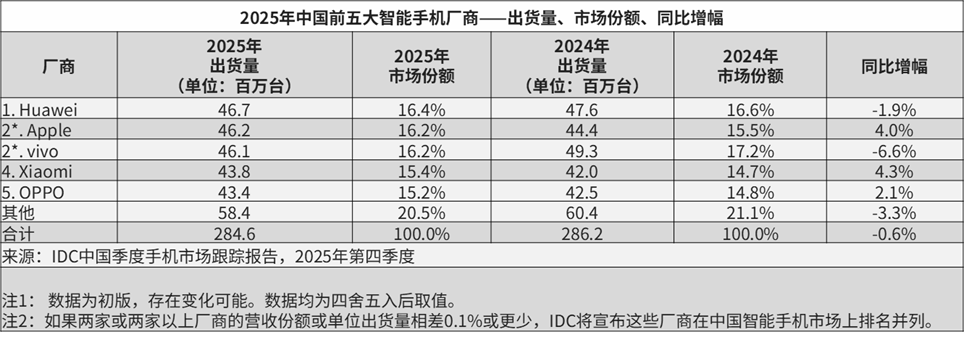
Core Insights - Huawei has regained the top position in the Chinese smartphone market with a market share of 16.4% in 2025, marking its return to the number one spot for the first time since 2020 [2][4] - The overall smartphone market in China is facing challenges, with a projected shipment volume of approximately 285 million units in 2025, reflecting a year-on-year decline of 0.6% [2][4] - Huawei's resurgence is attributed to a combination of technological advantages, product line restructuring, and a strong focus on high-end market segments [2][3] Market Dynamics - The competitive landscape is intense, with Huawei's market share closely contested by Apple, Vivo, Xiaomi, and OPPO, all of which have market shares ranging from 15.2% to 16.2% [4][5] - Huawei's growth strategy includes a diverse product structure, with high-end models like the Mate and Pura series recovering market share from Apple, while mid-range models like the Nova series appeal to a broader consumer base [3][4] - Despite regaining the top position, Huawei's performance in the latter half of 2025 showed signs of weakness, ranking third and fourth in the third and fourth quarters, respectively [4] Competitive Pressures - Apple and Xiaomi have also shown strong performance in the high-end market, with their new models experiencing significant sales growth of 22% and 21% year-on-year, respectively [5] - Honor, once a competitor to Huawei, has struggled to maintain its market position following Huawei's return to the 5G market, leading to a decline in its market presence [5][6] - Other brands like Vivo, Xiaomi, and OPPO are feeling increased pressure, prompting strategic moves such as OPPO's integration of the Realme brand to enhance competitiveness [6] Future Outlook - While Huawei has reclaimed its market leadership, it still faces significant challenges, including a substantial gap from its historical peak market share of 46% and ongoing pressures from rising component costs [7] - The smartphone market is expected to experience further declines in shipment volumes in 2026, indicating a challenging environment ahead for all manufacturers [7]
国元国际晨报-20260114
Guoyuan International· 2026-01-14 09:44
Economic Indicators - The U.S. core CPI in December increased by 2.6% year-on-year, which is lower than expected[4] - The U.S. deficit is projected to drop to a three-year low in 2025 due to a surge in tariff revenues[4] - The World Bank has raised its global economic growth forecast for 2026[4] Market Performance - The 2-year U.S. Treasury yield fell by 0.19 basis points to 3.530%[4] - The 5-year U.S. Treasury yield decreased by 0.17 basis points to 3.752%[4] - The 10-year U.S. Treasury yield rose by 0.40 basis points to 4.179%[4] Stock Market Updates - The Nasdaq index closed at 23,709.87, down by 0.10%[5] - The Dow Jones Industrial Average closed at 49,191.99, down by 0.80%[5] - The S&P 500 index closed at 6,963.74, down by 0.19%[5] Commodity Prices - ICE Brent crude oil price increased by 2.49% to $65.46[5] - The price of gold in London decreased by 0.28% to $4,585.66[5] - The CME Bitcoin futures rose by 3.01% to $94,415.00[5] Currency Exchange - The USD/CNY exchange rate was 6.98, up by 0.03%[5]
从广货到“新广货”,为何全球爆款频出?
2 1 Shi Ji Jing Ji Bao Dao· 2026-01-14 08:49
Core Viewpoint - The "Guangdong Products Going Global" spring promotional campaign is set to launch in Foshan, marking the beginning of the 2026 online promotional activities for Guangdong products, showcasing the diverse appeal of Guangdong manufacturing [2] Group 1: Geographic and Trade Advantages - Guangdong's geographic location, backed by the Nanling Mountains and facing the South China Sea, provides excellent conditions for foreign trade and industrialization, forming the foundation for the success of Guangdong products [3] - The evolution of trade structures has allowed Guangdong to continuously upgrade its products, with initial trade models attracting foreign investment and advanced manufacturing techniques, contributing to the wealth of Guangdong products [3] Group 2: Technological Advancements and Manufacturing - The current competitive edge of Guangdong products lies in intelligent manufacturing, moving from traditional appliances to smart devices like drones and robots, reflecting the region's adaptation to technological revolutions [4] - Guangdong is home to nine trillion-yuan industrial clusters, with projected revenues exceeding 19 trillion yuan by 2025, and it leads the nation in the number of industrial enterprises, producing a significant share of global consumer drones and smartphones [4] Group 3: Traditional and Emerging Industries - Traditional industries remain crucial for the legacy of Guangdong products, with ongoing transformations enhancing their viability through strategic investments in future industries [5] - Guangdong is a major hub for smartphone manufacturing, with significant advancements in technology, including breakthroughs in high-end chips and AI integration in mobile devices, further solidifying its position in the global market [6] Group 4: Future Prospects - Initiatives like "Smart Electric Guangdong Manufacturing" and "Fashion from Guangdong" are expected to further enhance the iterative upgrades of Guangdong products, indicating a promising future for the region's manufacturing sector [6]

IDC:2025年华为重返中国市场第一,OPPO四季度增长超10%
Feng Huang Wang· 2026-01-14 07:30
Core Insights - The report by IDC indicates that the top five smartphone brands in China for 2025 will be Huawei, Apple, vivo, Xiaomi, and OPPO, with Honor falling out of the top five [1] - The overall shipment volume for the Chinese smartphone market in 2025 is projected to be 284.6 million units, showing a slight decline of 0.6% compared to 2024 [2] - The global smartphone shipment volume is expected to reach approximately 1.26 billion units in 2025, reflecting a year-on-year growth of 1.9% [2] Group 1: Market Performance - Huawei is projected to ship 46.7 million units in 2025, holding a market share of 16.4%, which is a decrease of 1.9% from 2024 [2] - Apple is expected to ship 46.2 million units, with a market share of 16.2%, marking a growth of 4.0% from the previous year [2] - vivo's shipment is forecasted at 46.1 million units, also with a market share of 16.2%, but it will see a decline of 6.6% compared to 2024 [2] - Xiaomi is anticipated to ship 43.8 million units, achieving a market share of 15.4%, with a growth of 4.3% year-on-year [2] - OPPO is projected to ship 43.4 million units, holding a market share of 15.2%, reflecting a growth of 2.1% from 2024 [2] Group 2: Quarterly Insights - In the fourth quarter of 2025, the Chinese smartphone market is expected to see a shipment volume of approximately 75.78 million units, which represents a slight decline of 0.8% year-on-year [3] - OPPO is noted to achieve a significant growth of 10.2% in the same quarter, becoming the only Android brand in China to record positive growth [3]

机构报告:2025年中国手机市场出货量约为2.85亿台 华为登顶
Xin Lang Cai Jing· 2026-01-14 07:13
Core Insights - The Chinese smartphone market is projected to see a slight decline in shipments, with an estimated total of 285 million units in 2025, representing a year-on-year decrease of 0.6% [1][4]. Market Performance - Huawei leads the market with a shipment of 46.7 million units and a market share of 16.4% in 2025 [3][6]. - Apple and Vivo are tied for second place, with shipments of 46.2 million and 46.1 million units, respectively, both holding a market share of 16.2% [3][6]. - Xiaomi and OPPO rank fourth and fifth, with shipments of approximately 43.8 million and 43.4 million units, respectively, both exceeding a 15% market share [3][6]. - The gap in shipments between the top and fifth brands is only 3.3 million units, indicating intense competition in the industry [1][4]. Future Outlook - IDC anticipates that the cost pressures on smartphone manufacturers will increase due to expected significant rises in storage prices, which may lead to a more pronounced decline in shipments in 2026 [1][4].
IDC:2025年第四季度全球智能手机出货量同比增长2.3% 达到3.363亿部
智通财经网· 2026-01-14 05:53
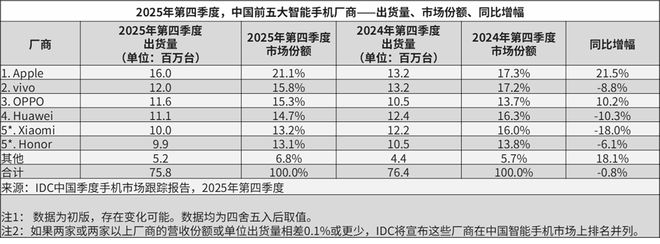
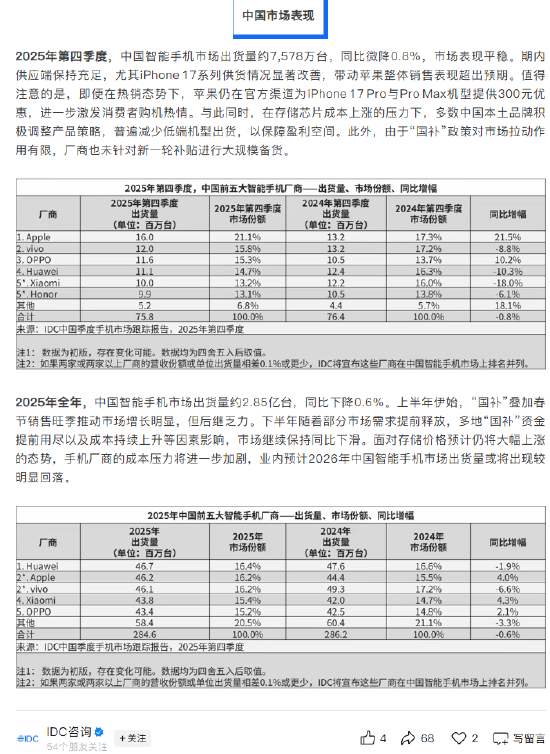
Core Insights - The global smartphone market is projected to grow by 2.3% year-on-year in Q4 2025, reaching 336.3 million units, driven by high-end model demand, strong performance of foldable phones, and consumer anticipation of price increases [1][2] - Apple and Samsung are the primary growth engines in the smartphone market, with year-on-year growth rates of 6.3% and 7.9% respectively, leading to a combined market share increase to 39% [2][3] - The overall smartphone market in 2025 is expected to reach 1.26 billion units, reflecting a 1.9% year-on-year growth despite challenges such as tariff fluctuations and supply chain disruptions [2][5] Global Market Performance - In Q4 2025, Apple shipped 81.3 million units, capturing 24.2% of the market share, while Samsung shipped 61.2 million units with an 18.2% market share [6] - The average selling price (ASP) of smartphones is expected to reach a historical high due to the strong performance of high-end models [3][5] - The overall market share of other manufacturers decreased slightly, with a total of 102.1 million units shipped, representing 30.4% of the market [6] Chinese Market Dynamics - The Chinese smartphone market saw a slight decline of 0.8% year-on-year in Q4 2025, with shipments around 75.8 million units [7][8] - Apple led the Chinese market with 16.0 million units shipped, achieving a market share of 21.1%, while vivo and OPPO faced challenges with year-on-year declines [8][9] - The overall annual shipment for the Chinese smartphone market is estimated at 284.6 million units, reflecting a 0.6% decrease compared to the previous year [9] Future Outlook - The smartphone market is expected to face challenges in 2026 due to a significant shortage of storage chips, which may lead to a market contraction [5] - Manufacturers' ability to manage supply chains and scale will be crucial in navigating the anticipated downturn [5] - Despite potential declines in shipments, the ASP is likely to continue rising due to increased costs [5]
2025中国手机出货:苹果四季度第一,华为全年第一
Guan Cha Zhe Wang· 2026-01-14 05:44
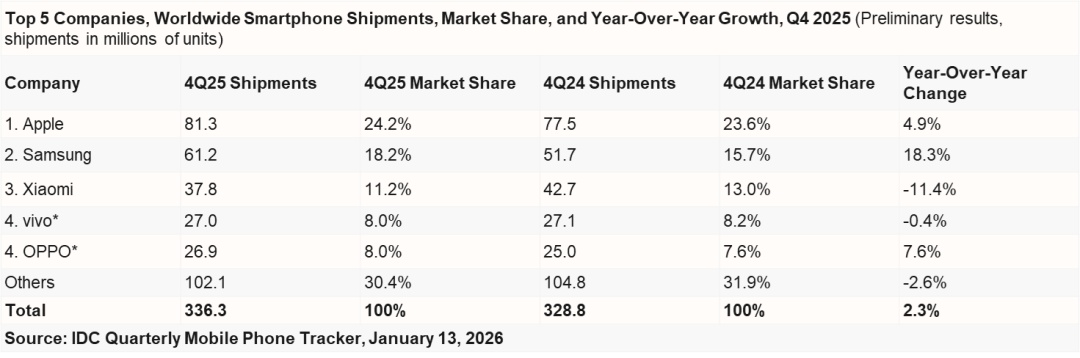
Core Insights - The Chinese smartphone market is projected to have a shipment volume of approximately 75.78 million units in Q4 2025, showing a slight year-on-year decline of 0.8%, with an annual total of about 285 million units, down 0.6% from the previous year [1][3] Q4 2025 Market Performance - Apple leads the Q4 2025 shipments with 16 million units, capturing a market share of 21.1%, marking a significant year-on-year increase of 21.5% [2] - Vivo ranks second with 12 million units shipped, holding a market share of 15.8, but experiencing a decline of 8.8% year-on-year [2] - OPPO follows closely with 11.6 million units, a year-on-year increase of 10.2%, and a market share of 15.3% [2] - Huawei's shipments are approximately 11.1 million units, down 10.3% year-on-year, with a market share of 14.7% [2] - Xiaomi and Honor are tied for fifth place, with Xiaomi shipping 10 million units (down 18%) and Honor shipping 9.9 million units (down 6.1%) [2] Annual Market Overview - For the entire year of 2025, Huawei tops the market with 46.7 million units shipped, a slight decline of 1.9%, and a market share of 16.4% [4] - Apple follows closely with 46.2 million units, reflecting a 4% increase year-on-year, and a market share of 16.2% [4] - Vivo's annual shipments are 46.1 million units, down 6.6% from the previous year, also sharing a market share of 16.2% with Apple [4] - Xiaomi and OPPO have annual shipments of 43.8 million and 43.4 million units, respectively, with Xiaomi showing a growth of 4.3% and OPPO a growth of 2.1% [4] Global Smartphone Market Insights - The global smartphone shipments reached 1.26 billion units in 2025, with Apple and Samsung leading the market shares at 19.7% and 19.1%, respectively [5][6] - Despite challenges such as storage chip shortages, the global market is driven by high-end model growth and consumer anticipation of price increases [5][6] - The average selling price is expected to continue rising, even as overall shipments face pressure [6]