
公交

Search documents
海汽集团涨2.07%,成交额3.67亿元,主力资金净流入184.70万元
Xin Lang Zheng Quan· 2025-11-07 02:07
Core Viewpoint - Hainan Haikou Transportation Group Co., Ltd. (海汽集团) has shown a significant stock price increase of 51.37% year-to-date, despite a recent decline of 2.09% over the last five trading days [1] Financial Performance - For the period from January to September 2025, the company reported a revenue of 489 million yuan, representing a year-on-year decrease of 24% [2] - The net profit attributable to the parent company was -48.11 million yuan, a significant decline of 703.6% compared to the previous year [2] Shareholder Information - As of September 30, 2025, the number of shareholders increased by 21.26% to 30,900, while the average circulating shares per person decreased by 17.53% to 10,231 shares [2] - Cumulative cash dividends since the company's A-share listing amount to 69.52 million yuan, with no dividends distributed in the last three years [3] Stock Market Activity - The stock price reached 27.64 yuan per share with a trading volume of 367 million yuan and a turnover rate of 4.17% [1] - The company has appeared on the "龙虎榜" (a list of stocks with significant trading activity) once this year, with the last appearance on April 10 [1] Business Overview - The company, established on November 28, 1985, primarily engages in road passenger transportation services, with the main revenue sources being passenger transport (58.78%), comprehensive automotive services (24.12%), and station operations (6.20%) [1] - The company operates within the transportation sector, specifically in the railway and road public transport industry, and is associated with concepts such as duty-free, Hainan Free Trade Zone, and state-owned enterprise reform [1]

海汽集团跌2.01%,成交额1.33亿元,主力资金净流出883.56万元
Xin Lang Cai Jing· 2025-11-04 01:59
Group 1 - The core viewpoint of the news is that Hainan Haikou Transport Group Co., Ltd. (海汽集团) has experienced a significant stock price increase of 54.55% year-to-date, despite a recent decline of 2.01% on November 4 [2][1] - As of November 4, the stock price is reported at 28.22 CNY per share, with a total market capitalization of 8.918 billion CNY [1] - The company has seen a net outflow of main funds amounting to 8.8356 million CNY, with large orders showing a buy of 29.0703 million CNY and a sell of 34.2837 million CNY [1] Group 2 - The company’s main business includes road passenger transport services, with revenue composition as follows: 58.78% from passenger transport, 24.12% from comprehensive automotive services, and 6.20% from passenger station operations [2] - As of September 30, 2025, the company reported a revenue of 489 million CNY, a year-on-year decrease of 24.00%, and a net profit loss of 48.1097 million CNY, a decrease of 703.60% [2] - The company has not distributed any dividends in the last three years, with a total payout of 69.52 million CNY since its A-share listing [3] Group 3 - The company is classified under the transportation industry, specifically in the railway and road sectors, and is associated with several concept sectors including Hainan Free Trade Zone and state-owned enterprise reforms [2] - As of September 30, 2025, the number of shareholders increased by 21.26% to 30,900, while the average circulating shares per person decreased by 17.53% to 10,231 shares [2][3] - The fourth largest circulating shareholder is Hong Kong Central Clearing Limited, which increased its holdings by 377,400 shares [3]
江西长运的前世今生:2025年三季度营收10.44亿行业第三,净利润-831.34万行业第五
Xin Lang Zheng Quan· 2025-10-31 08:15
Core Viewpoint - Jiangxi Changyun, a leading enterprise in Jiangxi's road passenger transport industry, has shown mixed financial performance in Q3 2025, ranking third in revenue but fifth in net profit among its peers [2][3]. Group 1: Company Overview - Jiangxi Changyun was established on March 10, 1995, and listed on the Shanghai Stock Exchange on July 16, 2002, with its headquarters in Nanchang, Jiangxi Province [1]. - The company specializes in road passenger transport, freight, and tourism, leveraging a differentiated advantage in network layout and resource integration [1]. Group 2: Financial Performance - In Q3 2025, Jiangxi Changyun achieved a revenue of 1.044 billion yuan, ranking third among six companies in the industry, surpassing the industry average of 895 million yuan and the median of 829 million yuan, but below the top two competitors, Dazhong Transportation (1.591 billion yuan) and Jinjiang Online (1.213 billion yuan) [2]. - The net profit for the same period was -8.3134 million yuan, placing the company fifth in the industry, significantly lower than the top performer, Fulinyunyi (160 million yuan), and the second, Dazhong Transportation (117 million yuan), as well as below the industry average of 61.5957 million yuan and median of 74.6271 million yuan [2]. Group 3: Financial Ratios - As of Q3 2025, Jiangxi Changyun's debt-to-asset ratio was 74.96%, a slight decrease from 75.79% in the previous year but still well above the industry average of 43.41% [3]. - The gross profit margin for Q3 2025 was -10.21%, further declining from -4.41% in the previous year and significantly lower than the industry average of 11.20% [3]. Group 4: Shareholder Information - As of September 30, 2025, the number of A-share shareholders decreased by 8.89% to 13,900, while the average number of circulating A-shares held per shareholder increased by 9.76% to 20,500 [5]. - Among the top ten circulating shareholders, Nuoan Multi-Strategy Mixed A (320016) entered as the tenth largest shareholder, holding 2.0651 million shares [5].


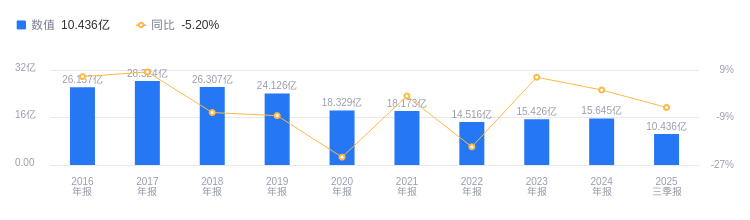
大众交通:第三季度净利润同比减少80.25%
2 1 Shi Ji Jing Ji Bao Dao· 2025-10-30 09:39
Core Insights - The company reported a decline in revenue and net profit for the third quarter and the first three quarters of the year [1] Financial Performance - In Q3, the company achieved a revenue of 550 million yuan, representing a year-on-year decrease of 11.32% [1] - The net profit attributable to shareholders for Q3 was 22.02 million yuan, down 80.25% year-on-year [1] - For the first three quarters, the company recorded a total revenue of 1.591 billion yuan, which is a year-on-year decline of 22.88% [1] - The net profit attributable to shareholders for the first three quarters was 98.08 million yuan, reflecting a decrease of 56.12% year-on-year [1]

对美船舶收费落地,油运干散迎景气催化 | 投研报告
Zhong Guo Neng Yuan Wang· 2025-10-21 01:11
Core Insights - The transportation sector in China showed a cumulative increase of 0.37% from October 13 to October 18, ranking 4th among 31 SW primary industries, while the CSI 300 index decreased by 2.22% [2] Subsector Performance - The performance of various subsectors within transportation during the week was as follows: Shipping (3.06%), Airport (2.57%), Expressway (2.33%), Road Freight (1.08%), Port (0.83%), Railway (0.22%), Bus (-2.00%), Cross-border Logistics (-3.49%), Express (-4.36%), and Warehousing Logistics (-4.76%) [1][3] Airline Sector Analysis - Domestic and international capacity recovery rates for major listed airlines in September 2025 compared to the same month in 2019 were as follows: Air China (145.09%), China Southern Airlines (116.42%), China Eastern Airlines (115.45%), Hainan Airlines (92.17%), Juneyao Airlines (115.48%), and Spring Airlines (176.49%) for domestic ASK; and for international ASK: 98.13%, 94.97%, 105.34%, 73.58%, 219.78%, and 81.74% respectively [3] Oil Prices and Exchange Rates - As of October 17, 2025, Brent crude oil was priced at $61.29 per barrel, reflecting a week-on-week decrease of 2.79% and a year-on-year decrease of 17.68% [3] - The exchange rate of the Chinese Yuan against the US Dollar was 7.1048, with a week-on-week depreciation of 0.08% and a year-on-year depreciation of 0.38% [3] Airport Traffic Recovery - Major airports in China showed the following recovery rates for domestic passenger throughput in September 2025 compared to 2019: Baiyun Airport (115.74%), Shanghai Airport (125.22%), Capital Airport (89.82%), and Shenzhen Airport (119.73%) [4] Shipping and Port Metrics - The SCFI index was reported at 1310 points, a week-on-week increase of 12.92% but a year-on-year decrease of 36.46% as of October 17, 2025 [4] - The CCFI index was at 973 points, with a week-on-week decrease of 4.11% and a year-on-year decrease of 30.75% [4] Dry Bulk Shipping Metrics - The BDI index was reported at 2069 points, reflecting a week-on-week increase of 6.87% and a year-on-year increase of 29.80% [5] Road and Rail Performance - In August 2025, railway passenger volume was 505 million, a year-on-year increase of 6.55%, while road passenger volume was 950 million, a year-on-year decrease of 4.80% [5] Express Delivery Sector - The express delivery industry achieved a revenue of 1189.60 billion Yuan in August 2025, a year-on-year increase of 4.20%, with a business volume of 16.15 billion pieces, up 12.30% year-on-year [5] Investment Recommendations - The airline sector is expected to benefit from increased international flights and domestic demand recovery, with recommendations for stocks such as Air China, China Southern Airlines, and others [6] - The airport sector is advised to focus on bottom-fishing opportunities due to the anticipated recovery in international passenger traffic [6] - The cross-border logistics sector is expected to benefit from the growth of cross-border e-commerce, with a recommendation to pay attention to Huamao Logistics [7] - The express delivery sector is seen as having growth potential due to the acceleration of e-commerce and improved industry dynamics [8]
打破“课程围墙”!苏州公交集团共享共育培训落地,300+基层管理者同上沟通必修课
Yang Zi Wan Bao Wang· 2025-10-17 12:24
Core Insights - The training program aims to enhance communication skills among grassroots managers in Suzhou Public Transport Group, aligning with the 2025 vision of "resource sharing and collaborative education" [1][6] - Over 300 grassroots management personnel from various operational subsidiaries participated in the training held from October 10 to 14 [1][6] Group 1: Training Details - The training was conducted using an innovative model of "point-to-point synchronization + expert lectures" [1] - Expert speaker Xie Jing from Shanghai Shanmang Enterprise Management Consulting provided insights on the core value of communication, emotional intelligence, and collaborative strategies [3] - Interactive elements such as scenario simulations and group discussions were incorporated to shift participants from passive listening to active practice [3] Group 2: Communication Techniques - The training included a detailed analysis of the "Fact-Feeling-Future" (3F) communication method, aimed at achieving a modern management philosophy of "management with warmth and execution with strength" [4] - The program effectively improved the communication skills of grassroots management personnel and served as a practical implementation of the "shared education" training concept [6] Group 3: Future Directions - Suzhou Public Transport Group plans to continue enhancing its training model to inject stronger momentum into grassroots management efficiency and improve public transport service quality [6]

股市必读:三峡旅游(002627)10月14日主力资金净流入669.58万元
Sou Hu Cai Jing· 2025-10-14 20:03
Group 1 - The stock price of China Three Gorges Tourism (002627) closed at 5.87 yuan on October 14, 2025, with an increase of 1.03% and a turnover rate of 3.16% [1] - The trading volume was 226,900 shares, with a total transaction amount of 134 million yuan [1] - On the same day, the net inflow of main funds was 6.6958 million yuan, indicating increased short-term interest from major investors [3] Group 2 - The company and its subsidiaries received a total of 5.6877 million yuan in government subsidies from July 1 to September 30, 2025, which accounts for 4.84% of the net profit attributable to shareholders for the most recent fiscal year [2][3] - The subsidies are related to various operational supports, including public transport operation subsidies and rural passenger transport development funds [2] - The sources of these subsidies include multiple government departments and organizations, such as transportation bureaus and educational institutions [2]

为欢度“双节”筑牢安全防线 市领导分多路开展节前安全生产检查
Zhen Jiang Ri Bao· 2025-09-30 23:29
Group 1 - City leaders are conducting safety inspections ahead of the National Day and Mid-Autumn Festival to ensure safety measures are in place [1][2][3] - Emphasis on the "three managements and three musts" in crowded religious venues to enhance safety education and emergency drills [1] - Focus on food and fire safety in hotels and nursing homes, ensuring proper management of fire, electricity, and gas [1] Group 2 - Inspections at entertainment venues like cinemas to optimize evacuation plans and enhance employee emergency training [2] - The need for cultural tourism to meet contemporary spiritual needs while ensuring safety during peak visitor times [2] - Strict enforcement of safety responsibilities in energy supply companies and water source protection to guarantee public safety [2][3] Group 3 - Continuous safety management in public spaces, healthcare institutions, and sports training facilities is highlighted as a priority [3] - Emphasis on risk assessment and safety management in chemical and paper manufacturing companies [3] - Logistics companies are urged to focus on core safety risks and ensure effective hazard identification and management [4]
最新公布!深圳这些国企,位列榜单前三
Nan Fang Du Shi Bao· 2025-09-25 15:23
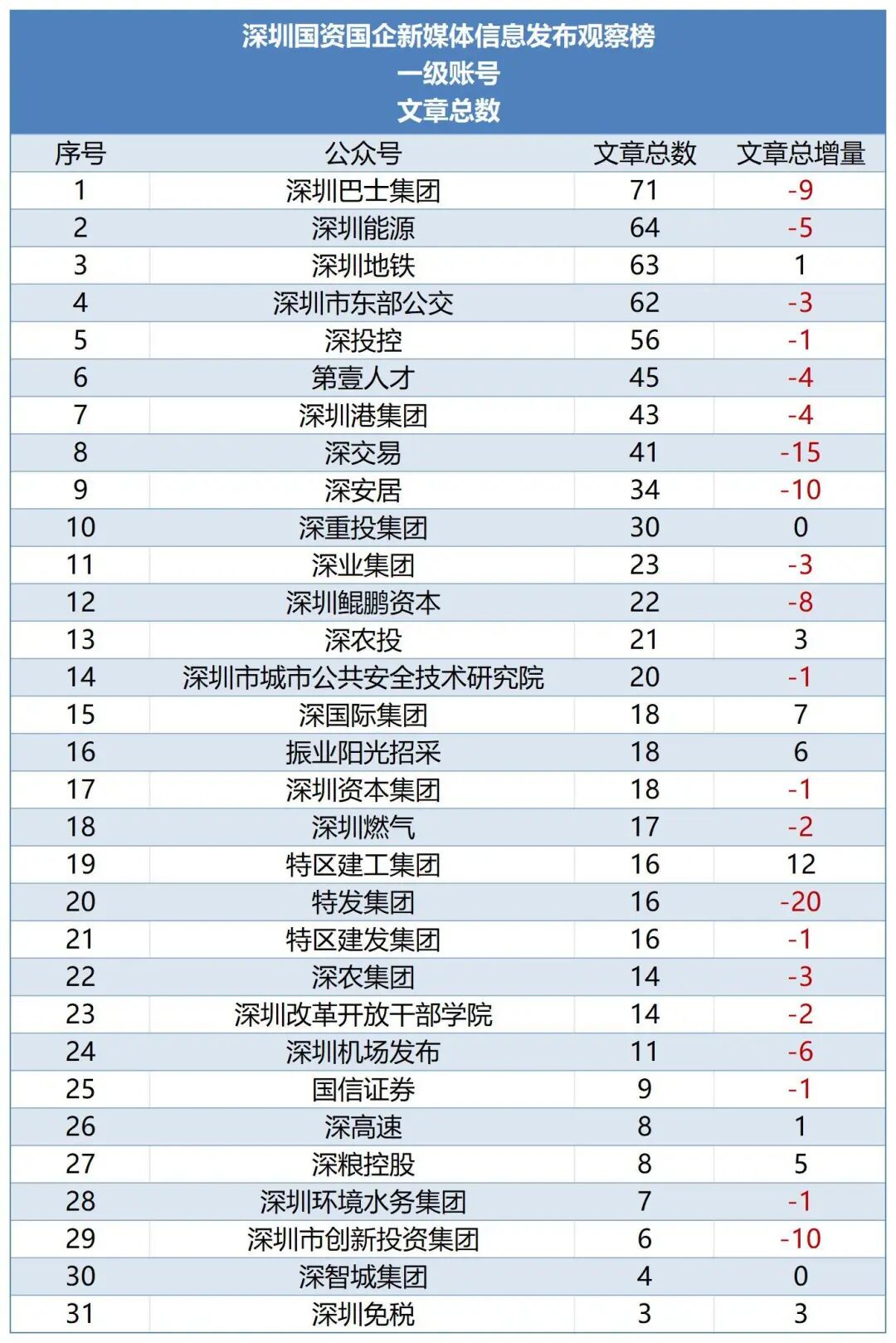
Core Insights - The overall performance of Shenzhen state-owned enterprises' new media accounts has declined in August, with significant drops in both article output and reading volume compared to July [2][20] - The "Shenzhen State-owned Enterprises New Media Information Release Observation List" evaluates 54 accounts, including 31 primary accounts of state-owned enterprises and 23 listed companies [1][20] Group 1: New Media Performance - In August, 21 out of 31 primary accounts saw a decrease in article output, with notable reductions from Shenzhen Stock Exchange, Shenzhen Anju, and others [2][3] - Reading volume for 21 accounts also declined, with some experiencing drops of over 50%, while the Special Zone Construction Group saw a significant increase of 16,610 in reading volume [2][3] - The top three accounts by article output were Shenzhen Bus Group (71 articles), Shenzhen Energy (64 articles), and Shenzhen Metro (63 articles, with a slight increase of 1 article) [3][4] Group 2: Reading Volume and Engagement - The top three accounts by reading volume were Shenzhen Metro (361,000+), Guoxin Securities (135,000+), and Shenzhen Eastern Bus (133,000+), while some accounts had reading volumes below 1,000 [4][5] - The total number of likes was highest for Shenzhen Metro (4,079), followed by Shenzhen Bus Group (2,881) and Shenzhen Gas (1,957) [6][7] - Recommendation volume was led by Shenzhen Bus Group (1,882), Shenzhen Metro (1,252), and Shenzhen Eastern Bus (513), indicating a positive reception of their content [8][9] Group 3: Listed Companies Performance - Among the 23 listed company accounts, 14 experienced declines in reading volume and article output, indicating instability in content planning [11][20] - Shenzhen Airlines, CIMC, and China Ping An led in reading volume with 110,000+, 50,913, and 43,212 respectively, but many accounts saw significant drops [14][15] - The article output for Shenzhen Airlines was 24, while CIMC maintained a steady output, benefiting from a recent event that boosted its reading volume [14][19] Group 4: Overall Trends and Recommendations - The overall data from August indicates a disparity in performance, with top accounts maintaining strong output and engagement, while lower-tier accounts struggle [20] - Recommendations for improvement include data review, strategy adjustments, content quality enhancement, and better rhythm control to foster a more balanced development across all accounts [20]




江西长运跌2.13%,成交额270.83万元
Xin Lang Cai Jing· 2025-09-23 01:53
Core Viewpoint - Jiangxi Changyun's stock price has experienced a decline recently, despite a year-to-date increase, indicating potential volatility in the transportation sector [1][2]. Company Overview - Jiangxi Changyun, established on March 10, 1995, and listed on July 16, 2002, is located in Nanchang, Jiangxi Province. The company primarily engages in road passenger transport, freight transport, and tourism services [2]. - The revenue composition of Jiangxi Changyun includes: 47.29% from passenger transport, 26.37% from freight transport, 18.22% from other services, and 8.12% from sales [2]. Stock Performance - As of September 23, Jiangxi Changyun's stock price was 6.44 CNY per share, with a market capitalization of 1.832 billion CNY. The stock has increased by 19.93% year-to-date but has seen declines of 8.13% over the last five trading days, 10.06% over the last 20 days, and 1.53% over the last 60 days [1][2]. Financial Performance - For the first half of 2025, Jiangxi Changyun reported a revenue of 699 million CNY, a year-on-year decrease of 2.20%. However, the net profit attributable to shareholders was 5.7227 million CNY, reflecting a year-on-year increase of 39.63% [2]. Shareholder Information - As of June 30, 2025, the number of shareholders for Jiangxi Changyun was 15,200, an increase of 18.03% from the previous period. The average number of circulating shares per shareholder was 18,702, a decrease of 15.28% [2]. - The company has distributed a total of 392 million CNY in dividends since its A-share listing, with no dividends paid in the last three years [3]. Institutional Holdings - As of June 30, 2025, CITIC Prudential Multi-Strategy Mixed Fund (LOF) A has exited the list of the top ten circulating shareholders of Jiangxi Changyun [3].