
居民服务

Search documents
浙江民营企业在册总量超370万户,平均每千人拥有56.5户
Sou Hu Cai Jing· 2026-01-20 02:40
Core Insights - Zhejiang's private enterprises are showing steady and positive development, with a total of 3.7689 million registered private enterprises expected by the end of 2025, equating to 56.5 private enterprises per 1,000 people in the province [1][3]. Group 1: Overall Development - The private enterprises in Zhejiang have made breakthroughs in new productive forces, global value chain layout, and cultural innovation, transitioning from "Zhejiang manufacturing" to "Zhejiang creation" [3]. - Private enterprises are a core engine for high-quality development and play a significant supporting role in the national new development pattern [3]. Group 2: Regional Distribution - The cities of Hangzhou, Ningbo, Wenzhou, and Jinhua host 70% of the province's private enterprises, with Hangzhou leading at 1.0096 million enterprises, accounting for 26.8% of the total [3][4]. - Other cities like Jinhua, Ningbo, and Wenzhou have 623,800, 569,100, and 442,100 registered enterprises, respectively [3]. Group 3: Industry Distribution - By the end of 2025, the registered private enterprises in Zhejiang will be distributed across three industries: 42,800 in primary, 905,400 in secondary, and 2,820,600 in tertiary, with nearly 75% operating in the tertiary sector [3][4]. - The main industries include wholesale and retail (1.2629 million), manufacturing (686,400), and rental and business services (448,500), collectively accounting for 92% of the total enterprises [4]. Group 4: Sectoral Characteristics - The private enterprises in Zhejiang exhibit distinctive characteristics in industry distribution, creating significant industrial clustering effects and competitive advantages [4]. - Hangzhou, recognized as the "digital economy capital," has seen strong development in private tech enterprises in AI, big data, and cloud computing, forming a complete industrial chain in the AI sector [4].


大连建立紧缺工种梯度补贴机制
Xin Lang Cai Jing· 2026-01-08 19:02
Core Viewpoint - The new policy aims to enhance skill training support for workers, particularly focusing on key employment groups, to stabilize employment and increase income through a structured subsidy system [1][2]. Group 1: Policy Overview - The Dalian Municipal Human Resources and Social Security Bureau and Finance Bureau have jointly issued the "Government Subsidy Training Occupational (Job) Guidance Directory (2025 Edition)" [1]. - The new directory includes 35 categories and 162 occupations, with a focus on critical areas such as agricultural product processing, machinery manufacturing, electronic equipment manufacturing, construction, and health services [1]. Group 2: Subsidy Mechanism - The policy introduces a multi-tiered, differentiated subsidy system to encourage participation in skill training [2]. - Employment priority groups who complete training and obtain relevant certificates can apply for vocational training subsidies [2]. - A gradient subsidy mechanism is established for critical occupations, with subsidy standards increased by 10%, 20%, and 30% for general, comparatively critical, and particularly critical jobs, respectively [2].
宏观专题报告:设备投资,能否“持续高增”?
Shenwan Hongyuan Securities· 2026-01-06 03:41
Group 1: Misconceptions about Equipment Investment Growth - Equipment investment growth is not primarily driven by the "Juga Cycle" but rather by strong infrastructure and service sector investments, with construction industry growth at 65.5% and narrow infrastructure at 46.1% in 2024, contributing an additional 8.2 percentage points to overall equipment investment[2] - The notion that equipment investment strength is influenced by the "Two New" policies is misleading; significant increases in manufacturing investment and equipment purchases occurred as early as February 2024, with equipment purchase investment growth reaching 17%[2] - Manufacturing equipment purchase investment growth was only 6.5% in 2024, significantly lower than the overall equipment investment growth of 15.7%[3] Group 2: Drivers of Equipment Investment Growth - The establishment of a modern industrial system has driven strong digital infrastructure investments, with software industry growth at 53% and computer services at 35%, contributing to overall equipment investment[4] - Public utility equipment investment has surged since the "dual carbon" policy was intensified in 2021, with electricity and heat equipment investment growth at 17.6%[4] - Service sector equipment investment has outpaced construction investment since 2023, with growth rates of 13.9% compared to 2.8% for construction investment in 2024[5] Group 3: Sustainability of Equipment Investment Growth - Equipment investment is expected to continue high growth in 2026, supported by a rebound in narrow infrastructure, particularly in digital infrastructure and hub-related investments[6] - The "dual carbon" policy is anticipated to further enhance investment in carbon reduction technologies, including high-energy-consuming industry upgrades and renewable energy investments[6] - Policies focused on "investing in people" are likely to increase service sector equipment investment, with a projected growth rate of around 6% in 2026, surpassing the overall fixed asset investment growth of 3%[7]
全省规上服务业企业营业收入连续6个月回升
Xin Lang Cai Jing· 2026-01-05 16:39
Group 1: Service Industry Performance - The province's service industry has shown steady growth, with revenue from large-scale service enterprises reaching 779.72 billion yuan, a year-on-year increase of 6.2%, accelerating by 1 percentage point compared to the previous month [1] - The business services sector has led this growth, with revenue from leasing and business service enterprises increasing by 21.2%, contributing 73.4% to the overall growth of the service industry [1] - Revenue from resident services, repair, and other service enterprises grew by 12.3%, with significant increases in automotive repair and maintenance (36.8%) and computer and auxiliary equipment repair (36.2%) [1] Group 2: Cultural, Sports, and Entertainment Industry - The cultural, sports, and entertainment sector saw a revenue increase of 12.7%, benefiting from more cultural festivals and concerts [2] - Revenue from cultural agents and artistic creation and performance grew by 45.9% and 24.6%, respectively, while the film market rebounded with production and screening revenues increasing by 116.9% and 14.9% [2] - Sports events and fitness activities contributed to a 16% growth in the management of sports facilities, enhancing public access to quality cultural and fitness options [2]
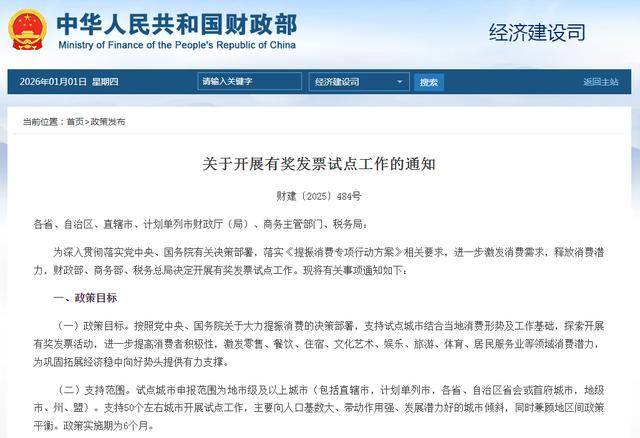
三部门联合开展有奖发票试点工作
Xin Lang Cai Jing· 2026-01-03 10:58
Core Viewpoint - The Ministry of Finance, Ministry of Commerce, and State Taxation Administration have announced a pilot program for prize invoices to stimulate consumer demand and support economic stability [1] Group 1: Policy Objectives - The policy aims to enhance consumer enthusiasm and stimulate consumption in sectors such as retail, dining, accommodation, cultural arts, entertainment, tourism, sports, and residential services [1] - The pilot program will be implemented in approximately 50 cities, focusing on those with large populations and strong economic potential, with a duration of six months [1] Group 2: Support Directions - Pilot cities will organize a lottery for consumers who purchase goods and services above a certain invoice amount, with a minimum threshold set at 100 yuan [2] - The maximum prize amount for a single invoice will not exceed 800 yuan, with cities determining the winning invoice ratio and prize structure [2] Group 3: Work Procedures - Local authorities must submit applications for pilot programs, ensuring that proposals are clear, logical, and data-driven, while avoiding extravagant materials [3] - A competitive evaluation will be conducted by provincial departments to select cities for the pilot, with specific recommendations based on consumer spending rankings [4] Group 4: Funding and Performance Evaluation - Central government will allocate prize funds based on city size, with a maximum of 3 billion yuan for super-large cities, 2 billion for large cities, and 1 billion for others [5] - After the pilot period, cities will conduct self-evaluations, and a comprehensive performance evaluation will be organized by the central authorities [5] Group 5: Work Requirements - Provincial departments are responsible for coordinating efforts, establishing performance indicators, and ensuring timely execution of the pilot program [6] - Strong oversight and management of funds are required, with a focus on ensuring the integrity of the lottery process and the security of financial transactions [7] - Promotion of the program will be essential, with a requirement for comprehensive communication strategies to engage consumers and report outcomes by the end of August 2026 [7]
有奖发票来了!记得抽奖→
Sou Hu Cai Jing· 2026-01-02 10:44
Group 1 - The core idea of the announcement is to stimulate consumer demand and unleash consumption potential through a pilot program of prize invoices in approximately 50 cities, with a policy implementation period of six months [1][3]. Group 2 - The pilot program allows individual consumers to participate in a lottery by obtaining invoices for purchases made in various sectors such as retail, dining, accommodation, cultural arts, entertainment, tourism, sports, and residential services, provided the invoice amount exceeds a certain threshold [3]. - The program focuses on everyday consumption scenarios closely related to residents' daily lives, including shopping, dining out, travel accommodation, cultural and sports activities, and life services [3]. - The eligible cities for the pilot program include city-level and above cities, such as municipalities, separately planned cities, provincial capitals, and prefecture-level cities [3]. - Central finance will allocate reward funds to the pilot cities based on a tiered arrangement [3]. - Participating cities are required to develop implementation plans that specify the scope of prize invoices, participation methods, winning rules, prize settings, redemption methods, and reporting of illegal activities, which will be made public [3].
传下去:发票留着能抽奖
Xin Lang Cai Jing· 2026-01-02 10:16
Group 1 - The core idea of the article is the introduction of a lottery system for invoices in approximately 50 cities, aimed at encouraging consumer spending in various sectors [1] - The initiative covers key areas of daily consumption, including retail, dining, accommodation, cultural arts, entertainment, tourism, sports, and residential services [1] - Participants can enter the lottery by obtaining eligible invoices, with a minimum invoice amount set by each trial city, not less than 100 yuan [1] Group 2 - The prize amount for a single invoice is capped at 800 yuan, promoting higher consumer engagement [1] - The policy will be implemented for a duration of six months, allowing for a trial period to assess its effectiveness [1] - Each trial city has the autonomy to determine the winning invoice ratio and prize structure, tailoring the program to local conditions [1]
零售文化艺术等试点发票抽奖
Xin Lang Cai Jing· 2026-01-02 09:15
Group 1 - The core idea of the article is the launch of a prize invoice pilot program by the Ministry of Finance, Ministry of Commerce, and State Taxation Administration, aimed at stimulating consumer spending through lottery-style incentives for invoices [1] - The pilot program will cover various sectors including retail, catering, accommodation, cultural arts, entertainment, tourism, sports, and residential services [1] - The program will be implemented in approximately 50 pilot cities for a duration of six months, with each city determining the minimum invoice amount for eligibility (not less than 100 yuan) and the prize distribution [1] Group 2 - The maximum prize amount for a single invoice is set at 800 yuan, encouraging consumers to participate in the program [1] - The initiative aims to enhance consumer engagement and boost economic activity in the targeted sectors [1] - Timely disbursement of subsidy funds is emphasized to ensure the effectiveness of the program [1]
多地将试点有奖发票!单张奖金最高800元
Xin Lang Cai Jing· 2026-01-02 09:13
Core Viewpoint - The Ministry of Finance, Ministry of Commerce, and State Taxation Administration have jointly issued a notice to support around 50 cities in conducting a trial for prize invoices, with a policy implementation period of six months [1] Group 1: Trial Implementation - The trial cities will determine the minimum invoice amount for winning (not less than 100 yuan), winning ratio, and prize settings, with a maximum prize amount of 800 yuan per invoice [1] - The trial covers various sectors including retail, catering, accommodation, cultural arts, entertainment, tourism, sports, and residential services, closely related to daily consumer activities [2] Group 2: Participation and Transparency - Every individual who obtains a qualifying invoice in the trial cities has the opportunity to participate in the lottery and win prizes [2] - The lottery process will be notarized for transparency, and results will be publicly available, allowing for social supervision [3] Group 3: Regulation and Oversight - The trial cities will enhance supervision and management of personnel involved in the trial to prevent corruption and manipulation [4] - Complaint and reporting mechanisms will be established for consumers to report any illegal or irregular issues encountered during the trial [5]
三部门发文 支持50个左右城市开展有奖发票试点
Ren Min Ri Bao Hai Wai Ban· 2026-01-02 03:11
Core Viewpoint - The Ministry of Finance, Ministry of Commerce, and State Taxation Administration announced a pilot program for prize invoices in approximately 50 cities to stimulate consumer demand and unleash consumption potential, with a policy implementation period of six months [1]. Group 1: Pilot Program Details - The pilot program will allow individual consumers to participate in a lottery by obtaining invoices for purchases made in various sectors, including retail, dining, accommodation, cultural arts, entertainment, tourism, sports, and residential services, provided the invoice amount exceeds a certain threshold [1]. - The program aims to enhance consumer spending in daily life scenarios closely related to residents' "clothing, food, housing, and transportation" [1]. Group 2: Implementation and Local Adaptation - Pilot cities are required to develop implementation plans that specify the scope of prize invoices, participation methods, winning rules, prize settings, redemption methods, and reporting of illegal activities, which will be made public [2]. - Consumers are encouraged to pay attention to announcements from pilot cities and actively participate according to the specific requirements of the prize invoice activities [2].