
修理和其他服务业

Search documents
浙江省个体工商户达748.96万户
Mei Ri Shang Bao· 2026-01-22 05:05
Core Insights - The report highlights the significant growth of individual businesses in Zhejiang, with a total of 7.49 million registered individual businesses by the end of last year, accounting for 64.36% of all operating entities, representing a year-on-year increase of 5.55% [1] Group 1: Industry Overview - Over half of the individual businesses in Zhejiang are concentrated in the wholesale and retail sector, with 4.28 million businesses, making up 57.16% of the total [2] - The distribution of individual businesses by industry includes manufacturing (778,300 businesses, 10.39%), accommodation and catering (766,500 businesses, 10.23%), and other service sectors (604,400 businesses, 8.07%) [2] - The employment rate among individual businesses is notable, with an average of 1.92 employees per business, contributing to nearly 12 million jobs, which is over 30% of the province's total employment [1] Group 2: Support Mechanisms - Zhejiang has established a differentiated support mechanism for individual businesses categorized as "survival," "growth," and "development," providing tailored assistance [2] - The "Big Enterprises Help Small Stores" initiative has paired thousands of large enterprises with tens of thousands of small stores, aiming to transition from "blood transfusion" to "blood production" [3] - The province plans to cultivate 500 "Zhejiang Good" brand merchants annually and conduct skills training for 200,000 individuals, alongside enhancing financial support and digital platform capabilities [3]
全省规上服务业企业营业收入连续6个月回升
Xin Lang Cai Jing· 2026-01-05 16:39
Group 1: Service Industry Performance - The province's service industry has shown steady growth, with revenue from large-scale service enterprises reaching 779.72 billion yuan, a year-on-year increase of 6.2%, accelerating by 1 percentage point compared to the previous month [1] - The business services sector has led this growth, with revenue from leasing and business service enterprises increasing by 21.2%, contributing 73.4% to the overall growth of the service industry [1] - Revenue from resident services, repair, and other service enterprises grew by 12.3%, with significant increases in automotive repair and maintenance (36.8%) and computer and auxiliary equipment repair (36.2%) [1] Group 2: Cultural, Sports, and Entertainment Industry - The cultural, sports, and entertainment sector saw a revenue increase of 12.7%, benefiting from more cultural festivals and concerts [2] - Revenue from cultural agents and artistic creation and performance grew by 45.9% and 24.6%, respectively, while the film market rebounded with production and screening revenues increasing by 116.9% and 14.9% [2] - Sports events and fitness activities contributed to a 16% growth in the management of sports facilities, enhancing public access to quality cultural and fitness options [2]
2024年上市公司内部控制质量进一步提高
Shang Hai Zheng Quan Bao· 2025-12-25 19:11
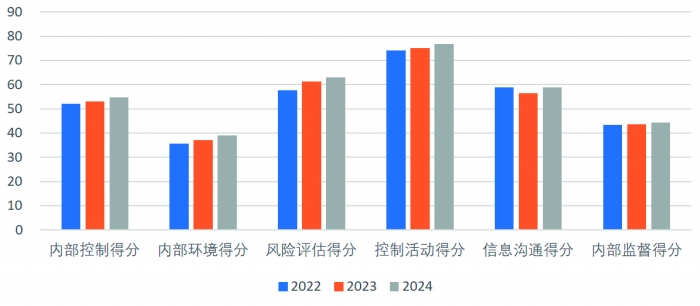
Core Insights - The internal control quality of listed companies in 2024 has improved compared to 2023, with internal environment remaining the weakest aspect that requires further enhancement [4][19] - Companies with financial shared centers, high digital transformation levels, and high-quality new productivity show better internal control levels, while those facing penalties, restatements, or receiving non-standard audit opinions exhibit lower internal control levels [20] Group 1: Overall Internal Control Status - The overall internal control level of listed companies has shown a steady increase from 52.47 in 2022 to 54.75 in 2024 [7] - The distribution of listed companies is concentrated in economically developed regions, with Guangdong, Zhejiang, and Jiangsu having the highest number of listed companies [8] Group 2: Regional Analysis - Internal control index averages vary by region, with Yunnan (58.49), Beijing (56.25), and Hebei (56.60) showing higher scores, while Qinghai (50.42), Hainan (50.33), and Heilongjiang (51.64) are lower [8] - The internal control quality is more balanced in economically developed areas like Beijing, Shanghai, and Guangdong, indicating a mature governance structure [8] Group 3: Industry Analysis - The financial industry maintains a significantly higher internal control quality compared to other sectors, attributed to stringent government regulations [9] - Some service and public sectors have shown notable improvements in internal control levels from 2022 to 2024, while education, construction, and comprehensive industries remain at lower levels [9] Group 4: Financial Shared Services and Digital Transformation - Companies utilizing financial shared services have an internal control index average of 57.76, compared to 54.36 for non-financial shared companies, indicating a clear advantage [10] - Companies with high digital transformation levels have an internal control index average of 55.54, outperforming those with lower levels at 53.98, highlighting the positive impact of digital transformation on internal control quality [11] Group 5: ESG and New Productivity - Companies with high ESG levels have an internal control index that is 4.51 points higher than those with lower ESG levels, particularly in the internal environment dimension [13] - Companies with high new productivity levels demonstrate superior internal control quality across various dimensions compared to those with lower levels [14] Group 6: Penalties and Audit Opinions - Companies that have faced penalties have an internal control index average of 44.45, significantly lower than the 55.06 average of non-penalized companies, with the internal environment being the most affected area [15] - Companies receiving non-standard audit opinions have a notably lower internal control index, with a score of 34.76 in 2024, indicating serious deficiencies in internal control execution [18]

12月31日截止 快来申请重点群体社会保险补贴
Xin Lang Cai Jing· 2025-12-25 17:24
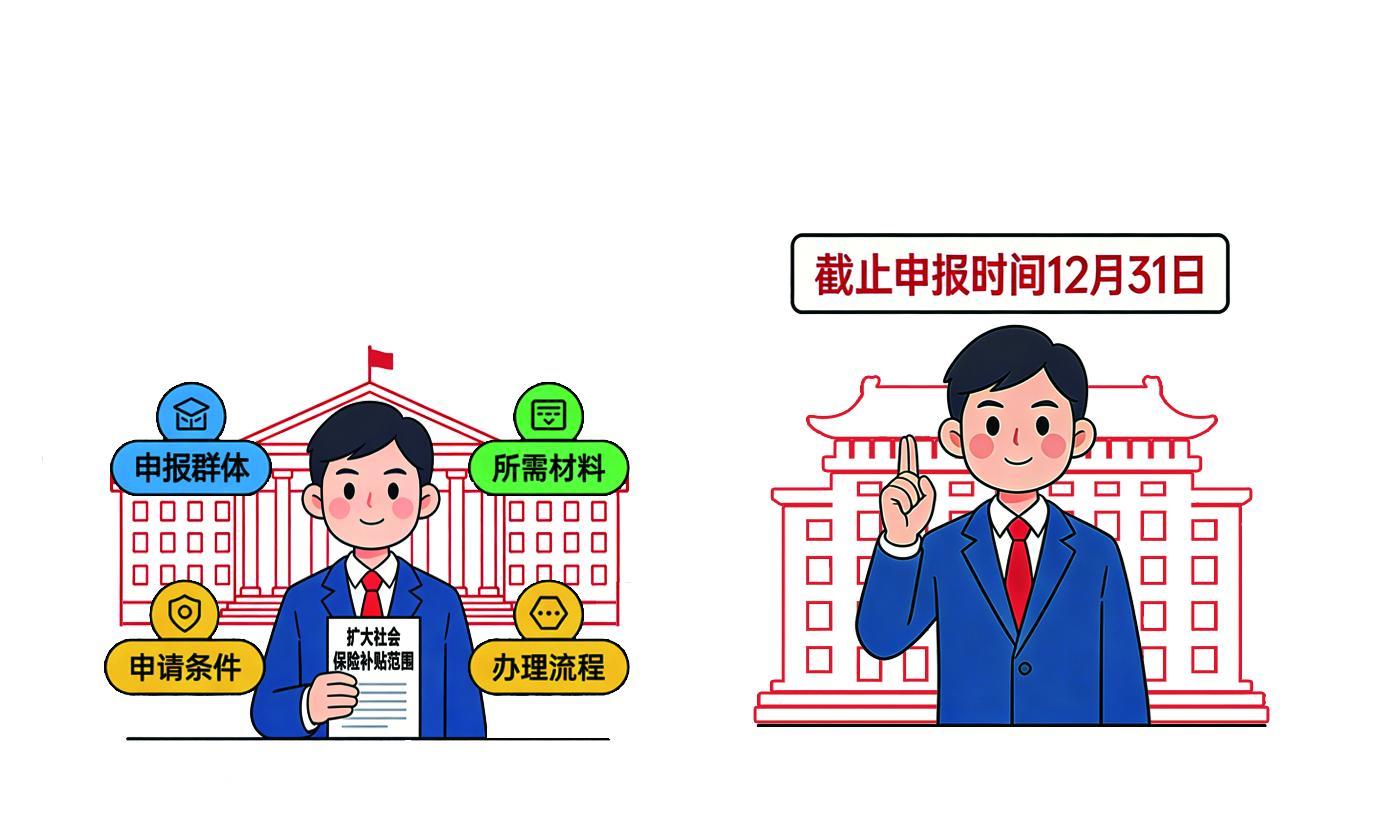
Policy Overview - The Chongqing Human Resources and Social Security Bureau has issued a notification to accelerate the implementation of expanded social insurance subsidy and one-time employment expansion subsidy policies, providing a 25% subsidy on individual social insurance contributions to encourage enterprises to expand employment [2][3] Subsidy Details - The subsidy is targeted at small and medium-sized enterprises in key industries that sign labor contracts for over one year and have made new or continued contributions to basic pension, medical, and unemployment insurance in 2025 [2] - Key industries include manufacturing, information transmission/software and IT services, wholesale and retail, accommodation and catering, leasing and business services, and other services [2] - Key groups eligible for the subsidy include 2025 college graduates, unemployed graduates from 2023 and 2024, individuals registered as unemployed for over six months in 2025, and those monitored for poverty prevention [2] Subsidy Amount - Eligible individuals can receive a monthly subsidy ranging from 115.6 yuan to 577.9 yuan based on their social insurance contribution amounts [2] Application Process - The application deadline for the subsidy is December 31, 2025, with the subsidy period lasting for one year, starting from the month the enterprise makes actual social insurance contributions for the key groups [4] - The subsidy will be disbursed monthly, with the latest payment expected by the end of 2026 [4] Implementation Measures - Chongqing is utilizing big data to establish a dynamic screening mechanism to identify key industries and groups, facilitating a "direct subsidy and quick processing" approach [3] - The policy includes a "one-time certification, subsequent exemption from reporting" system, where enterprises only need to confirm information once, and the system will automatically generate subsidy lists based on monthly insurance data [3] - Local districts are tasked with accurately identifying key groups and ensuring timely insurance contributions and subsidy applications by eligible employees [3][5]
2025年11月中国企业信用指数162.66 持续稳中有进
Zhong Guo Jing Ji Wang· 2025-12-23 10:29
Group 1 - The corporate credit index in China for November is 162.66, indicating a steady improvement in corporate credit levels [1] - The corporate credit index increased by 1.11 points from October, reaching a peak for the second half of the year, reflecting a positive change in corporate credit levels amid stable economic performance [2] - Most regions in China showed positive growth in credit indices, with notable increases in Guangdong and Shandong, indicating enhanced self-discipline among enterprises and effective credit repair mechanisms [3] Group 2 - Nearly 80% of industries saw an increase in credit indices compared to the previous month, with the finance and manufacturing sectors leading the growth [4] - The credit index for the real estate industry has shown a continuous upward trend for four months, indicating a recovery in credit levels [4]
2025年11月中国企业信用指数较10月上升1.11点 攀升至下半年峰值
Bei Jing Shang Bao· 2025-12-23 10:17
Core Insights - The corporate credit index in China reached 162.66 in November 2025, marking an increase of 1.11 points from October, indicating a positive change in corporate credit levels amid stable economic growth [1] Industry Summary - Nearly 80% of industries experienced a month-on-month increase in their credit indices, with the top five performing sectors being finance, manufacturing, water conservancy, environmental and public facilities management, and electricity, heat, gas, and water production and supply [1] - The credit index for the resident services, repair, and other service industries saw the highest growth among all sectors, while the manufacturing sector ranked second in terms of credit index growth [1] - The real estate industry has maintained a month-on-month increase in its credit index for four consecutive months, indicating a recovery trend in credit levels [1] Regional Summary - The top five provinces in terms of credit index rankings are Anhui, Shaanxi, Tianjin, Shandong, and Chongqing, with Shandong making its first appearance in the national top five in 2025 [1]
1—11月广西经济保持平稳向好发展态势
Xin Lang Cai Jing· 2025-12-21 01:11
Economic Overview - The overall economic operation of the region is stable, with continuous enhancement in production supply, expansion in consumption scale, and good momentum in import and export [1][2] - High-quality development is being solidly advanced [1] Industrial Production - The industrial added value of enterprises above designated size increased by 7.6% year-on-year from January to November [1] - Key industries such as paper and paper products, electrical machinery and equipment manufacturing, automobile manufacturing, and non-ferrous metal smelting and rolling processing saw year-on-year growth rates of 40.4%, 23.3%, 16.5%, and 12.2% respectively [1] - High-tech manufacturing and equipment manufacturing added value increased by 25.2% and 17.3% year-on-year [1] - Production of wind turbine generators, lithium-ion power batteries for automobiles, and service robots increased by 55.6%, 48.2%, and 22.4% respectively [1] Service Sector - The service sector is showing good momentum, with emerging service industries developing rapidly [1] - From January to November, the turnover of railway, road, and waterway passenger and freight transport increased by 4.6% year-on-year, accelerating by 0.3 percentage points compared to January to October [1] - The operating income of enterprises in the above-scale service industry increased by 8.6% year-on-year [1] - High-tech service industry enterprises saw a year-on-year operating income growth of 16.6% [1] Foreign Trade - The total import and export value of the region reached 726.541 billion yuan from January to November, with a year-on-year growth of 9.5% [2] - Trade with ASEAN amounted to 384.224 billion yuan, a year-on-year increase of 10.0%, accounting for 52.9% of the region's total foreign trade [2] - Year-on-year growth rates for trade with the EU, Africa, and Latin America were 49.5%, 24.9%, and 20.5% respectively [2]
江苏前11月规上工业增加值增长6.6%
Xin Hua Ri Bao· 2025-12-19 19:59
Economic Performance - The provincial economy has shown steady progress in the first 11 months of the year, with industrial growth and a vibrant service sector contributing to a stable recovery in the consumer market [1] - The industrial added value for large-scale enterprises increased by 6.6% year-on-year from January to November, with a monthly growth of 5.1% in November [1] - Key sectors such as equipment manufacturing, high-tech manufacturing, and digital core product manufacturing saw growth rates of 7.5%, 10.4%, and 10.2% respectively [1] Service Sector - The service industry has shown a steady recovery, with large-scale service industry revenue increasing by 7.5% year-on-year from January to October [1] - Notable growth was observed in residential services, repair and other services (15.5%), leasing and business services (13.4%), and scientific research and technical services (10.1%) [1] - Financial operations remained stable, with the balance of RMB deposits in financial institutions reaching 27 trillion yuan, a year-on-year increase of 7.8% [1] Consumer Market - The consumer market is experiencing a steady recovery, with total retail sales of consumer goods reaching 42,586.8 billion yuan, reflecting a year-on-year growth of 3.8% from January to November [2] - Sales in the wholesale and retail sectors increased by 5.1% and 7.1% respectively, while the accommodation and catering sectors saw growth rates of 2.5% and 5.4% [2]
GDP规模增速双居前列,武汉成都要争副省级城市“领跑者”
Sou Hu Cai Jing· 2025-11-07 20:14
Core Insights - The economic performance of 15 sub-provincial cities in China varies significantly, with Chengdu and Wuhan showing strong growth in GDP and service sectors [3][6][12] Group 1: Economic Growth and Performance - Chengdu's GDP reached 1.82 trillion yuan in the first three quarters, ranking third among sub-provincial cities, with a year-on-year growth rate of 5.8%, the second highest [3][6] - Wuhan's GDP was 1.55 trillion yuan, ranking fifth, with a year-on-year growth of 5.6%, the fourth highest [3][6] - Shenyang lagged behind with a GDP growth rate of only 2.3%, less than half the national average [3] Group 2: Service Sector Contribution - The rapid growth of the service sector is a key driver for Chengdu and Wuhan, with Chengdu's service sector contributing 70% to its GDP and Wuhan's contributing 65% [6][8] - Both cities achieved service sector growth rates of 6%, surpassing the national average of 5.4% [6][8] - Shenzhen also performed well, with a service sector growth rate of 6.6%, contributing 65% to its GDP [8] Group 3: Industrial Growth in Other Cities - Dalian and Xiamen, part of the third tier of sub-provincial cities, showed significant industrial growth, with Dalian's industrial GDP growing by 8% and Xiamen's by 7% [14][16] - Dalian's GDP for the first nine months was 724.8 billion yuan, while Xiamen's was 641.9 billion yuan [14][16] Group 4: Overall Economic Contribution of Sub-Provincial Cities - The total GDP of the 15 sub-provincial cities reached 19.3 trillion yuan, accounting for 19.06% of the national GDP, marking the highest contribution since the start of the 14th Five-Year Plan [19][20] - The second tier of sub-provincial cities has seen an increase in GDP share from 29.9% in 2019 to 31.6% in 2025 [21][23]

九部门发文推动降低服务业经营主体融资成本
Chang Jiang Shang Bao· 2025-08-13 08:37
Core Viewpoint - The Chinese government is implementing a loan interest subsidy policy to stimulate consumption in eight service sectors, aiming to reduce financing costs and enhance market vitality [1][2]. Group 1: Policy Overview - The policy is part of the "Consumption Promotion Special Action Plan" and aims to provide financial subsidies for loans to service industry entities in specific sectors [1]. - The sectors eligible for the subsidy include catering, accommodation, health, elderly care, childcare, housekeeping, cultural entertainment, tourism, and sports [2]. Group 2: Loan Conditions - Loans must be issued by banks to eligible service industry entities between March 16, 2025, and December 31, 2025, and funds must be used for improving consumption infrastructure and service capabilities [2]. - The policy specifies that the loan amount eligible for interest subsidies can reach up to 1 million yuan per entity [3]. Group 3: Subsidy Details - The interest subsidy is set at 1% per annum for a maximum period of one year, with the central and provincial finances covering 90% and 10% of the subsidy, respectively [3]. - The policy allows for the potential extension and expansion of support based on its effectiveness after the initial implementation period [3].