
有色行业

Search documents
中孚实业:股东怡诚创投累计减持约4000万股,减持计划实施完毕
Mei Ri Jing Ji Xin Wen· 2025-10-10 12:33
Group 1 - The core point of the article is that Zhongfu Industrial has completed a share reduction plan, with a total of 39,999,924 shares reduced, representing 1% of the company's total share capital [1] - As of October 10, 2025, after the completion of the reduction plan, Yicheng Venture Capital holds 160,471,611 shares, which is 4.0039% of Zhongfu Industrial's total share capital [1] - For the first half of 2025, Zhongfu Industrial's revenue composition is as follows: non-ferrous industry accounts for 94.76%, electricity for 9.96%, coal for 2.71%, and other businesses for 0.47%, with a negative offset of 7.9% [1] Group 2 - The market capitalization of Zhongfu Industrial is reported to be 21.5 billion yuan [1]

国证国际港股晨报-20251010
Guosen International· 2025-10-10 06:11
Group 1 - The core viewpoint of the report highlights that international gold prices have surpassed the $4000 per ounce mark, impacting various sectors positively, particularly the metals sector [2][4][6] - The Hong Kong stock market showed mixed results with the Hang Seng Index declining by 0.29%, while the Hang Seng Tech Index fell by 0.66%, indicating volatility in the market [2][3] - The report notes significant inflows from northbound funds, with a net inflow of HKD 30.43 billion into Hong Kong stocks, suggesting strong investor interest [2][3] Group 2 - The report provides insights into the software and internet industry, indicating a robust domestic tourism performance during the National Day holiday, with total tourism revenue reaching CNY 809 billion and a year-on-year increase of 15% in revenue per capita [7][8] - The report anticipates a stable growth rate of 10% for the overall tourism market in 2025, with expectations of a rebound in average spending per person in the second half of the year [7][10] - Online travel agencies (OTAs) like Ctrip and Qunar have shown strong performance, with significant increases in outbound travel orders and hotel bookings, reflecting a positive trend in consumer behavior [9][10]
沪指突破3900点 创十年来新高
Yang Guang Wang· 2025-10-10 01:13
Core Points - A-shares experienced a strong performance on October 9, with all three major indices rising significantly, marking a ten-year high for the Shanghai Composite Index [1] - The total market turnover reached 2.67 trillion yuan, with over 3,100 stocks rising [1] - The Shanghai Composite Index closed at 3,933.97 points, up 1.32%, while the Shenzhen Component Index and the ChiNext Index also saw increases of 1.47% and 0.73%, respectively [1] Industry Performance - The non-ferrous metals sector saw a widespread surge, with precious metals, rare earths, and copper stocks experiencing a wave of limit-up trading [1] - The nuclear power sector also performed notably well during this trading session [1] Market Sentiment - A chief strategist from a fund company noted that the positive performance of global risk assets during the holiday period created a favorable macro environment for the A-share market [1] - The upcoming third-quarter report trading window in October is expected to attract capital focusing on sectors with strong performance indicators [1] - According to a report from China International Capital Corporation, the expectations surrounding the "14th Five-Year Plan" policies are likely to gain momentum post-holiday, suggesting a continued stable performance for A-shares [1]
“反内卷”下一步施政展望: 盈利改善如何向中下游传导
Sou Hu Cai Jing· 2025-09-28 17:01
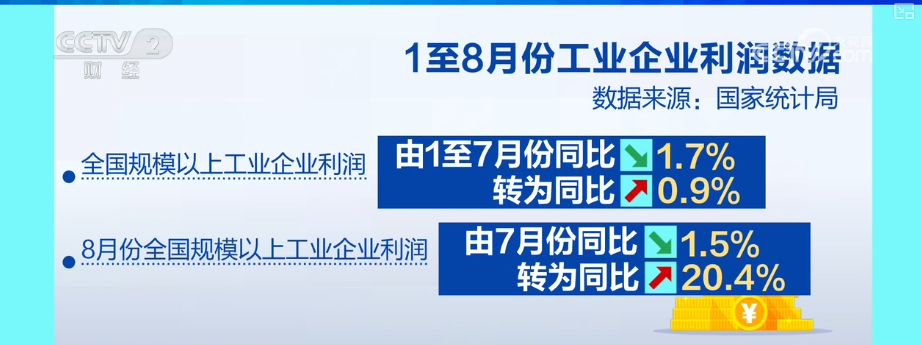
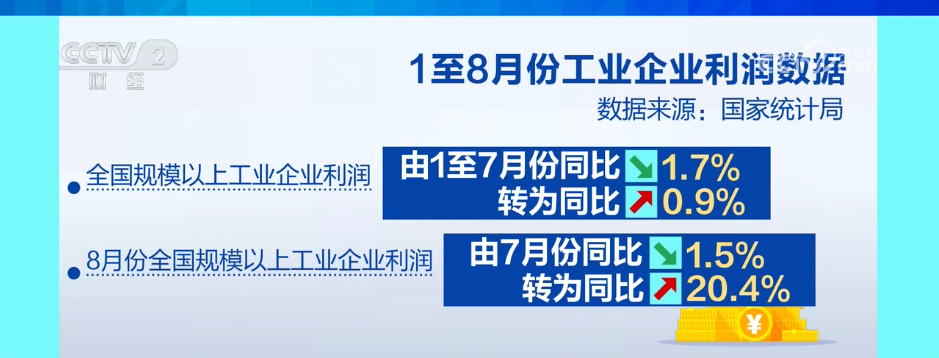
Core Viewpoint - The ongoing efforts to combat "involution" and disordered competition in various industries have shown positive results, with expectations for further policy support to sustain this momentum [1][7]. Group 1: Industrial Profit Improvement - From January to August, industrial profits for large-scale enterprises turned from a decline of 1.7% to a growth of 0.9%, marking a significant recovery [2]. - In August alone, industrial profits saw a notable increase of 20.4%, reversing the previous month's decline of 1.5% [2]. - The improvement in industrial profits is attributed to macroeconomic policies, a unified national market, and a low base effect from the previous year [2][3]. Group 2: Price and Cost Dynamics - The Producer Price Index (PPI) saw a narrowing decline of 2.9% in August, the smallest drop since March, indicating a recovery in pricing power [3]. - Specific industries, such as coal processing and steel manufacturing, experienced reduced price declines, contributing to the overall improvement in industrial profits [3][4]. - The recovery in prices is linked to enhanced market competition and effective governance of industry practices [3][7]. Group 3: Policy Support and Future Outlook - The government is expected to continue implementing targeted policies to stimulate downstream demand, particularly in consumer goods and real estate [1][6]. - Analysts suggest that if policies effectively boost demand, the benefits of profit improvements could extend to downstream sectors, leading to a more comprehensive recovery in industrial profits [6][8]. - Recent government initiatives focus on stabilizing growth in key industries such as steel and automotive, emphasizing the need for structured governance and competition regulation [8][9].
“反内卷”的下一步:盈利改善如何向中下游传导
Di Yi Cai Jing· 2025-09-28 13:29
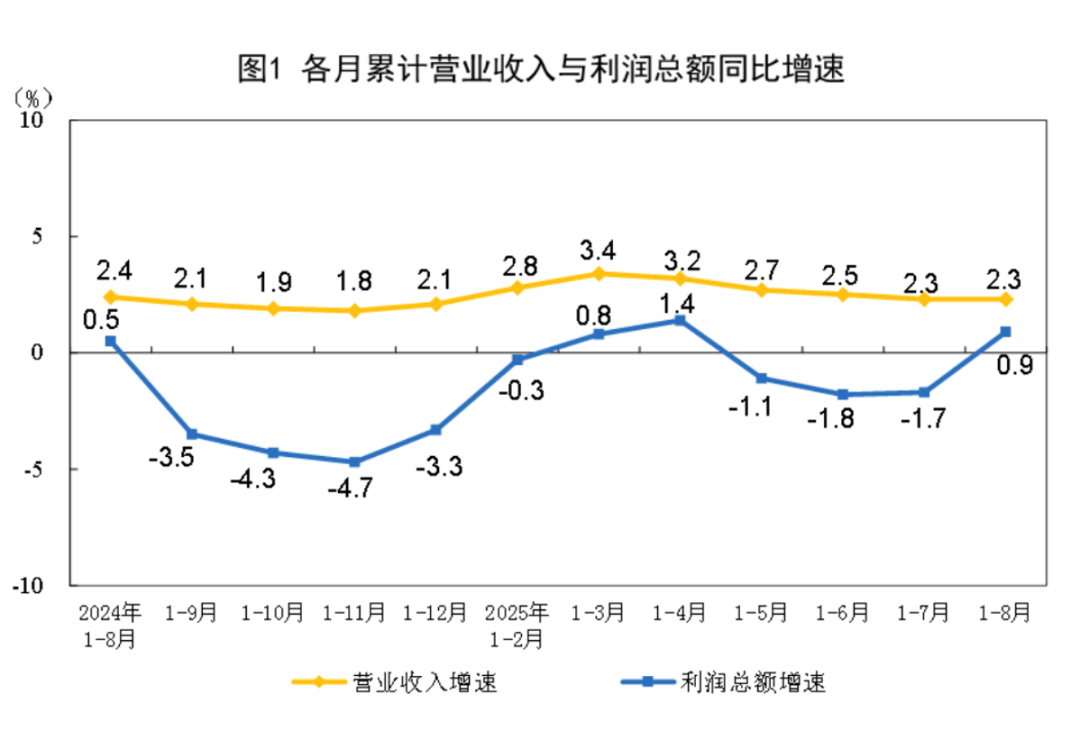
Core Viewpoint - The recovery of upstream industry prices has been observed, while the midstream and downstream sectors still require more policy support to combat "involution" and promote sustainable development [1][5][7] Group 1: Industrial Profit and Price Trends - From January to August, the profit of the raw materials manufacturing industry increased by 22.1% year-on-year, with the steel industry turning from loss to profit [1][5] - The overall industrial profit growth turned positive, with a 0.9% increase in profits for large-scale industrial enterprises from January to August, reversing a decline since May [2][4] - In August, the Producer Price Index (PPI) decline narrowed to 2.9% year-on-year, marking the first reduction in the decline since March [3][4] Group 2: Policy Measures and Industry Support - The State-owned Assets Supervision and Administration Commission (SASAC) emphasized the need for state-owned enterprises to resist "involution" and promote healthy competition [1][7] - The Ministry of Industry and Information Technology (MIIT) has released multiple industry stabilization plans, focusing on sectors like automotive, steel, and non-ferrous metals to enhance governance and competition order [7][8] - Future policies should focus on expanding domestic demand and ensuring the effective implementation of "anti-involution" measures to support downstream industries [6][8] Group 3: Market Dynamics and Challenges - Despite improvements in industrial profits, revenue growth indicates that demand has not significantly improved, with rising inventory levels and longer accounts receivable periods [4][6] - The structural differentiation of profits between upstream and downstream industries persists, with upstream benefiting from "anti-involution" policies while downstream remains constrained by weak terminal demand [6][8] - The steel industry faces challenges with excess capacity and demand imbalance, necessitating precise capacity control and supply-demand coordination [9]
0.9%、20.4%、7.2%,增长!多维度“数”览全年工业利润改善有基础
Yang Shi Wang· 2025-09-28 02:14
Group 1 - The core viewpoint is that from January to August 2025, the profits of large-scale industrial enterprises in China increased by 0.9% year-on-year, reversing a trend of decline since May 2025 due to effective macro policies and the deepening of a unified national market [1][3][17] - In August 2025, profits of large-scale industrial enterprises showed significant improvement, with a growth of 20.4%, compared to a decline of 1.5% in July [3] - The equipment manufacturing sector was a major contributor to profit recovery, with a profit growth of 7.2% from January to August 2025 [6] Group 2 - Among the eight industries in the equipment manufacturing sector, seven experienced profit growth, with notable increases in the railway, shipbuilding, aerospace, and electrical machinery industries [9] - The raw materials manufacturing sector saw a profit increase of 22.1% year-on-year, driven by rising market demand, price recovery, and cost reductions, with the steel industry turning profitable [14] - The consumer goods manufacturing sector also turned around, with profits growing by 1.4% year-on-year, particularly in the beverage and agricultural products industries, which achieved double-digit growth [15]

增长0.9%,透过工业利润数据看经济韧性
Yang Shi Wang· 2025-09-27 08:22
Core Insights - The profits of industrial enterprises above designated size in China increased by 0.9% year-on-year from January to August this year, reversing a decline that had persisted since May [1][3]. Group 1: Profit Trends - From January to August, the profits of industrial enterprises shifted from a 1.7% year-on-year decline in the first seven months to a 0.9% increase, indicating a significant recovery [3]. - In August alone, profits for industrial enterprises experienced a notable improvement, achieving a growth of 20.4%, compared to a decline of 1.5% in July [3]. Group 2: Sector Performance - The equipment manufacturing sector saw a profit increase of 7.2% from January to August, making it one of the strongest contributors to the overall profit recovery of industrial enterprises [5]. - Among the eight industries within the equipment manufacturing sector, seven reported profit growth, with the railway, shipbuilding, aerospace, and electrical machinery industries showing particularly rapid profit increases [5]. Group 3: Raw Materials and Consumer Goods - The profits of the raw materials manufacturing sector rose by 22.1% year-on-year, accelerating by 10 percentage points compared to the first seven months, driven by increased market demand, price recovery, and reduced costs [7]. - The steel industry turned from losses to profits, while the non-ferrous metals sector also saw significant profit growth [7]. - The consumer goods manufacturing sector transitioned from a year-on-year decline to a 1.4% profit increase, with the beverage and agricultural products industries achieving double-digit growth [7]. Group 4: Economic Outlook - The improvement in industrial profits is corroborated by revenue growth, cost reductions, and other positive financial indicators, suggesting a favorable impact on market expectations and laying a solid foundation for overall industrial profit improvement for the year [7].
数“读”1至8月工业企业营收保持稳定增长 装备制造业“压舱石”作用明显
Yang Shi Wang· 2025-09-27 05:14
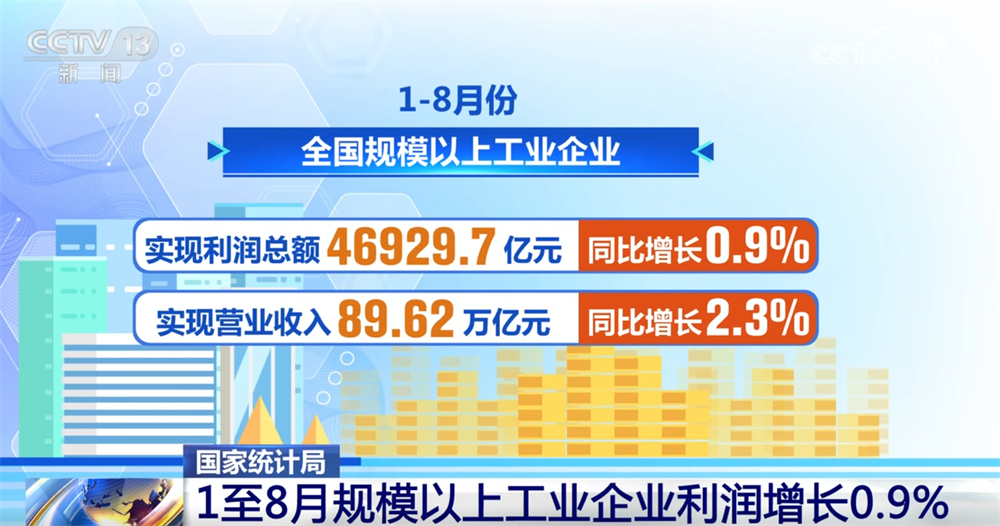
Group 1 - In the first eight months of the year, the total profit of industrial enterprises above designated size reached 46,929.7 billion yuan, a year-on-year increase of 0.9%, while operating income was 89.62 trillion yuan, up 2.3% [1] - The profit of the equipment manufacturing industry increased by 7.2%, significantly supporting the recovery of profits in industrial enterprises, with rapid profit growth in the railway, shipbuilding, aerospace, and electrical machinery sectors, achieving growth rates of 37.3% and 11.5% respectively [3] - In August, the profit of industrial enterprises turned from a decline in July to a growth of 20.4%, with operating income increasing by 1.9%, accelerating by 1.0 percentage points compared to July [4] Group 2 - The profit of the raw materials manufacturing industry increased by 22.1% year-on-year, accelerating by 10 percentage points compared to the first seven months, with the steel industry turning profitable with a total profit of 83.7 billion yuan, and the non-ferrous industry profit growing by 12.7%, accelerating by 5.8 percentage points [6] - Experts indicate that in the next phase, it is essential to further expand domestic demand and promote the construction of a unified national market to create favorable conditions for the sustained recovery of industrial enterprise profits [8]
重要数据公布!同比增长20.4%
Zhong Guo Zheng Quan Bao· 2025-09-27 02:58
Core Insights - The total profit of industrial enterprises above designated size in China reached 46,929.7 billion yuan from January to August, marking a year-on-year increase of 0.9% [1][4] - In August, profits for these enterprises saw a significant turnaround, growing by 20.4% year-on-year, compared to a decline of 1.5% in July [1][4] - The recovery in profits is attributed to effective macro policies, the deepening of a unified national market, and a low base from the previous year [1][4] Profit Trends - From January to August, the profit decline of industrial enterprises was reversed, with a shift from a 1.7% decrease in the first seven months to a 0.9% increase [4] - Revenue for these enterprises also showed stable growth, with a 2.3% year-on-year increase from January to August, and a 1.9% increase in August alone [4] - Different scales of enterprises saw profit improvements, with private enterprises experiencing a notable profit growth of 3.3%, surpassing the average growth of all industrial enterprises [4][6] Cost and Profitability - In August, the cost per hundred yuan of revenue for industrial enterprises decreased by 0.20 yuan, marking the first year-on-year decline since July 2024 [5] - The profit margin for these enterprises improved to 5.83%, reflecting a year-on-year increase of 0.90 percentage points [5] Sector Performance - The equipment manufacturing sector played a crucial role, with profits growing by 7.2% from January to August, contributing 2.5 percentage points to the overall profit growth of industrial enterprises [6] - Among the eight industries within equipment manufacturing, seven reported profit increases, with notable growth in the railway, shipping, aerospace, and electrical machinery sectors [6][7] - The raw materials manufacturing sector also saw significant profit growth of 22.1%, while the consumer goods manufacturing sector turned from a 2.2% decline to a 1.4% increase in profits [6][7] Future Outlook - The government emphasizes the need to expand domestic demand and further develop a unified national market to support the continuous recovery of industrial enterprise profits [7]
【收盘】A股午后直线下挫,三大股指跌超1%:两市成交31352亿元
Sou Hu Cai Jing· 2025-09-18 07:13
Market Overview - The three major A-share indices opened lower on September 18, with significant fluctuations in the semiconductor sector leading to early gains [1] - By the afternoon, all three indices continued to decline, with the ChiNext Index dropping over 2% at one point [1] Sector Performance - The financial sector experienced a broad decline, while the non-ferrous metals industry fell sharply following the Federal Reserve's interest rate cut [1] - Real estate, oil, and media sectors showed weakness, whereas the robotics and semiconductor supply chain saw a pullback after initial gains [1] - The SPD and tourism sectors performed well in the afternoon, showing resilience against the overall market trend [1] Index Closing Figures - The Shanghai Composite Index closed down 1.15% at 3831.66 points [1] - The Sci-Tech Innovation 50 Index increased by 0.72% to 1380.35 points [1] - The Shenzhen Component Index fell by 1.06% to 13075.66 points [1] - The ChiNext Index decreased by 1.64% to 3095.85 points [1] Trading Volume - The total trading volume in the Shanghai and Shenzhen markets reached 31,352 billion yuan, an increase of 7,584 billion yuan compared to the previous trading day [1] - The Shanghai market accounted for 13,660 billion yuan, up 3,593 billion yuan from the previous day, while the Shenzhen market saw a volume of 17,692 billion yuan [1] Stock Movement - A total of 1,026 stocks rose, while 4,348 stocks fell, with 52 stocks remaining flat [1] - There were 80 stocks with gains exceeding 9%, and 6 stocks with losses exceeding 9% [1]