
液化气

Search documents
LPG数据日报-20250825
Guo Mao Qi Huo· 2025-08-25 07:26
Report Summary 1. Market Overview - On August 22, 2025, the domestic LPG market price declined, with the average price dropping by 4 yuan/ton to 4422 yuan/ton, a decrease of -0.09% [3]. - The closing price of the futures main - contract decreased by 6 yuan/ton to 4387 yuan/ton, a decline of -0.14% [3]. - The trading volume of the futures main - contract was 188,767 lots, a decrease of 6,094 lots compared to the previous day [3]. 2. International Situation - The previous trading day's CP was equivalent to about 3708.692 yuan/ton for propane and 3494.729 yuan/ton for butane in RMB [3]. - On August 21, international oil prices rose, boosting the external market. The expected value of September CP increased slightly by 1 dollar/ton. The Far - East demand continued to boost buying interest, supporting the premium price [3]. 3. Regional Market Analysis 3.1 East China - The average price of civil gas remained stable at 4398 yuan/ton. Supply was under control, production and sales were balanced, and the price was stable due to limited news guidance [3]. - The price of imported gas at some Jiangnan wharves increased by 50 yuan/ton, while other wharves remained stable [3]. 3.2 South China - The average price of civil gas decreased by 30 yuan/ton to 4490 yuan/ton, a decline of -0.66%. The market showed a differentiated trend, with prices in some areas dropping due to increased supply [3]. - In the industrial gas market, the inventory pressure in Zhanjiang was relieved, and prices were low [3]. 3.3 Shandong - The average price of civil gas increased by 10 yuan/ton to 4510 yuan/ton, a rise of 0.22%. The market continued the stable - to - rising trend [3]. - The average price of ether - post carbon four remained stable at 4620 yuan/ton [3]. 4. Spread Analysis 4.1 Inter - monthly Spread - The spread between PG2510 - PG2511 was 77 yuan/ton, a decrease of 3 yuan/ton compared to the previous day [3]. - The spread between PG2510 - PG2512 was 138 yuan/ton, a decrease of 7 yuan/ton compared to the previous day [3]. 4.2 Inter - variety Spread - The spread between PG - 7.33*SC was - 25.79 yuan/ton, a decrease of 2.92 yuan/ton compared to the previous day [3]. - The spread between PG - PP was - 139 yuan/ton, a decrease of 3 yuan/ton compared to the previous day [3]. 5. Other Information - The LPG market is oscillating weakly [3]. - The number of registered contracts decreased by 396 to 12,887 [3].
能源化工期权策略早报-20250822
Wu Kuang Qi Huo· 2025-08-22 01:50
Group 1: Report Overview - The report is an energy and chemical options strategy morning report dated August 22, 2025 [2] - The energy and chemical options covered include energy (crude oil, LPG), polyolefins (polypropylene, PVC, plastic, styrene), polyesters (paraxylene, PTA, staple fiber, bottle chips), alkali chemicals (caustic soda, soda ash), and others (rubber) [3] - The recommended strategy is to construct option portfolio strategies mainly as sellers, along with spot hedging or covered call strategies to enhance returns [3] Group 2: Underlying Futures Market Overview - The report provides the latest prices, price changes, price change percentages, trading volumes, volume changes, open interests, and open interest changes of various option underlying futures contracts [4] Group 3: Option Factor - Volume and Open Interest PCR - The report presents the volume and open interest PCR data of different option varieties, which are used to describe the strength of the option underlying market and the turning point of the underlying market respectively [5] Group 4: Option Factor - Pressure and Support Levels - The report shows the pressure and support levels of different option varieties, determined by the strike prices with the largest open interest of call and put options [6] Group 5: Option Factor - Implied Volatility - The report provides the implied volatility data of different option varieties, including at - the - money implied volatility and weighted implied volatility [7] Group 6: Strategy and Recommendations for Different Option Types Energy - related Options - **Crude Oil**: OPEC + will increase supply by 550,000 barrels per day in September, and Russia will cut production. The market shows short - term upward resistance. Implied volatility is around the mean, and the open interest PCR indicates a weak - oscillating market. Recommended strategies include selling a neutral call + put option combination and constructing a long collar strategy for spot hedging [8] - **LPG**: Supply is abundant, and demand has little change. The market is short - term bearish. Implied volatility has dropped to near the mean, and the open interest PCR indicates strong bearish power. Recommended strategies include selling a bearish call + put option combination and constructing a long collar strategy for spot hedging [10] Alcohol - related Options - **Methanol**: Port and enterprise inventories are rising, and the market is weak. Implied volatility is below the mean, and the open interest PCR indicates a weak - oscillating market. Recommended strategies include selling a bearish call + put option combination and constructing a long collar strategy for spot hedging [10] - **Ethylene Glycol**: Port inventory is expected to accumulate, and the market is in a wide - range weak oscillation. Implied volatility is below the mean, and the open interest PCR indicates an oscillating market. Recommended strategies include shorting volatility and constructing a long collar strategy for spot hedging [11] Polyolefin - related Options - **Polypropylene**: PE and PP inventories show different trends. The market is weak. Implied volatility is below the mean, and the open interest PCR indicates a weakening market. Recommended strategies include a long collar strategy for spot hedging [11] Rubber - related Options - **Rubber**: Tire production shows different trends. The market is short - term weak. Implied volatility is near the mean, and the open interest PCR indicates a weak market. Recommended strategies include selling a neutral call + put option combination [12] Polyester - related Options - **PTA**: Social inventory is rising, and the market is in a weak consolidation. Implied volatility is above the mean, and the open interest PCR indicates a weakening market. Recommended strategies include selling a neutral call + put option combination [13] Alkali - related Options - **Caustic Soda**: Capacity utilization has changed, and the market is in a short - term upward trend. Implied volatility is high, and the open interest PCR indicates strong bullish power. Recommended strategies include a long collar strategy for spot hedging [14] - **Soda Ash**: Factory and social inventories are rising, and the market is in a weak consolidation. Implied volatility is high, and the open interest PCR indicates strong bearish power. Recommended strategies include shorting volatility and constructing a long collar strategy for spot hedging [14] Other Options - **Urea**: Inventory is at a high level, and the market is in a low - level oscillation. Implied volatility is near the historical mean, and the open interest PCR indicates strong bearish power. Recommended strategies include selling a bearish call + put option combination and constructing a long collar strategy for spot hedging [15] Group 7: Option Charts - The report includes price charts, volume and open interest charts, open interest distribution charts, PCR charts, implied volatility charts, and historical volatility cone charts for various option varieties such as crude oil, LPG, methanol, etc. [17][35][54]
能源化工期权策略早报-20250821
Wu Kuang Qi Huo· 2025-08-21 02:10
Group 1: Report Overview - The report is an energy and chemical options strategy morning report dated August 21, 2025 [2] - It covers various energy and chemical option varieties, including energy, polyolefins, polyesters, alkali chemicals, and others [3] - The recommended strategy is to construct option portfolio strategies mainly as sellers, along with spot hedging or covered call strategies to enhance returns [3] Group 2: Underlying Futures Market Overview - The report provides the latest prices, price changes, price change rates, trading volumes, volume changes, open interests, and open interest changes of multiple energy and chemical futures contracts [4] Group 3: Option Factors - Volume and Open Interest PCR - The volume and open interest PCR data of different option varieties are presented, which are used to describe the strength of the option underlying market and the turning points of the underlying market [5] Group 4: Option Factors - Pressure and Support Levels - The pressure and support levels of option underlying assets are analyzed based on the strike prices with the largest open interest of call and put options [6] Group 5: Option Factors - Implied Volatility - The implied volatility data of different option varieties are provided, including at-the-money implied volatility, weighted implied volatility, and the difference between implied and historical volatility [7] Group 6: Option Strategies and Recommendations Energy Options - **Crude Oil**: The fundamental analysis shows that OPEC+ will increase supply in September, and Russia will cut production. The market is in a short - term recovery with resistance. Option strategies include constructing a neutral call + put option selling strategy and a long collar strategy for spot hedging [8] - **LPG**: The supply is abundant, and the market is short - term bearish. Option strategies include constructing a bearish call + put option selling strategy and a long collar strategy for spot hedging [10] Alcohol Options - **Methanol**: The port inventory is increasing, and the market is weak. Option strategies include constructing a bearish call + put option selling strategy and a long collar strategy for spot hedging [10] - **Ethylene Glycol**: The port inventory is expected to accumulate, and the market is in a weak and wide - range oscillation. Option strategies include constructing a volatility - selling strategy and a long collar strategy for spot hedging [11] Polyolefin Options - **Polypropylene**: The PE inventory is decreasing, while the PP inventory has different trends. The market is weak. Option strategies include a long collar strategy for spot hedging [11] Rubber Options - **Rubber**: The tire production has different trends in operating rates. The market is short - term weak. Option strategies include constructing a neutral call + put option selling strategy [12] Polyester Options - **PTA**: The inventory is increasing, and the market is in a weak consolidation. Option strategies include constructing a neutral call + put option selling strategy [13] Alkali Chemical Options - **Caustic Soda**: The production capacity utilization rate has changed, and the market is in a short - term bullish recovery. Option strategies include a long collar strategy for spot hedging [14] - **Soda Ash**: The inventory is increasing, and the market is in an oscillatory state. Option strategies include constructing a volatility - selling strategy and a long collar strategy for spot hedging [14] Other Options - **Urea**: The inventory is at a high level, and the market is in a low - level oscillation. Option strategies include constructing a bearish call + put option selling strategy and a long collar strategy for spot hedging [15] Group 7: Option Charts - The report includes price charts, trading volume and open interest charts, PCR charts, implied volatility charts, and historical volatility cone charts of various option varieties such as crude oil, LPG, methanol, etc. [17][35][54]
能源化工期权策略早报-20250819
Wu Kuang Qi Huo· 2025-08-19 01:31
1. Report Industry Investment Rating - No relevant content provided 2. Core Views of the Report - The energy and chemical sector is divided into energy, alcohols, polyolefins, rubber, polyesters, alkalis, and others [9] - For strategy, it is recommended to construct option portfolio strategies mainly as sellers, along with spot hedging or covered call strategies to enhance returns [3] 3. Summary According to Related Catalogs 3.1 Market Overview of Underlying Futures - Different option varieties have different latest prices, price changes, trading volumes, and open interest. For example, the latest price of crude oil (SC2510) is 489, with a price increase of 3 and a trading volume of 11.05 million lots [4] 3.2 Option Factors - Volume and Open Interest PCR - The volume and open interest PCR of various option varieties are presented, which are used to describe the strength of the underlying option market and the turning point of the market trend [5] 3.3 Option Factors - Pressure and Support Levels - The pressure and support levels of various option varieties are analyzed from the perspective of the strike prices with the largest open interest of call and put options [6] 3.4 Option Factors - Implied Volatility - The implied volatility of various option varieties is provided, including at - the - money implied volatility and weighted implied volatility [7] 3.5 Strategy and Recommendations for Different Option Types 3.5.1 Energy - related Options (Crude Oil, LPG) - **Crude Oil**: The OPEC+ production increase cycle has ended, and Russia has announced production cuts. The market shows a short - term upward受阻 pattern. It is recommended to construct a neutral short call + put option combination strategy and a long collar strategy for spot hedging [8] - **LPG**: Supply is abundant, and the market is short - term bearish. It is recommended to construct a bearish short call + put option combination strategy and a long collar strategy for spot hedging [10] 3.5.2 Alcohol - related Options (Methanol, Ethylene Glycol) - **Methanol**: Port inventory is rising, and the market is bearish. It is recommended to construct a bearish short call + put option combination strategy and a long collar strategy for spot hedging [10] - **Ethylene Glycol**: Port inventory is expected to accumulate, and the market is in a wide - range volatile pattern. It is recommended to construct a short volatility strategy and a long collar strategy for spot hedging [11] 3.5.3 Polyolefin - related Options (Polypropylene, PVC, Plastic, Styrene) - **Polypropylene**: The inventory situation of PE and PP is different, and the market is weak. It is recommended to construct a long collar strategy for spot hedging [11] - **PVC**: The market is in a certain trend, and specific strategies are not fully detailed in the summary [113] - **Plastic**: No detailed strategy summary provided in the current output - **Styrene**: No detailed strategy summary provided in the current output 3.5.4 Rubber - related Options (Rubber, Synthetic Rubber) - **Rubber**: The tire industry's operating rate has changed, and the market is short - term weak. It is recommended to construct a neutral short call + put option combination strategy [12] - **Synthetic Rubber**: No detailed strategy summary provided in the current output 3.5.5 Polyester - related Options (PX, PTA, Short - fiber, Bottle Chip) - **PTA**: Social inventory is rising, and the market is in a weak consolidation pattern. It is recommended to construct a neutral short call + put option combination strategy [13] - **PX**: No detailed strategy summary provided in the current output - **Short - fiber**: No detailed strategy summary provided in the current output - **Bottle Chip**: No detailed strategy summary provided in the current output 3.5.6 Alkali - related Options (Caustic Soda, Soda Ash) - **Caustic Soda**: The capacity utilization rate has changed, and the market is in a rebound pattern. It is recommended to construct a long collar strategy for spot hedging [14] - **Soda Ash**: Factory inventory and social inventory are rising, and the market is in a consolidation pattern. It is recommended to construct a short volatility combination strategy and a long collar strategy for spot hedging [14] 3.5.7 Other Options (Urea) - Urea: Port inventory is decreasing, and enterprise inventory is rising. The market is in a low - level volatile pattern. It is recommended to construct a bearish short call + put option combination strategy and a long collar strategy for spot hedging [15]
能源化工:C3产业链周度报告-20250817
Guo Tai Jun An Qi Huo· 2025-08-17 12:10
Report Overview - Report Title: C3 Industry Chain Weekly Report - Report Date: August 17, 2025 - Report Institution: Guotai Junan Futures Research Institute 1. Report Industry Investment Rating - Not provided in the report 2. Core Views LPG Section - Short - term valuation is reasonable, and the market will move in a range. Domestic civil gas supply and demand remain loose, with prices showing weak and narrow fluctuations. Ether - post C4 prices are in an upward - trending pattern. In the next week, civil demand will remain seasonally weak, and the short - term boost to the overall chemical end's operating rate is limited [3]. Propylene Section - Supply and demand are tightening, and prices have certain support. Although the supply will increase after the restart of some devices, there is still a large supply - demand gap in Shandong in August and September, and price support is expected to remain [4]. 3. Summary by Relevant Catalogs LPG Part - Price & Spread - Domestic LPG spot prices: Except for Shandong domestic gas, the price centers have all been adjusted upwards. For example, the prices of East China and South China civil gas and imported gas have increased to varying degrees [7][10]. - Regional quotes, discounts, and freight: The Panama Canal has slow passage, resulting in high freight rates; FEI discounts have narrowed; the arbitrage window from the US Gulf to the Far East has improved compared to last week [19]. - Propane prices: Some propane price indices have changed, such as the AFEI index increasing by 2.39% to 524.00 USD/t [32]. LPG Part - Supply - US propane shipments: Shipments to Japan and South Korea have significantly decreased on a week - on - week basis. Shipments to China this week are 50,000 tons, and Kpler statistics show that next week's shipments will increase significantly [3][45]. - Canadian propane shipments: There is no significant change in shipments [46]. - Middle East LPG shipments: Overall shipments have decreased compared to last week, and shipments to India have declined from a high level, while shipments to China have decreased [47][53]. - Imports of China, India, Japan, and South Korea: India's imports have increased, while China's imports have declined [60]. - LPG commodity volume: The total commodity volume is 521,000 tons (-1.6%), of which the civil gas commodity volume is 216,000 tons (-0.6%) [3][61]. - Propane commodity volume: China's propane supply this week is 62,690 tons, a 10.35% week - on - week increase. Domestic refinery commodity volume has decreased by 2.66%, and the international ship arrival volume is 583,000 tons [75]. LPG Part - Demand & Inventory - Chemical demand: PDH operating rate has increased, while MTBE operating rate has decreased for 3 consecutive weeks after 8 consecutive weeks of increase [78]. - LPG domestic refinery inventory: The week - on - week change is small [82]. - LPG terminal imported cargo inventory: Shandong and South China (excluding Fujian) have accumulated inventory, while other regions have reduced inventory [96]. Propylene Part - Price & Spread - Propylene industry chain operating rate: The overall operating rate of the industry has changed slightly. For example, the operating rate of PDH has increased by 2.49 percentage points to 76.33% [107]. - Propylene industry chain prices: Upstream prices such as Brent and WTI have slightly decreased; propylene prices in different regions have different trends, with Shandong prices first rising and then falling, and East China prices rising slightly [110]. - Propylene industry chain profits: Some profit indicators have changed, such as MTO profit increasing by 75 yuan/ton to - 304 yuan/ton [4]. Propylene Part - Balance Sheet - Propylene national balance sheet - Supply: In August 2025, the total domestic propylene supply is expected to be 524,000 tons, with a 4.01% increase in the weighted operating rate [129]. - Propylene national balance sheet - Demand: In August 2025, the total domestic propylene demand is 524,000 tons, with a - 0.22% change in the weighted operating rate [130].
商品日报(8月14日):双焦领跌 多晶硅、鸡蛋跌超3%
Xin Hua Cai Jing· 2025-08-14 14:01
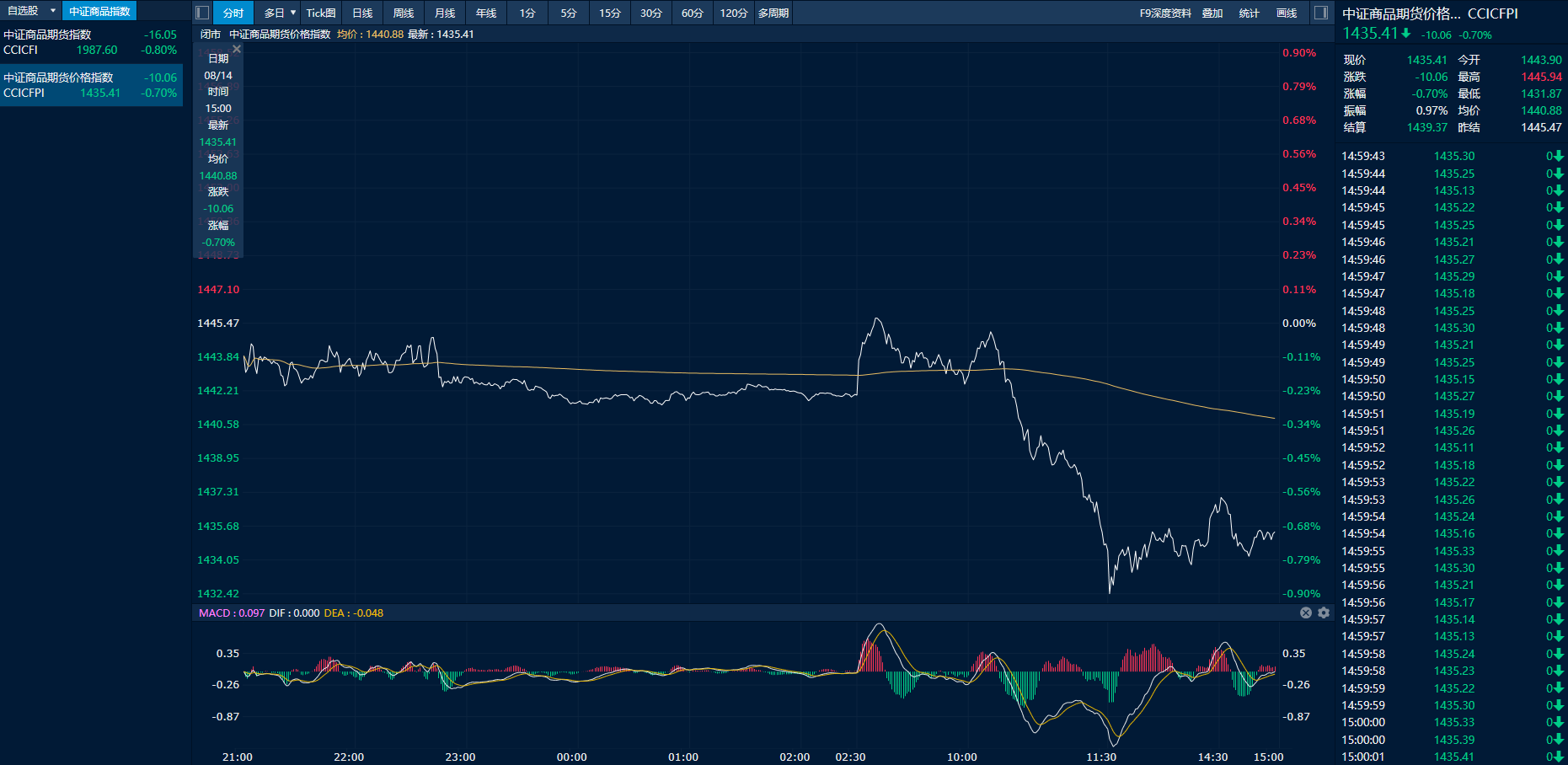
Group 1: Market Overview - The domestic commodity market experienced widespread declines on August 14, with coking coal dropping over 6% and coke falling over 4% [1][2] - The China Securities Commodity Futures Price Index closed at 1435.41 points, down 10.06 points or 0.7% from the previous trading day [1] - The China Securities Commodity Futures Index closed at 1987.6 points, down 16.05 points or 0.8% from the previous trading day [1] Group 2: Coking Coal and Coke Market - Coking coal saw a significant drop, with prices falling over 6% after a brief dip of over 7% during the trading session [2] - Supply-side factors such as coal mine production inspections and the implementation of the 276 work system continue to disrupt market sentiment, limiting capacity release [2] - The daily customs clearance at the Mengkou port has recovered to over 1300 vehicles, alleviating some supply pressure [2] Group 3: Multi-Crystalline Silicon Market - Multi-crystalline silicon futures fell over 3%, with market dynamics expected to alternate between fundamental logic and "anti-involution" logic in the second half of the year [3] - Fluctuations in electricity prices will directly impact production costs, affecting the price center of multi-crystalline silicon [3] - The demand side has seen limited growth expectations due to the early consumption of market demand during the first half of the year [3] Group 4: Alkali and LPG Market - Caustic soda was one of the few industrial products to rise, increasing by 1.69% due to limited supply pressure from maintenance and unstarted production lines [4] - The average utilization rate of caustic soda production capacity decreased by 1 percentage point to 84.1% [4] - LPG prices rose for the fourth consecutive day, supported by a decrease in port arrivals and a recovery in demand from propane deep processing [6]

能源化工期权策略早报-20250814
Wu Kuang Qi Huo· 2025-08-14 02:25
1. Report Industry Investment Rating No relevant content provided. 2. Core Viewpoints of the Report - The energy - chemical sector is divided into energy, alcohols, polyolefins, rubber, polyesters, alkalis, and others [9]. - Strategies mainly involve constructing option combination strategies dominated by sellers and spot hedging or covered strategies to enhance returns [3]. 3. Summary by Related Catalogs 3.1 Futures Market Overview - Multiple energy - chemical futures are presented, including their latest prices, price changes, trading volumes, and open interest changes. For example, the latest price of crude oil (SC2510) is 486, down 5 with a decline of 0.92%, trading volume of 4.09 million lots, and open interest of 3.09 million lots [4]. 3.2 Option Factors 3.2.1 Volume and Open Interest PCR - Volume and open interest PCR data for various energy - chemical options are provided, which are used to describe the strength of the option underlying market and potential turning points. For instance, the volume PCR of crude oil options is 0.71, with a change of - 0.05, and the open interest PCR is 0.72, with a change of 0.14 [5]. 3.2.2 Pressure and Support Levels - Pressure and support levels for different energy - chemical options are analyzed from the perspective of the strike prices with the largest call and put option open interest. For example, the pressure level of crude oil options is 600, and the support level is 450 [6]. 3.2.3 Implied Volatility - Implied volatility data for various energy - chemical options are given, including at - the - money implied volatility, weighted implied volatility, and the difference between implied and historical volatility. For example, the at - the - money implied volatility of crude oil options is 26.505%, and the weighted implied volatility is 30.72%, down 1.56% [7]. 3.3 Option Strategies and Recommendations 3.3.1 Energy - related Options - **Crude Oil**: Fundamental analysis shows a decrease in US crude oil inventories. The market is in a short - term upward -受阻 and downward - trending state. Option strategies include constructing a neutral call + put option selling combination strategy and a long collar strategy for spot hedging [8]. - **LPG**: Factory inventories are high, and the market is in a short - term bearish state. Strategies involve constructing a bearish spread strategy for put options, a short - biased call + put option selling combination strategy, and a long collar strategy for spot hedging [10]. 3.3.2 Alcohol - related Options - **Methanol**: Production and import data are presented. The market is in a weak state. Strategies include a short - biased call + put option selling combination strategy and a long collar strategy for spot hedging [10]. - **Ethylene Glycol**: Inventory has decreased. The market is in a weak and volatile state. Strategies include a short - volatility strategy and a long collar strategy for spot hedging [11]. 3.3.3 Polyolefin - related Options - **Polypropylene**: Inventory is expected to decrease. The market is in a weak state. Strategies include a long collar strategy for spot hedging [12]. 3.3.4 Rubber - related Options - **Rubber**: Import volume has increased. The market is in a short - term weak state. Strategies include a neutral call + put option selling combination strategy [13]. 3.3.5 Polyester - related Options - **PTA**: Inventory has decreased, but filament has accumulated. The market is in a weak and volatile state. Strategies include a neutral call + put option selling combination strategy [14]. 3.3.6 Alkali - related Options - **Caustic Soda**: Production is high, and demand is low. The market is in a state of rebound. Strategies include a long collar strategy for spot hedging [15]. - **Soda Ash**: Inventory and production data are presented. The market is in a volatile state. Strategies include a short - volatility combination strategy and a long collar strategy for spot hedging [15]. 3.3.7 Other Options - **Urea**: Inventory has decreased. The market is in a low - level volatile state. Strategies include a short - biased call + put option selling combination strategy and a long collar strategy for spot hedging [16]. 3.4 Option Charts - Charts for various energy - chemical options are provided, including price trends, trading volume, open interest, PCR, implied volatility, and historical volatility cones, which help in analyzing the market conditions of different options [18][37][55] etc.
能源化工期权策略早报-20250813
Wu Kuang Qi Huo· 2025-08-13 01:51
1. Report Industry Investment Rating - Not provided in the document 2. Core Viewpoints of the Report - The energy - chemical sector is divided into energy, alcohols, polyolefins, rubber, polyesters, alkalis, and others. Option strategies and suggestions are provided for selected varieties in each sector. Strategies mainly involve constructing option combinations with sellers as the main body and spot hedging or covered strategies to enhance returns [2][8] 3. Summary by Relevant Catalogs 3.1 Futures Market Overview - The document presents the latest prices, price changes, price change rates, trading volumes, volume changes, open interests, and open interest changes of various energy - chemical option underlying futures contracts, including crude oil, LPG, methanol, etc. [3] 3.2 Option Factor - Volume and Open Interest PCR - Volume PCR and open interest PCR are used to describe the strength of the option underlying market and the turning point of the underlying market. The document provides the volume, volume change, open interest, open interest change, volume PCR, volume PCR change, open interest PCR, and open interest PCR change of various energy - chemical options [4] 3.3 Option Factor - Pressure and Support Levels - The pressure and support levels of the option underlying are determined from the exercise prices with the largest open interest of call and put options. The document provides the pressure points, pressure point offsets, support points, support point offsets, maximum call open interest, and maximum put open interest of various energy - chemical options [5] 3.4 Option Factor - Implied Volatility - The document provides the at - the - money implied volatility, weighted implied volatility, weighted implied volatility change, annual average implied volatility, call implied volatility, put implied volatility, 20 - day historical volatility, and the difference between implied and historical volatility of various energy - chemical options [6] 3.5 Option Strategies and Suggestions 3.5.1 Energy - related Options - **Crude Oil**: Fundamentally, US crude oil inventories decreased last week. The market is in a short - term upward - blocked and downward - adjusted state. Option strategies include constructing a neutral call + put option combination strategy for volatility, and a long collar strategy for spot hedging [7] - **LPG**: Factory inventories are high, and port inventories are in a high - level shock. The market is short - term bearish. Strategies include constructing a bearish spread strategy for direction, a short - biased call + put option combination strategy for volatility, and a long collar strategy for spot hedging [9] 3.5.2 Alcohol - related Options - **Methanol**: Production and capacity utilization are expected to rise, and imports are estimated. The market is in a weak state with pressure above. Strategies include constructing a short - biased call + put option combination strategy for volatility, and a long collar strategy for spot hedging [9] - **Ethylene Glycol**: East China main port inventories have decreased significantly. The market is in a weak and wide - range shock state. Strategies include constructing a short - volatility strategy for volatility, and a long collar strategy for spot hedging [10] 3.5.3 Polyolefin - related Options - **Polypropylene**: Production enterprise inventories are expected to decline. The market is in a weak state with bearish pressure above. Strategies include a long collar strategy for spot hedging [11] 3.5.4 Rubber - related Options - **Rubber**: Imports have increased. The market is in a short - term weak state with pressure above. Strategies include constructing a neutral call + put option combination strategy for volatility [12] 3.5.5 Polyester - related Options - **PTA**: Industry inventories have decreased, but filament inventories have increased. The market is in a weak consolidation state with pressure above. Strategies include constructing a neutral call + put option combination strategy for volatility [13] 3.5.6 Alkali - related Options - **Caustic Soda**: Enterprises have high operating rates, and it is in the off - season of demand. The market is in a weak shock state with pressure above. Strategies include a long collar strategy for spot hedging [14] - **Soda Ash**: Domestic inventories and production have increased. The market is in a shock state with support below. Strategies include constructing a short - volatility combination strategy for volatility, and a long collar strategy for spot hedging [14] 3.5.7 Other Options - **Urea**: Enterprise inventories have decreased slightly. The market is in a low - level shock state. Strategies include constructing a short - biased call + put option combination strategy for volatility, and a long collar strategy for spot hedging [15]
能源化工期权策略早报-20250812
Wu Kuang Qi Huo· 2025-08-12 02:20
1. Report Industry Investment Rating - Not provided in the given content 2. Core Viewpoints of the Report - The energy - chemical sector is divided into energy, alcohols, polyolefins, rubber, polyesters, alkalis, and others. Strategies mainly involve constructing option combination strategies with sellers as the main body and spot hedging or covered strategies to enhance returns [3][9]. 3. Summary by Related Catalogs 3.1. Market Overview of Underlying Futures - Various energy - chemical option underlying futures have different price changes, trading volumes, and open interest changes. For example, the latest price of crude oil (SC2510) is 492, with a rise of 2 and a rise - fall rate of 0.33%, and the trading volume is 4.87 million lots with a change of 1.58 million lots [4]. 3.2. Option Factors - Volume and Open Interest PCR - Different option varieties have different volume and open interest PCR values and their changes. For instance, the volume PCR of crude oil is 0.88 with a change of 0.07, and the open interest PCR is 0.52 with a change of 0.01 [5]. 3.3. Option Factors - Pressure and Support Levels - From the perspective of option factors, different option varieties have corresponding pressure and support levels. For example, the pressure level of crude oil is 550 and the support level is 480 [6]. 3.4. Option Factors - Implied Volatility - Each option variety has different implied volatility indicators such as at - the - money implied volatility, weighted implied volatility, etc. For example, the at - the - money implied volatility of crude oil is 27.72%, and the weighted implied volatility is 34.76% with a change of - 3.41% [7]. 3.5. Option Strategies and Suggestions 3.5.1. Energy - related Options - **Crude Oil**: The fundamental situation shows a decrease in US crude oil inventory. The market shows short - term weakness after an attempt to rebound. Option strategies include constructing a short - neutral call + put option combination strategy and a long collar strategy for spot hedging [8]. - **LPG**: Factory and port inventories are at relatively high levels, and the market is short - term bearish. Strategies include constructing a bearish spread strategy for put options, a short - bearish call + put option combination strategy, and a long collar strategy for spot hedging [10]. 3.5.2. Alcohol - related Options - **Methanol**: Production and import data are given, and the market is in a weak state. Strategies include constructing a short - bearish call + put option combination strategy and a long collar strategy for spot hedging [10]. - **Ethylene Glycol**: The inventory in the main port in East China has decreased. The market shows a wide - range weak oscillation. Strategies include constructing a short - volatility strategy and a long collar strategy for spot hedging [11]. 3.5.3. Polyolefin - related Options - **Polypropylene**: The inventory of production enterprises is expected to change. The market is in a weak state. The strategy is to hold a long spot + buy an at - the - money put option + sell an out - of - the - money call option for spot hedging [12]. 3.5.4. Rubber - related Options - **Rubber**: The import volume has increased. The market shows short - term weakness. Strategies include constructing a short - neutral call + put option combination strategy [13]. 3.5.5. Polyester - related Options - **PTA**: The industry inventory has decreased, but the filament inventory has increased. The market is in a weak consolidation state. Strategies include constructing a short - neutral call + put option combination strategy [14]. 3.5.6. Alkali - related Options - **Caustic Soda**: The enterprise's production is high, and it is in the off - season of demand. The market shows a weak oscillation. The strategy is to construct a long collar strategy for spot hedging [15]. - **Soda Ash**: The inventory and production data are given, and the market is in a weak and bearish state. Strategies include constructing a short - volatility combination strategy and a long collar strategy for spot hedging [15]. 3.5.7. Other Options - **Urea**: The enterprise inventory has decreased slightly. The market shows a low - level oscillation. Strategies include constructing a short - bearish call + put option combination strategy and a long collar strategy for spot hedging [16].
能源化工期权策略早报-20250811
Wu Kuang Qi Huo· 2025-08-11 01:21
1. Report Industry Investment Rating No relevant content provided. 2. Core Viewpoints - The energy - chemical sector is mainly divided into energy, alcohols, polyolefins, rubber, polyesters, alkalis, and others. For each sector, options strategies and suggestions are provided for selected varieties. Each option variety's strategy report includes analysis of the underlying market, research on option factors, and option strategy suggestions [9]. - It is recommended to construct option portfolio strategies mainly as sellers, along with spot hedging or covered strategies to enhance returns [3]. 3. Summary by Relevant Catalogs 3.1 Futures Market Overview - The report presents the latest prices, price changes, price change percentages, trading volumes, volume changes, open interests, and open interest changes of various energy - chemical option underlying futures contracts, such as crude oil, liquefied petroleum gas (LPG), methanol, etc. [4]. 3.2 Option Factors 3.2.1 Volume - to - Open - Interest PCR - It shows the trading volume, volume change, open interest, open interest change, volume PCR, volume PCR change, open interest PCR, and open interest PCR change of various option varieties. Volume PCR is used to describe whether the underlying market has a turning point, and open interest PCR is used to describe the strength of the underlying option market [5]. 3.2.2 Pressure and Support Levels - The pressure points, pressure point offsets, support points, support point offsets, maximum call option positions, and maximum put option positions of various option varieties are provided. These are determined from the strike prices of the maximum call and put option positions [6]. 3.2.3 Implied Volatility - The report shows the at - the - money implied volatility, weighted implied volatility, weighted implied volatility change, annual average implied volatility, call option implied volatility, put option implied volatility, 20 - day historical volatility, and the difference between implied and historical volatility for each option variety [7]. 3.3 Option Strategies and Suggestions 3.3.1 Energy - related Options - **Crude Oil**: The U.S. crude oil inventory decreased last week. The market showed a short - term upward rebound受阻 pattern with pressure above. The implied volatility of crude oil options fluctuates around the mean. The open interest PCR indicates a weak - oscillating market. Strategies include constructing a neutral call + put option selling portfolio, and a long collar strategy for spot hedging [8]. - **LPG**: Factory inventories decreased slightly, while port inventories are at a high level and oscillating. The market is short - term bearish. The implied volatility of LPG options is at a relatively high historical level. The open interest PCR indicates strong bearish power. Strategies include a bearish put option spread, a bearish call + put option selling portfolio, and a long collar strategy for spot hedging [10]. 3.3.2 Alcohol - related Options - **Methanol**: China's methanol production and capacity utilization are expected to increase, and import volumes are estimated. The market shows a weak pattern with pressure above. The implied volatility of methanol options is falling and fluctuating below the mean. The open interest PCR indicates a weak - oscillating market. Strategies include a bearish call + put option selling portfolio and a long collar strategy for spot hedging [10]. - **Ethylene Glycol**: The inventory in East China's main ports decreased significantly. The market shows a weak and wide - range oscillating pattern with pressure above. The implied volatility of ethylene glycol options fluctuates around the lower - than - mean level. The open interest PCR indicates an oscillating market. Strategies include a volatility - selling strategy and a long collar strategy for spot hedging [11]. 3.3.3 Polyolefin - related Options - **Polypropylene**: The inventory of polyethylene and polypropylene production enterprises is expected to change. The market shows a weak pattern with bearish pressure above. The implied volatility of polypropylene options fluctuates around the historical mean. The open interest PCR indicates a weakening trend. Strategies include a long collar strategy for spot hedging [12]. 3.3.4 Rubber - related Options - **Rubber**: The import volume of natural and synthetic rubber in July increased. The market shows a short - term weak pattern with pressure above. The implied volatility of rubber options first rises sharply and then falls to around the mean. The open interest PCR indicates a weak market. Strategies include a neutral call + put option selling portfolio [13]. 3.3.5 Polyester - related Options - **PTA**: The industry inventory has decreased, but there is inventory accumulation in finished filament. The market shows a weak - oscillating pattern with pressure above. The implied volatility of PTA options fluctuates at a relatively high level above the mean. The open interest PCR indicates a weakening trend. Strategies include a neutral call + put option selling portfolio [14]. 3.3.6 Alkali - related Options - **Caustic Soda**: Enterprises have high production starts, but it is the off - season for demand, and export orders are few. The market shows a weak - oscillating pattern with pressure above. The implied volatility of caustic soda options first rises sharply and then falls but remains at a high level. The open interest PCR indicates strong bearish pressure. Strategies include a long collar strategy for spot hedging [15]. - **Soda Ash**: The total inventory of domestic soda ash manufacturers is high, and production has increased. The market shows a weak - bearish pattern. The implied volatility of soda ash options first rises sharply and then falls but remains at a high level. The open interest PCR indicates strong bearish pressure. Strategies include a volatility - selling portfolio and a long collar strategy for spot hedging [15]. 3.3.7 Other Options - **Urea**: The total inventory of urea enterprises has decreased. The market shows a low - level oscillating pattern. The implied volatility of urea options fluctuates slightly around the historical mean. The open interest PCR indicates strong bearish pressure. Strategies include a bearish call + put option selling portfolio and a long collar strategy for spot hedging [16].