电子代工

Search documents
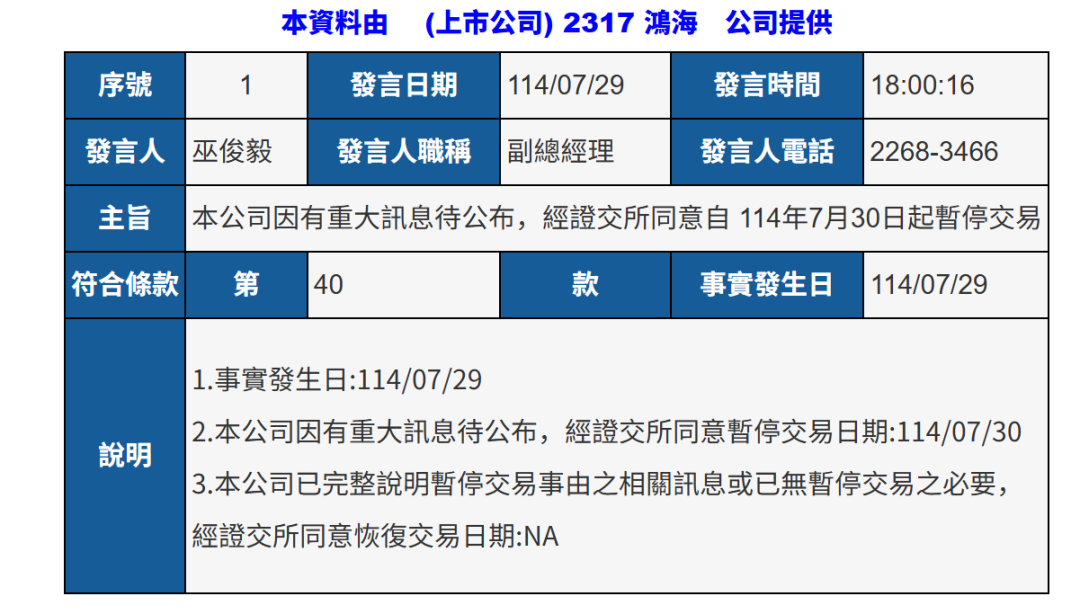
突发!富士康母公司暂停交易
中国基金报· 2025-07-29 22:46
Core Viewpoint - Hon Hai Precision Industry and Dong Yuan Electric will suspend trading due to significant news pending disclosure, with trading resuming after the information is made public [2][5]. Group 1: Company Announcements - Hon Hai Precision Industry announced the suspension of trading for its common stock and warrants starting July 30, 2023, due to significant news pending disclosure [3]. - Dong Yuan Electric also issued a similar announcement regarding the suspension of trading effective July 30, 2023, for the same reason [6]. Group 2: Market Speculation - Market insiders suggest that both companies may announce an important collaboration or acquisition plan after July 30, 2023 [6]. Group 3: Company Profiles - Dong Yuan Electric, established in 1956, is the third-largest industrial motor supplier globally, with a market capitalization of approximately NT$99.2 billion as of July 29, 2023 [7][8]. - Hon Hai Precision Industry, founded in 1974, is the largest and fastest-growing international group in the 3C (computer, communication, consumer electronics) manufacturing sector, with a market capitalization of about NT$2.38 trillion as of July 29, 2023 [10].


突发!富士康母公司暂停交易
Zhong Guo Ji Jin Bao· 2025-07-29 16:23
Group 1 - Hon Hai Precision Industry (Foxconn) has announced a trading suspension for its common stock and warrants starting July 30 due to significant news pending disclosure [1][2] - The Taiwan Stock Exchange has approved the trading suspension, and the resumption of trading will occur after the information is made public [2] - Another company, TECO Electric and Machinery, has issued a similar trading suspension announcement [4] Group 2 - Market sources suggest that both companies may announce an important collaboration or merger plan after July 30 [4] - TECO Electric, established in 1956, is the third-largest industrial motor supplier globally, with a market capitalization of approximately NT$99.2 billion as of July 29 [5] - Hon Hai Precision, founded in 1974, is the largest and fastest-growing international group in the 3C (computer, communication, consumer electronics) manufacturing sector, with a market capitalization of about NT$2.38 trillion as of July 29 [7]
华勤技术拟约24亿元入股晶合集成,牵手晶圆代工新锐能否搅动产业链格局?
Mei Ri Jing Ji Xin Wen· 2025-07-29 13:28
一个是手机、笔记本、服务器代工巨头,一个是冲进全球前十的晶圆代工新锐。华勤技术 (603296.SH,股价85.78元,市值871.31亿元)市值超870亿元,晶合集成(688249.SH,股价22.23元, 市值445.96亿元)市值约446亿元,两者"牵手",能否搅动产业链格局? 华勤技术承诺通过本次协议转让取得的晶合集成股份,以长期投资为目的,自交割日起36个月内不对外 转让。 7月29日晚间,华勤技术、晶合集成双双披露公告称,华勤技术与晶合集成股东力晶创投签署《股权转 让协议》,力晶创投拟将其持有的晶合集成6%股份转让给华勤技术,转让总价款为23.93亿元。本次股 份转让完成后,华勤技术将持有晶合集成6%股份,并将向其提名1名董事。记者注意到,当下,华勤技 术因代工英伟达H20服务器而广受市场追捧。两大巨头"牵手" 据了解,本次权益变动前,力晶创投持有晶合集成19.08%的股份,此次权益变动后,力晶创投将持有 晶合集成13.08%的股份,而华勤技术持有晶合集成6%股份。 封面图片来源:视觉中国-VCG211322973159 目前华勤技术市值大幅超过闻泰科技。截至7月29日收盘,华勤技术市值超870亿 ...


29省份半年报出炉,“中部第一省”或将易主
Mei Ri Jing Ji Xin Wen· 2025-07-24 16:31
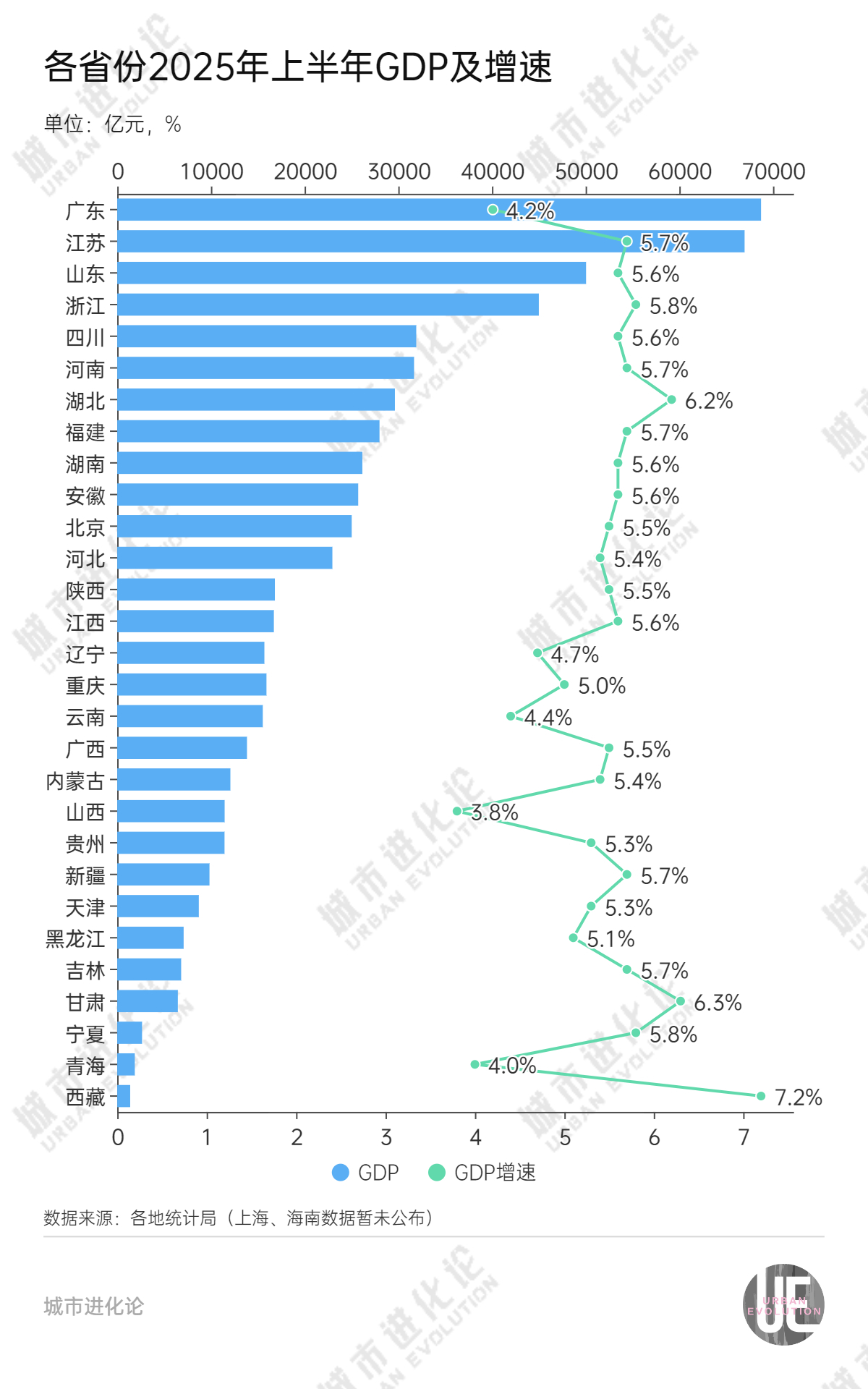
Economic Performance Overview - In the first half of the year, 22 out of 29 provinces reported GDP growth rates equal to or above the national average of 5.3%, while 7 provinces fell short [1] - Notable performers include Hubei with a GDP growth rate of 6.2%, ranking third among the reported provinces, following Tibet (7.2%) and Gansu (6.3%) [1][5] - Conversely, Shanxi reported the lowest GDP growth at 3.8%, and Guangdong's growth was below its target at 4.2% [1][8] Regional Highlights - Tibet's GDP growth of 7.2% is attributed to its low base, with a total GDP of 138.2 billion yuan, comparable to a medium-sized city [5] - Gansu's GDP reached 646.88 billion yuan, with a 6.3% growth, driven by a 10.2% increase in industrial output [5] - Hubei's GDP growth reflects a significant recovery, with a GDP increment of approximately 230 billion yuan, narrowing the gap with Henan [13][17] Investment and Trade Dynamics - Hubei's import-export volume surpassed 400 billion yuan, marking a 28.4% year-on-year increase, while its fixed asset investment growth outpaced the national average by 3.7 percentage points [17][19] - In contrast, Shanxi's foreign trade declined by 20.8%, and its fixed asset investment growth was only 1.4% [8] - Guangdong's real estate sector faced challenges, with a 16.3% drop in development investment, contributing to a 9.7% decline in overall fixed asset investment [22][25] Economic Goals and Future Outlook - Most provinces have met their mid-year economic growth targets, but several, including Guangdong and Yunnan, need to accelerate efforts in the second half to achieve annual goals [9] - Guangdong aims for a GDP growth of around 5% for the year, necessitating enhanced focus on investment, consumption, and exports [26][27]
重回盛夏的港股,与中国大公司“共舞”
财富FORTUNE· 2025-07-23 13:04
Core Viewpoint - The Hong Kong stock market is expected to transition from winter to spring in 2024 and then to summer in 2025, reflecting a significant recovery and growth potential, as evidenced by the 2025 Fortune China 500 rankings and the trend of Chinese companies seeking secondary listings in Hong Kong [1][2]. Group 1: Market Recovery and IPO Trends - The Hong Kong stock market has seen a resurgence in IPO activities, with the total fundraising amount reaching HKD 1,067 billion in the first half of 2024, surpassing the total for the entire previous year and marking the highest level since 2022 [2]. - The "A+H" dual listing trend has contributed significantly to the recovery of the Hong Kong market, with companies like CATL, Hengrui Medicine, and Haitian Flavor contributing nearly 70% of the fundraising in the first half of 2025 [2]. - The IPO of Lens Technology, which has established a strong partnership with Apple, highlights the strategic shift of companies towards diversification and innovation beyond their traditional markets [1][2]. Group 2: Company-Specific Developments - Lens Technology has seen a remarkable rise in the Fortune China 500 rankings, moving up 63 places, as it reduces its dependency on Apple and expands into emerging sectors such as smart vehicles and AI glasses [1]. - Seres, another company in the electric vehicle sector, has made significant strides by pivoting from fuel vehicles to electric vehicles, achieving a market capitalization exceeding RMB 200 billion and planning to list in Hong Kong [4]. - The strategic partnership between Seres and Huawei has allowed the company to penetrate the luxury market, showcasing a successful transformation from a struggling brand to a competitive player in the EV industry [4]. Group 3: Foreign Investment and Market Dynamics - Foreign investment in Hong Kong stocks has shown a reversal, with significant inflows into companies like Meituan, which has seen an 85% increase in stock price, indicating renewed confidence in Chinese assets [5]. - The competitive landscape in the food delivery sector is intensifying, with Meituan facing challenges from rivals like JD and Alibaba, necessitating a focus on maintaining market share despite potential short-term profit declines [5][6]. - The ongoing competition among major tech platforms raises concerns about resource allocation in the Chinese tech industry, as companies may become overly focused on short-term operational battles rather than long-term innovation [6][7].

数字孪生与工业互联网赋能工厂智能运维升级
Sou Hu Cai Jing· 2025-07-17 07:11
Core Insights - The integration of digital twin technology and industrial internet is revolutionizing factory operations and maintenance, shifting from passive response to proactive prevention, significantly enhancing operational efficiency and equipment reliability [1] Group 1: Real-time Monitoring and Predictive Maintenance - Real-time perception of equipment status is fundamental to intelligent maintenance, with sensors deployed on factory equipment continuously collecting operational parameters and transmitting them to digital twin systems [1] - Predictive maintenance is the core value of intelligent operations, with digital twin systems utilizing operational data and machine learning to accurately predict equipment failure times and locations [2] - A chemical plant's digital twin model improved fault detection rates to over 95% by enabling early identification of potential issues, thus preventing unplanned downtime [1] Group 2: Remote Operations and Collaborative Diagnosis - Remote operations and collaborative diagnosis eliminate spatial limitations, allowing experts to participate in maintenance diagnostics without being on-site [4] - A remote expert resolved a welding quality issue in a car manufacturing plant within 2 hours, a task that would typically take 1 day, by analyzing real-time data through the digital twin system [4] - This remote collaboration accelerates fault resolution and optimizes the sharing of technical resources across geographically dispersed factory clusters [4] Group 3: Spare Parts Management and Inventory Optimization - Spare parts management is enhanced through digital twin support, allowing for dynamic inventory management based on equipment failure patterns and maintenance history [4] - A mechanical processing plant's digital twin platform improved key spare parts inventory turnover by 40%, ensuring maintenance needs are met while reducing capital tied up in inventory [4] - The system also verifies spare parts compatibility before purchase, minimizing waste due to mismatched components [4] Group 4: Digital Reconstruction of Maintenance Processes - The digital reconstruction of maintenance processes through digital twin systems enhances overall efficiency by linking maintenance work orders, repair procedures, and equipment records to virtual models [5] - An electronic manufacturing plant achieved a 90% standardization rate in maintenance tasks, significantly reducing the processing time for maintenance work orders by 40% [5] - The accumulated maintenance data continuously optimizes the digital twin model's analytical capabilities, fostering a virtuous cycle of improved maintenance proficiency [5]

不留手,特朗普重税落下,菲律宾终于意识到不对劲,替美国卖命不会有好下场
Sou Hu Cai Jing· 2025-07-16 04:35
Core Viewpoint - The announcement by President Trump to impose a 20% tariff on Philippine products starting August 1, 2025, reveals the harsh reality for the Philippines, indicating that unwavering support for the U.S. does not guarantee favorable treatment, but rather leads to significant challenges for the nation [1][3]. Economic Impact - The Philippines' exports to the U.S. are concentrated in low to mid-end industries, with semiconductor components accounting for 35% of total exports, but with profit margins generally below 8% [4]. - The U.S. market absorbs nearly one-sixth of Philippine exports, with agricultural products like bananas and coconut oil having over 60% dependency on the U.S. market [4]. - The 20% tariff implies an additional cost of $3 for every $100 worth of exports, which poses a heavy burden on small and medium enterprises, potentially leading to a shift of orders to countries like Mexico and India [4]. - In 2024, the trade deficit with the U.S. reached $4.9 billion, a 21.8% increase from the previous year, highlighting the imbalance where imports from the U.S. far exceed exports [4]. Political Ramifications - The tariff imposition may weaken the Philippines' political support for the U.S., prompting the Philippine government to adopt more counterbalancing strategies in its foreign policy [6]. - Concerns have been raised by former U.S. officials that the tariffs could damage U.S.-Philippine relations and hinder America's ability to counter China in the Indo-Pacific region [6]. - The Philippines faces a dilemma of relying on U.S. security assurances in the South China Sea while grappling with the economic repercussions of the tariffs [6]. Strategic Considerations - The situation has led to a realization among Filipinos that aligning too closely with the U.S. may not yield the expected benefits and could result in becoming collateral damage in the larger geopolitical struggle [8]. - There is a call for the Philippines to adopt an independent foreign policy and seek diversified development to secure long-term national interests [8].

戏剧性的一幕发生,对美国马首是瞻的菲律宾,拿到的关税比谁都高
Sou Hu Cai Jing· 2025-07-13 05:44
Group 1: U.S. Tariff Policy - The U.S. President Trump announced new tariffs of 20% to 30% on six countries, including the Philippines, which has raised concerns due to its higher rate compared to many non-allied nations [1] - Trump's initial tariff on the Philippines was 17%, which he later increased to 20%, indicating a lack of leniency even towards allied nations [7] - The tariff imposition serves as a warning to countries that are compliant but have not made sufficient economic concessions, highlighting Trump's "America First" policy [7] Group 2: Philippines' Strategic Position - The Philippines has cooperated closely with U.S. foreign policy, including allowing the establishment of four additional U.S. military bases, totaling nine, to enhance military presence in the Indo-Pacific region [3] - Despite military cooperation, the Philippines faces challenges as its low-cost manufacturing base primarily focuses on labor-intensive products, which are easily replaceable [8] - The situation serves as a cautionary tale for other ASEAN countries, suggesting that those who are overly compliant may face harsher treatment from the U.S. [8][10] Group 3: Economic Implications - The trade deficit and economic dynamics between the U.S. and the Philippines have led to Trump's perception that the Philippines benefits from U.S. support without adequate economic contributions [7] - The potential for industries in the Philippines to relocate to countries more willing to negotiate with the U.S. could result in significant economic losses for the Philippines [8] - The case of the Philippines illustrates the need for ASEAN countries to reassess their strategic alliances and understand the implications of their loyalty to the U.S. [10]

鸿海二季报符合市场预期,AI服务器需求强劲
Hua Er Jie Jian Wen· 2025-07-06 03:44
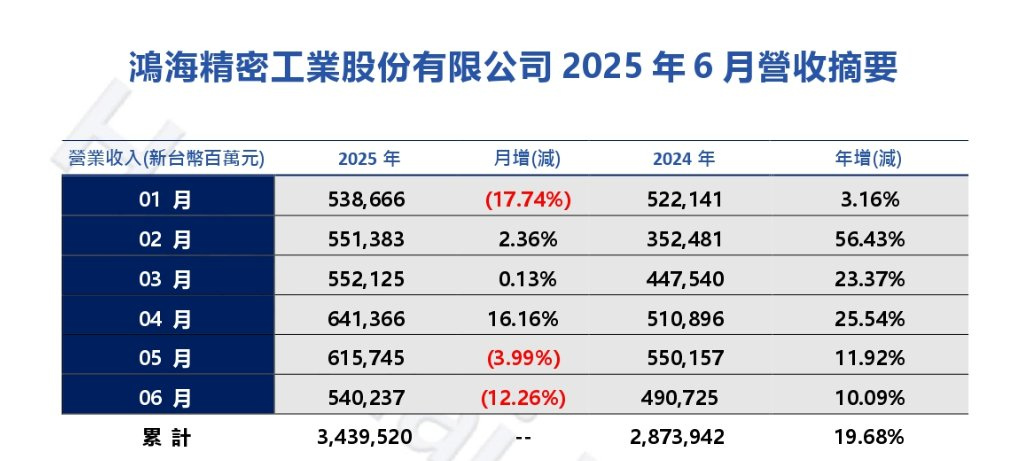
Core Viewpoint - Hon Hai Precision Industry's revenue growth in Q2 is driven by strong demand for AI servers and iPhones, with a year-on-year increase of 15.8%, reaching NT$1.8 trillion, and expectations for continued growth in the next quarter [1]. Group 1: Financial Performance - In Q2, Hon Hai's revenue reached NT$1.8 trillion, marking a 15.8% year-on-year increase, aligning with market expectations [1]. - Cumulative revenue for the first half of 2025 is NT$3.44 trillion, reflecting a 19.68% year-on-year growth compared to NT$2.87 trillion in the same period of 2024 [2]. Group 2: Business Segments - The AI server segment benefits from stable spending by cloud service providers, contributing to a robust order base for Hon Hai [3]. - The iPhone segment sees increased production orders due to anticipated tariff impacts, leading to heightened demand for expedited deliveries [3]. - Apple's performance in the Chinese market supports Hon Hai's revenue growth, with a reported 8% increase in iPhone sales in Q2 driven by strong demand for the iPhone 16 Pro and Pro Max models [3]. Group 3: Market Outlook - Analysts predict that the AI supply chain will continue to experience strong growth, providing stable orders for contract manufacturers like Hon Hai as major cloud service providers increase their AI-related investments [3]. - Despite the positive outlook, geopolitical uncertainties pose challenges for Hon Hai, leading to a downward adjustment of the annual revenue guidance in May [2].
本科毕业后,我进厂打工
36氪· 2025-06-24 23:59
Core Viewpoint - The article highlights the changing landscape of employment for recent graduates in China, where many are opting for factory jobs instead of traditional corporate roles, reflecting a shift in attitudes towards work and economic necessity [4][5][6]. Group 1: Employment Trends - An increasing number of young graduates are entering manufacturing jobs directly after graduation, with many sharing their experiences on social media platforms like Xiaohongshu, where related posts exceed 5.15 million [5]. - The average salary for factory jobs, particularly in electronics, is around 5,000 to 6,000 yuan per month, which is seen as a viable option for many graduates [5][20]. - Graduates express mixed feelings about factory work; some view it as a necessary step to save money, while others warn against the potential long-term implications of such a choice [6][20]. Group 2: Personal Experiences - Individuals like Wang Liuliu, a master's graduate, describe the stark contrast between their educational aspirations and the reality of working in a factory, often feeling a sense of loss regarding their academic achievements [9][12]. - Su Hong, who transitioned from a high-pressure job in foreign trade to a factory role, emphasizes the mental relief and financial stability that factory work can provide, despite the physical demands [15][20]. - He Yu, another factory worker, shares the emotional toll of factory life, including feelings of exhaustion and the struggle to maintain a sense of purpose amidst monotonous tasks [26][36]. Group 3: Economic Necessity - The article illustrates how economic pressures drive graduates to accept factory jobs, often as a last resort when other employment opportunities are scarce [27][33]. - Many workers report that factory jobs offer a straightforward way to earn money without the complexities of corporate environments, which can be fraught with competition and stress [15][20]. - The narrative suggests that for some, factory work serves as a temporary solution while they seek better opportunities, highlighting a pragmatic approach to employment in challenging economic conditions [40].