
自动驾驶出租车

Search documents
够智能?安全?方便?实测3家头部Robotaxi:有人苦等1小时无车接单
Di Yi Cai Jing Zi Xun· 2025-08-15 06:26
Core Insights - The recent activities of "Wooden Sister" and notable institutions short-selling have brought Robotaxi services back into the spotlight, highlighting their growing attention from global capital and the public [2] Group 1: Robotaxi Experience in Shanghai - The experience with Xiaoma Zhixing's Robotaxi in Shanghai involved a wait time of two minutes despite being first in line, with a total journey of 6.4 km costing 23.1 yuan [3][4] - Passengers must complete safety prompts, including phone verification and seatbelt fastening, before the vehicle can start, and the driving process was described as smooth with appropriate signaling for lane changes [4][5] Group 2: Robotaxi Experience in Beijing - In Beijing, the experience with WeRide's Robotaxi covered a distance of 5.2 km in 13 minutes, with a fare of 13.05 yuan after discounts [6][8] - The vehicle provided real-time updates on journey status and required passengers to fasten seatbelts before departure, demonstrating a smooth driving experience without abrupt stops [7][8] Group 3: Robotaxi Experience in Guangzhou - In contrast, the experience with Luobo Kuaipao's Robotaxi in Guangzhou was disappointing, with a wait time exceeding one hour without a vehicle being dispatched, attributed to a lack of available cars [9] - Local residents noted a decline in the visibility of Luobo Kuaipao vehicles compared to the previous year, indicating potential operational challenges for the company [9]

第一财经记者三地实探:文远、萝卜、小马的Robotaxi都进化了吗?
Di Yi Cai Jing· 2025-08-15 03:48
Core Insights - The recent focus on Robotaxi services has been heightened by significant investments and short-selling activities, drawing attention from both global capital and the public [1] Group 1: Shanghai Xiaoma Zhixing - The Robotaxi service in Shanghai demonstrated a smooth driving experience, with a total journey of 6.4 kilometers costing 23.1 yuan [2][3] - Passengers must complete safety prompts, including phone verification and seatbelt fastening, before the vehicle can start [2] - The vehicle provides real-time updates on surrounding traffic and journey progress through screens in the back seat [2] Group 2: Beijing Wenyuan Zhixing - In Beijing, the Robotaxi service covered a distance of 5.2 kilometers in 13 minutes, with an estimated fare of 13.05 yuan after discounts [4][5] - The service allows for vehicle tracking and provides safety prompts, including a requirement to fasten seatbelts before departure [5] - The vehicle effectively navigated complex situations, such as avoiding cyclists and handling traffic lights smoothly [6] Group 3: Guangzhou Luobo Kuai Pao - In Guangzhou, the Robotaxi service faced significant operational challenges, with a reported wait time of over one hour without a vehicle being dispatched [7] - Customer feedback indicated dissatisfaction with the service's availability, as residents noted a decline in visible Robotaxi vehicles compared to the previous year [7] - The company’s customer service cited dynamic adjustments in vehicle availability as a reason for the delays [7]
又一家大行力挺!瑞银:中国Robotaxi处于大规模部署前夜,领先企业有望2026年实现“单车盈利”
Hua Er Jie Jian Wen· 2025-08-05 02:22
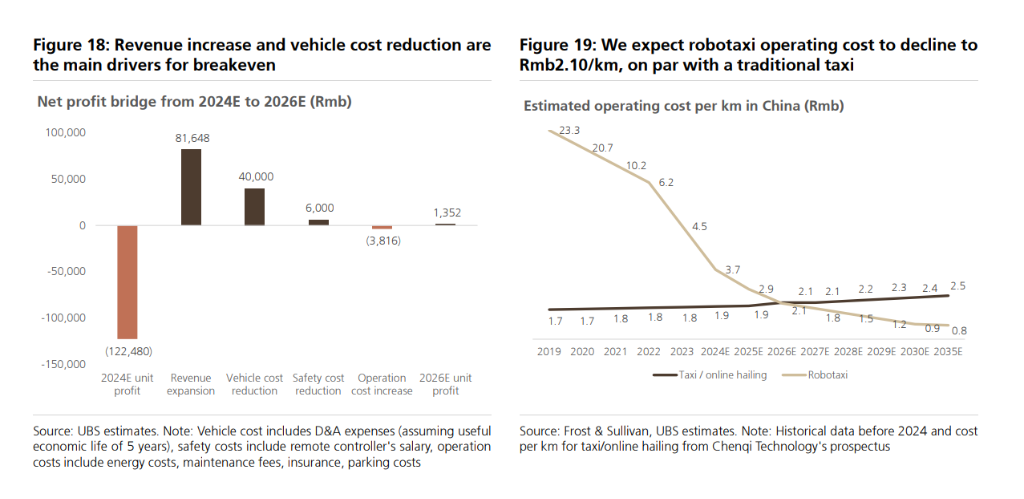
自动驾驶出租车(Robotaxi)——这个曾经只存在于科幻电影中的概念,正以前所未有的速度驶入中国的城市街道。 据追风交易台消息,瑞银(UBS)在最新发布的报告中明确指出,中国Robotaxi行业正处于大规模商业化部署的前夜,一个价值数千亿美元的庞大市场即 将被激活。随着技术成熟、成本下降和法规放开,行业即将迎来一个重要的里程碑。 一个近4000亿美元的庞大市场正在开启 瑞银在报告中描绘了一幅宏伟的蓝图。报告预测,到本世纪30年代后期,中国Robotaxi服务市场的潜在规模(TAM)将达到1830亿美元,届时全国将有约 400万辆Robotaxi投入运营。 放眼全球,前景更为广阔。如果将除美国以外的海外市场计算在内,这一市场的潜在规模将跃升至3940亿美元,运营车辆总数将达到600万辆(中国市场 以外为200万辆)。 瑞银认为,这一增长路径将分阶段实现。在2030年代初,仅中国一线城市(北京、上海、广州、深圳)就有望部署30万辆Robotaxi。这一判断基于对纽约 曼哈顿数据的模拟分析:一个面积60平方公里的曼哈顿需要4500辆Robotaxi覆盖,而中国四大一线城市的核心城区面积超过3000平方公里,需求潜 ...
特斯拉Robotaxi启用里程计费:11英里约13.7美元,较Uber更具价格优势
Sou Hu Cai Jing· 2025-07-31 03:47
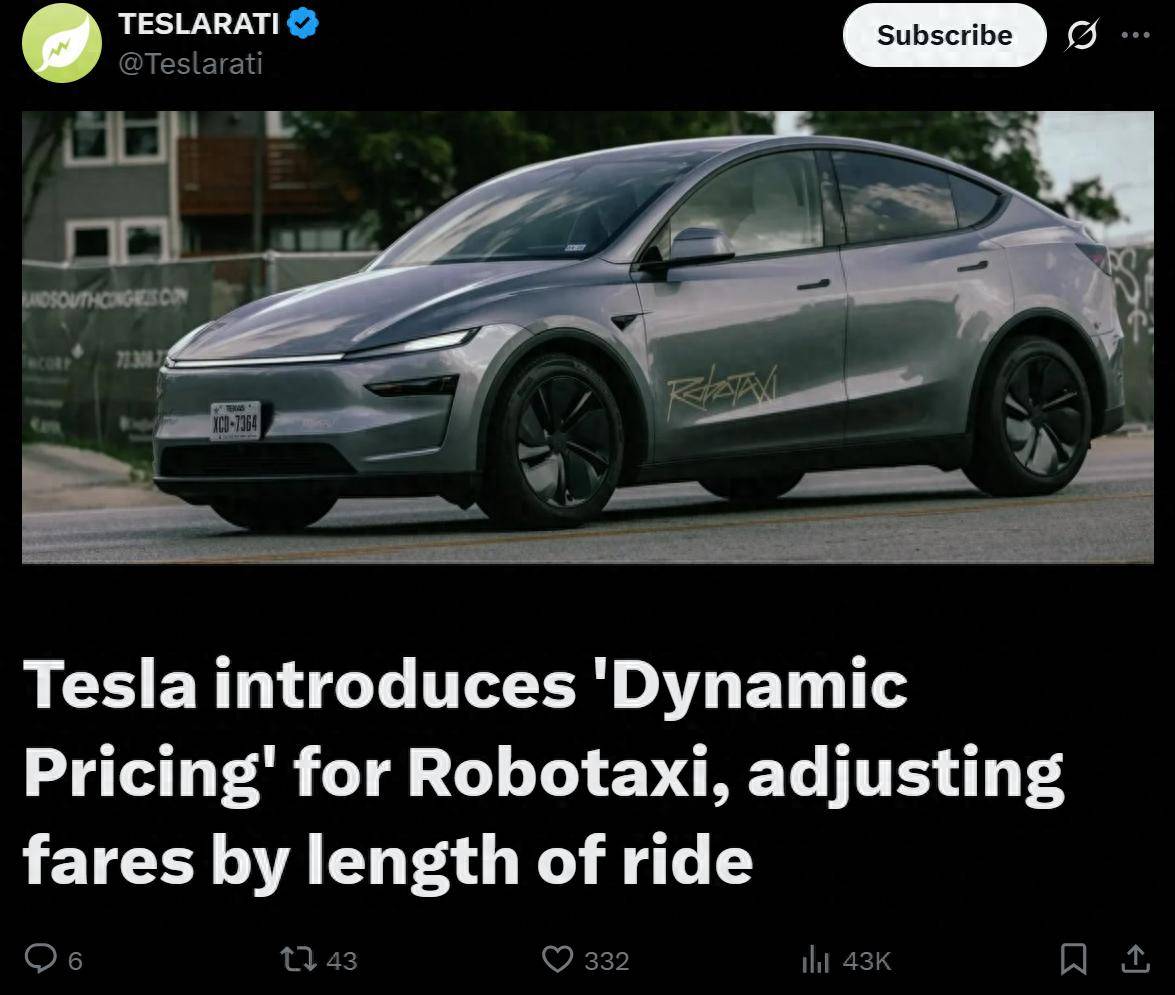
Core Insights - Tesla has adjusted its Robotaxi pricing strategy in Austin, shifting from a fixed fee to a dynamic pricing model based on mileage, offering competitive rates compared to Uber's similar services [1][3]. Pricing Strategy - Initially, the Robotaxi service charged a fixed fee of $4.20 per trip when launched in late June, regardless of distance or time [3]. - The fare was later increased to $6.90 per trip as the service area expanded [3]. - The latest update introduces a dynamic pricing model, where shorter trips are charged less and longer trips more, with an example fare of approximately $13.70 for an 11-mile (17.7 km) trip, compared to over $16 for the same route via Uber [3]. Service Expansion - Tesla's CEO Elon Musk announced plans to expand the Robotaxi service to California in the coming weeks and further extend the service area in Austin [4]. - The service area in Austin has already been expanded, with expectations for significant growth in coverage that will surpass competitors [4].

高盛:自动驾驶出租车商业化推进 车队规模有望扩大
智通财经网· 2025-07-31 03:21
Group 1 - Goldman Sachs expresses a positive outlook on the expansion of commercial autonomous taxi services in Shanghai, where licensed operators can provide fully driverless taxi services to the public in designated areas and charge fees [1] - The development of the autonomous taxi industry will be supported by continuous technological advancements, decreasing material costs due to large-scale deployment, and the expansion of the ecosystem among operators, original equipment manufacturers (OEMs), and asset owners [1] - During the World Artificial Intelligence Conference (WAIC) held in July 2025, Shanghai issued demonstration operation licenses for intelligent connected vehicles to companies such as Pony.ai, Baidu Group, WeRide, Jinjiang Taxi, Dazhong Transportation, and SAIC Motor [1]
特斯拉 Robotaxi 开始按行驶里程计费:11 英里约 13.7 美元
Sou Hu Cai Jing· 2025-07-30 15:21
Group 1 - Tesla has implemented a new pricing strategy for its Robotaxi service in Austin, marking the second modification to its fare structure since the service launched [1][3] - Initially, the fare for a Robotaxi ride was fixed at $4.20, regardless of distance or time, but it was later increased to $6.90 after expanding the service area [3] - The latest update introduces a "dynamic pricing" model, where fares will vary based on the length of the trip, with shorter rides costing less and longer rides costing more [3] Group 2 - The estimated fare for a trip from one end of the Robotaxi service area to the other is approximately $13.70 for a distance of about 11 miles, which is cheaper than Uber's fare of over $16 for the same route [5] - Elon Musk announced plans to expand the Robotaxi service to California in the coming weeks and to further increase the service area in Austin within a week [13]
中国Robotaxi市场:渗透率将高速增长,单车运营接近盈亏平衡,激光雷达是降本核心
Hua Er Jie Jian Wen· 2025-07-30 03:54
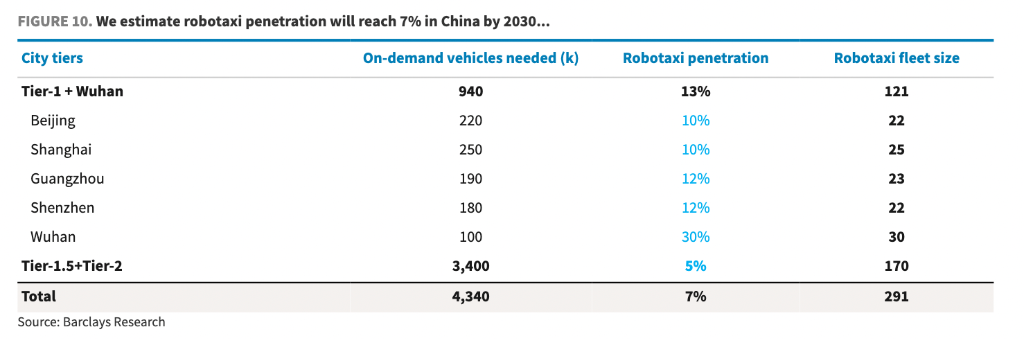
中国Robotaxi(自动驾驶出租车)行业正迎来关键拐点。 据追风交易台消息,巴克莱分析师Jiong Shao及其团队在28日发布的报告中表示,目前全国约有2000辆Robotaxi投入运营,随着道路覆盖率的提升和运营 商车队规模的扩张,预计Robotaxi行业将在未来五年迎来加速增长期,预计到2030年将实现30-50万辆的规模部署,渗透率为5-10%。 报告强调,目前,中国Robotaxi的单车制造成本已降至3.5-4万美元,与特斯拉Cybercab的目标成本基本一致。得益于激光雷达成本的大幅下降和整车制造 成本的显著优化,Robotaxi行业的领军企业已接近单车运营层面的盈亏平衡。 报告预计,到2030年,预计整车制造成本还将进一步下降30%以上,单车运营成本有望再降60%。 市场渗透率将实现跳跃式增长 报告显示,中国网约车市场拥有超过5亿用户,年订单量约160亿次,年增长率约10%。整体按需出行市场中,网约车与出租车各占50%份额。 而Robotaxi主要竞争的是一二线城市的按需出行市场,涉及450-500万辆车的总体市场规模。 目前,Robotaxi在总体可及市场中的渗透率仅为0.05%,即使在被视 ...
四大动力驱动,运营部署提速、高盛大幅上调中国Robotaxi市场规模预测
Hua Er Jie Jian Wen· 2025-07-17 08:29
Core Viewpoint - The Robotaxi market in China is entering a rapid growth phase, with Goldman Sachs analysts raising their market size forecasts significantly due to advancements in technology, reduced hardware costs, and accelerated commercial deployment by operators [1][2]. Group 1: Market Size and Growth Projections - Goldman Sachs projects the Chinese Robotaxi market to grow to $14 billion by 2030 and $61.2 billion by 2035, up from previous estimates of $12 billion and $46.6 billion [1]. - The fleet size forecast for 2030 has been increased from 474,000 to 535,000 vehicles, and for 2035 from 1.9 million to 2.3 million vehicles [1]. Group 2: Growth Drivers - The long-term growth of the Robotaxi industry in China is supported by four main drivers: 1. Technological advancements improving safety and passenger experience [2]. 2. New passenger experiences attracting users, including entertainment and customized services [2]. 3. The ability of Robotaxis to fill the gap left by retiring human drivers, with an estimated 4 million drivers retiring by 2035 [2]. 4. New business models that convert idle assets into cash flow and improve profitability [2]. Group 3: Operator Deployment and Expansion - Chinese Robotaxi operators are accelerating commercialization through new vehicle launches and large-scale deployments, with companies like Pony.ai and Baidu Apollo making significant strides [3]. - Pony.ai aims to achieve a fleet of 1,000 vehicles by the end of 2025, while Baidu Apollo has completed over 11 million public rides and plans to expand its fleet significantly [3]. Group 4: Market Penetration and Financial Outlook - The penetration rate of Robotaxis in China is expected to grow, with first-tier cities reaching 22% by 2030 and 41% by 2035 [4]. - First-tier cities are projected to achieve breakeven by 2026, while second-tier cities are expected to reach breakeven by 2030 [4]. - Annual revenue per vehicle in first-tier cities is forecasted to increase from $10,000 in 2024 to $32,000 by 2035 [4]. Group 5: Market Share - By 2035, Robotaxis are expected to account for 29% of the shared mobility fleet in China [5].
宁德时代再发力Robotaxi
起点锂电· 2025-07-16 10:10
Core Viewpoint - CATL is actively expanding its presence in the autonomous driving sector, particularly in the taxi segment, through a partnership with T3 Mobility, focusing on electric vehicle solutions and battery swapping technology [2][3]. Group 1: Partnership and Collaboration - CATL's subsidiary, Times Intelligent, has signed a collaboration agreement with T3 Mobility, centering around the CATL Rock Solid chassis, which will involve hardware manufacturing and operational services [3]. - The partnership aims to develop a platform for customization, create tailored products, and collaborate with automotive manufacturers and algorithm companies to leverage data for operational scenarios [3][4]. Group 2: Rock Solid Chassis Features - The Rock Solid chassis, unveiled in April, emphasizes high safety, strong performance, and advanced intelligence, utilizing fully controlled technology and a distributed electric drive system [6]. - It is designed with a biomimetic structure to enhance safety during collisions, ensuring no fire or explosion occurs at speeds of 120 km/h [6][7]. - The chassis includes advanced safety features such as intelligent high-voltage management and rapid disconnection systems to mitigate secondary risks in the event of a collision [7]. Group 3: Future of Robotaxi - The Robotaxi sector is witnessing rapid advancements, with companies like Pony.ai testing their autonomous systems in vehicles like the Arcfox Alpha T5 [9]. - In North America, major players such as Tesla, Waymo, and Amazon's Zoox are competing, with Waymo operating nearly 2,000 vehicles and Tesla predicting over 100,000 Robotaxis in the U.S. by the end of next year [11]. - However, challenges such as technology, cost, and regulatory hurdles remain significant barriers to large-scale deployment in the Robotaxi market [12][13].


Robotaxi产品逐渐放量,传统出租车市场是否将受到威胁?
2025-07-16 06:13
Summary of RoboTaxi Industry Conference Call Industry Overview - The RoboTaxi industry is undergoing a significant transformation, driven by advancements in autonomous driving technology and the integration of AI, sensor fusion, and 5G communication systems [1][2][5] - The industry has evolved from its inception around 2000, with notable developments in China starting from 2012, leading to initial commercialization by 2013 [4][10] Key Insights - **Market Dynamics**: The RoboTaxi model is not merely a technological replacement but requires a comprehensive rethinking of regulatory frameworks, urban infrastructure, and user behavior [2] - **Safety and Efficiency**: Remote assistance for autonomous vehicles can enhance safety by allowing cloud-based operators to take control in complex situations, demonstrating faster response times than human drivers [3] - **Accident Reduction**: Autonomous driving technology can significantly reduce accidents caused by human error, with statistics showing that young drivers have a higher accident rate [6] - **Environmental Impact**: The adoption of electric and autonomous vehicles is projected to reduce greenhouse gas emissions by up to 34% by 2050, improving air quality and public health [7] Market Potential - The Chinese RoboTaxi market is expected to reach approximately 1.65 billion by 2024, with global market size projected at 8 billion [13] - By 2030, the market sizes are anticipated to grow to 2.35 billion in China and 11.4 billion globally, although growth rates may be limited due to regulatory and cost challenges [13][14] Competitive Landscape - The leading players in the RoboTaxi sector are primarily based in the US and China, with US companies having a slight head start in development [5][15] - The operational scale of RoboTaxi fleets is expanding, with over 1,500 vehicles deployed across 12 cities in China [15] Cost Structure - The operational costs for RoboTaxi include maintenance, insurance, and energy costs, averaging around 50,000 per vehicle annually [12] - The cost of operating RoboTaxi is expected to decrease significantly as technology advances and production scales up, with projections indicating that costs per kilometer could match traditional taxi services by 2026 [18][20] Regulatory Environment - The regulatory landscape for autonomous vehicles varies between the US and China, with the US having a more permissive environment that encourages innovation, while China focuses on safety and gradual implementation [8][9] Future Outlook - The RoboTaxi industry is poised for growth, but significant technological and regulatory hurdles remain. Achieving widespread commercialization will require further advancements in technology and a supportive regulatory framework [14][18] Conclusion - The RoboTaxi sector represents a transformative shift in urban mobility, with the potential to enhance safety, reduce environmental impact, and reshape consumer behavior towards vehicle ownership [11][19]