
饮料和精制茶制造业

Search documents
开源晨会-20251028
KAIYUAN SECURITIES· 2025-10-28 14:44
Core Insights - The report highlights a recovery in industrial enterprise profits, with a cumulative year-on-year increase of 3.2% for the first nine months of 2025, compared to 0.9% in the previous period, indicating a positive trend in the industrial sector [5][30] - The report emphasizes the importance of the "Fifteenth Five-Year Plan" and outlines ten investment directions, focusing on economic construction and consumer spending [11][12][18] - The report notes that the central bank's resumption of government bond trading is expected to positively impact the market, providing a new channel for monetary policy [20][21][25] Industry Analysis Agriculture, Forestry, Animal Husbandry, and Fishery - The pig industry is entering a destocking phase, driven by policy and market factors, presenting a good investment opportunity [38] - The beef market is experiencing a cyclical uptrend, supported by strong demand and limited supply recovery [39] - The poultry sector is facing challenges due to disease outbreaks and import uncertainties, but demand is expected to strengthen [40] Food and Beverage - Jin Hui Jiu's revenue for the first three quarters of 2025 was 2.306 billion yuan, a year-on-year decrease of 1.0%, with net profit declining by 2.8% [45] - Qingdao Beer reported a revenue of 29.37 billion yuan for the first three quarters, a year-on-year increase of 1.41%, but faced pressure on profits due to weak demand [50] - Chenguang Biotech's revenue decreased by 3.4% year-on-year, but net profit showed significant growth due to improved profitability in its core business [55] Chemical Industry - Yun Tu Holdings reported a revenue of 15.87 billion yuan for the first three quarters, with a net profit of 675 million yuan, but faced challenges due to weak autumn fertilizer demand [60] - Xingfa Group's revenue for the first three quarters was 23.781 billion yuan, with a net profit of 1.318 billion yuan, benefiting from rising prices of glyphosate and increased sales of specialty chemicals [65] Overall Market Trends - The report indicates a trend of rising profits in the upper and middle reaches of the industrial chain, with a notable recovery in manufacturing profits [7][30] - The report suggests that the economic growth rate may face downward pressure in Q4, but fiscal policies are expected to support market stability [8][18]




安徽省淮南市市场监管局“守护消费”铁拳行动第五批典型案例(守护知识产权专项执法行动专刊)
Zhong Guo Zhi Liang Xin Wen Wang· 2025-10-24 07:43
Group 1 - The article discusses the enforcement actions taken by the Huainan Market Supervision Administration to combat violations of intellectual property rights, particularly focusing on trademark infringement and the misuse of geographical indications [1][2][3] - Several cases are highlighted, including the imposition of fines and administrative penalties against companies and individuals for selling counterfeit products [2][3][4][5] Group 2 - In a notable case, Anhui Sanhe Cable Co., Ltd. was fined 600,000 yuan for producing and selling cables that infringed on registered trademarks, with the total value of the counterfeit goods exceeding 1.55 million yuan [2] - The Huainan High-tech Zone Market Supervision Bureau penalized a convenience store for selling counterfeit "Wuliangye" liquor, resulting in a warning, confiscation of 33 bottles, and a fine of 31,350 yuan [3][4] - A significant case involved the sale of counterfeit Marshall speakers on an online platform, with the offenders reportedly generating over 14 million yuan in illegal revenue from selling 10,760 counterfeit items [5] Group 3 - The Huainan Economic and Technological Development Zone Bureau confiscated 39 bottles of counterfeit Mobil oil and imposed a fine of 10,000 yuan on Huainan Xingchi Automobile Maintenance Service Co., Ltd. [7] - The Huainan Market Supervision Bureau also took action against a mother and baby store for selling counterfeit "Pigeon" and "Beichan" branded products, resulting in the confiscation of 25 items and a fine of 2,200 yuan [8] - The article details multiple enforcement actions across various sectors, including the confiscation of counterfeit products and fines imposed on businesses for trademark violations [6][9][10]


2025年1-8月酒、饮料和精制茶制造业企业有5881个,同比下降0.94%
Chan Ye Xin Xi Wang· 2025-10-23 02:52
Core Insights - The report highlights a slight decline in the number of enterprises in the liquor, beverage, and refined tea manufacturing industry, with a total of 5,881 companies reported for the period from January to August 2025, representing a decrease of 56 companies or 0.94% year-on-year [1]. Industry Overview - The number of large-scale industrial enterprises in the liquor, beverage, and refined tea manufacturing sector has been adjusted from a minimum annual main business income of 5 million yuan to 20 million yuan since 2011, indicating a shift in the industry standards [1]. - The proportion of liquor, beverage, and refined tea manufacturing enterprises within the total industrial enterprises stands at 1.13% [1]. Market Research - The data is sourced from the National Bureau of Statistics and compiled by Zhiyan Consulting, a leading industry consulting firm in China, which specializes in providing in-depth industry research reports and tailored consulting services [1].

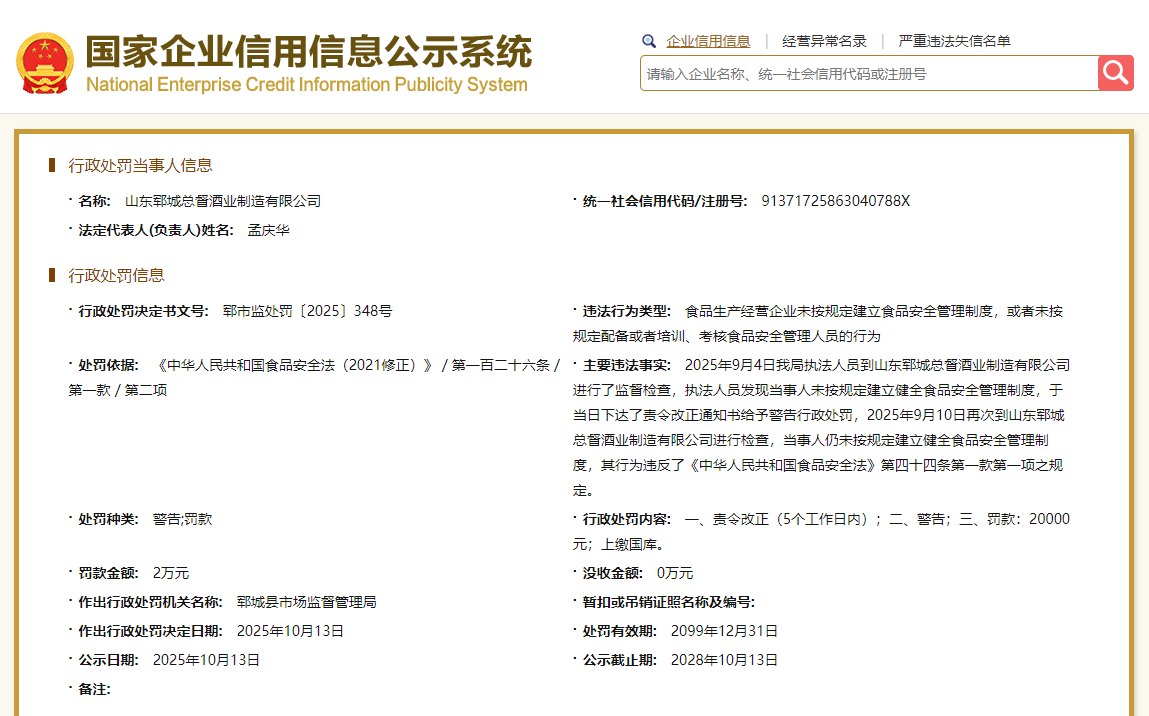
山东郓城总督酒业因未按规定建立健全食品安全管理制度被罚2万元
Qi Lu Wan Bao· 2025-10-21 04:31
Core Points - Shandong Yuncheng Zongdu Liquor Manufacturing Co., Ltd. was penalized for failing to establish a food safety management system as required by law [1] - The company was found non-compliant during an inspection on September 4, 2025, and was given a warning and a notice to rectify the issue [1] - A follow-up inspection on September 10, 2025, revealed that the company had not made the necessary corrections, leading to further penalties [1] Company Summary - Shandong Yuncheng Zongdu Liquor Manufacturing Co., Ltd. was established on June 26, 1997, with a registered capital of 5 million yuan [1] - The legal representative of the company is Meng Qinghua, and it is located in the Yuncheng Economic Development Zone, Heze City, Shandong Province [1] - The company operates in the liquor, beverage, and refined tea manufacturing industry [1] Regulatory Actions - The Yuncheng County Market Supervision Administration ordered the company to correct its illegal activities within 5 working days and imposed a fine of 20,000 yuan, which is to be paid to the national treasury [1] - The penalty decision was made on October 13, 2025, and the public announcement period will last until October 13, 2028 [1]
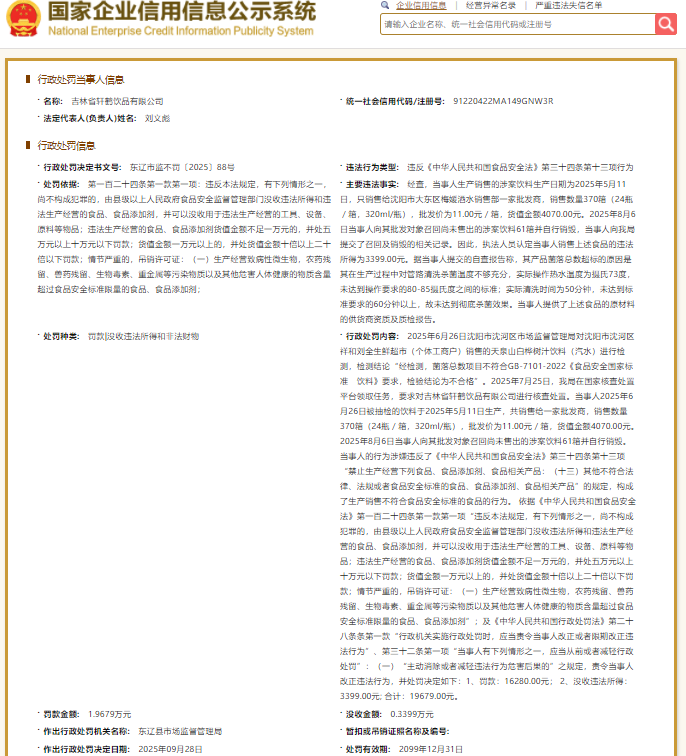
吉林轩鹤饮品公司因生产的白桦树汁饮料菌落超标被罚19679元
Qi Lu Wan Bao· 2025-10-17 08:56
Core Points - The administrative penalty against Jilin Xuanhe Beverage Co., Ltd. for producing substandard beverages amounts to a total of 19,679 yuan [1][2] - The company sold 370 boxes of the non-compliant product, with a total value of 4,070 yuan, and voluntarily recalled 61 boxes after discovering the issue [1][2] Company Information - Jilin Xuanhe Beverage Co., Ltd. was established on June 29, 2017, with a registered capital of 5 million yuan, and is located in Dongliao County [4]
三只松鼠新成立全资酒饮子公司
Bei Jing Shang Bao· 2025-10-15 11:14
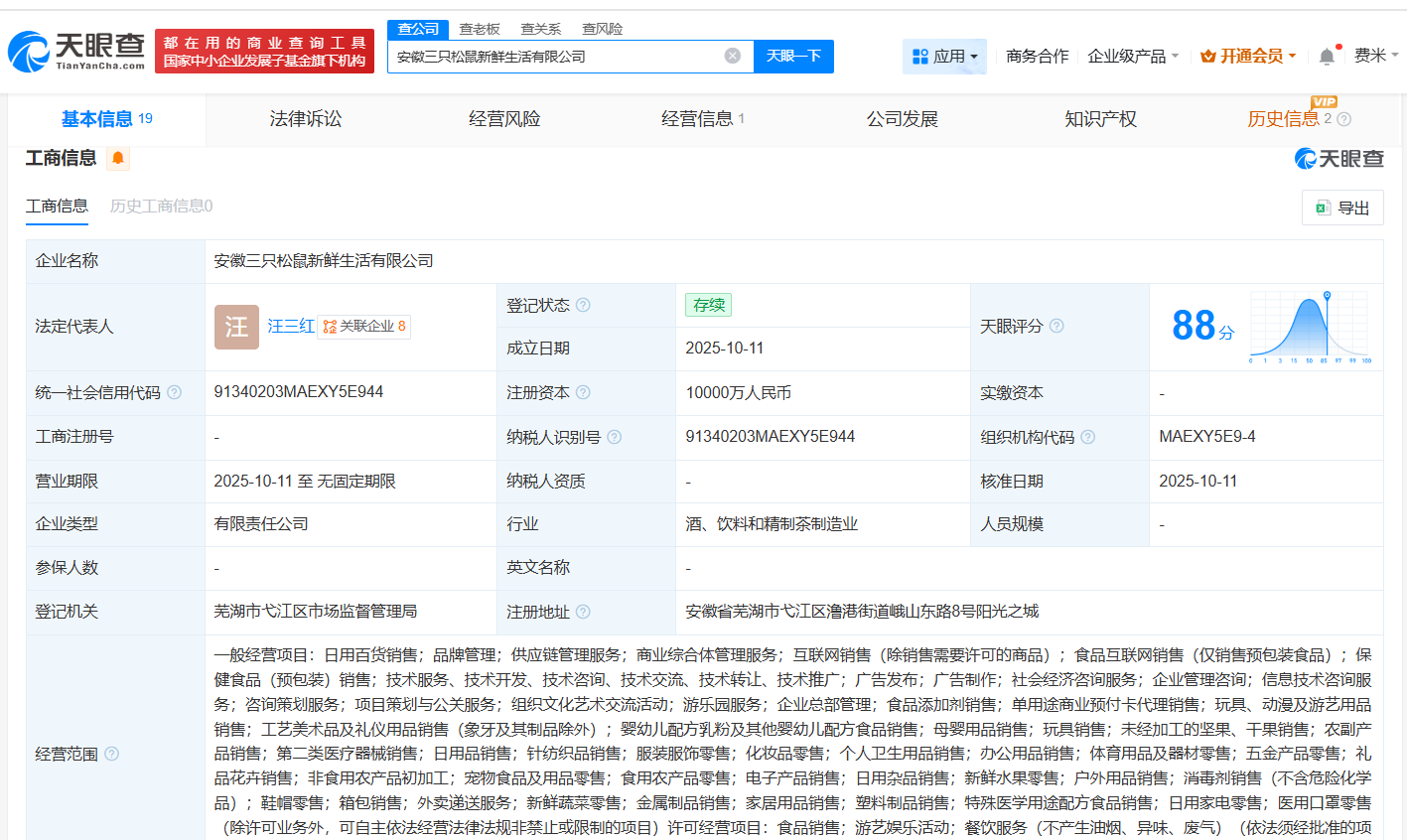
Group 1 - Company has recently invested in the establishment of Anhui Three Squirrels Fresh Life Co., Ltd [1] - The registered capital of the new company is 100 million yuan [1] - The industry classification for the new company is beverage and refined tea manufacturing [1]

三只松鼠成立新鲜生活公司
Mei Ri Jing Ji Xin Wen· 2025-10-15 04:03
Core Viewpoint - Anhui Three Squirrels Fresh Life Co., Ltd. has been established with a registered capital of 100 million RMB, focusing on food sales, entertainment activities, and catering services, fully owned by Three Squirrels [1][2]. Company Information - The legal representative of the company is Wang Sanhong [1]. - The company was established on October 11, 2025, and is registered with a unified social credit code of 91340203MAEXY5E944 [2]. - The company operates as a limited liability company in the beverage and refined tea manufacturing industry [2]. Business Scope - The business scope includes food sales, entertainment activities, catering services, daily necessities sales, brand management, supply chain management, and various other retail and service activities [2]. - The company is authorized to operate without a fixed term, indicating a long-term business strategy [2].
晨会纪要:2025年第172期-20251014
Guohai Securities· 2025-10-14 01:34
Key Insights - The recent announcement by two departments regarding the governance of price disorder in the market is expected to stabilize the prices of epoxy propane and polyether, leading to a positive outlook for the chemical industry [3][4] - The chemical industry in China is anticipated to undergo a revaluation due to the reduction of overcapacity globally, which could enhance cash flow and dividend yields for companies in this sector [4] - The "Work Plan for Stable Growth in the Petrochemical Industry (2025-2026)" aims for an average annual growth of over 5% in the added value of the petrochemical industry, focusing on innovation and quality improvement [5][6] Industry Analysis - The chemical industry is expected to see a significant increase in demand for chromium salts due to the rising orders for gas turbines and commercial aircraft engines, with a projected shortfall of 250,000 tons by 2028 [8] - The report highlights four key investment opportunities in the chemical sector: low-cost expansion, improved industry conditions, new materials, and high dividend yields from state-owned enterprises [9][10] - The report emphasizes the importance of focusing on leading companies in various sub-sectors, such as Wanhua Chemical and Hualu Hengsheng, which are well-positioned to benefit from these trends [11] Market Trends - The report notes that the price of Brent and WTI crude oil has decreased by 3.53% and 4.04% respectively, indicating a potential impact on the chemical industry [12] - The domestic market for epoxy propane has shown a steady upward trend, supported by supply constraints and increased purchasing activity during the holiday season [13][14] - The report also mentions the stable pricing of various chemical products, including MDI and ammonium phosphate, suggesting a balanced supply-demand dynamic in the market [15][19] Company-Specific Insights - Companies like Zhenhua Co. are expected to benefit from the anticipated increase in demand for chromium salts, with a production capacity of 260,000 tons in 2024 [8] - The report highlights the performance of various companies in the chemical sector, including the stable pricing of products from companies like Yangu Huatai and Huafeng Chemical [16][23] - The report indicates that companies such as Yonghe Co. are projected to see significant profit growth in the upcoming quarters, with an expected net profit increase of over 200% [29]






工业企业利润高增探究
SINOLINK SECURITIES· 2025-09-30 06:58
Group 1: Profit Growth Analysis - In August, industrial enterprises' profits increased significantly by 21% year-on-year to 19.8%, driven by low base effects, improved upstream industry gross margins, and investment income recognition[4] - The low base contributed 6.7 percentage points to the profit growth, ranking as the third-largest factor[4] - August profits totaled 672.6 billion yuan, with an increase of 111.4 billion yuan year-on-year, where upstream manufacturing contributed 49.9% of this growth[7] Group 2: Sector-Specific Insights - The substantial improvement in upstream industrial profits was primarily from the black metal and non-ferrous metal smelting industries, which saw profit increases of 336 billion yuan and 128 billion yuan respectively[8] - The gross margin for black metal smelting rose to 7% in August from 2% in the same month last year, leading to a gross profit increase of 329 billion yuan[8] - Investment income in August rose by 502 billion yuan, a year-on-year increase of 66.6%, contributing 45% to the overall profit growth[9] Group 3: Future Outlook and Risks - As the base effects diminish and investment income support weakens, profit growth may decline in September[12] - The price index for production materials has been declining, with a 0.5% decrease in the average from early September, indicating potential impacts on commodity prices and enterprise profits[12] - Risks include increased volatility in exports and profit declines due to U.S.-China trade tensions and global supply chain adjustments[3]
2025年1-8月全国酒、饮料和精制茶制造业出口货值为154.9亿元,累计下滑0.1%
Chan Ye Xin Xi Wang· 2025-09-26 03:47
Core Insights - The article discusses the performance of China's beverage industry, highlighting a decline in export value for the sector in 2025 compared to previous years [1] Industry Overview - In August 2025, the export value of the national wine, beverage, and refined tea manufacturing industry was 1.65 billion, representing a year-on-year decrease of 15.6% [1] - From January to August 2025, the cumulative export value for the same industry was 15.49 billion, showing a slight year-on-year decline of 0.1% [1] Company Insights - The article lists several companies in the beverage sector, including Chengde Lulule (000848), Sunshine Dairy (001318), Huangshi Group (002329), and others, indicating a broad range of players in the market [1] - The report by Zhiyan Consulting provides insights into the operational landscape and future prospects of the beverage industry in China from 2025 to 2031 [1]
