
传感器

Search documents
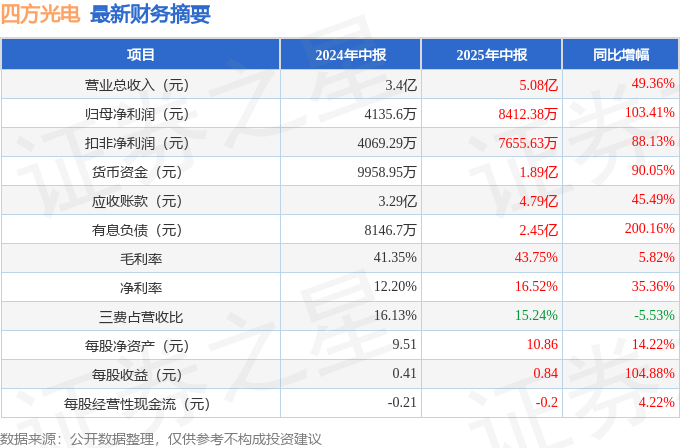
四方光电2025年中报简析:营收净利润同比双双增长,应收账款上升
Zheng Quan Zhi Xing· 2025-08-18 22:32
Core Insights - The company reported a significant increase in revenue and profit for the first half of 2025, with total revenue reaching 508 million yuan, a year-on-year increase of 49.36%, and net profit of 84.12 million yuan, up 103.41% [1] - The gross margin improved to 43.75%, reflecting a 5.82% increase year-on-year, while the net margin rose to 16.52%, up 35.36% [1] - The company experienced a substantial rise in accounts receivable, which increased by 45.49% year-on-year, indicating potential cash flow concerns [1] Financial Performance - Total revenue for 2025 reached 508 million yuan, compared to 340 million yuan in 2024, marking a 49.36% increase [1] - Net profit for 2025 was 84.12 million yuan, up from 41.36 million yuan in 2024, representing a 103.41% increase [1] - The company’s gross margin was 43.75%, an increase from 41.35% in the previous year, while the net margin improved to 16.52% from 12.20% [1] Cost and Expense Analysis - Total operating expenses, including sales, management, and financial expenses, amounted to 77.41 million yuan, accounting for 15.24% of revenue, down 5.53% year-on-year [1] - Sales expenses increased by 35.54%, attributed to higher personnel costs and marketing expenses [5] - Management expenses rose by 27.96%, driven by increased employee salaries and other operational costs [5] Cash Flow and Debt - Cash flow from operating activities showed a negative per share value of -0.20 yuan, a slight improvement from -0.21 yuan in the previous year [1] - The company’s monetary funds increased by 90.05% to 189 million yuan, primarily due to bank loan receipts [1][7] - Interest-bearing liabilities rose significantly by 200.16%, reaching 245 million yuan, indicating increased leverage [1] Investment and Growth - The company’s investment in construction projects surged by 248.27%, reflecting increased capital expenditure in the Hungarian park [2] - Research and development expenses grew by 22.58%, indicating a commitment to innovation and product development [6] - The return on invested capital (ROIC) for the previous year was 9.92%, with a historical median of 22.85%, suggesting potential for improved capital efficiency [8] Business Model and Market Position - The company’s performance is primarily driven by research and development, highlighting the importance of understanding the underlying factors of this growth [9] - Analysts project a net profit of 142 million yuan for 2025, with an expected earnings per share of 1.42 yuan [10]


六维力传感器成机器人关键部件 多家上市公司掀起“军备竞赛”
Zheng Quan Shi Bao· 2025-08-18 21:53
Core Insights - The six-dimensional force sensor is a key component for solving motion control challenges in humanoid robots, with several A-share listed companies engaged in a "arms race" in this field [1][2][3] - The production cost of six-dimensional force sensors is currently high, but there is a strong demand for cost reduction as the humanoid robot industry rapidly advances [1][9] - The price of six-dimensional force sensors is expected to decrease significantly from over 20,000 yuan to around 2,000 yuan with mass production [1][10] Industry Competition - Jiuding Investment plans to acquire a 53.29% stake in Nanjing Shenyuan Intelligent Technology for 213 million yuan, highlighting the competitive landscape in the six-dimensional force sensor market [2] - More than ten listed companies are competing in the six-dimensional force sensor sector, with companies like Donghua Testing and Minxin Co. actively developing and customizing sensors for various robot manufacturers [2][3] - Companies such as Haoshi Electromechanical and Zhongding Co. are focusing on the development of core components for humanoid robots, indicating a strategic shift towards this technology [3] Market Potential - The demand for six-dimensional force sensors is expected to surge due to the expanding application scenarios for humanoid robots, particularly in the aging economy and smart home sectors [5][8] - According to IDC, the commercial sales volume of humanoid robots in China is projected to reach approximately 2,000 units in 2024, with a global forecast of 18,000 units by 2025 [7] - The market for six-dimensional force sensors is anticipated to exceed hundreds of millions of yuan by 2030, with humanoid robots being the primary application area [8] Cost Reduction Strategies - The high production costs of six-dimensional force sensors stem from technical challenges, material costs, and limited application scale [9] - Companies are exploring MEMS technology to significantly reduce costs, as it allows for mass production of sensors [9] - The production line planned by Ice Zero Technology aims to achieve a capacity of 2 million units, potentially lowering the cost of six-dimensional force sensors to about one-tenth of the current industrial product price [10]


不“内卷”向“外翻” 华工科技以科技创新拼价值
Shang Hai Zheng Quan Bao· 2025-08-18 19:17
Core Viewpoint - 华工科技 reported strong financial performance in the first half of the year, driven by increased demand for high-speed optical modules, particularly in the context of growing computational needs from domestic internet and equipment manufacturers [5][6]. Financial Performance - The company achieved operating revenue of 7.629 billion yuan, a year-on-year increase of 44.66% [5]. - The net profit attributable to shareholders reached 911 million yuan, up 44.87% year-on-year [5]. - The revenue from the connectivity business was 3.744 billion yuan, showing a remarkable growth of 124% [5]. Market Position and Strategy - The chairman emphasized the importance of innovation over price competition, advocating for a shift from "price wars" to "value wars" in the industry [5]. - Since its establishment in 1999, the company has maintained an average annual revenue growth rate of 20.7% and a net profit growth rate of 15.8% [5]. - The company has expanded its production capacity with new facilities in Wuhan and Thailand, aiming to meet the surging demand for 400G/800G optical modules [6]. Technological Innovation - The company has made significant investments in R&D, with a compound annual growth rate of 25% in R&D spending over the past five years [5]. - The establishment of Yunling Optoelectronics in 2018 marked a strategic move to develop high-end optical chips independently, achieving full coverage from 2.5G to 100G optical chips [8]. - The company has transitioned to silicon photonics, becoming a leading supplier of silicon optical modules globally [8][9]. Product Development - The company launched several innovative products, including a 1.6T silicon optical module that has entered the testing phase with key clients [9]. - The introduction of an intelligent laser weeding robot showcases the company's commitment to innovation in agricultural technology [10]. Organizational Changes - Following the separation from the university, the company has implemented management reforms to enhance operational efficiency and align employee interests with corporate growth [12]. - The company encourages innovation through internal "maker" teams, fostering a culture of creativity and product development [11][12].

芯动联科: 《公司章程》
Zheng Quan Zhi Xing· 2025-08-18 16:33
Core Points - The company, Anhui XDLK Microsystem Corporation Limited, was established as a joint-stock company in accordance with Chinese laws and regulations, with its registration approved by the China Securities Regulatory Commission on May 9, 2023, and it listed on the Shanghai Stock Exchange's Sci-Tech Innovation Board on June 30, 2023 [2][3][4] - The registered capital of the company is RMB 400.71566 million, and it aims to become a leader in high-performance sensors through continuous innovation and research and development [3][4][5] - The company is engaged in the development, transfer, and sales of MEMS projects and related components, as well as microelectronic devices and sensor application systems [4][5] Company Structure - The company operates as a permanent joint-stock company, with the general manager serving as the legal representative [3][4] - Shareholders are liable for the company's debts only to the extent of their subscribed shares, while the company is liable for its debts with all its assets [3][4] - The company has established a legal framework that governs the rights and obligations of shareholders, directors, and senior management [3][4][5] Share Issuance and Management - The company has issued a total of 405.71566 million shares, all of which are ordinary shares with a par value of RMB 1 per share [5][6] - The issuance of shares follows principles of openness, fairness, and justice, ensuring equal rights for all shareholders of the same class [5][6] - The company is restricted from providing financial assistance for the acquisition of its shares, except under specific conditions approved by the shareholders' meeting [6][7] Shareholder Rights and Responsibilities - Shareholders have the right to receive dividends, participate in meetings, supervise the company's operations, and transfer their shares in accordance with the law [10][11] - The company has established rules for the transfer of shares, including restrictions on the transfer of shares held by directors and senior management during their tenure [10][11][12] - Shareholders are obligated to comply with laws and regulations, pay for their subscribed shares, and not abuse their rights to harm the company or other shareholders [15][16] Governance and Meetings - The company holds annual and extraordinary shareholder meetings, with specific procedures for convening and conducting these meetings [47][48] - The board of directors is responsible for convening shareholder meetings and must ensure compliance with legal and regulatory requirements [51][52] - Shareholders holding more than 10% of the shares can request the board to convene an extraordinary meeting, and if the board fails to do so, they can convene the meeting themselves [54][55]
芯动联科: 关于公司2025年度提质增效重回报专项行动方案的半年度评估报告
Zheng Quan Zhi Xing· 2025-08-18 16:30
Core Viewpoint - The company has successfully implemented its 2025 "Quality Improvement and Efficiency Enhancement" action plan, achieving significant revenue and profit growth while focusing on high-performance MEMS sensors and enhancing shareholder returns [1][2][5] Group 1: Financial Performance - The company reported total revenue of 253 million RMB, an increase of 84.34% year-on-year [1] - The net profit attributable to shareholders reached 154 million RMB, reflecting a year-on-year growth of 210.65% [1] - Research and development expenses amounted to 58.11 million RMB, up 8.17% from the previous year, representing 22.95% of total revenue [1] Group 2: Market Development - The company secured two large annual orders and is actively delivering to clients, with an increasing number of customers seeking collaboration and product trials [2] - The company has expanded its customer base across high-end industrial sectors, surveying, oil exploration, commercial aerospace, intelligent driving, and high-reliability fields [2] - The company is committed to enhancing its product layout and market competitiveness by focusing on market demand and improving the efficiency of R&D investments [2] Group 3: Shareholder Returns - The company plans to distribute a cash dividend of 1.56 RMB per 10 shares (before tax), which represents a significant portion of the net profit attributable to shareholders [2] - The company aims to maintain a cash dividend ratio of over 30% in the next three years, ensuring a stable and continuous profit distribution policy to protect investor interests [2] Group 4: Corporate Governance - The company has established a governance structure that includes a shareholders' meeting, board of directors, supervisory board, independent directors, and senior management, ensuring clear responsibilities and effective checks and balances [3] - The company is actively responding to national policies promoting capital market health by developing a value management system to enhance investment value and protect investor interests [3] Group 5: Information Disclosure and Investor Relations - The company emphasizes high-quality information disclosure, adhering to relevant regulations and principles to ensure timely and accurate communication with investors [4] - The company is enhancing the readability and effectiveness of its announcements, making information more accessible to investors [4] - The company has set up dedicated communication channels for investor inquiries, ensuring timely and comprehensive responses to investor questions [4] Group 6: Key Personnel Responsibility - The company prioritizes the responsibilities of key personnel, including actual controllers, directors, supervisors, and senior management, by supporting their participation in training related to regulatory changes [5] - The company aims to improve the knowledge and skills of key personnel to ensure effective compliance with securities market regulations [5]
华工科技(000988) - 2025年8月15日投资者关系活动记录表
2025-08-18 08:18
Group 1: Financial Performance - The company achieved a revenue of 7.629 billion CNY, representing a 45% year-on-year growth [5] - The net profit attributable to the parent company was 911 million CNY, also reflecting a 45% increase [5] - R&D investment reached 461 million CNY, marking a 19% increase compared to the previous period [5] Group 2: Business Segments - The perception business generated a revenue of 2.154 billion CNY, with a 17% year-on-year growth; sensor business revenue was 1.942 billion CNY [6] - The optical connection business saw a revenue of 3.744 billion CNY, a significant 124% increase [6] - The laser + intelligent manufacturing segment achieved a revenue of 1.676 billion CNY, with notable growth in high-power laser equipment [7] Group 3: Market Expansion and Strategy - The company is focusing on the new energy vehicle and shipbuilding industries, enhancing its global operations and international business base [5] - The domestic demand for optical modules is expected to grow, transitioning from 400G to 800G products [8] - The overseas market for optical connection business is expanding, with a 50% increase in orders in the first half of the year [9] Group 4: Technological Advancements - The company has made significant progress in silicon photonics technology, with applications in 400G optical modules and plans for 800G and 1.6T modules [10] - The pressure sensor business has seen substantial growth, with a focus on domestic and international automotive markets [14] - The laser precision micro-nano business is targeting 3D printing and green agriculture, with plans for commercial applications of intelligent laser weeding robots [16][17]
瞭望 | 一座城打造一个“谷”
Xin Hua She· 2025-08-18 07:26
Core Viewpoint - The city of Bengbu is actively developing its sensor industry, aiming to create a comprehensive ecosystem for intelligent sensors, leveraging its historical strengths and modern technological advancements in the AI era [1][2][3]. Group 1: Industry Development - Bengbu has established itself as one of China's major sensor manufacturing bases since the 1990s, focusing on upgrading its sensor industry to meet high-end application demands [2][3]. - The city is constructing the "China Sensor Valley," which includes a comprehensive industrial cluster for research, design, manufacturing, packaging, and testing of intelligent sensors [3][4]. - The global sensor market is projected to exceed $200 billion in 2024, with an annual growth rate of 8.1% [1]. Group 2: Technological Advancements - The establishment of the Anhui MEMS Technology Industry Innovation Research Institute aims to overcome technical bottlenecks in MEMS wafer manufacturing through collaborative innovation [4][5]. - Bengbu is now one of the few cities in China with both MEMS and CMOS technology, as well as 6-inch and 8-inch MEMS wafer manufacturing lines [5]. - The city is focusing on various sensor types, including inertial, pressure, gas, acoustic, optical, and multi-parameter sensors, targeting applications in robotics, smart vehicles, and healthcare [5][6]. Group 3: Ecosystem and Collaboration - Over 200 upstream and downstream companies in the intelligent sensor industry have gathered in Bengbu, including more than 40 specialized and innovative enterprises [6][7]. - The city has created a public demonstration line to support enterprises in engineering testing and production, facilitating the transformation of scientific research achievements into practical applications [5][6]. - Bengbu is enhancing its innovation ecosystem by establishing high-level platforms for technology, talent, and funding, which are crucial for the development of the sensor industry [7][8]. Group 4: Economic Impact - The intelligent sensor industry in Bengbu is expected to contribute significantly to the local economy, with the city’s GDP growing by 5.6% year-on-year in the first half of 2025 [13]. - The establishment of the "China Sensor Valley" is part of a broader strategy to integrate with other regional technology hubs, enhancing collaboration and innovation across the AI industry [13].
成都成立一支科幻基金
Sou Hu Cai Jing· 2025-08-17 13:27
Group 1 - Chengdu has launched the first city-level Sci-Fi and Future Industry Development Fund with a target size exceeding 3 billion yuan, focusing on sci-fi reading, film, games, and related sectors [2] - ZhenDian Smart Sensor has completed nearly 10 million yuan in angel round financing, aiming to enhance its core technology in industrial and consumer-grade sensors [3] - JuXin Microelectronics has completed a D+ round financing to further develop low-power, high-integration smart sensing chips, breaking foreign monopolies in high-end chip markets [3] - Shanghai Leju Technology has secured exclusive B++ round financing from Kunlun Capital, enhancing its digital services in the energy sector [4] - YiPu Power has completed an A round financing to support innovation in power systems for new energy vehicles and industrial equipment [5] - DeRui Smart Chip has completed a C round financing to advance its research in smart chips for various applications [5] - Hongshi Baosheng Technology has successfully completed an angel round financing, focusing on new material development with potential applications in energy-saving and environmental protection [5] - Suzhou Jiedi has completed a B round financing to expand production and enhance competitiveness in high-end equipment manufacturing [6] Group 2 - Meijin Energy is planning to issue H-shares and list on the Hong Kong Stock Exchange to enhance its international capital layout and competitiveness [7] - Dapeng Industrial has successfully passed the review for listing on the Beijing Stock Exchange, aiming to raise 154 million yuan for smart industrial cleaning equipment projects [7]
四方光电(688665.SH)发布上半年业绩,归母净利润8412.38万元,增长103.41%
智通财经网· 2025-08-17 07:48
Core Viewpoint - Sifang Optoelectronics (688665.SH) reported significant growth in its 2025 semi-annual report, with a notable increase in both revenue and net profit, driven by its industrial and safety business and recent acquisitions [1] Financial Performance - The company's operating revenue reached 508 million yuan, representing a year-on-year growth of 49.36% [1] - Net profit attributable to shareholders was 84.12 million yuan, showing a year-on-year increase of 103.41% [1] - The net profit after deducting non-recurring gains and losses was 76.56 million yuan, reflecting an 88.13% year-on-year growth [1] - Basic earnings per share stood at 0.84 yuan [1] Business Growth Drivers - The substantial revenue growth was primarily attributed to the rapid expansion of the industrial and safety business, particularly in refrigerant leak monitoring sensors [1] - The inclusion of the recently acquired subsidiaries, Nopu Thermal Energy and Jingding Electric, in the consolidated financial statements also contributed to the increased revenue [1]
联接业务增长124%,华工科技加快下一代超高速光模块研发
Zheng Quan Shi Bao Wang· 2025-08-15 05:06
受益于AI算力需求的爆发,2025年上半年,华工科技联接业务实现营业收入37.44亿元,同比增长 124%。公司表示,400G、800G光模块实现规模交付,客户版图、交付份额进一步扩充。公司正在加快 推进下一代超高速光模块的研发和生产,光电子信息产业研创园一期工程将于三季度正式竣工投产。 在产品研发创新能力方面,公司在业界首发1.6T LPO、1.6T LRO产品,以及1.6T 3nm DSP方案;行业 首推3.2T CPO解决方案,可支撑51.2T交换机,并适配液冷散热方案。 三大核心业务齐头并进,华工科技(000988)交出上半年成绩单。8月14日,华工科技披露2025年半年 报,公司上半年实现营收76.29亿元,同比增长44.66%;实现归属于上市公司股东的净利润9.11亿元, 同比增长44.87%。 在无线业务领域,4G/5G/5G-A基站应用光模块持续保持行业领先份额,布局开发低轨卫星通信模块及 下一代前传光模块技术;800G ZR/ZR+ Pro相干光模块量产,在关键客户处完成测试导入。在F5G-A业 务领域,25G PON OLT和ONU批量交付,并推出50G PON OLT产品,同时布局车载光 ...