
电子信息

Search documents
“两新”加力扩围,内需潜力加速释放
Sou Hu Cai Jing· 2025-12-08 07:54
大规模设备更新在推动产业转型升级方面也发挥了重要作用。根据国家税务总局公布的税收数据,前三季度,信息、科技行业设备 更新投入力度加大,企业数字化设备更新动力较足,民营企业设备更新支撑作用凸显,政策红利正在有效转化为产业转型升级的新 动力。 2024年,"两新"(大规模设备更新和消费品以旧换新)政策实施成效明显,有力激发了全年经济增长动能。当年中央经济工作会议强 调,加力扩围实施"两新"政策。一年来,政策在更深层次、更广领域持续释放红利,成为提振消费需求、促进转型升级的关键引 擎。 今年,用于加力扩围实施"两新"政策的超长期特别国债资金规模大幅增加。5000亿元资金中,3000亿元用于支持消费品以旧换新, 比上年增加1500亿元;2000亿元用于支持设备更新,比上年增加500亿元。 同时,政策支持范围也有所扩大,设备更新扩大至电子信息、安全生产、设施农业等领域;以旧换新对个人消费者购买手机、平 板、智能手表手环等3类数码产品给予补贴。不仅如此,政策还进一步提高农业机械报废更新、新能源城市公交车及动力电池更新 等补贴标准,加大家装消费品换新的支持力度。在机制方面,设备更新审批流程进一步简化,消费品以旧换新的资金分 ...


陈博彰在浏阳市宣讲党的二十届四中全会、省委十二届九次全会精神并开展调研
Chang Sha Wan Bao· 2025-12-08 06:49
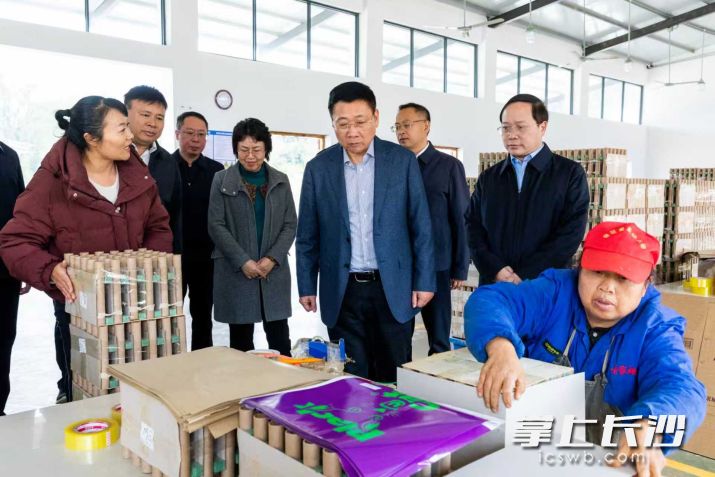
Group 1 - The Deputy Mayor Chen Bozhang emphasized the importance of integrating red culture with tourism and cultural development, aiming to enhance visitor experiences and create new consumption scenarios in the cultural tourism sector [1][3] - Chen highlighted the need to strengthen the safety production measures in the fireworks industry, ensuring strict adherence to safety protocols across production, storage, transportation, and large-scale events [3] - The focus on the development of the electronic information and intelligent equipment manufacturing industries was underscored, with encouragement for companies to increase R&D investment and enhance core competitiveness [6] Group 2 - The city aims to leverage its resource endowments and industrial advantages to drive high-quality economic development, with a focus on attracting investment, project construction, and ensuring public safety [6] - The integration of the fireworks industry with other sectors such as hospitality, education, and night economy is seen as a way to create a new engine for cultural tourism consumption [3] - The city is positioned as a regional center, with a strategic goal to achieve a successful conclusion to the 14th Five-Year Plan and a strong start to the 15th Five-Year Plan [6]
2025年GDP20强城市大预测:深圳约4万亿,武汉远超南京,青岛增速7%!
Sou Hu Cai Jing· 2025-12-08 06:15
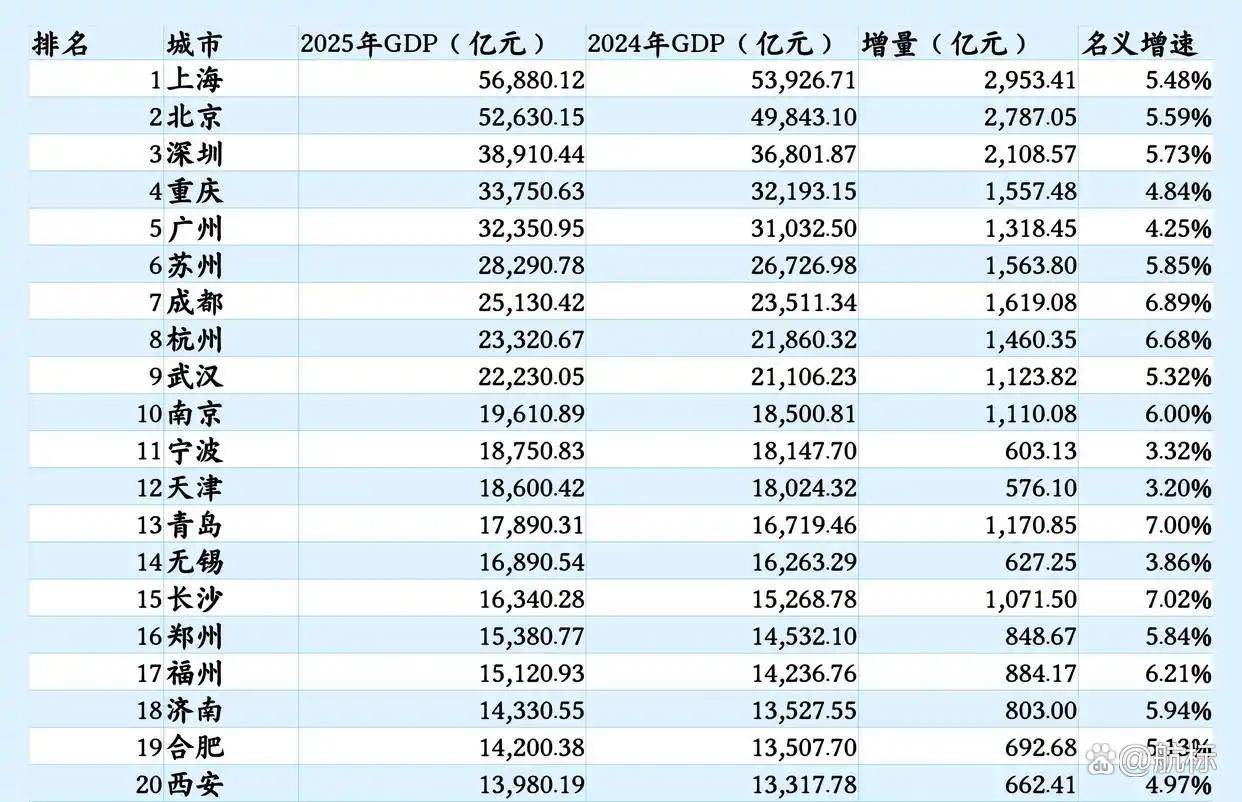
Core Insights - The competition among China's leading cities has entered a new phase characterized by refined and differentiated comparisons, with Shanghai and Beijing leading with GDPs exceeding 5.5 trillion yuan, while cities like Shenzhen, Wuhan, and Qingdao show significant growth potential [1][2] Group 1: Economic Growth and Projections - Shanghai's projected GDP for 2025 is 56,880.12 billion yuan, with an increase of 2,953.41 billion yuan from 2024 [2] - Beijing's projected GDP for 2025 is 52,630.15 billion yuan, reflecting an increase of 2,787.05 billion yuan from 2024 [2] - Shenzhen is approaching the 4 trillion yuan mark with a projected GDP of 38,910.44 billion yuan, marking a nominal growth rate of 5.73% [2][3] - Wuhan's GDP is projected to reach 22,230.05 billion yuan, expanding its lead over Nanjing to approximately 2,620 billion yuan [5] - Qingdao is expected to have a GDP growth rate of 7.00%, making it one of the fastest-growing economies among the top 20 cities [7] Group 2: Strategic Development and Innovation - Shenzhen's growth is driven by a robust innovation ecosystem, with strategic emerging industries accounting for over 40% of its GDP [2][3] - Major companies like Huawei, BYD, and Tencent are not only revenue contributors but also serve as innovation hubs within the industrial chain [3] - Wuhan is leveraging its geographical advantages to become a center for market and supply chain nodes, supported by significant projects in new energy and intelligent vehicles [5] - Qingdao is focusing on marine economy and innovation, with initiatives like the "Blue Granary" strategy targeting advanced fields such as marine pharmaceuticals [7] Group 3: Competitive Landscape and Future Outlook - The competition among cities is intensifying, with cities like Changsha and Chengdu showing remarkable growth rates of 7.02% and 6.89%, respectively [9] - The shift from mere scale expansion to developing core competencies in unique sectors is becoming crucial for future success [9] - The next five years will reveal which cities can leverage their unique industrial characteristics to achieve significant advancements in their economic standings [9]
中共广东省委关于制定广东省国民经济和社会发展第十五个五年规划的建议
2 1 Shi Ji Jing Ji Bao Dao· 2025-12-07 23:35
Core Viewpoint - The Guangdong Provincial Committee emphasizes the importance of the "15th Five-Year Plan" in advancing China's modernization, highlighting the achievements during the "14th Five-Year Plan" and setting ambitious goals for economic and social development in the coming years [1][2]. Group 1: Achievements During the "14th Five-Year Plan" - Guangdong has made significant progress, achieving a GDP of 14 trillion yuan, with a focus on high-quality development and technological innovation [1]. - The province has effectively responded to challenges such as the pandemic and global changes, enhancing its economic resilience and social stability [1]. - Key initiatives include the promotion of the Guangdong-Hong Kong-Macao Greater Bay Area and improvements in public welfare, with over 7 million new urban jobs created [1]. Group 2: Historical Context for the "15th Five-Year Plan" - The "15th Five-Year Plan" is positioned as a critical period for consolidating the foundations of socialist modernization and creating new advantages for Guangdong [2]. Group 3: Development Environment for the "15th Five-Year Plan" - Guangdong faces both opportunities and challenges, including global shifts in power dynamics and the need for technological advancements [3]. - The province's strengths include its large economy, population, and proximity to Hong Kong and Macao, which provide a solid foundation for future growth [3]. Group 4: Guiding Principles and Goals for Economic and Social Development - The guiding principles include upholding the Party's leadership, prioritizing people-centered development, and focusing on high-quality growth [6][7]. - Goals for the "15th Five-Year Plan" include significant improvements in economic growth, technological self-reliance, and social welfare [9][10]. Group 5: Development of the Guangdong-Hong Kong-Macao Greater Bay Area - The Greater Bay Area is envisioned as a strategic hub for high-quality development and modernization, with efforts to enhance collaboration and resource sharing among the regions [12][13]. Group 6: Modernization of the Industrial System - The plan emphasizes building a modern industrial system centered on advanced manufacturing, with a focus on innovation and sustainability [18][19]. - Key initiatives include optimizing traditional industries and fostering emerging sectors such as new energy and biotechnology [20]. Group 7: Enhancing Domestic Demand and Consumption - Strategies to boost domestic consumption include improving public services and creating new consumption scenarios to stimulate economic growth [31][32]. Group 8: Reform and Opening Up - The plan outlines the importance of deepening reforms and expanding openness to enhance economic vitality and competitiveness [35][36]. - Measures include improving the business environment and fostering diverse economic ownership [37][38].
邬爱其丨200家工厂告诉我的中国制造业真相
Xin Lang Cai Jing· 2025-12-07 11:57
Group 1 - The core issue facing many small and medium-sized manufacturing enterprises in China is their low profit margins, with over 70% of them having a net profit margin below 5%, and many below 2% [2][26] - The manufacturing sector's contribution to GDP is 26.2% in 2023, but this figure masks the struggles of many companies within the industry [2][26] - The end of high growth has led to market saturation and fierce price competition, making it difficult for companies to transition to digital and intelligent operations [3][27] Group 2 - There is a noticeable absence of younger workers in traditional manufacturing sectors, with many opting for industries that offer better working conditions and higher pay [4][28] - The age structure of skilled labor in China is concerning, with less than 30% of skilled workers under 35, compared to over 50% in countries like Japan and Germany [6][29] - The societal perception of factory work has shifted, leading to a decline in the attractiveness of manufacturing jobs among younger generations [6][30] Group 3 - There is a disconnect between management theory and the realities of manufacturing, with less than 5% of top management research focusing on frontline management in the manufacturing sector [8][31] - Many companies are finding success through practical, localized solutions rather than relying on Western management theories [8][32] - The resilience of Chinese manufacturing is evident in the innovative practices developed by companies to improve efficiency and reduce costs [11][34] Group 4 - Companies are increasingly adopting lean management practices tailored to their specific contexts, leading to significant improvements in efficiency [12][35] - Emotional management strategies, such as treating employees as family, have proven effective in retaining talent and reducing turnover rates [12][36] - Innovative organizational structures, such as profit-sharing models, are being implemented to foster a sense of ownership among workers [12][37] Group 5 - The manufacturing ecosystem in China consists of 40 million small and medium-sized enterprises, with only 14,000 classified as specialized and innovative, highlighting a significant imbalance in research focus [16][39] - The majority of research is concentrated on large enterprises, neglecting the operational needs and challenges faced by smaller companies [16][39] - A shift in focus is needed from large-scale innovation to enhancing the efficiency and effectiveness of smaller firms within the manufacturing sector [18][41] Group 6 - The transformation of China's manufacturing industry requires three key shifts: from scale thinking to specialization, from product innovation to process innovation, and from copying Western models to developing Chinese wisdom [18][41][42] - Emphasizing process improvements can yield substantial financial benefits, as seen in companies that focus on increasing production yield [20][44] - Understanding the cultural context of Chinese workers is crucial for developing effective management practices that resonate with their values and motivations [22][45]
这场特殊的“部长对话”,为何让协会商会直呼“接地气”?
Mei Ri Jing Ji Xin Wen· 2025-12-07 06:39
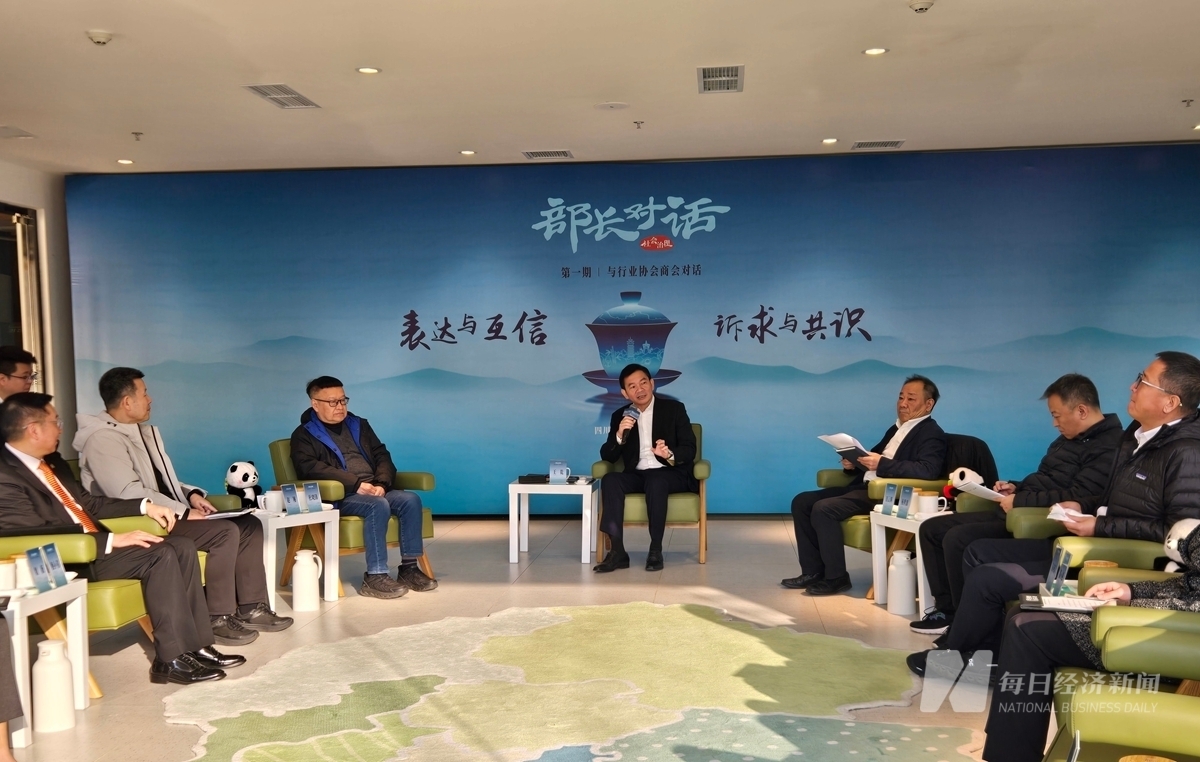
Core Viewpoint - The "Minister Dialogue" event in Sichuan aims to enhance interaction between government officials and industry associations, addressing challenges and opportunities for industry development through collaborative discussions [2][9]. Group 1: Industry Association Challenges - Industry associations face significant challenges, including identity issues, survival difficulties, talent shortages, ecological problems, and leadership crises [8]. - The identity issue arises from a lack of clear legal authorization, hindering associations' ability to perform essential functions like industry statistics and credit evaluation [8]. - The ecological problem is characterized by multiple associations within the same industry, leading to resource fragmentation and increased burdens on member enterprises [8]. Group 2: Government and Industry Collaboration - The government emphasizes the need for industry associations to align with local government enterprise service centers to enhance service quality [6]. - The provincial government is considering special support for associations like the New Display Association to further explore their role in empowering industry development [6]. - The dialogue format allows for open discussions, enabling associations to express their concerns and collaboratively seek solutions [2][4]. Group 3: Economic Performance and Industry Growth - Sichuan's GDP reached 49,322.2 billion yuan, with a year-on-year growth of 5.5%, and the industrial added value increased by 7.1% [4]. - The electronic information industry has been a leader with a growth rate of 15.8%, maintaining double-digit growth throughout the year [4]. - The provincial government has implemented a collaborative mechanism to promote key industries, focusing on building strong industry chains and enhancing resource integration [4][3]. Group 4: Future Directions for Industry Associations - There is a consensus on restructuring industry associations from a supply chain perspective to better serve the industry and enhance regional collaboration [3][7]. - Suggestions include establishing a "total association + professional sub-association + alliance" model to maintain professionalism while reducing the burden on enterprises [8]. - The provincial government is exploring the feasibility of drafting regulations to clarify the legal functions of industry associations, aiming to integrate and optimize their roles [8][9].
新质服务风起:产业转型升级催生万亿市场需求
2 1 Shi Ji Jing Ji Bao Dao· 2025-12-05 10:55
Group 1 - The core viewpoint of the article emphasizes the acceleration of innovation capabilities in China's industries, driven by policy support for cultivating new productive forces, leading to the upgrading of traditional industries and the rapid development of emerging industries [1][3]. - The emergence of new quality services is identified as a crucial engine for cultivating new productive forces, characterized by new dynamics through innovative production factors like information technology and AI, new ecosystems relying on collaborative partnerships, and new paradigms promoting deep industry integration [2][3]. Group 2 - The demand for new quality services is closely linked to China's focus on developing new productive forces, as highlighted in the "14th Five-Year Plan," which aims for significant breakthroughs in high-quality development and the construction of a modern economic system [4][5]. - Since the "14th Five-Year Plan," the average annual growth rate of the added value of high-tech manufacturing has been 9.2%, with projections indicating that by 2024, it will account for 16.3% of the total industrial added value [5]. - The "Two New" policies, which include large-scale equipment updates and the replacement of consumer goods, are expected to release market potential worth trillions, marking a significant step in the comprehensive deepening of these policies [5][6]. Group 3 - The new quality service market is entering a trillion-level explosive growth phase, with key sectors such as industrial, electronics, transportation, medical, and construction serving as core areas for this development [6][7]. - In the industrial sector, the demand for equipment updates is driving the foundation of the new quality service market, with policies promoting upgrades in high-end equipment and digital transformation [6][7]. - The medical sector's new quality services focus on intelligent equipment upgrades, digital diagnosis, and green construction, supported by increasing policy backing and rapid market growth [7]. Group 4 - The transportation sector is a key application area for equipment updates and dual transformation, with the shift to new energy vehicles and the development of smart logistics driving the new quality service market [7]. - In the construction sector, new quality services are centered on the renovation of old buildings, smart building construction, and the application of green materials, driven by urban renewal initiatives and carbon neutrality requirements [7][8]. - Overall, new quality services are seen as an inevitable trend in economic development, serving as a vital support for optimizing and upgrading the economic structure, driven by technological innovation and user demand [8].
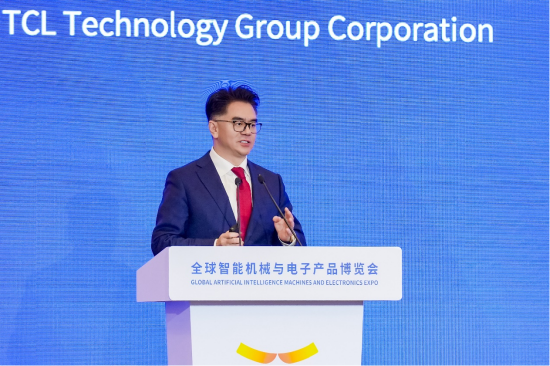
TCL科技COO王成:AI向实,产业发展更具韧性与活力
Xin Lang Cai Jing· 2025-12-05 04:25
Core Insights - TCL Technology has evolved into a global advanced manufacturing group over 44 years, focusing on technological breakthroughs, AI empowerment, ecosystem alliances, and building a complete industrial chain to promote the development of the electronic information industry [1][4]. R&D and Innovation - Over the past six years, TCL has invested more than 60 billion yuan in R&D and has filed over 110,000 patents covering key strategic technologies, material technologies, equipment technologies, and device process technologies [1][4]. AI Strategy - TCL has introduced the "AI to Reality" strategy, integrating AI technology deeply into the entire industrial development process to enhance resilience and vitality [3][6]. - In manufacturing, AI technology is reshaping traditional production models, optimizing costs, improving efficiency, and upgrading quality [3][6]. - In R&D, the use of "AI + simulation" and "Star Intelligence Model" aims to reduce costs and increase efficiency in technological innovation [3][6]. - In operations, intelligent agents are being integrated throughout the business process to promote comprehensive intelligent upgrades [3][6]. Future Investments - To position itself in the next generation of display industry core competitiveness, TCL has initiated the construction of its first high-generation printed OLED production line, the TCL Huaxing T8 project, with an initial investment of 29.5 billion yuan [3][6]. Product Showcase - During the expo, TCL showcased several smart terminal products and cutting-edge technologies, including the TCL SQD-Mini LED TV, Blue Wing fresh air conditioner, Cold Pudding ice-making refrigerator, Big Eye Meng Ultra washing and drying machine, and Thunderbird AR/AI glasses [3][6].

大湾区内地九市GDP达11.54万亿元!广东促进粤港澳大湾区内地九市内涵式高质量发展
Nan Fang Nong Cun Bao· 2025-12-05 03:34
大湾区内地九市 GDP达11.54万 亿元!广东促进 粤港澳大湾区内 地九市内涵式高 质量发展_南方 +_南方plus 12月4日,广东 省第十四届人大 常委会第二十二 次会议审议通过 《广东省人民代 表大会常务委员 会关于促进粤港 澳大湾区内地九 市内涵式高质量 发展的决定》 (以下简称《决 定》)。当日下 午,省人大常委 会召开新闻发布 会,就《决定》 的背景意义、主 要内容及实施路 径进行权威解 读。省人大环境 资源委主任委员 任小铁、省发展 改革委副主任朱 伟等出席发布 会。 据介绍,《决 定》由七个部分 二十二条构成。 第一部分,创新 协同机制,着力 优化现代化城市 体系;第二部 分,激活发展空 间,着力推动率 先实现集约高效 发展;第三部 分,壮大发展动 能,着力建设全 球科技创新高地 和新兴产业未来 产业重要策源 地;第四部分, 彰显湾区特色, 着力锻造具有全 球竞争力的蓝色 引擎;第五部 分,坚持人民至 上,着力营造世 界级宜居宜业宜 游的优质生活 圈;第六部分, 聚集高端要素, 着力建成高水平 对外开放国际枢 纽;第七部分, 加强统筹实施, 着力凝聚推进大 湾区建设的合 力。 四大创新亮点 ...

中经评论:打造智能工厂金字塔
Jing Ji Ri Bao· 2025-12-04 23:57
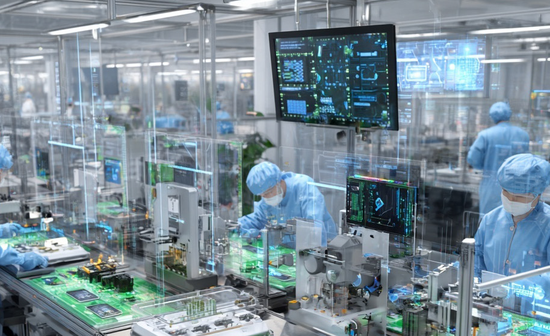
Core Insights - The Ministry of Industry and Information Technology and five other departments have announced the first batch of 15 leading smart factories, covering key industries such as equipment manufacturing, raw materials, electronics, and consumer goods, providing a clear path for the intelligent transformation of manufacturing enterprises [1] - Leading smart factories represent the pinnacle of smart manufacturing in China, serving as benchmarks for future manufacturing models and global competitiveness [1][2] - The cultivation of smart factories follows a gradient approach, categorized into four levels: basic, advanced, excellent, and leading, allowing enterprises at different stages to set achievable goals [1][2] Group 1 - Leading smart factories have an intelligent penetration rate exceeding 80% and are accelerating integration into high-value upstream and downstream supply chain segments [1] - The gradient cultivation strategy aims to prevent ecological imbalance by fostering a broad base of basic smart factories, enabling small and medium-sized enterprises to keep pace with technological advancements [2] - Advanced and excellent smart factories act as a core force, disseminating experiences from leading factories to specialized fields, creating a ripple effect [2] Group 2 - To enhance global competitiveness, leading smart factories must leverage artificial intelligence, with a requirement for at least 60% of their applications to involve AI technology [2] - Small and medium-sized enterprises face challenges in transformation due to high costs, risks, and a lack of technology and talent, necessitating low-cost transformation solutions and shared service platforms [3] - The evolution of smart manufacturing in China has progressed from isolated breakthroughs to systemic collaboration, indicating a significant historical leap towards becoming a manufacturing powerhouse [3]