纺织服装
Search documents
魏建国:非洲价值超5000万美元的基建项目,31%都有中国企业参与
Feng Huang Wang Cai Jing· 2025-09-24 14:34
Core Insights - The global economic and trade landscape is undergoing profound restructuring, presenting both challenges and opportunities for businesses [1][2]. Group 1: New Economic Landscape - The new global economic structure is characterized by a coexistence of "six transformations," including the simultaneous presence of group and fragmentation, multi-polarity and bilateralism, as well as service-oriented and green economies [2]. - Regional trade agreements, such as the Regional Comprehensive Economic Partnership (RCEP), now cover over 30% of global GDP, with 90% of tariffs within the region eliminated, leading to a 9% increase in China's exports to ASEAN [2]. - The service trade is becoming a new engine for global economic growth, with a projected total of $8.6 trillion in global service trade by 2024, reflecting a 9% year-on-year growth, significantly outpacing global GDP growth [2]. Group 2: Opportunities for Chinese Enterprises - The rise of emerging markets opens new avenues for Chinese enterprises, with China signing cooperation memorandums with 52 African countries, participating in 31% of infrastructure projects valued over $50 million in Africa [3]. - The implementation of multiple free trade agreements is helping traditional industries in China, such as home appliances and textiles, regain market share through tariff reductions and streamlined customs processes [3]. - China's cross-border e-commerce import and export volume reached 2.63 trillion yuan, marking a 10.8% year-on-year increase, maintaining its position as the global leader for 15 consecutive years [3]. Group 3: Challenges for Chinese Enterprises - Chinese enterprises face increasing uncertainties and costs due to rising geopolitical tensions and trade protectionism, which complicate their operational landscape [3]. - The global supply chain is trending towards regionalization and shorter chains, intensifying international competition [3]. - To navigate this complex environment, Chinese enterprises must accelerate technological innovation and brand development, reshaping their global strategies to enhance competitiveness [3].
魏建国:非洲价值超5000万美元的基建项目,31%都有中国企业参与
凤凰网财经· 2025-09-24 14:08
Core Viewpoint - The forum "Phoenix Bay Area Finance Forum 2025" emphasizes the need for a new perspective and courage to embrace the evolving global economic landscape, highlighting the profound changes and opportunities present in the current era [1][3]. Group 1: Global Economic Landscape - The global economic landscape is characterized by a complex coexistence of six trends: 1. Coexistence of group and fragmentation, with regional trade agreements like RCEP covering over 30% of global GDP and reducing tariffs within the region, while exclusive agreements like CPTPP increase trade barriers [4]. 2. Coexistence of multipolarity and bilateralism, with a trend towards a multipolar distribution of economic power and an increase in bilateral trade agreements among major economies [5]. 3. Coexistence of service-oriented and green economies, with global service trade projected to reach $8.6 trillion in 2024, growing at 9%, significantly outpacing global GDP growth [5]. Group 2: Opportunities and Challenges for Chinese Enterprises - The new economic landscape presents vast opportunities for Chinese enterprises, particularly through the rise of emerging markets. China has signed cooperation memorandums with 52 African countries, participating in 31% of infrastructure projects valued over $50 million [6]. - The implementation of multiple free trade agreements has allowed traditional industries like home appliances and textiles to regain market share through tariff reductions and streamlined customs processes [6]. - Chinese cross-border e-commerce reached 2.63 trillion yuan, growing by 10.8%, maintaining its position as the global leader for 15 consecutive years. Platforms like TikTok facilitate direct access for "Made in China" products to global consumers, with exports of green products like electric vehicles and lithium batteries exceeding 1 trillion yuan [6]. - However, challenges such as rising geopolitical tensions and trade protectionism increase operational uncertainties and costs for Chinese enterprises. The trend towards regionalization and shorter supply chains intensifies international competition [6]. - To navigate these challenges, Chinese enterprises are urged to accelerate technological innovation and brand development, reshaping their global strategies to enhance competitiveness [6][7].
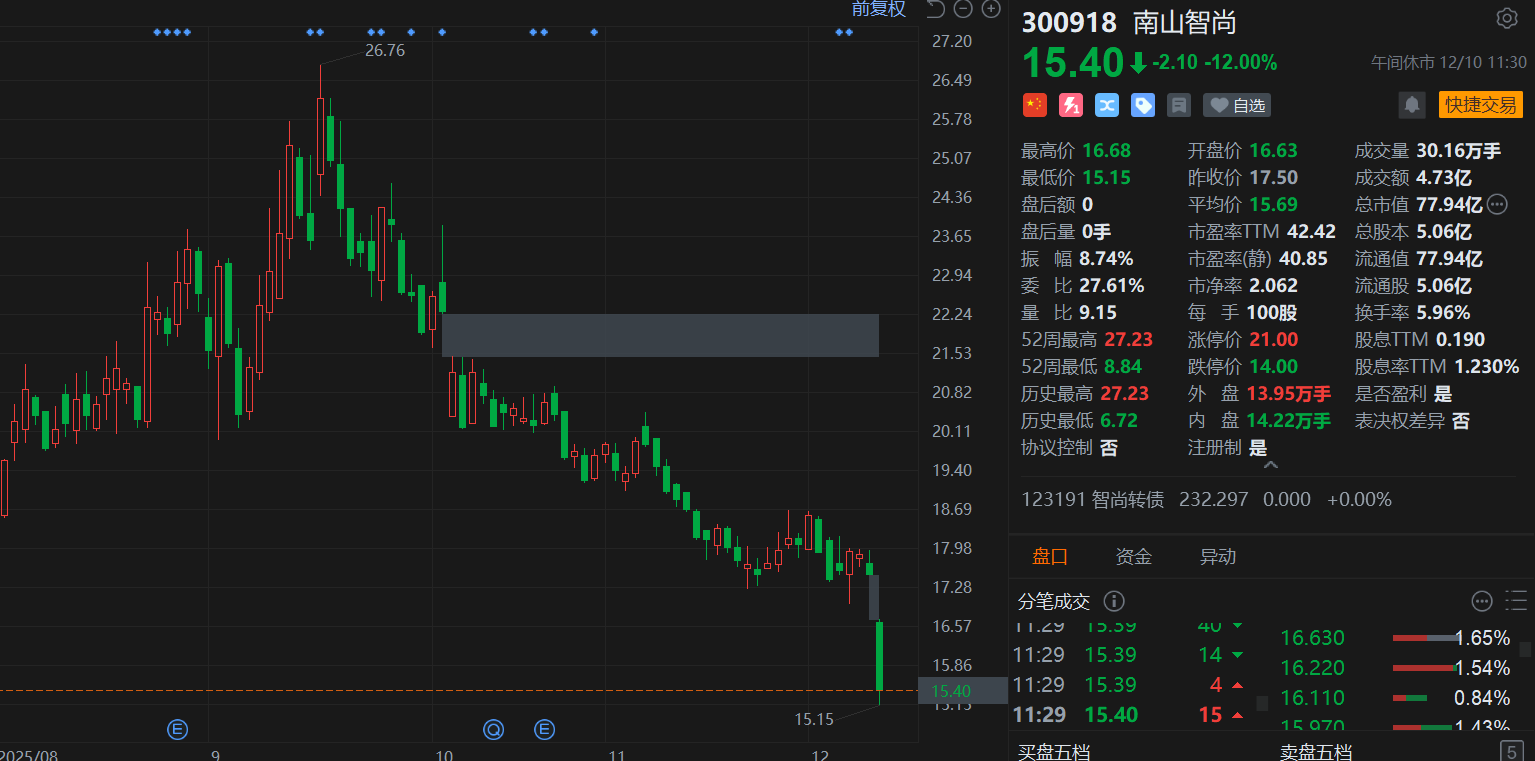
南山智尚:上半年营收同比下降5.8% 员工持股计划全年目标增长15%
2 1 Shi Ji Jing Ji Bao Dao· 2025-09-24 02:49
Core Viewpoint - Nanshan Zhishang (300918.SZ) announced a 2025 employee stock ownership plan on September 24, aiming to enhance employee engagement and align interests with company performance through share repurchase [1] Group 1: Employee Stock Ownership Plan - The plan will cover up to 40 participants, including directors, executives, and key personnel, with a maximum fundraising scale of 62.55 million yuan [1] - Participants can subscribe using interest-free loans provided by the controlling shareholder, Nanshan Group [1] Group 2: Performance Targets - The company has set performance assessment targets requiring a minimum of 15% revenue growth in 2025 compared to 2024, and either a 45% revenue growth or a 20% net profit growth in 2026 [1] Group 3: Recent Financial Performance - In the first half of 2025, the company reported revenue of 731 million yuan, a year-on-year decline of 5.8%, and a net profit of 75.15 million yuan, down 8.66% year-on-year [1] - The decline in performance is primarily attributed to the traditional woolen garment business, which has been affected by changes in consumer demand and intensified industry competition [1] - Although the new materials business, particularly ultra-high molecular weight polyethylene fibers, saw revenue growth and secured small orders in the robotics tendon field, its low business proportion could not offset the weakness in the main business [1]
苏州6项职工创新创造成果将亮相工匠大会
Su Zhou Ri Bao· 2025-09-24 00:42
Group 1 - The third National Craftsman Innovation Exchange Conference and Craftsman Forum is being held in Chongqing from September 23 to 26, organized by the All-China Federation of Trade Unions in collaboration with the Chongqing Municipal Committee and the Chongqing Municipal Government [1] - The Jiangsu exhibition area, covering 150 square meters, showcases innovations in four main areas: integration of technological and industrial innovation, deep reform and high-level opening-up, implementation of major national development strategies, and promotion of common prosperity for all [1] - Six innovative achievements from Suzhou are featured, including the world's first lightweight jacket produced from a complete negative carbon fiber industrial chain and the first decoupled cold plate liquid cooling system in the communications industry [1] Group 2 - Suzhou's trade unions focus on a comprehensive work mechanism that includes promoting employee technological innovation activities, cultivating innovative talents, supporting innovation projects, and facilitating the transformation of innovation results [2] - The "Thousand Employee Innovation Achievements Promotion Action" has been implemented, along with city-wide innovation achievement display and promotion activities [2] - The establishment of innovation working groups pairing model workers and craftsmen aims to support key employee innovation projects and continuously inspire innovation and efficiency among the workforce [2]
金融活水点绿成金
Jing Ji Ri Bao· 2025-09-23 22:10
Core Viewpoint - The concept of "green finance" is essential for transforming ecological value into economic value, facilitating the transition from "green mountains and clear waters" to "golden mountains and silver mountains" in economic development [1][7]. Group 1: Green Finance and Economic Transformation - Financial institutions are optimizing products and services to direct resources towards energy conservation, environmental protection, and ecological restoration, supporting corporate transformation and achieving a win-win situation between ecological protection and economic development [1]. - The "Big Yucun" development model in Zhejiang Anji integrates resources from surrounding villages, enhancing financing capabilities and risk control through collective development [2][3]. - The total financing amount for the "Big Yucun" project is 1 billion yuan, with a loan term of 18 years, utilizing a syndicate loan model to meet the financing needs of borrowers [2]. Group 2: Innovative Financing Methods - Zhejiang Anji Yucun Construction Holding Group is exploring various financing methods, including PPN (Private Placement Notes) and CMBS (Commercial Mortgage-Backed Securities), to support its projects [2]. - The green financing balance of Industrial Bank's Hangzhou branch reached 221.9 billion yuan, with green loans amounting to 139.9 billion yuan as of June this year [3]. Group 3: Case Studies of Green Transformation - Huafeng Group utilizes recycled plastic bottles to produce sustainable fibers for sportswear, supported by timely financial assistance from Industrial Bank [4][5]. - The bank has provided over 14 billion yuan in financing support to 129 shoe and clothing enterprises in Putian, facilitating their transition from OEM production to brand development [5]. Group 4: Climate-Friendly Financial Mechanisms - Industrial Bank has established a scoring system for climate-ecological friendly projects, linking loan interest rates to project performance in climate resilience and ecological value [6][7]. - The bank has issued 245 million yuan in loans for the Moganshan tourism project, promoting its development as an international rural tourism model [7]. Group 5: Bridging Environmental and Economic Value - Various financial institutions are innovating to quantify ecological value, such as ESG-linked loans and carbon credit-based financing, to address the challenges of financing ecological projects [8].
9月上半月越南进出口增速放缓
Shang Wu Bu Wang Zhan· 2025-09-23 15:52
Core Insights - Vietnam's total goods import and export value for the first half of September 2025 reached 39.05 billion USD, reflecting a month-on-month decrease of 3.25% [1] - The export value was 19.2 billion USD, down 4.3% month-on-month, primarily due to significant declines in four major product categories [1] - The import value was 19.85 billion USD, showing a month-on-month decrease of 2.21%, with declines concentrated in two main categories [1] Export Analysis - The decline in exports was driven by significant drops in textile and garment exports (335 million USD), footwear exports (250 million USD), mobile phones and components (120 million USD), and wood and wooden products (110 million USD) [1] - The data indicates a weakening external demand, particularly for labor-intensive products heavily reliant on large markets such as the US and Europe [1] - Foreign investment continues to play a dominant role in exports, accounting for 79.2% of total exports, highlighting a slow growth rate for domestic enterprises [1] Import Analysis - The decrease in imports was primarily focused on two categories: computers, electronic products, and components (210 million USD decrease), which, despite the largest drop, remained the highest import category; and machinery, tools, and components (120 million USD decrease) [1]
旧瓶装新酒!纺织服装行业近期频现涨停股
Mei Ri Jing Ji Xin Wen· 2025-09-23 13:22
Market Overview and Sector Characteristics - The overall market showed a U-shaped trend with the Shanghai Composite Index down by 0.18%, while individual stocks experienced more declines than gains, with a median drop of 1.54% [2] - A total of 50 stocks hit the daily limit up, a decrease of 15 from the previous day, while 9 stocks hit the limit down, an increase of 1 [2] - The sectors with the most limit-up stocks included automotive parts, textiles and apparel, and semiconductors [3] Industry Analysis - In the automotive parts sector, 6 stocks reached the limit up, driven by consumer upgrades and demand growth for new energy vehicles, supported by policy incentives [4] - The textile and apparel sector saw 4 stocks limit up, attributed to a recovery in consumer demand and the arrival of peak season [4] - The semiconductor sector also had 4 stocks limit up, benefiting from technological breakthroughs and a recovery in demand [4] Conceptual Characteristics - The most prominent concepts among limit-up stocks included domestic chips (10 stocks), robotics (8 stocks), and computing power (5 stocks) [5] - The domestic chip sector is driven by policy support and the need for self-sufficiency, while the robotics sector benefits from policy backing and technological advancements [5] Limit-Up Stock List - Among the limit-up stocks, 9 reached historical highs, including Heertai, Changchuan Technology, Zhangjiang Hi-Tech, and others [6] - 17 stocks reached near one-year highs, indicating strong performance in the market [7] Main Capital Inflows - The top five stocks with the highest net capital inflow included Wolong Materials, Changchuan Technology, Wanxiang Qianchao, Yongding Co., and Dayang Electric [9] - The stocks with the highest capital inflow as a percentage of market value were Ningbo Shipping, Taimushi, Nanjing Port, Dalong Real Estate, and Xidian Co. [8] Continuous Limit-Up Stocks - The stocks with the most consecutive limit-ups included Hangdian Co. (6 consecutive), Tianpu Co. (4 consecutive), and others [10] - A total of 32 stocks made their first limit-up today, with 11 stocks achieving two consecutive limit-ups, and 7 stocks achieving three or more [10]
广州番禺“顶流”商圈,如何靠硬实力跻身世界级城市会客厅?
Nan Fang Du Shi Bao· 2025-09-23 13:11
Core Insights - The article highlights the transformation of Panyu's Changlong Wanbo Business District into a vibrant hub for fashion and commerce, showcasing its evolution from a manufacturing base to a fashion capital and a top headquarters economy zone in China [1][2][13]. Group 1: Fashion Industry Development - The 2025 Guangdong Fashion Week, held in Panyu, features over 80 themed events and attracts more than 200 brands, generating over 1 billion yuan in intended cooperation [2][4]. - The textile and apparel industry in Panyu is projected to grow by 16.48% in 2024, reaching a scale of 21.406 billion yuan [2]. - The number of "Four Up" enterprises in Panyu is increasing, from 206 in 2023 to 225 in the first half of 2025, indicating a growth of 4% [2]. Group 2: Business District Expansion - The Changlong Wanbo Business District has over 30,000 market entities as of the first half of 2025, with more than 600 "Four Up" enterprises, reflecting double-digit growth [7][9]. - The district has been recognized as one of the "Top 20 Competitive Headquarters Economies in China" and has received multiple national honors for its economic development [7][13]. - The area is undergoing expansion from 1.5 square kilometers to 7.2 square kilometers, enhancing its status as a southern CBD in Guangzhou [13][16]. Group 3: Consumer Experience and Market Dynamics - The introduction of the "7×24" night economy model in the Changlong Wanbo Business District has increased nighttime foot traffic by over 30% [10][12]. - The upcoming K11 Select, the first in the Greater Bay Area, aims to provide a modern shopping experience that integrates local culture [12]. - The district features a mix of traditional shopping centers and open park-style commercial areas, creating a diverse consumer landscape [10]. Group 4: Infrastructure and Connectivity - The opening of the Guangzhou East Ring Intercity Railway and the Pailian Intercity Railway enhances connectivity, making the district a key transportation hub [1][13]. - The district is strategically positioned with access to multiple subway lines and intercity routes, facilitating business and tourism [13][14]. - Plans for a 10-kilometer golden corridor from Changlong Wanbo to Guangzhou South Station aim to further integrate the area into the broader urban fabric [16].
旧瓶装新酒!纺织服装行业近期频现涨停股——道达涨停复盘
Mei Ri Jing Ji Xin Wen· 2025-09-23 13:02
Market Overview - The overall market showed a U-shaped trend with the Shanghai Composite Index down by 0.18%, while the median change for individual stocks was -1.54% [2] - A total of 50 stocks hit the daily limit up, which is a decrease of 15 from the previous day, while 9 stocks hit the limit down, an increase of 1 [3] Sector Characteristics - The sectors with the most limit-up stocks today were automotive parts, textiles and apparel, and semiconductors [4] - The top three concepts for limit-up stocks were domestic chips, robotics, and computing power [5] Sector Summary | Sector | Limit-Up Stocks | Sector Logic | Specific Stocks | |---------------------|----------------|-------------------------------------------------------|-----------------------------------------------------| | Automotive Parts | 6 | Growth in automotive consumption and new energy vehicles, supported by policy [5] | | Textiles and Apparel | 4 | Recovery in consumption and arrival of peak season [5] | | Semiconductors | 4 | Benefiting from technological breakthroughs and demand recovery [5] | Concept Summary | Concept | Limit-Up Stocks | Concept Logic | Specific Stocks | |---------------------|----------------|-------------------------------------------------------|-----------------------------------------------------| | Domestic Chips | 10 | Policy support and demand for self-sufficiency [6] | Initial Ling Information, Heertai, Dazhong Public, etc. | | Robotics | 8 | Supported by policy and technological breakthroughs [6] | | Computing Power | 5 | Driven by policy support and increasing data demand [6] | Notable Limit-Up Stocks - 9 stocks reached historical highs, indicating strong market interest and a clear upward trend [7] - 17 stocks reached new highs in the past year, suggesting significant breakout trends [8] Main Capital Inflows - The top 5 stocks with the highest net inflow of main capital included Wolong Material, Changchuan Technology, and Wanxiang Qianchao, indicating strong market interest [9] Capital Inflow Proportions - The top 5 stocks by net inflow as a percentage of market value included Ningbo Shipping and Taimao, highlighting significant investor interest [10] Limit-Up Stock Trends - There were 32 first-time limit-up stocks today, 11 with two consecutive limit-ups, and 7 with three or more consecutive limit-ups, indicating strong market momentum [11]
嘉麟杰上半年净利大增27% 轻工业稳增长方案促出口新机遇
Zhong Jin Zai Xian· 2025-09-23 10:48
Core Viewpoint - The Chinese light industry is experiencing a new development opportunity due to precise growth policies, with Shanghai Jialinjie Textile Co., Ltd. exemplifying success through high-end and intelligent strategies, as evidenced by significant profit and cash flow increases in the first half of 2025 [1]. Group 1: Financial Performance - The company reported a net profit increase of 27.38% in the first half of 2025, with operating cash flow surging over 30 times, indicating a strong recovery and operational efficiency [1][2]. - The net cash flow from operating activities reached 62.58 million yuan, a substantial increase of 3005.17% year-on-year, reflecting enhanced collection capabilities [2]. - The weighted average return on net assets rose to 2.82%, an increase of 0.58 percentage points year-on-year, while earnings per share grew by 27.76% to 0.0359 yuan per share, showcasing excellent cost control and operational efficiency [2]. Group 2: Business Segmentation - The company achieved a total revenue of 616 million yuan in the first half of 2025, with the apparel business contributing 427 million yuan, a year-on-year growth of 8.66%, accounting for 69.29% of total revenue [3]. - Despite a slight adjustment in fabric business revenue, the gross margin increased by 3.02 percentage points, indicating successful product structure optimization and high-end strategy implementation [3]. - The company demonstrated significant profitability resilience compared to the industry, which faced a 7.6% year-on-year decline in profits for large enterprises from January to May 2025, thanks to high-value-added products like functional fabrics and wool knits [3]. Group 3: Market Outlook and Policy Support - Recent joint announcements from the Ministry of Industry and Information Technology, the Ministry of Commerce, and the State Administration for Market Regulation provide favorable expectations for the export business, supporting new foreign trade formats like cross-border e-commerce [4]. - The policies aim to promote generative artificial intelligence in product design and production, fostering new growth points in sectors like sports and leisure, which will benefit light industry companies like Jialinjie [4]. - The global trend of consumption upgrading and the rise of health and fitness culture present vast opportunities for functional textiles, aligning with the company's ongoing high-end and intelligent strategies, which are well-supported by domestic growth policies [4].