合成生物

Search documents
“沪”航科创——上海科创产业创新突围样本调研
Shang Hai Zheng Quan Bao· 2025-12-11 18:40
Group 1 - Shanghai's "14th Five-Year Plan" outlines a strategic blueprint for high-quality development, emphasizing innovation and internationalization for local tech companies [1][2] - Companies like Titan Technology, Kasei Biotech, and Yingfang Software are leveraging Shanghai's supportive ecosystem to tackle key technological challenges and expand into global markets [1][2][19] - Kasei Biotech aims to become a pioneer in the global biomanufacturing industry, focusing on high-value utilization of biomass and synthetic biology technologies [4][11][12] Group 2 - Titan Technology has transitioned from a focus on basic manufacturing to a comprehensive production system covering reagents, consumables, and instruments, with significant investments in capacity expansion [19][20][21] - The company has established a full industrial chain and is actively pursuing mergers and acquisitions to enhance its product capabilities and market presence [22][23] - Titan Technology's goal during the "14th Five-Year Plan" is to break into the global market, supported by a strong customer base and ongoing product development [24][25] Group 3 - Yingfang Software has developed a robust disaster recovery system, addressing critical data management needs for various industries, including finance and healthcare [13][14][15] - The company has achieved significant market penetration, serving over 6,000 clients globally, and aims to increase its international revenue share [13][18] - Yingfang Software is focusing on AI integration and international expansion to enhance its competitive edge in the data resilience sector [17][18] Group 4 - Chuangyuan Xinke is advancing communication testing technologies, with a focus on 6G and satellite communication, and has invested heavily in R&D to maintain its competitive position [27][28][29] - The company is expanding its testing capabilities to cover low-altitude and satellite communication, aiming to provide comprehensive testing solutions across various domains [29][30] - Chuangyuan Xinke is also exploring opportunities in the robotics testing sector, recognizing its potential for long-term growth [34][35]




上海高质量孵化器增至18家
Jie Fang Ri Bao· 2025-12-11 05:27
Core Insights - Shanghai has added 6 new high-quality incubators, bringing the total to 18, focusing on emerging industries such as synthetic biology, brain-machine intelligence, and integrated circuits [1][2]. Group 1: New Incubators - The newly added incubators include: - Nest Shanghai Innovation Incubator, focusing on synthetic biology and gene therapy [1] - Sinan Brain-Machine Intelligence Incubator, concentrating on brain-machine interfaces and cognitive disorder interventions [2] - Shanghai Aimi Sanjiang New Materials Innovation Center, targeting new materials and membrane materials [2] - "Shutong Chain Valley" Blockchain Application Innovation Incubator, focusing on blockchain core technologies [2] - "Zero Bay" Science and Technology Innovation Incubator, emphasizing electronic information and advanced equipment [2] - Zhangjiang Gaoke 895 Incubator, serving the integrated circuit design industry [3] Group 2: Focus Areas and Objectives - The high-quality incubators aim to accelerate the construction of local technology enterprises and nurture future industries, with a focus on areas such as large models, quantum optics, intelligent sensing, humanoid robots, and cell and gene therapy [1]. - The Nest Shanghai Innovation Incubator aims to support the biopharmaceutical industry by exploring disruptive life science technologies and establishing a mechanism for technology transfer [1]. - The Sinan Brain-Machine Intelligence Incubator collaborates with academic and medical institutions to create a comprehensive incubation model [2]. - The Shanghai Aimi Sanjiang New Materials Innovation Center has established a full-cycle incubation chain for technology commercialization [2]. - The "Shutong Chain Valley" incubator integrates various application scenarios for blockchain technology to empower startups [2]. - The "Zero Bay" incubator focuses on identifying commercially valuable technologies and projects through collaboration with universities [2].
总市值1.69万亿! 161家国内合成生物上市公司盘点
Sou Hu Cai Jing· 2025-12-11 02:18
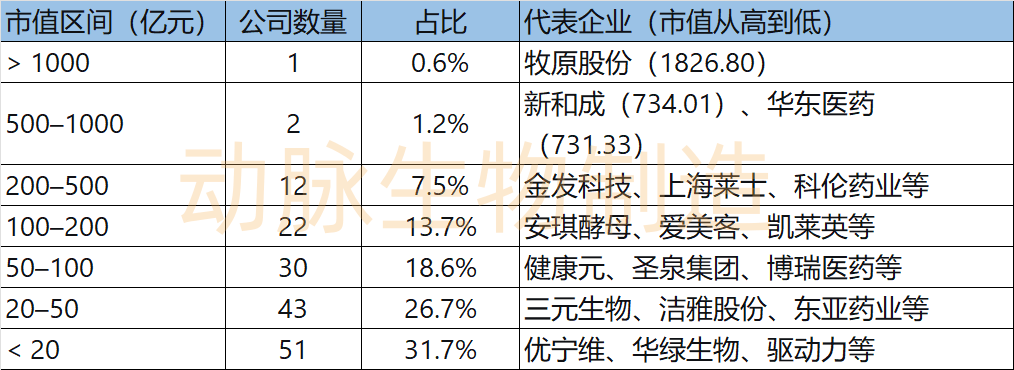
随着十五五年规划建议的正式发布,推动生物制造"成为新的经济增长点"被确定为国家级前瞻布局,这标志着生物制造已从一项前沿技术正式上升至战略 高度。 上市公司作为各行业产业基石,其战略布局、技术优势与资本动向,无疑成为观察中国生物制造从蓝图迈向现实的最生动样本。在这一历史性机遇下,对 合成生物领域上市公司的梳理或许正是一次关键的产业"透视"。 动脉网根据同花顺数据梳理发现,截至2025年你2月9日,A股市场里共有161家公司均属于"合成生物"概念,总市值约1.69万亿,平均市值达到105亿。 从养猪行业的牧原股份,到做维生素的新和成,再到做创新药的华东医药,不同行业的企业都在用合成生物技术改造自身的业务。甚至包括化妆品、宠物 食品甚至电池材料相关企业,都开始与合成生物相结合。 这161家企业就像一面镜子,照出了中国合成生物产业的真实面貌——既有已经盈利的传统业务升级,也有还在摸索的新技术尝试;既有医药健康这样的 主力赛道,也有农业、化工这些正在被改造的传统领域。 01 市值金字塔:161家公司,1.6万亿市场的真实格局 | 市值区间(亿元) | 公司数量 | 出 | 代表企业(市值从高到低) | | --- | ...

总书记的关切·落地的回响丨因地制宜发展新质生产力
Ren Min Ri Bao· 2025-12-11 00:37
原标题:因地制宜发展新质生产力(总书记的关切·落地的回响) "发展新质生产力不是要忽视、放弃传统产业,要防止一哄而上、泡沫化,也不要搞一种模式。各地要 坚持从实际出发,先立后破、因地制宜、分类指导。" ——2024年3月5日,习近平总书记在参加十四届全国人大二次会议江苏代表团审议时强调 驶出青海察尔汗盐湖中央码头,"钾肥10号"采盐船来到碧绿的盐池中作业。 青海盐湖工业股份有限公司钾肥分公司生产车间里,矿浆经过多道工序分离出粒径0.3毫米、钾含量达 95%的钾肥。矿渣被"吃干榨净",成为提锂的重要原料。 2024年6月,习近平总书记在青海考察时指出:"因地制宜改造提升传统产业、发展战略性新兴产业,培 育新质生产力。" 广东深圳光明科学城内,合成生物研究重大科技基础设施的"预约单"排得满满当当。"使用这一'科研利 器',不仅能节省大量投入,还能享受'定制化服务',缩短研发周期,提升效率。"森瑞斯生物科技(深 圳)有限公司研发中心主任黎阳说。 "因地制宜"一词,深刻蕴含着发展新质生产力必须处理好的两组重要辩证关系。 一方面,"传统"与"新兴""未来"产业间不是对立,而是可以相互促进。统筹好培育新动能和更新旧动 能 ...
因地制宜发展新质生产力(总书记的关切·落地的回响)
Ren Min Ri Bao· 2025-12-10 22:11
——2024年3月5日,习近平总书记在参加十四届全国人大二次会议江苏代表团审议时强调 驶出青海察尔汗盐湖中央码头,"钾肥10号"采盐船来到碧绿的盐池中作业。 青海盐湖工业股份有限公司钾肥分公司生产车间里,矿浆经过多道工序分离出粒径0.3毫米、钾含量达 95%的钾肥。矿渣被"吃干榨净",成为提锂的重要原料。 2024年6月,习近平总书记在青海考察时指出:"因地制宜改造提升传统产业、发展战略性新兴产业,培 育新质生产力。" 广东深圳光明科学城内,合成生物研究重大科技基础设施的"预约单"排得满满当当。"使用这一'科研利 器',不仅能节省大量投入,还能享受'定制化服务',缩短研发周期,提升效率。"森瑞斯生物科技(深 圳)有限公司研发中心主任黎阳说。 近年来,深圳形成了链条完整的合成生物产业生态,3年来国内新成立的合成生物企业约有40%落户深 圳。 2025年11月,习近平总书记在广东考察时强调,"着眼发展新质生产力,强化科技创新和产业创新深度 融合"。 "发展新质生产力不是要忽视、放弃传统产业,要防止一哄而上、泡沫化,也不要搞一种模式。各地要 坚持从实际出发,先立后破、因地制宜、分类指导。" 一方面,"传统"与"新兴 ...
连跨3个万亿元台阶,江苏地区生产总值今年有望突破14万亿元
Yang Zi Wan Bao Wang· 2025-12-10 13:42
Economic Growth - Jiangsu's GDP has increased from 10.5 trillion yuan in 2020 to 13.7 trillion yuan in 2024, with expectations to surpass 14 trillion yuan this year, marking the crossing of the fourth trillion yuan milestone during the "14th Five-Year Plan" [1][3] - All 13 cities in Jiangsu have entered the national top 100, reflecting significant economic progress [3] Consumer Market - The retail sales of consumer goods in Jiangsu remain among the highest in the country, with a projected consumption boost of over 351 billion yuan from the "old-for-new" consumption initiative in 2024-2025 [3] - The integration of events and consumption has led to the emergence of new business models, stimulating consumer potential [3] Manufacturing and Innovation - Jiangsu's regional innovation capability has risen to second in the nation, with over 70% growth in high-tech enterprises and significant contributions to patent creation and technological platforms [4] - The province leads the nation in advanced manufacturing clusters and strategic emerging industries, including power batteries, integrated circuits, and biomedicine [4] Environmental Initiatives - Jiangsu is actively promoting carbon neutrality and has launched a provincial carbon footprint public service platform to track emissions across various stages of production [5] - The province has achieved significant environmental quality improvements, with PM2.5 levels meeting national standards for four consecutive years [5] Employment and Social Welfare - Jiangsu has maintained urban employment growth above 10% nationally, with a reduction in the urban-rural income gap to 2.04:1 [6] - The province has established a comprehensive elderly care service system and achieved high rates of basic health insurance coverage [6] Consumer Engagement and Events - The province has issued approximately 2.54 billion yuan in consumption vouchers and digital currency red packets, with over 500,000 businesses participating in the "Su New Consumption + Su Super League" initiative [7] - Various promotional activities, including food festivals and local delicacies, have attracted significant public engagement, enhancing the integration of commerce, culture, and sports [7]
杭州钱塘高新区创新之路:向高而行,向新而生
Xin Lang Cai Jing· 2025-12-10 11:46
Core Viewpoint - The renaming of Xiaoshan Linjiang High-tech Industrial Development Zone to Hangzhou Qiantang High-tech Industrial Development Zone signifies a profound evolution in regional development logic, transitioning from a geographical concept to an industrial capability focus [1][3]. Group 1: Historical Context - The original name "Xiaoshan Linjiang High-tech Zone" reflects a history of entrepreneurship starting from 2003, evolving into a national-level high-tech zone by 2015, despite its initial small area of 3.55 square kilometers [3]. - The establishment of Qiantang New District in 2020 expanded the management area to 531.7 square kilometers, marking a nearly 150-fold physical expansion and a shift in development strategy from isolated park operations to integrated resource utilization [3][4]. Group 2: Development Trajectory - Qiantang High-tech Zone has shown a significant upward trajectory in its national ranking, moving from 138th in 2019 to 69th in 2024, reflecting a cumulative improvement of 69 positions over five years [6]. - The industrial output value of Qiantang is projected to exceed 370 billion yuan in 2024, maintaining its position as the top contributor in Hangzhou for six consecutive years, with over 85% of this output concentrated in five key industries: automotive, pharmaceuticals, semiconductors, chemicals, and aerospace [6][7]. Group 3: Innovation and Future Development - Qiantang is focusing on enhancing its advanced manufacturing cluster through a "296X" plan, which aims to integrate new and traditional industries while fostering emerging sectors like synthetic biology and low-altitude economy [7][9]. - The region is home to Zhejiang's largest higher education park, with 14 universities and 250,000 students, providing a rich source of intellectual resources, although challenges remain in translating academic research into practical applications [10][11]. - A "dual-direction" integration mechanism has been established to connect academic research with industry needs, including initiatives like the "Doctor into Enterprise" program and the creation of industry colleges to address skill shortages [11][12]. Group 4: Strategic Significance - The renaming reflects a strategic shift from merely establishing a high-tech zone to using it as an engine for driving a new industrial city, emphasizing the need for a modern industrial system in Hangzhou [4][9]. - The mission of Qiantang High-tech Zone is to serve as a key engine for cultivating "new productive forces" while leveraging its unique advantages as a composite platform integrating various economic zones [12].
5分钟,一场“细胞级革命”
Xin Hua Ri Bao· 2025-12-07 22:51
以往,酵母细胞计数或通过人工使用显微镜完成,或通过非自动化的传统设备完成,存在费时费力又不 够精准的问题。"市场上精酿啤酒质量、口感参差不齐,就在于一些企业细胞计数的不精准,甚至干脆 省去这一环节。"潘登直言。 □ 本报记者许雯斐 通讯员耿瑞雪王若宇 12月3日晚9点,南京酵富生物技术有限公司(以下简称"酵富生物")创始人潘登风尘仆仆地从外地赶回南 京,便径直返回公司进行盘点。这次当天往返的紧急出差,源于客户对新产品的迫切需求。 酵富生物位于江北新区智能制造产业园,就在近日,其推出颠覆啤酒酿造行业的新产品,全量全自动酵 母细胞计数仪JFYCC-S1,该仪器仅需五分钟即可完成从取样到生成报告的全流程。 潘登此次出差,正是去帮客户调试刚订购的新设备。"我们在全国有1000多家客户,得知我们推出这一 新产品,很多客户主动联系订购。"潘登说。 酵母是神奇的酿酒"魔法师",通过精准调控温度与菌群配比,可以生成不同风味物质,例如酯类产生果 香,酚类带来花香。当代人追捧各式精酿啤酒的迷人风味,正是酵母在其中扮演关键角色。 一罐啤酒发酵时,工作中的酵母细胞数量可达百亿级。而酵母细胞数会影响啤酒风味和发酵的稳定,因 此,唯有精 ...
美妆融资逻辑变了!11月数据给出答案
Sou Hu Cai Jing· 2025-12-06 13:53
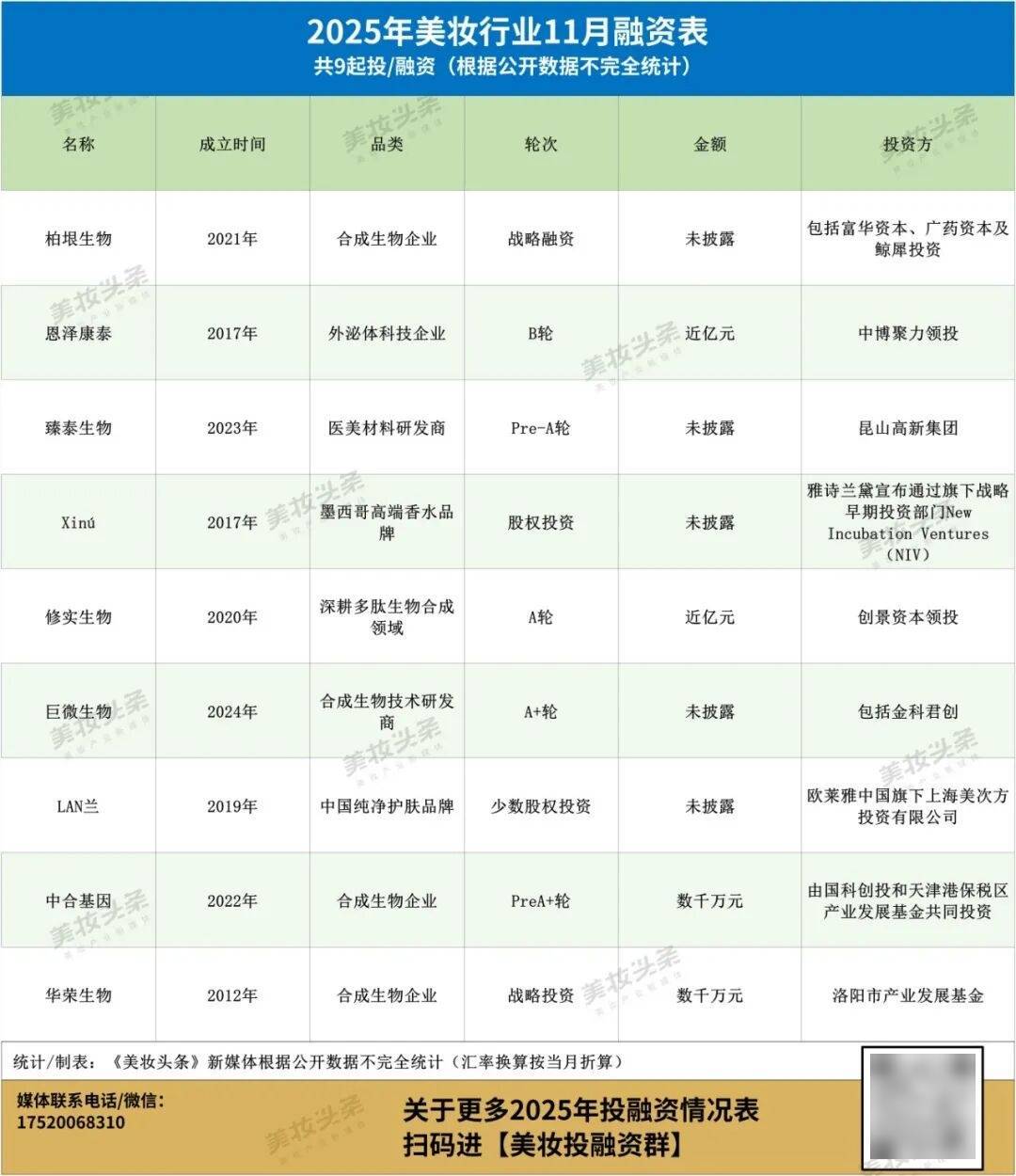
Core Insights - The financing market in November 2025 is characterized by a shift from a focus on traffic to a deeper valuation of the beauty industry, indicating a significant transformation in capital assessment logic [4][5] - The trend shows that capital is increasingly cautious, with a notable concentration of funds towards leading foreign brands, reflecting a "Matthew Effect" in the industry [5][6] Financing Overview - In November 2025, there were 9 financing events exceeding 200 million yuan, but the total financing amount of over 300 million yuan indicates a cooling market compared to previous years [4][5] - The number of financing cases has decreased significantly from 14 in November 2021 to just 5 in November 2024, highlighting a trend of capital retreat from domestic beauty brands [5][6] Upstream Sector Dynamics - The upstream sector remains hot, with 7 out of 9 financing cases involving upstream companies, particularly in synthetic biology, which aligns with the industry's trend towards sustainable and efficient production [6][7] - Notable financing events include nearly 100 million yuan raised by Xiushi Biopharmaceuticals and several million yuan investments in Huaron Biotech, both focusing on synthetic biology [9][11] Brand Investment Trends - Significant investments in brand segments include Estée Lauder's minority stake in the Mexican high-end perfume brand Xinú and L'Oréal's strategic investment in the Chinese pure skincare brand "LAN" [15][19] - The global fragrance market is projected to grow significantly, with estimates reaching between 57 billion to 61 billion USD in 2024, indicating strong potential for investment in this sector [17][19] Future Outlook - The changes in the beauty financing market reflect the natural evolution of the industry, with a focus on technological innovation and niche market development expected to drive future growth [20]

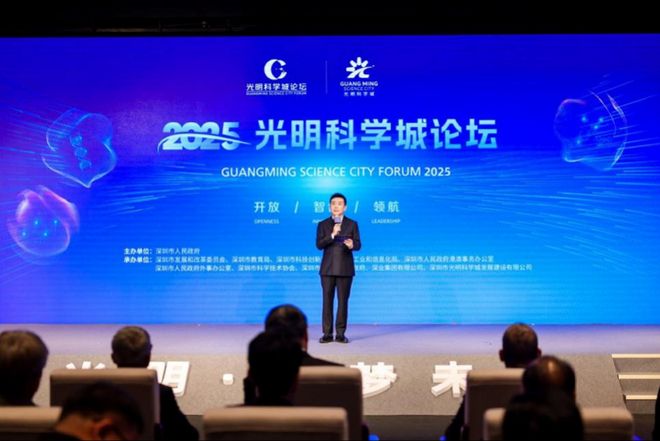
七年蝶变,从光明科学城看深圳科创的厚积薄发
Nan Fang Du Shi Bao· 2025-12-05 15:53
Core Insights - China's innovative drugs, new energy vehicles, and AI electronic products have emerged as the new three major export items, with innovative drug licensing output reaching $93.7 billion in the first three quarters of 2025, accounting for nearly 40% of the global total, reflecting the strong momentum of China's high-quality development [1][24]. Group 1: Major Technological Achievements - The launch of the National Bio-Manufacturing Industry Innovation Center, led by the Shenzhen Institute of Advanced Technology, marks China's only national-level innovation platform in the bio-manufacturing sector, focusing on green low-carbon, bio-agriculture, and medical health [3]. - The completion of the second phase of the Seventh Affiliated Hospital of Sun Yat-sen University in Shenzhen, a modern hospital designed with a patient-centered approach, aims to enhance healthcare innovation in the region [5]. - The Shenzhen Science and Technology Innovation Fund officially commenced operations, aiming to support original innovation and technology breakthroughs through early-stage investments [7]. Group 2: Infrastructure and Collaboration - The establishment of user committees for major scientific infrastructures like synthetic biology research facilities and brain analysis facilities will ensure efficient operation and high-level research output [9]. - The unveiling of the Regional Technology Transfer and Transformation Center for Higher Education Institutions in the Guangdong-Hong Kong-Macao Greater Bay Area will accelerate the conversion of academic research into practical applications [11]. - The emphasis on open collaboration has led to the formation of a global innovation network, enhancing regional cooperation and attracting international research institutions to participate in the development of the Guangming Science City [12]. Group 3: Talent and Innovation Ecosystem - Over the past seven years, Guangming Science City has attracted more than 3,100 high-level talents, including 59 academicians, forming a robust talent pool that supports innovation in fields like brain science and artificial intelligence [24]. - The establishment of a comprehensive open-sharing mechanism for major scientific infrastructures has allowed over 200 users, including universities and research institutions, to access advanced research facilities [25]. - The rise of industrial innovation has led to the development of several billion-dollar industry clusters, including high-end medical devices and synthetic biology, fostering a deep integration of technological and industrial innovation [26].