
数字贸易

Search documents
广东:支持广州、深圳创建国家服务贸易创新发展示范区、数字贸易示范区
Zheng Quan Shi Bao Wang· 2026-01-05 03:19
Core Viewpoint - The Guangdong Provincial Government aims to enhance the development of digital trade and service trade through high-level openness, focusing on establishing various digital service export bases and innovation zones [1] Group 1: Digital Service Export Bases - Support for Guangzhou and Shenzhen to create national service trade innovation development demonstration zones and digital trade demonstration zones [1] - Emphasis on exploring market access for cross-border service trade and improving the entire regulatory chain for cross-border service trade [1] - Establishment of risk management and monitoring early warning mechanisms [1] Group 2: Infrastructure Development - Support for the construction of a data element aggregation development area in Guangzhou's Tianhe Central Business District [1] - Development of a digital service export base in Guangzhou Development Zone, including a public service platform for digital trade [1] - Promotion of artificial intelligence large model demonstration applications in the Guangzhou Pazhou Artificial Intelligence and Digital Economy Experimental Zone [1] Group 3: Digital Trade Port and Innovation - Construction of Dongguan Songshan Lake Digital Trade Port, focusing on information technology outsourcing and knowledge process outsourcing [1] - Development of an artificial intelligence large model center and a developer village to foster innovation in the digital sports health industry [1] - Support for Hengqin to accelerate the establishment of a digital trade international hub port and explore the creator economy [1]
以产教融合创新数字贸易人才培养模式
Xin Lang Cai Jing· 2026-01-01 20:49
Group 1 - The core viewpoint of the articles emphasizes the importance of high-quality composite talents in driving the development of digital trade in China, which is crucial for participating in global economic competition and upgrading foreign trade [1] - The integration of education and industry is highlighted as a key approach to break down barriers between education and industry, providing a new direction for cultivating talents who are proficient in technology, regulations, and practical skills [1] - Establishing a collaborative ecosystem between schools and enterprises is essential for nurturing composite talents, encouraging the development of reverse training programs based on real business standards in areas such as cross-border e-commerce and digital trade compliance [1][2] Group 2 - The articles suggest that universities and enterprises should jointly select valuable projects for teaching, such as designing annual operational plans for cross-border e-commerce platforms and assessing digital trade data security risks [2] - It is important to incorporate regional trade characteristics into training modules, as seen in the example of developing a "Vietnam Digital Trade Training Package" in Guangxi, which addresses specific cross-border e-commerce operations and compliance [2] - A collaborative evaluation system involving government, industry, and educational institutions is proposed to ensure comprehensive assessment of talent development, integrating compliance and industry adaptability into evaluation standards [3] Group 3 - The articles advocate for a process-oriented evaluation approach that reflects both theoretical knowledge and practical project outcomes, ensuring that the evaluation results feed back into the talent cultivation ecosystem [3] - Utilizing big data technology to analyze course quality and its influencing factors is recommended, allowing for targeted improvements in teaching methods and resources based on assessment data [3]
为“十五五”开好局,成都市商务局聚焦消费、外贸、开放三大领域
Sou Hu Cai Jing· 2025-12-30 13:13
Group 1 - The core focus of Chengdu's economic work for 2026 includes stimulating consumer vitality, enhancing foreign trade quality, and deepening open cooperation [1][3] - Chengdu's Commerce Bureau plans to implement special actions to boost consumption, including promoting the exchange of old consumer goods for new ones and expanding the second-hand car market [1] - The city aims to enhance service consumption by improving the quality of sectors such as catering and home services, and by launching initiatives like the "Hundred Products Thousand Stores" plan [1] Group 2 - In terms of enhancing foreign trade quality, Chengdu will strengthen the integration of production and trade, and support enterprises in expanding into diverse markets [3] - The city will promote the integration of trade and investment, as well as domestic and foreign trade, while encouraging the development of new foreign trade models [3] - Chengdu plans to innovate in digital and green trade to create new growth points and aims to include more products in the bonded maintenance directory [3] Group 3 - To deepen open cooperation, Chengdu will align with international high-standard economic and trade rules and implement strategies to enhance its free trade zone [3] - The focus will be on characteristic advantageous industries and emerging strategic industries, promoting a comprehensive open trial across the entire industrial chain [3] - The city aims to enhance the level of trade and investment liberalization and facilitation, while improving the allocation of international high-end factor resources [3]


2025年1-11月天津市贸易统计分析:天津市进出口总额为7630.5亿元,同比增长3.1%
Chan Ye Xin Xi Wang· 2025-12-30 03:06
Group 1 - The core viewpoint of the article highlights the growth in Tianjin's import and export activities, with a total import and export value of 763.05 billion yuan from January to November 2025, representing a year-on-year increase of 3.1% [1] - Exports during the same period reached 394.986 billion yuan, showing a significant year-on-year growth of 11.1%, while imports amounted to 368.069 billion yuan, reflecting a decline of 4.4% [1] - The trade surplus for Tianjin in this timeframe was recorded at 26.917 billion yuan [1] Group 2 - The article references various listed companies, including Zhongcheng Co., Ltd. (000151), Yuanda Holdings (000626), and Xiamen Xinda (000701), among others, indicating their relevance in the context of the digital trade industry [1] - A report by Zhiyan Consulting titled "2026-2032 China Digital Trade Industry Competitive Strategy Research and Future Outlook" is mentioned, suggesting a focus on the competitive landscape and future prospects of the digital trade sector [1] - Zhiyan Consulting is described as a leading industry consulting firm in China, providing comprehensive industry research reports, business plans, feasibility studies, and customized services, emphasizing its expertise and market insight [1]

2025年1-11月陕西省贸易统计分析:陕西省进出口总额为4720.4亿元,同比增长13.7%
Chan Ye Xin Xi Wang· 2025-12-30 03:06
Core Viewpoint - The report highlights the growth of Shaanxi Province's import and export activities, indicating a positive trend in trade performance for the region in 2025 [1] Group 1: Company Information - Listed companies mentioned include Zhongcheng Co., Ltd. (000151), Yuanda Holdings (000626), Xiamen Xinda (000701), and others, indicating a diverse range of firms involved in the trade sector [1] - The report is published by Zhiyan Consulting, a leading industry consulting firm in China, known for its in-depth industry research and comprehensive consulting services [1] Group 2: Trade Statistics - In the period from January to November 2025, Shaanxi Province's total import and export value reached 472.04 billion yuan, representing a year-on-year growth of 13.7% [1] - The export value was 326.695 billion yuan, showing a year-on-year increase of 16.6%, while the import value was 145.342 billion yuan, with a growth of 7.8% [1] - The trade surplus for the same period was 181.353 billion yuan, indicating a strong export performance relative to imports [1]

王立勇:持续提高数字贸易竞争力
Jing Ji Ri Bao· 2025-12-28 23:32
Core Viewpoint - The revised Foreign Trade Law draft emphasizes the support and encouragement of digital trade development, providing legal guarantees for its growth, which is seen as a crucial engine for high-quality foreign trade development in China [1][2]. Group 1: Digital Trade Development - Digital trade is characterized by data as a key production factor, digital services as core content, and digital ordering and delivery as main features, encompassing various sectors such as digital services, digital products, and cross-border e-commerce [1]. - During the "14th Five-Year Plan" period, China has achieved significant expansion, structural optimization, and system improvement in digital trade, enhancing its cultural soft power and international influence through competitive advantages in cloud computing and artificial intelligence [1][2]. Group 2: Policy and Regulatory Framework - The digital trade policy system is gradually being improved with the introduction of laws and regulations such as the "Data Exit Security Assessment Measures" and "Regulations on Promoting and Regulating Cross-Border Data Flow," which strengthen the legal foundation for digital trade [2]. - Core digital trade platforms like free trade pilot zones and national digital service export bases are addressing systemic barriers and generating replicable experiences to unleash the potential of digital trade [2]. Group 3: Challenges and Solutions - Current challenges in China's digital trade include competition for global digital trade rule dominance, insufficient core technology innovation capabilities, and lagging intellectual property protection mechanisms [3]. - To address these challenges, it is essential to enhance innovation-driven development, focus on key technological breakthroughs, and improve digital infrastructure, including advancements in 5G networks and the development of quantum computing [3][4]. Group 4: Regulatory and Institutional Enhancements - There is a need to accelerate the legislative process in the digital trade sector, establishing foundational systems for data property rights, transaction rules, and security guarantees, while creating a modern regulatory framework that aligns with digital trade characteristics [4]. - Optimizing digital trade supervision through the use of big data, artificial intelligence, and blockchain technologies is crucial for effective regulation of business entities [4]. Group 5: Global Integration and Influence - Actively integrating into the global digital trade system and participating in global governance is vital for enhancing China's rule-making power and influence in the digital trade sector [5]. - Strengthening the construction of standardization technical organizations and cultivating influential industry associations will support the expansion of digital trade [5].
“杨数浦·数贸谷”启动 第二届上海数字贸易论坛举办
Jie Fang Ri Bao· 2025-12-27 00:58
Group 1 - The second Shanghai Digital Trade Forum was held, focusing on the theme "Digital New Momentum, Trade New Future," with over a hundred participants from various sectors discussing new trends in digital trade [1] - The "Yangshu Pu·Digital Trade Valley" was launched at the forum, aiming to become a core benchmark and important engine for Shanghai's digital trade development [1] - During the 14th Five-Year Plan period, Shanghai's digital trade scale has reached new heights, with an average annual growth rate of 12% in digital delivery service trade from 2021 to 2024, accounting for approximately 30% of the national total [1] - Shanghai's digital delivery service trade has increased from 70 billion USD to 110 billion USD over the past five years, with cross-border e-commerce representing a significant portion of this growth [1] Group 2 - The "Action Plan for Promoting the Innovative Development of Cultural Trade in Shanghai" was released, aiming to solidify Shanghai's position as a cultural trade hub in China by 2027, targeting a total import and export volume of cultural products and services to reach 32 billion USD [1] - The plan includes initiatives to develop new cultural export categories, strengthen traditional cultural trade advantages, enhance enterprise and platform construction, increase trade promotion efforts, and improve support measures to boost international competitiveness and brand influence [1] - The "Three-Year Action Plan for Promoting the Construction of Digital Trade Gathering Area in Yangpu District" was also published, with a goal to establish a robust digital trade zone by 2027, characterized by solid industrial foundations, diverse business models, leading standards, convenient business environments, alignment with international rules, and sound regulatory systems [2]
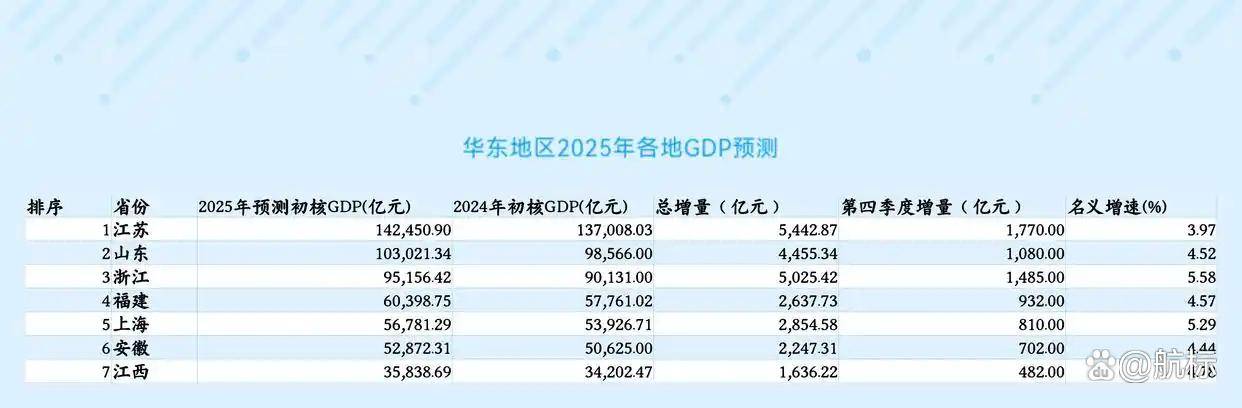
华东6省1市2025年GDP预测:江苏增速不到4%,浙江约10万亿,福建任超上海!
Sou Hu Cai Jing· 2025-12-26 19:03
Group 1 - The core viewpoint of the article highlights the economic competition in the East China region, with Jiangsu, Zhejiang, and Fujian showcasing their GDP forecasts for 2025, revealing underlying development dynamics [1] - Jiangsu is projected to have a GDP of 14.25 trillion, maintaining its leading position, but its growth rate has decreased to 3.97% [1][5] - Zhejiang's GDP is forecasted at 9.52 trillion, nearing the 10 trillion mark, driven by its digital economy and strong private sector [1][4] Group 2 - Fujian's GDP is expected to reach 6.04 trillion, surpassing Shanghai, supported by its strategic position in cross-strait cooperation and marine economy [1][6] - The article emphasizes the interplay between national strategies and local characteristics, questioning the sustainability of Fujian's growth, Zhejiang's potential to break the 10 trillion barrier, and Jiangsu's need for transformation amid slowing growth [1][6]
学习规划建议每日问答丨如何理解创新发展数字贸易
Xin Hua Wang· 2025-12-26 00:38
Core Viewpoint - The article emphasizes the importance of "innovative development of digital trade" as outlined in the Central Committee's suggestions for the 15th Five-Year Plan, highlighting digital trade as a key component of international trade and economic growth [1] Group 1: Current State of Digital Trade in China - China's digital trade has rapidly developed and is now one of the "three pillars" of trade power alongside goods and services trade [1] - The scale of digitally deliverable services imports and exports is projected to reach 2.9 trillion yuan in 2024, with a year-on-year growth of 6.5% [1] - The total import and export volume of cross-border e-commerce is expected to reach 2.7 trillion yuan, reflecting a year-on-year increase of 14% [1] - Key sectors such as digital films, online games, and digital technology trade are gaining global popularity, with a strong foundation provided by China's second-largest digital economy and vast consumer market [1] Group 2: Challenges in Digital Trade Development - Challenges include the need for improved openness in the digital services market, the necessity for a more robust digital governance system, and the fragmentation of international digital trade rules [2] Group 3: Strategies for Innovation in Digital Trade - The first strategy is to expand foreign access to the digital sector by relaxing market entry restrictions and encouraging foreign investment [2] - The second strategy focuses on developing new business models and enhancing the quality of digital content, particularly in sectors like digital films, online education, and digital finance [3] - The third strategy involves creating high-level open platforms for digital trade, including establishing national digital trade demonstration zones and enhancing the competitiveness of digital service exports [3] - The fourth strategy emphasizes deepening international cooperation in digital trade, participating in rule-making, and expanding partnerships with countries in ASEAN, Central Asia, BRICS, and the Shanghai Cooperation Organization [4]
如何理解创新发展数字贸易
Xin Lang Cai Jing· 2025-12-25 19:23
Core Viewpoint - The article emphasizes the significance of innovating and developing digital trade as a new trend in international trade and a new growth point for the economy, as outlined in the recommendations for the 15th Five-Year Plan by the Central Committee of the Communist Party of China [1]. Group 1: Current State of Digital Trade - China's digital trade has rapidly developed and has become one of the "three pillars" of trade power construction alongside goods and service trade, with a projected scale of digital service imports and exports reaching 2.9 trillion yuan in 2024, a year-on-year increase of 6.5% [1]. - The total import and export volume of cross-border e-commerce is expected to reach 2.7 trillion yuan, reflecting a year-on-year growth of 14% [1]. - Key sectors such as digital films, online games, and digital technology trade are gaining global popularity, with significant growth potential in digital service trade [1]. Group 2: Challenges in Digital Trade - The development of digital trade in China faces challenges, including the need for improved openness in the digital service market, a more refined digital governance system, and fragmented international digital trade rules [2]. Group 3: Strategies for Innovation in Digital Trade - The article outlines four key areas for enhancing digital trade: 1. Expanding foreign access to the digital sector by relaxing market entry restrictions and promoting foreign investment in telecommunications, internet, and cultural sectors [2]. 2. Developing new business models and applications in digital trade, focusing on enhancing the quality of digital content and expanding export channels for digital products [3]. 3. Establishing high-level open platforms for digital trade, including the creation of national digital trade demonstration zones and enhancing the competitiveness of digital service exports [3]. 4. Deepening international cooperation in digital trade by participating in the formulation of relevant rules and expanding partnerships with ASEAN, Central Asian countries, BRICS nations, and members of the Shanghai Cooperation Organization [4].