
海洋经济

Search documents
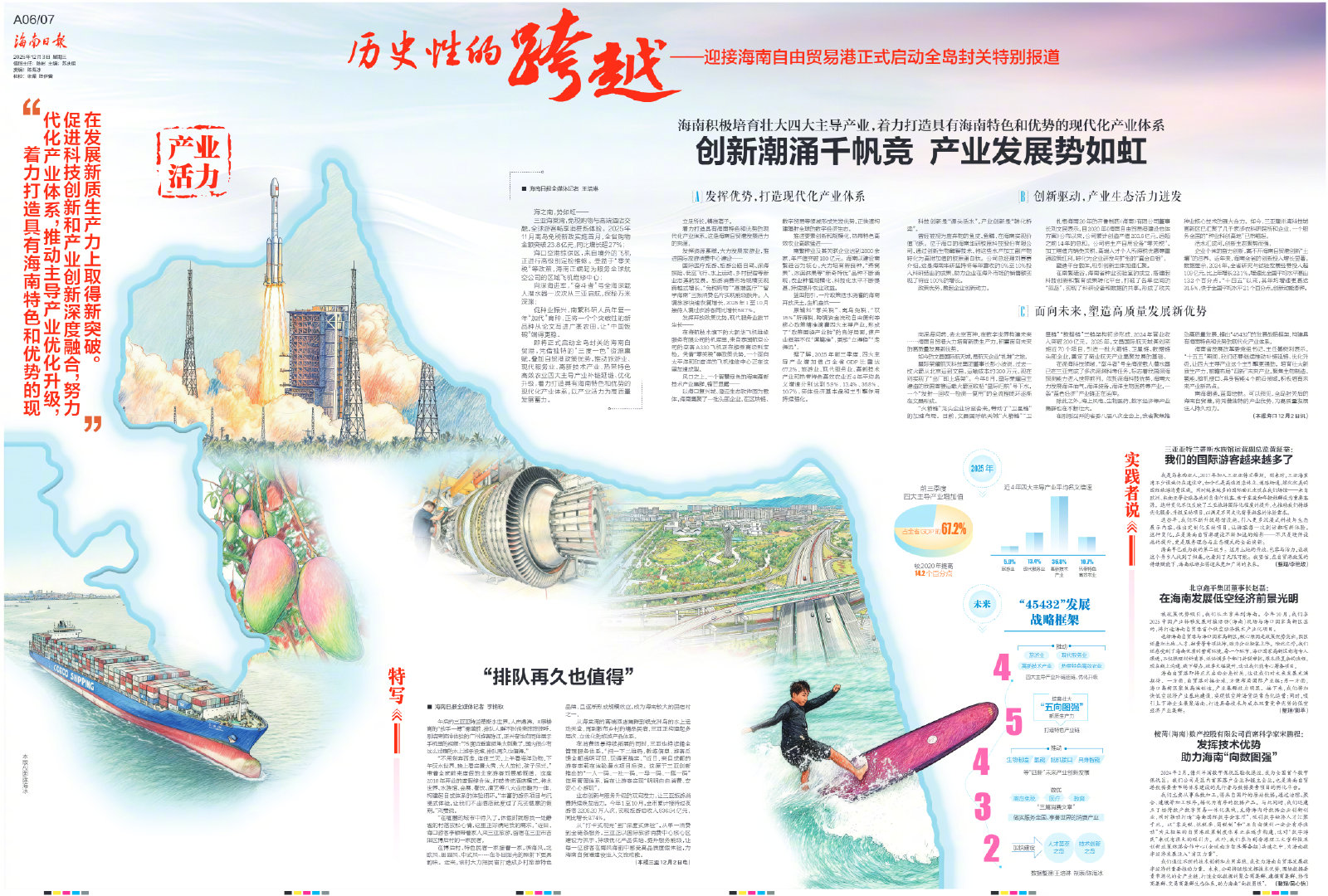
海南积极培育壮大四大主导产业
Hai Nan Ri Bao· 2025-12-03 07:08
Group 1 - Hainan is focusing on building a modern industrial system with unique characteristics and advantages, aiming for high-quality development through the optimization and upgrading of leading industries [3][8] - The tourism sector is experiencing significant growth, with a 58.7% year-on-year increase in overnight international visitors from January to October 2025, and a notable rise in consumption driven by duty-free shopping and high-end medical services [4][20] - The modern service industry is rapidly developing, with Hainan becoming a regional aircraft maintenance center benefiting from zero tariff policies, attracting international airlines [5][8] Group 2 - Hainan is establishing a high-tech industrial cluster, particularly in blockchain and digital trade, with significant investments in innovation and technology [6][12] - The tropical agriculture sector is thriving, with over 2,800 seed industry-related enterprises generating an annual output value exceeding 18 billion yuan, focusing on the development of new varieties [7][8] - The province's innovation ecosystem is being strengthened through increased R&D investment, which reached over 10.9 billion yuan in 2024, growing by 22.1% year-on-year [12] Group 3 - Hainan is positioning itself for future high-quality development by fostering new productive forces in sectors such as deep-sea exploration and space breeding, with a focus on emerging industries [13][16] - The Wenchang International Space City is becoming a hub for aerospace companies, with a projected revenue of over 20 billion yuan in 2024, driven by a comprehensive supply chain for rockets and satellites [14][16] - The province is also expanding its blue economy, focusing on marine oil and gas, marine equipment, and marine biomedicine, creating a robust industrial chain [14][15]

不足全国5%国土面积,四大湾区贡献全国约1/4经济总量
Di Yi Cai Jing· 2025-12-03 04:00
Core Insights - The Bay Area economy in China is evolving into a strategic hub for high-quality development, contributing approximately 25% of the national economic output while occupying less than 5% of the country's land area [1][3] Group 1: Economic Development - The report emphasizes the need for a global perspective to enhance the high-quality development of the Bay Area economy, focusing on key areas such as planning, industry, transportation, and innovation [1][3] - The Central Economic Work Conference of 2024 highlighted the importance of developing marine and Bay Area economies [1][3] Group 2: Regional Collaboration - The report outlines that cities within the Guangdong-Hong Kong-Macao Greater Bay Area are increasingly connected through infrastructure projects, transforming the "one-hour living circle" from a vision into reality [1][2] - In the Northern Bay Area, the "two-hour road circle" and "one-hour high-speed rail circle" significantly enhance internal connectivity among major cities [2] Group 3: Challenges and Recommendations - Current challenges include a gap in innovation capabilities compared to world-class Bay Areas, insufficient resource aggregation, and limited connectivity with global markets [3][4] - Recommendations include creating a high-level collaborative Bay Area economy, focusing on innovation, green transformation, and digital empowerment to enhance competitiveness [3][4] Group 4: Infrastructure and Ecosystem - The report suggests breaking development bottlenecks by optimizing spatial layouts and enhancing industrial upgrades, while also addressing transportation issues [4] - Emphasis is placed on ecological protection and low-carbon development, advocating for a system that prioritizes environmental governance and pollution control [4]
中国深圳创新创业大赛第九届国际赛总决赛收官 89个项目与深圳签订意向落地协议
Zheng Quan Shi Bao Wang· 2025-12-03 03:55
Core Insights - The ninth International Innovation and Entrepreneurship Competition in Shenzhen concluded on December 2, focusing on the city's "20+8" industrial cluster layout [1] Group 1: Competition Overview - The competition featured seven industry tracks: new generation electronic information, digital and fashion, high-end equipment manufacturing, green and low-carbon, new materials, biomedicine and health, and marine economy [1] - The event aimed to align with the industrial development needs of Shenzhen, injecting "global momentum" into the city's high-quality development [1] Group 2: Project Outcomes - A total of 89 projects have signed intention agreements for landing in various districts of Shenzhen, indicating initial success of the competition [1]

当好自然资源“大管家”和美丽中国“守护者”
Ren Min Ri Bao· 2025-11-29 01:05
Core Viewpoint - The construction of a beautiful China is a crucial goal for the comprehensive modernization of the socialist nation, emphasizing the harmonious coexistence of humans and nature [1] Group 1: Regional Economic Layout and Land Space System - The natural resources department aims to optimize the land space development pattern by balancing population, resources, and environmental factors [2] - Policies will be refined to enhance the implementation of the main functional area strategy, promoting differentiated development based on local advantages [2][3] - The department will maintain stability in urbanization areas, agricultural production zones, and key ecological function areas while optimizing specific functional areas [2] Group 2: Land Space Planning and Protection - The focus will be on dynamic assessment and optimization of land space planning, integrating major projects into a unified management system [3] - Strict adherence to the three control lines: farmland protection, ecological protection red lines, and urban development boundaries will be enforced [3] - The goal is to ensure the preservation of 1.865 billion acres of arable land and 1.546 billion acres of permanent basic farmland [3] Group 3: Resource Allocation and Support - The department will enhance the quality and efficiency of natural resource allocation, promoting comprehensive land supply and redevelopment of inefficient land [4] - Provincial governments will be granted greater autonomy in land use management, with a focus on integrated approval processes for various land uses [4] Group 4: Marine Economy and Ecological Protection - The "14th Five-Year" plan emphasizes strengthening marine development and protection, with a focus on high-quality marine economic growth [5] - The department will promote innovation in marine technology and establish platforms for marine research and development [6] - Collaborative efforts will be made to balance marine resource utilization with ecological protection, including the development of marine ecosystems [6] Group 5: Resource Security and National Safety - The natural resources sector is integral to national security, focusing on food, energy, and supply chain security [7] - Emphasis will be placed on protecting farmland and enhancing the quality of agricultural land through strategic planning [7] - The department will implement a new round of mineral exploration strategies to ensure resource security [7] Group 6: Geographic Information and Disaster Management - A new national spatial reference system will be established to support digital China initiatives and enhance disaster monitoring and response capabilities [8] - The department will focus on geological disaster prevention and response, particularly in high-risk areas [8] Group 7: Ecological Protection and Restoration - The department will prioritize the establishment of a natural protection area system, focusing on national parks and ecological restoration [9] - Efforts will be made to enhance the quality of forests and grasslands through large-scale greening initiatives [10] - The development of a market mechanism for ecological compensation and resource rights will be explored to promote sustainable resource management [10]
超200家世界500强及跨国企业将参加深圳全球招商大会
Sou Hu Cai Jing· 2025-11-28 14:52
Core Points - The 2025 Shenzhen Global Investment Conference will be held on December 5 at the Shenzhen Convention and Exhibition Center, with participation from over 200 Fortune 500 companies and multinational corporations from more than 30 countries and regions [1][3] - The theme of the conference is "Open Chain Global, Innovation Leads the Future," aiming to create a comprehensive, broad, and high-level investment cooperation platform to enhance Shenzhen's attractiveness and influence on global resources [1][3] Group 1 - The conference will feature a "1+7+N" series of activities, including one main event, seven themed investment activities, and multiple investment inspection activities combined with overseas sub-conferences [3] - The event will showcase Shenzhen's economic vitality, innovation capability, industrial strength, and investment potential [3] - Key sectors for themed investment activities include AI terminals and software, artificial intelligence and robotics, biomedicine and medical devices, new energy and high-performance materials, finance, cultural tourism and commerce, and marine economy [3] Group 2 - Two AI-related themed investment activities will highlight Shenzhen's industrial foundation, policy support, and resource layout, showcasing emerging enterprises and facilitating connections with policy funds and venture capital institutions [3] - The financial special event will present innovations in financial reform and development, inviting influential global financial institutions to share practices in Shenzhen's financial innovation [3] - Shenzhen's districts, including Dapeng New District and Shenshan Special Cooperation Zone, have designed 13 investment inspection routes for guests to experience the development atmosphere, entrepreneurial ecosystem, and business environment [4]

片区化推进乡村振兴,打造乡村振兴齐鲁样板的创新实践
Feng Huang Wang Cai Jing· 2025-11-20 05:43
Core Viewpoint - The article emphasizes the importance of "regionalization" in promoting rural revitalization in Shandong, aligning local practices with national strategies to create a robust model for rural development [1][3]. Group 1: Regionalization Strategy - Shandong's approach to rural revitalization focuses on "regionalization," which involves grouping villages based on geographical, social, and industrial connections to foster collaborative growth [2][3]. - The provincial government has initiated a series of strategic plans since 2019 to establish demonstration areas for rural revitalization, emphasizing systematic and prioritized development [3][4]. Group 2: Diverse Regional Development - Different regions in Shandong are leveraging their unique advantages: coastal areas like Qingdao and Yantai are developing marine economies, while central regions focus on urban and smart agriculture [5][6]. - The province plans to construct around 300 new regional development areas annually, with 70 designated as provincial-level, ensuring tailored development plans that consider local conditions [7]. Group 3: Tailored Development Approaches - The article highlights the necessity of avoiding a "one-size-fits-all" approach, advocating for precise strategies that cater to the specific needs and resources of each village [8]. - Successful case studies illustrate how localized industries, such as the cultivation of North American holly and garlic, have significantly boosted local economies and employment [9]. Group 4: Ecological and Cultural Integration - The integration of ecological resources into development plans has proven beneficial, with projects like the "Dragon Lake Moonlight" area attracting over 700,000 visitors and generating substantial revenue [10]. - Cultural initiatives, such as sports events and local art, are enhancing community engagement and contributing to the overall soft power of rural areas [12]. Group 5: Organizational Collaboration - The establishment of cooperative organizations among villages is crucial for resource sharing and collective growth, as demonstrated by successful partnerships that have improved local incomes and employment opportunities [13][14]. - Political leadership and effective governance are essential for fostering collaboration and ensuring that rural revitalization efforts are sustainable and impactful [16][17]. Group 6: Resource Activation and Financial Support - The article discusses how regionalization has enabled the activation of dormant resources and the mobilization of financial support, transforming previously underutilized assets into productive capital [19][20]. - The shift from external financial aid to internal resource mobilization marks a significant evolution in the approach to rural revitalization, promoting self-sufficiency and sustainable growth [20].
大湾区是商业航天的“沃土”
Guang Zhou Ri Bao· 2025-11-19 00:42
Core Insights - The 20th China Economic Forum held in Nansha, Guangdong, focused on nine key topics, including marine economy and technological innovation [1] Marine Economy Development - Nansha is recognized for its significant potential in marine economic development, supported by geographical, policy, industrial, and infrastructural advantages [2] - The region is positioned as a core area for marine economic development in Guangzhou and a key hub for the Greater Bay Area [3] - Nansha aims to focus on deep-sea, green, smart, and integrated development to enhance its marine economy [3] Commercial Aerospace Opportunities - The commercial aerospace sector in China is transitioning from high-tech exploration to civilian applications, with significant growth potential in the Greater Bay Area [4] - Nansha is identified as a fertile ground for commercial aerospace development, leveraging its diverse application scenarios and abundant resources [4] - A virtuous cycle is suggested for Nansha, linking satellite manufacturing with launch services and application demands [5]
金融支持生态产品价值实现的思考与实践 以烟台为例
Jin Rong Shi Bao· 2025-11-17 04:57
Core Insights - The article emphasizes the importance of establishing a mechanism for realizing the value of ecological products, which is crucial for achieving harmony between humans and nature [1][2][3] Group 1: Financial Mechanisms and Collaboration - The People's Bank of Yantai has initiated a collaborative governance framework to support the realization of ecological product value, transitioning from fragmented departmental efforts to a system-integrated approach [2] - A long-term cooperation mechanism has been established among various stakeholders, including government and financial institutions, to enhance the financing of ecological products [2][3] - The introduction of policies and reports has laid a theoretical foundation for financial support in specific regions, guiding resources towards key ecological areas [3] Group 2: Financial Product Innovation - Financial institutions in Yantai have developed a comprehensive financial support system that covers all regions, industries, and scenarios, enabling ecological products to be tradable and valued [4] - The innovation of green financial products, such as marine carbon credit loans and ecological environment-oriented development loans, has created a product matrix that facilitates the conversion of ecological resources into economic value [6][7] Group 3: Sustainable Development Mechanisms - The use of monetary policy tools has been crucial in providing low-cost resources to ecological industries, enhancing the capital accessibility of ecological products [8] - Financial institutions are exploring innovative financing products and service models tailored to the unique characteristics of ecological industries, such as carbon credit loans and green development-linked loans [9] - A project database has been established to support sustainable and replicable projects, with significant financial backing provided to selected projects [10]
让场景更好赋能高质量发展
Xin Hua Ri Bao· 2025-11-11 00:20
Core Viewpoint - The State Council has issued an implementation opinion to accelerate the cultivation and opening of application scenarios, marking a systematic deployment at the national level for the first time [1] Group 1: Definition and Importance of Scenarios - Scenarios are defined as specific contexts for the innovative application of new technologies, products, and business models, serving as a bridge between technology and industry [2] - The cultivation of scenarios is aimed at leveraging China's large market and diverse application scenarios to create experimental fields for new technologies and products, thus accelerating their industrialization [2] Group 2: Multi-Party Efforts in Scenario Cultivation - The Ministry of Industry and Information Technology has supported 46 cities in promoting digital and green technologies, and has implemented insurance compensation policies for major technological equipment [3] - Anhui Province plans to establish nearly 300 application scenarios by the end of this year and aims for 1,000 by 2027, focusing on quantum information [3] Group 3: Role of Central Enterprises - Central enterprises are seen as a rich source for scenario supply, providing over 400 pilot services and collaborating with various entities to enhance technological innovation and industrial renewal [4] Group 4: Future Directions and Mechanisms - The Ministry of Science and Technology will focus on key core technology breakthroughs and the efficient transformation of major technological achievements to drive new industrial momentum [6] - The State-owned Assets Supervision and Administration Commission aims to enhance the supply of high-value scenarios and broaden the scope of scenario opening, encouraging participation from various business entities [6] Group 5: Implementation and Coordination - Effective implementation of the opinion requires strengthening collaboration, highlighting key areas, and improving mechanisms to support the establishment of a diverse scenario cultivation system [7]
让场景更好赋能高质量发展,这场吹风会详细解读
Xin Hua She· 2025-11-10 14:42
Core Insights - The State Council has issued a systematic deployment for scene cultivation and opening, marking a significant step in promoting high-quality development through innovative applications of new technologies and products [1][2] Group 1: Definition and Importance of Scenes - "Scenes" are defined as specific contexts for the innovative application of new technologies, products, and business models, serving as a bridge between technology and industry [2] - The cultivation of scenes is seen as a key resource for innovation, facilitating the transformation of technological achievements into productive forces [2] Group 2: Implementation and Support - The Ministry of Industry and Information Technology has supported 46 cities in promoting smart and green technologies, with plans to establish 63 provincial future industry pilot zones [3] - Various provinces, such as Anhui and Guangdong, are actively developing application scenarios, with Anhui aiming to implement nearly 300 scenarios by the end of the year and 1,000 by 2027 [3][4] Group 3: Role of Central Enterprises - Central enterprises are identified as significant contributors to scene supply, with 190 pilot verification platforms providing over 400 services to various sectors [4] - The State-owned Assets Supervision and Administration Commission is encouraging the participation of private and small enterprises in scene construction [5] Group 4: Future Directions and Coordination - The focus will be on strengthening core technology breakthroughs and enhancing the role of enterprises in technological innovation [5] - The implementation of the opinions will require coordinated efforts to expand market access and explore new market configurations for innovative elements [6]