
医美

Search documents
商贸零售行业周报:潮宏基订货会火热举办,优质新品受加盟商欢迎-20250921
KAIYUAN SECURITIES· 2025-09-21 12:30
Investment Rating - The industry investment rating is "Positive" (maintained) [1] Core Views - The retail industry is experiencing a shift towards emotional consumption, with brands that possess differentiated product capabilities and deep consumer insights gaining traction [31] - The report highlights the strong performance of the jewelry sector, particularly in high-end and fashion segments, driven by consumer preferences and innovative marketing strategies [31][39] Summary by Sections Retail Market Overview - The retail index closed at 2384.72 points, down 0.51% for the week, outperforming the Shanghai Composite Index, which fell 1.30% [6][13] - Year-to-date, the retail index has increased by 6.51%, lagging behind the Shanghai Composite Index's 13.97% rise [13][15] Key Industry Dynamics - The report emphasizes the successful autumn ordering meeting of Chao Hong Ji, showcasing strong demand for new products rooted in traditional craftsmanship and innovative designs [25][26] - The jewelry sector, particularly the high-end and fashion categories, is benefiting from emotional consumption trends, with brands like Lao Pu Gold and Chao Hong Ji recommended for investment [31][39] Company Performance Highlights - Lao Pu Gold reported a revenue of 12.354 billion yuan for H1 2025, a 250.9% increase year-on-year, with a net profit of 2.268 billion yuan, up 285.8% [33][36] - Chao Hong Ji achieved a revenue of 4.102 billion yuan in H1 2025, reflecting a 19.5% increase, with a net profit of 331 million yuan, up 44.3% [39][40] - The report also highlights the performance of other companies such as Mao Ge Ping and Ru Ben, which are experiencing significant growth in the cosmetics sector [32][42] Investment Recommendations - The report suggests focusing on high-quality companies in the emotional consumption theme, particularly in the jewelry and cosmetics sectors, with specific recommendations for Lao Pu Gold, Chao Hong Ji, and Mao Ge Ping [7][31][32]

X @𝘁𝗮𝗿𝗲𝘀𝗸𝘆
𝘁𝗮𝗿𝗲𝘀𝗸𝘆· 2025-09-19 17:58
转需Tintin(3/3) 🔜KBW (@Tintinx2021):4. 医美由于太多人问我了,不得不专门跟大家说一下,在此只跟大家说一下大家感兴趣的注意事项和基础的项目价格水平,不做任何医院推荐,主要是防止被骗。1️⃣ 水光针• 丽珠兰黑盒 2cc:18–20 万韩币• 丽珠兰白盒 1cc:12–14 万韩币• 丽珠兰红盒 2cc:26–28 万韩币• Juvelook 蓝瓶 2cc:14–16 ...
南京医美主力人群为20岁以上女性,美团携手医生创业机构助力转型
Yang Zi Wan Bao Wang· 2025-09-19 13:21
Core Insights - Emerging markets are becoming a significant growth driver for the medical beauty industry, leading to a more balanced industry structure [1] - The "Leading Plan" initiated by Meituan in 2025 aims to support quality medical beauty institutions in emerging markets and provide consumers with reliable services [1] Group 1: Market Trends - By 2025, the proportion of medical beauty consumers registered in second-tier and lower cities is expected to rise, indicating increasing penetration and popularity in emerging markets [1] - In the first half of 2025, the daily traffic for medical beauty in Nanjing grew nearly 30% year-on-year, with the average transaction price exceeding 800 yuan, reflecting over 50% growth [2] Group 2: Consumer Insights - Female consumers dominate the local medical beauty market, accounting for 87%, with over 54% of consumers aged 30 and above, indicating that mature women are the primary demographic [1] - In terms of purchasing behavior, 25% of consumers are motivated by repeat purchases of similar medical beauty projects, while 25% are driven by age-related anxiety [2] Group 3: Operational Insights - The success of medical beauty institutions relies not only on technical expertise but also on effective operations, with Meituan leveraging its data and industry insights to assist emerging institutions in digital transformation [1] - The insights gathered from local consumer data can help medical beauty institutions refine their operational strategies, allowing for more targeted marketing efforts [2] Group 4: Future Plans - Meituan's "Leading Plan" will expand to more emerging cities, aiming to connect quality medical beauty institutions with local users, providing experiences comparable to first-tier cities [2]

日均流量增长近30% 美团发布南京医美消费数据
Xin Hua Ri Bao· 2025-09-19 03:46
Core Insights - Emerging markets are becoming a significant growth driver for the medical beauty industry, leading to a more balanced industry structure [1] - The "Leading Plan" initiated by Meituan in 2025 aims to support high-quality medical beauty institutions in emerging markets, enhancing consumer access to reliable services [1] Group 1: Market Trends - By 2025, the proportion of medical beauty consumers registered in second-tier and lower cities is expected to rise, indicating increasing penetration and popularity in emerging markets [1] - In Nanjing, the average daily traffic for medical beauty services increased by nearly 30% in the first half of 2025, with the average transaction value exceeding 800 yuan, reflecting substantial market potential [8] Group 2: Institutional Development - The establishment of Jia Shu Zhi Yan Medical Beauty in early 2024 faced initial challenges, including the need for a competent operational team, despite having strong technical expertise [3][4] - After six months, the hiring of an experienced operations head led to the development of a mature operational system, facilitating rapid growth for Jia Shu Zhi Yan [6] Group 3: Consumer Insights - Female consumers dominate the local medical beauty market, accounting for 87%, with over 54% of consumers aged 30 and above, indicating a trend towards mature female clientele [7] - Popular services among consumers include photon rejuvenation, water light needles, and ice point hair removal, highlighting consumer preferences in the market [7] Group 4: Future Plans - Meituan's "Leading Plan" will expand to more emerging cities, aiming to connect high-quality medical beauty institutions with local users, providing a consumer experience comparable to first-tier cities [10]


爱美客:2025年半年度分红派息实施公告
Zheng Quan Ri Bao· 2025-09-18 13:36
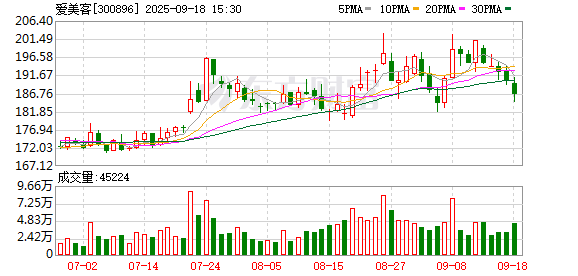
Core Viewpoint - Aimeike announced its profit distribution plan for the first half of 2025, proposing a cash dividend of 12.00 RMB per 10 shares to all shareholders [2] Summary by Relevant Sections - **Profit Distribution Plan** - The profit distribution plan is based on a total share capital of 301,426,187 shares, excluding 1,165,874 repurchased shares [2] - The cash dividend will be distributed on a per-share basis, amounting to 12.00 RMB (including tax) for every 10 shares held [2] - **Key Dates** - The record date for shareholders to be eligible for the dividend is September 25, 2025 [2] - The ex-dividend date is set for September 26, 2025 [2]
爱美客:2025年半年度分红派息实施
Hua Er Jie Jian Wen· 2025-09-18 09:14
Dividend Plan Key Points - Dividend Standard: Cash dividend of 12 yuan per 10 shares (including tax) [1] - Total Dividend Amount: 361.71 million yuan, accounting for 45.82% of the net profit attributable to shareholders for the first half of 2025 [1] - Distribution Base: Based on total share capital of 302,592,061 shares minus repurchased shares of 1,165,874, resulting in a base of 301,426,187 shares [1] - No Stock Bonus: Only cash dividends will be distributed, with no capital reserve fund conversion into share capital [1] Key Dates - Share Registration Date: September 25, 2025 [1] - Ex-Dividend Date: September 26, 2025 [1] - Dividend Payment Date: September 26, 2025 [1] Ex-Dividend Arrangement - Dividend Calculation: 11.953764 yuan per 10 shares (including tax) [1] - Ex-Dividend Price: Closing price before the ex-dividend date minus 1.1953764 yuan [1] Additional Points - Repurchased shares of 1,165,874 will not participate in the dividend [1] - Adjustment of the restricted stock incentive plan's vesting price [1] - Minimum reduction price for certain specific shareholders adjusted to 34.16 yuan per share [1]
爱美客:利润分配股权登记日为2025年9月25日
Sou Hu Cai Jing· 2025-09-18 08:44
Group 1 - The company Aimeike announced a profit distribution plan, distributing 12 RMB in cash (including tax) for every 10 shares to all shareholders, based on approximately 301 million shares after excluding about 1.17 million repurchased shares [1] - The record date for the distribution is set for September 25, 2025, and the ex-dividend date is September 26, 2025 [1]
这家医美巨头创始人遭罚单!公司紧急撇清关系
Guo Ji Jin Rong Bao· 2025-09-18 03:44
Core Viewpoint - Shanghai Haohai Biological Technology Co., Ltd. (688366.SH) is facing potential regulatory penalties due to insider trading allegations against its controlling shareholder Jiang Wei, although the company asserts that this matter will not significantly impact its operations or financials [1][3]. Group 1: Company Structure and Shareholding - Jiang Wei and his spouse You Jie are the actual controllers of Haohai Biological, holding a combined 45.82% of the company's shares as of March 2025, with Jiang Wei owning 28.53% and You Jie 17.29% [3]. - The regulatory penalty is directed solely at Jiang Wei, and the company clarifies that the issue is unrelated to its business operations [3]. Group 2: Business Overview and Financial Performance - Haohai Biological is a prominent producer of hyaluronic acid in China, operating in four main sectors: aesthetic medicine, ophthalmology, orthopedics, and hemostasis [3]. - In 2024, the revenue breakdown by product category shows that aesthetic medicine accounts for 44.30%, ophthalmic products 31.79%, and orthopedic products 16.92% [3]. - The ophthalmology segment is expected to see a revenue decline of 7.6% to 858 million yuan due to the impact of bulk procurement of artificial lenses [3]. - For the first half of 2025, the company reported a revenue of 1.304 billion yuan, a year-on-year decrease of 7.12%, and a net profit of 211 million yuan, down 10.29% year-on-year [3].


这家医美巨头创始人遭罚单!公司紧急撇清关系
IPO日报· 2025-09-18 00:33
Core Viewpoint - The announcement regarding the administrative penalty against Jiang Wei, a controlling shareholder of Shanghai Haohai Biological Technology Co., Ltd., is significant as it stems from an insider trading investigation by the China Securities Regulatory Commission (CSRC) [1][2]. Group 1: Company Overview - Shanghai Haohai Biological Technology Co., Ltd. is a well-known hyaluronic acid producer in China, operating in four major fields: medical aesthetics, ophthalmology, orthopedics, and hemostasis [4]. - The company is recognized as one of the "three giants" in the Chinese hyaluronic acid market, alongside Huaxi Biological and Aimeike [4]. Group 2: Shareholding Structure - Jiang Wei and his spouse, You Jie, are the actual controllers of Haohai Biological, holding a combined 45.82% of the company's shares as of March 2025, with Jiang Wei owning 28.53% and You Jie 17.29% [4]. Group 3: Financial Performance - In the first half of 2025, the company reported a revenue of 1.304 billion yuan, a year-on-year decrease of 7.12%, and a net profit of 211 million yuan, down 10.29% year-on-year [5]. - For 2024, the revenue from the medical aesthetics segment is projected to account for 44.30% of total revenue, while ophthalmology products will contribute 31.79%, and orthopedics will make up 16.92% [4]. - The ophthalmology business is expected to see a revenue decline of 7.6% to 858 million yuan due to the impact of bulk procurement of artificial lenses [4].

锦波生物(832982):薇旖美?四周年拥抱新渠道,驱动新增长
Shenwan Hongyuan Securities· 2025-09-17 10:42
Investment Rating - The report maintains a "Buy" rating for the company [1] Core Insights - The company celebrates the fourth anniversary of its brand, Wei Yi Mei®, with over 2.7 million clinical applications and coverage of more than 4,000 medical institutions [6] - The launch of the new product combination, Wei Yi Mei® ColPlus, aims to enhance customer engagement and expand the sales channel through collaboration with Meituan [6] - The ColPlus product is designed for anti-aging targeting users aged 30 and above, offering a more precise solution for skin issues compared to previous products [6] - The online platform is becoming a significant channel for medical beauty consumption, with Meituan's data-driven marketing expected to improve user conversion rates [6] - The company is positioned to lead the collagen market by adapting to channel changes and expanding its online presence [6] - The financial forecast estimates the company's net profit to be 1.042 billion, 1.474 billion, and 1.867 billion yuan for 2025, 2026, and 2027 respectively, with corresponding PE ratios of 34, 24, and 19 [6] Financial Data and Profit Forecast - Total revenue is projected to grow from 1,443 million yuan in 2024 to 3,943 million yuan in 2027, with a compound annual growth rate of 22.7% [5] - The net profit is expected to increase significantly, with a growth rate of 144.3% in 2024 and 42.3% in 2025 [5] - The gross margin is forecasted to remain high, around 89.8% in 2025, indicating strong profitability [5]