
生物医药

Search documents
市政协委员、沃特股份董事长吴宪:鼓励上市公司在深投入,建立产业链上市公司集群
Sou Hu Cai Jing· 2026-02-09 09:38
Core Viewpoint - The total number of listed companies in Shenzhen has surpassed 600, with 426 domestic and 174 overseas companies, highlighting their critical role in the city's economic stability and growth [1][4]. Group 1: Economic Impact - Listed companies are seen as the "ballast" of Shenzhen's real economy and a "driving force" for urban development [1]. - The support for local investments by listed companies is deemed essential for strengthening industrial core advantages and unlocking urban potential [1][4]. Group 2: Policy Recommendations - There is a call to upgrade the policy incentive system to enhance local investment guidance, including financial rewards for companies investing in local projects [4][5]. - Suggestions include optimizing talent evaluation mechanisms to attract and retain skilled professionals in Shenzhen, which is crucial for maintaining competitive advantages [4][5]. Group 3: Industry Development - The establishment of industry chain clusters is recommended to stimulate deeper investments from listed companies, leveraging existing resources in sectors like low-altitude economy, robotics, and new energy vehicles [5]. - The focus on creating a collaborative environment among local listed companies is expected to enhance efficiency and foster long-term investment motivations [5]. Group 4: Women in Business - The emergence of outstanding female entrepreneurs in Shenzhen is noted, with women making up about 40% of the city's tech workforce, increasingly leading in fields like AI and biomedicine [5]. - Initiatives to promote women's participation in technology and entrepreneurship, such as hosting an international competition for female innovators, are proposed to attract global talent and investment [6].


研发投入比肩国际顶尖经济体,深圳“创新朋友圈”如何打造?
Nan Fang Du Shi Bao· 2026-02-09 09:31
Core Insights - Shenzhen's economic growth during the "14th Five-Year Plan" period is highlighted by significant achievements, including a GDP increase from 2.83 trillion yuan in 2020 to 3.87 trillion yuan by 2025, with an average annual growth rate of 5.5%, leading among first-tier cities in China [3][5] - The city's industrial output and foreign trade have also shown remarkable performance, maintaining the top position nationally for four consecutive years in both industrial output and foreign trade, with total foreign trade reaching 4.55 trillion yuan [3][11] Economic Performance - Shenzhen's GDP is projected to grow significantly, with a target of 3.87 trillion yuan by 2025, marking a substantial increase from 2.83 trillion yuan in 2020 [3] - The city has achieved the highest growth rate among first-tier cities, with a consistent annual growth rate of 5.5% [3] - The total value of foreign trade reached 4.55 trillion yuan, maintaining the top position nationally for two consecutive years [3][11] Innovation and Industry - The rapid development of the technology sector and foreign trade is credited as the main driver of Shenzhen's economic leap, with advanced manufacturing accounting for 68.4% of industrial output [5] - Shenzhen's strategic emerging industries now account for 43.0% of GDP, indicating a healthy balance between traditional and new industries [8] - The city has established a robust innovation ecosystem, with a research and development investment intensity of 6.67%, leading the nation in PCT international patent applications for 22 consecutive years [10] Trade and Market Dynamics - Shenzhen's foreign trade structure is evolving towards high-end, technology-driven, and high-value-added products, moving from being a "foreign trade giant" to a "foreign trade stronghold" [11] - The city is enhancing its international trade environment and expanding into emerging markets, focusing on digital, service, and green trade [11] Future Outlook - The upcoming APEC meeting in 2026 is expected to boost Shenzhen's international development, particularly in sectors like technology, consumption, and healthcare, positioning the city as a benchmark for global quality of life [12]
从产业融合、广纳全球英才、赋能文旅聚焦AI机遇
Nan Fang Du Shi Bao· 2026-02-09 08:49
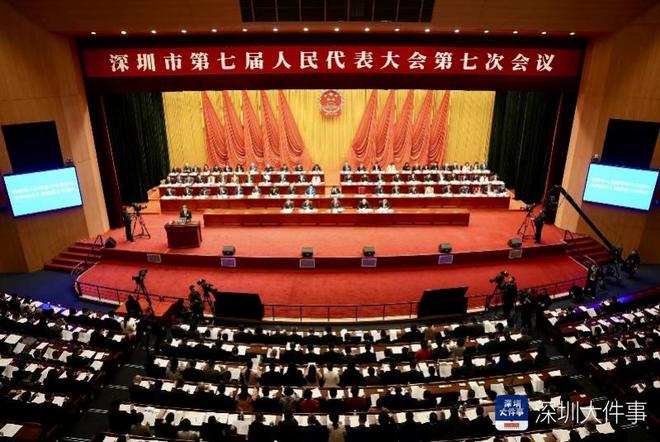
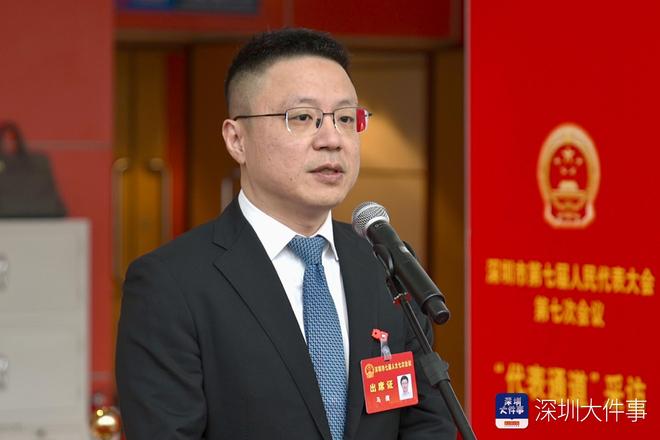
马健说:"今年是深圳的APEC机遇之年,我们的企业要有更大的格局、更高的战略,用于布局未来产 业、布局科技前沿的技术。" 孙迎彤:以AI思维吸引全球人才,推动深圳成AI创新高地 深圳市人大代表,国民技术股份有限公司董事长、总经理孙迎彤围绕深圳新兴产业的发展情况分享了自 己的看法。他表示,深圳的新兴产业发展环境已经处于第一阵营,在刚过去的2026年CES展4000家参展 企业中也包含了将近400家深圳企业,占比约10%。这离不开深圳坚持的市场化、法治化、国际化,激 发了全球创业者来深圳扎根创业发展。 孙迎彤提出,深圳正从"深圳速度"转向"深圳质量",在努力创建中国特色社会主义现代化强国的城市范 例、打造粤港澳大湾区国际科技创新中心的进程中,深圳正锻造"引领"的DNA。 2月9日,深圳市七届人大七次会议举行首场"代表通道"集中采访活动,来自不同领域的3位市人大代表 走上通道,围绕人工智能、生物医药、人才战略与文化发展等关键议题建言献策。深圳市人大代表、晶 泰科技CEO马健提出聚焦"三个跨越",推动AI与生物医药深度融合,助力产业向系统性创新转型;市人 大代表、国民技术(300077)董事长孙迎彤强调以AI思维吸引 ...
聚焦AI赋能,直击2026深圳两会首场“代表通道”
Shen Zhen Shang Bao· 2026-02-09 08:03
Group 1: AI and Economic Integration - The year 2025 is highlighted as a critical point for Shenzhen's AI and biomedicine industries, marking a transition to high-quality development [2] - Shenzhen's innovation cluster, comprising Shenzhen, Hong Kong, and Guangzhou, is projected to rank first globally in the innovation index by 2025, attributed to its strong innovation ecosystem [2] - Emphasis on three focal points for technology-driven industry leadership: ecological collaboration, industry value realization, and ecosystem cultivation [3] Group 2: Talent Development and Industry Competitiveness - Shenzhen is recognized as a leading global hub for emerging industries, with a strong emphasis on quality over quantity in manufacturing [4] - The city has a high R&D investment intensity of 6.67%, with 93% of this funding coming from enterprises, enhancing its competitive edge [4] - There is a call for increased focus on talent development in the AI sector, aiming to attract global talent and cultivate AI-thinking professionals from the existing engineering workforce [6] Group 3: Cultural and Tourism Integration - Shenzhen has established numerous world-class cultural facilities, contributing to its cultural and technological foundation [8] - The development of cruise economy and AI-enabled cultural landmarks is proposed to enhance the cultural tourism experience [8][9] - The integration of various cultural narratives and community involvement is essential for creating a vibrant cultural ecosystem in Shenzhen [9]
提案摘编・推动基础产业和基础设施发展
Xin Lang Cai Jing· 2026-02-09 07:57
Group 1: Artificial Intelligence Industry Development - The integration of artificial intelligence (AI) with economic and social development faces challenges such as an unoptimized enterprise ecosystem and uneven industrial chain layout [1] - Recommendations include optimizing the AI industry ecosystem and enhancing the role of leading enterprises in key technology innovation [1][2] - A national-level approach is suggested to streamline information related to AI resources, guiding local exploration of AI-enabled scenarios [2] Group 2: Low-altitude Economy Development - The low-altitude economy is rapidly developing in China, with potential to create a trillion-yuan market, but faces issues like inadequate infrastructure and talent shortages [3][4] - Policy support is recommended to improve airspace management and provide financial backing for low-altitude economic sectors [3][4] - Emphasis on building ground and information infrastructure to support low-altitude operations is highlighted [4] Group 3: Virtual Power Plant Management - The establishment of a multi-level virtual power plant management system is crucial for enhancing the flexibility and reliability of the power system [6] - Recommendations include improving settlement mechanisms and creating a diversified market for virtual power plants [6] Group 4: Commercial Aerospace Innovation - The development of commercial aerospace is seen as a strategic choice for advancing military-civilian integration and enhancing China's aerospace capabilities [7] - Suggestions include accelerating the implementation of support plans for commercial aerospace industries and encouraging local production capabilities [7] Group 5: Traditional Industry Transformation - The role of new production factors like data in traditional industries is not fully realized, necessitating stronger support from the digital economy [8] - Recommendations focus on developing new production capabilities tailored to local resources and promoting deep cooperation between AI and traditional industries [8] Group 6: Green Energy and Storage Development - The development of green energy storage is essential for building a diversified energy security system [19][20] - Suggestions include utilizing various energy storage technologies and enhancing the value and competitiveness of the energy industry [19][20] Group 7: Artificial Intelligence Education and Awareness - There is a need for enhanced public education on AI to improve understanding and application [21] - Recommendations include government-led initiatives to create an AI education framework and encourage community involvement in AI literacy [21] Group 8: Algorithm Governance and Ethics - The importance of establishing a governance system for algorithms to balance safety and innovation is emphasized [22][28] - Recommendations include improving algorithm transparency and user rights protection, as well as fostering a rational public perception of algorithms [22][28]
代表通道 从产业融合、广纳全球英才、赋能文旅聚焦AI机遇
Nan Fang Du Shi Bao· 2026-02-09 07:54
Core Viewpoint - The Shenzhen Municipal People's Congress representatives emphasized the integration of artificial intelligence (AI) with various sectors such as biomedicine and cultural development, aiming to transform Shenzhen into a hub for innovation and talent attraction. Group 1: AI and Biomedicine Integration - Representative Ma Jian highlighted the importance of focusing on "three crossovers" to promote deep integration between AI and biomedicine, facilitating a transition towards systematic innovation in industries [4]. - The "three focuses" proposed by Ma include ecological collaboration, value realization, and ecological cultivation, aiming to break innovation barriers and enhance the competitiveness of industries [4][5]. Group 2: Talent Attraction and Development - Representative Sun Yingtong stated that Shenzhen's emerging industries are in the top tier, with around 400 out of 4,000 exhibitors at the recent CES being from Shenzhen, representing approximately 10% [8]. - Sun emphasized the need for Shenzhen to attract global talent and train existing technical engineers to become part of the AI talent pool, ensuring the city remains a leader in the AI era [8]. Group 3: Cultural Development and Innovation - Representative Chen Xiangbo proposed using "culture + IP + new business models" to enhance world-class cultural landmarks in Shenzhen, making them more appealing to residents and tourists [11]. - Chen suggested developing the cruise economy and leveraging AI to create a new ecosystem for cultural tourism, emphasizing the importance of nurturing cultural talent alongside technological talent [12].
科创与金融双向赋能,推动上海“五个中心”联动跃升
Di Yi Cai Jing· 2026-02-09 07:30
Group 1 - Shanghai is in a critical period for building a world-class socialist modern international metropolis, focusing on the integration of global technology innovation and international financial centers as key engines for development [1] - The construction of the "Five Centers" (international economy, finance, trade, shipping, and technology innovation) is essential for enhancing the city's global competitiveness and systemic efficiency [1] - By 2026, Shanghai aims to address deep-seated obstacles in the integration of technology and finance, promoting a new pattern of "technology-led, finance-enabled, industry-supported, and system-guaranteed" development [1] Group 2 - Since the 13th and 14th Five-Year Plans, Shanghai has achieved significant milestones in the construction of the "Five Centers," with its international financial center ranking among the top globally in terms of market transaction volume and financing scale [2] - The global technology innovation center has shown notable capabilities, with a preliminary cluster of large scientific facilities and rapid development in integrated circuits, biomedicine, and artificial intelligence [2] - However, there remains a significant gap in the deep integration and mutual empowerment of technology and finance compared to leading global city clusters like New York-Boston and the San Francisco Bay Area [2] Group 3 - The financial support for technology innovation lacks "risk adaptability," with a mismatch between the indirect financing system and the high-risk, long-cycle nature of technology innovation [2] - The value transformation chain from technology to finance is not smooth, with insufficient breakthroughs in foundational technologies like blockchain and quantum computing, limiting the fundamental reshaping of financial services [3] - The institutional ecosystem for collaborative development between technology and finance is not robust, requiring innovation in cross-departmental collaboration and regulatory frameworks [3] Group 4 - To enhance capital support for the entire lifecycle of technology innovation, a "patient capital" cultivation system should be established, optimizing government fund operations and encouraging long-term investments [4] - The development of multi-tiered capital markets should be deepened, with continuous optimization of listing standards and trading mechanisms to support key technology enterprises [4] - Innovative financial products like intellectual property securitization and technology notes should be developed to broaden financing channels for technology companies [4] Group 5 - The establishment of a financial technology innovation hub focusing on cutting-edge fields such as blockchain and AI is essential, along with the creation of national-level financial technology laboratories [6] - Data as a key production factor should be effectively circulated and applied in compliance with regulations to enhance financial service innovation and risk management capabilities [6] - The integration of technology into financial operations should be promoted, utilizing regulatory technology to improve monitoring and risk management in cross-border financial activities [6] Group 6 - A supportive institutional environment for mutual empowerment between technology and finance should be optimized, with enhanced cross-departmental collaboration and regulatory innovation [7] - The knowledge property operation and protection system should be improved, with a focus on developing comprehensive services for intellectual property transactions [7] - High-end composite talent should be attracted and incentivized, with mechanisms in place to support professionals who understand both technology and finance [7] Group 7 - The facilitation of cross-border channels for technology and finance should be prioritized, exploring the relaxation of restrictions on foreign financial institutions and simplifying cross-border funding procedures [8] - Global cooperation in innovation and finance should be strengthened, encouraging foreign R&D centers to connect with local financial systems [8] - Hosting influential technology finance summits and participating in the formulation of international rules are essential for integrating into global networks [8] Group 8 - The construction of the "Five Centers" has entered a new phase of "system integration, functional superposition, and fusion development," emphasizing the need for both sectors to pursue excellence in their respective fields while innovating at the intersection [9] - A dual approach is required, focusing on financial supply-side structural reforms to meet technology innovation needs while leveraging cutting-edge technology to reshape financial competitiveness [9] - Shanghai aims to establish a unique "technology-finance-industry" cycle model that will enhance the overall capabilities of its international economic, trade, and shipping centers [9]
北方经济十强市,竞争更激烈了
3 6 Ke· 2026-02-09 06:50
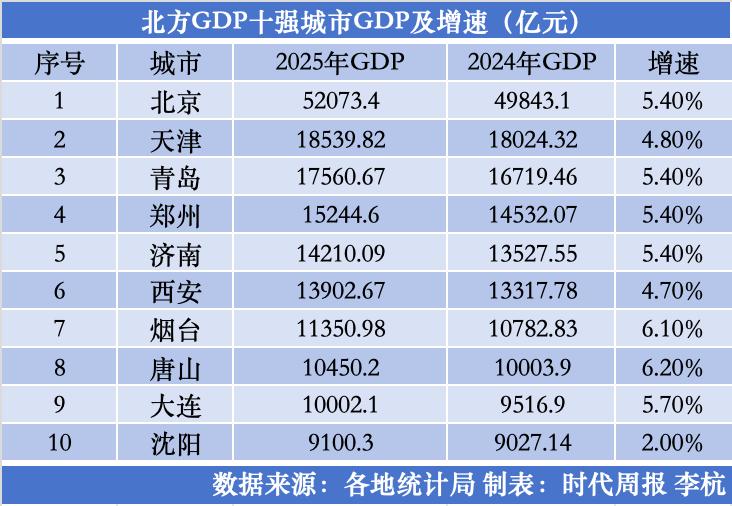
Core Insights - The competition among northern cities is intensifying, with a focus on economic growth and structural optimization as they aim to break through existing barriers [1][6]. Group 1: Economic Performance of Northern Cities - In 2025, the top ten northern cities by GDP are Beijing, Tianjin, Qingdao, Zhengzhou, Jinan, Xi'an, Yantai, Tangshan, Dalian, and Shenyang, with Beijing leading at 52,073.4 billion yuan [2][3]. - Seven out of the ten cities have GDP growth rates exceeding the national average of 5%, with Tangshan achieving the highest growth rate of 6.2% and Shenyang the lowest at 2% [3][4]. - Beijing is the first northern city to surpass the 50 trillion yuan mark, showcasing its economic resilience and high-end service industry advantages [3][4]. Group 2: Competitive Dynamics - Tianjin maintains its position as the "second city of the north" with a GDP of 18,539.82 billion yuan, significantly ahead of Qingdao by 979.15 billion yuan [3][4]. - Qingdao is narrowing the GDP gap with Tianjin, with a notable increase in its industrial output, particularly in marine economy and emerging industries [5][6]. - The competition between Tianjin and Qingdao is expected to intensify, with Qingdao's growth in the Jiaodong Economic Circle enhancing its position [5][6]. Group 3: Challenges and Opportunities - Despite some progress, the economic disparity between northern and southern cities remains significant, with northern provinces' GDP share decreasing slightly from 35.2% to 35.1% [6][7]. - The northern cities are encouraged to leverage policy benefits to shift from total output growth to structural optimization, focusing on industrial collaboration and green energy transitions [8][9]. - Shenyang is on track to become the second "trillion-yuan city" in Northeast China, with a GDP of 9,100.3 billion yuan, but faces challenges due to its lower growth rate [8][9].
20cm速递|科技主线迎大涨,科创200ETF国泰(589220)涨超2%,科技+顺周期仍是年度配置主线
Mei Ri Jing Ji Xin Wen· 2026-02-09 06:18
Core Viewpoint - The main investment theme for the year is a combination of technology and cyclical sectors, with expectations of PPI turning positive driving EPS growth and liquidity [1] Group 1: Investment Strategy - The focus remains on the value of technology investments, particularly in the context of the Kondratiev wave cycle, which is expected to continue pushing valuation limits [1] - Emphasis is placed on stable growth at the end-user level and the commercialization of ToB applications, with specific attention to sectors such as computing hardware, energy storage, AI applications, and intelligent driving [1] Group 2: Index and ETF Information - The Guotai Science and Technology 200 ETF (589220) tracks the Science and Technology 200 Index (000699), which has a daily price fluctuation limit of 20% [1] - This index selects 200 stocks from the Sci-Tech Innovation Board based on market capitalization and liquidity, reflecting the overall performance of the Sci-Tech Innovation Board [1] - The index covers multiple high-tech and strategic emerging industries, including information technology, biomedicine, and new energy, showcasing strong innovation and growth characteristics [1]
港股异动 | 英矽智能(03696)午后涨超10% MEN2501再获里程碑付款 大摩看好公司在AIDD领先地位
智通财经网· 2026-02-09 05:56
Core Viewpoint - The stock of Insilico Medicine (03696) rose over 10% following the announcement of a milestone payment from Menarini Group after the completion of the first patient dosing in the Phase I clinical trial of MEN2501, a KIF18A inhibitor designed for treating chromosomal instability solid tumors [1] Group 1: Company Developments - Insilico Medicine received a milestone payment of HKD 39 million from Menarini Group after the first patient dosing in the MEN2501 project [1] - This follows a previous milestone payment of over HKD 23.4 million received in July 2025 for development and regulatory milestones [1] - MEN2501 is a highly differentiated KIF18A inhibitor designed using Insilico's generative AI engine [1] Group 2: Industry Insights - Morgan Stanley's report highlights Insilico Medicine as a leader in the AIDD (AI-Driven Drug Discovery) field, noting substantial progress in both technology validation and application [1] - The execution capability of its chemical models supports a repeatable "1-to-N" innovation creation engine [1] - As biological model human validation becomes more evident, the potential upside for the company is expected to be further released as the industry enters a broader adoption phase of AIDD [1]