
运输设备制造

Search documents
北方经济十强市,竞争更激烈了
3 6 Ke· 2026-02-09 06:50
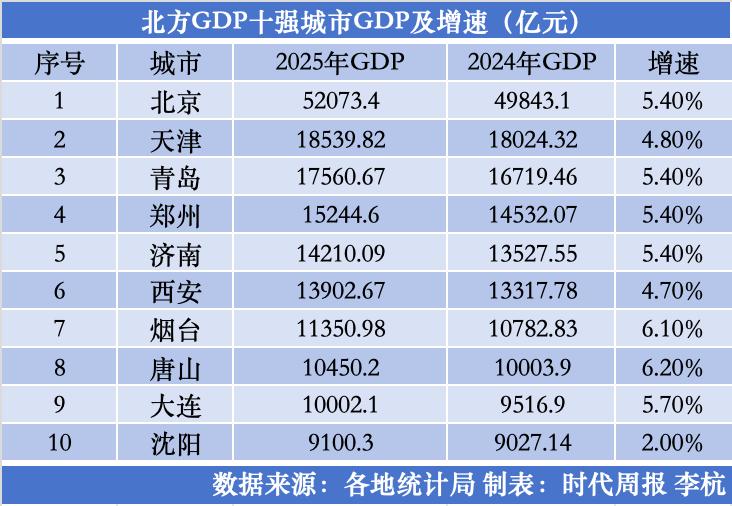
Core Insights - The competition among northern cities is intensifying, with a focus on economic growth and structural optimization as they aim to break through existing barriers [1][6]. Group 1: Economic Performance of Northern Cities - In 2025, the top ten northern cities by GDP are Beijing, Tianjin, Qingdao, Zhengzhou, Jinan, Xi'an, Yantai, Tangshan, Dalian, and Shenyang, with Beijing leading at 52,073.4 billion yuan [2][3]. - Seven out of the ten cities have GDP growth rates exceeding the national average of 5%, with Tangshan achieving the highest growth rate of 6.2% and Shenyang the lowest at 2% [3][4]. - Beijing is the first northern city to surpass the 50 trillion yuan mark, showcasing its economic resilience and high-end service industry advantages [3][4]. Group 2: Competitive Dynamics - Tianjin maintains its position as the "second city of the north" with a GDP of 18,539.82 billion yuan, significantly ahead of Qingdao by 979.15 billion yuan [3][4]. - Qingdao is narrowing the GDP gap with Tianjin, with a notable increase in its industrial output, particularly in marine economy and emerging industries [5][6]. - The competition between Tianjin and Qingdao is expected to intensify, with Qingdao's growth in the Jiaodong Economic Circle enhancing its position [5][6]. Group 3: Challenges and Opportunities - Despite some progress, the economic disparity between northern and southern cities remains significant, with northern provinces' GDP share decreasing slightly from 35.2% to 35.1% [6][7]. - The northern cities are encouraged to leverage policy benefits to shift from total output growth to structural optimization, focusing on industrial collaboration and green energy transitions [8][9]. - Shenyang is on track to become the second "trillion-yuan city" in Northeast China, with a GDP of 9,100.3 billion yuan, but faces challenges due to its lower growth rate [8][9].

中集车辆子公司参与美国“双反”调查,积极应对供应链挑战
Ju Chao Zi Xun· 2026-01-26 04:15
Group 1 - The core announcement is that CIMC Vehicles' subsidiary, Vanguard Global Trailer Holding, along with three other companies, is participating in a countervailing and anti-dumping investigation initiated by the U.S. Department of Commerce regarding box semi-trailers and their components produced in Mexico, Canada, and China [2] - The investigation was officially launched on January 21, 2026, following a request from the U.S. Trailer Manufacturers Association, which claims that the high export levels of box semi-trailers from Mexico are putting pressure on the domestic industry [2] - The announcement indicates potential market adjustment opportunities for component suppliers from other regions that have advantages in product quality, technical compatibility, and supply chain resilience, due to the potential demand for alternative suppliers in the U.S. [2] Group 2 - The U.S. International Trade Commission is expected to make a preliminary ruling on industry damage by February 17, 2026, with the Department of Commerce planning to release preliminary rulings on countervailing and anti-dumping investigations on March 27 and June 10, 2026, respectively [3] - CIMC Vehicles has established a dedicated project coordination team at its headquarters to ensure the orderly delivery of necessary documents and materials for the investigation, given the supply chain relationship between Vanguard Global and CIMC's subsidiary in Qingdao [3] - Vanguard Global has set up a specialized project organization in the U.S. and hired a professional legal team to actively respond to the investigation, aiming to maintain a stable supply chain and accelerate the expansion of its component production capacity in the U.S. [3] - The investigation is currently in the investigation phase, with a final result expected to be announced in approximately 12 to 18 months [3]


中集车辆:子公司Vanguard Global以及旗下三家公司参与美国商务部反补贴、反倾销调查
Zheng Quan Ri Bao Zhi Sheng· 2026-01-25 13:37
Core Viewpoint - The U.S. Department of Commerce has officially launched an anti-subsidy and anti-dumping investigation into Van-type trailers and their subassemblies from Mexico, Canada, and China, following a petition from the American Trailer Manufacturers Coalition [1][2]. Group 1: Investigation Details - The investigation is led by Vanguard Global Trailer Holding, a subsidiary of CIMC Vehicles, along with its three subsidiaries [1]. - The American Trailer Manufacturers Coalition includes three major trailer manufacturers: Great Dane LLC, Wabash National Corporation, and Stoughton Trailers LLC [2]. - The petition claims that the export volume of Van-type trailers from Mexico has been high, exerting market pressure on the U.S. domestic industry [2]. Group 2: Timeline and Process - The U.S. International Trade Commission is expected to make a preliminary ruling on industry damage by February 17, 2026 [3]. - If the preliminary ruling is affirmative, the Department of Commerce will issue preliminary determinations for the anti-subsidy investigation by March 27, 2026, and for the anti-dumping investigation by June 10, 2026 [3]. - The entire investigation process is expected to take 12 to 18 months to complete [4]. Group 3: Company Response and Strategy - CIMC Vehicles has established a project coordination team at its headquarters to ensure the orderly delivery of necessary documents for the investigation [4]. - Vanguard Global has set up a dedicated project organization in the U.S. and hired a professional legal team to actively respond to the investigation [4]. - The company aims to maintain the stability of its existing supply chain while accelerating the expansion of production capacity for Van-type trailers in two locations in the U.S. [4].
全球媒体聚焦 |英媒:三分之二日企认为日中关系紧张伤害日本经济
Sou Hu Cai Jing· 2026-01-15 13:41
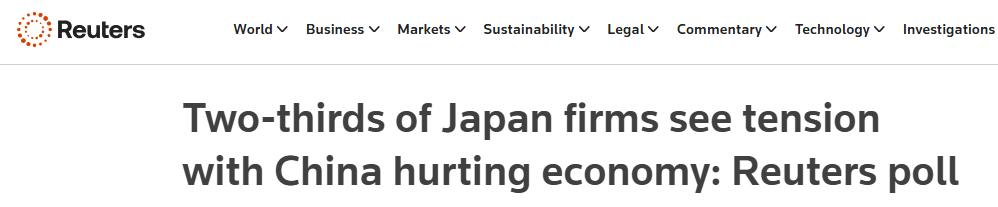
Group 1 - Over two-thirds of Japanese companies expect that tensions in Japan-China relations will impact the Japanese economy, with nearly half already experiencing or anticipating direct operational impacts [1][2] - Approximately 9% of surveyed companies reported that their business has already been affected, while an additional 35% expect varying degrees of impact [2] - About 43% of respondents believe that if Japan-China relations remain tense for an extended period, they will need to reassess their business arrangements related to China [2] Group 2 - A railway operator noted that the decline in Chinese tourists to Japan has started to negatively affect hotel occupancy rates and average revenue per room [2] - An electronics manufacturing executive stated that developments in China's critical mineral policies are a "matter of life and death" for their company [2] - A transportation equipment manufacturer indicated that if Japanese automakers face sales declines in the Chinese market, their own sales could also drop, potentially forcing them to exit the Chinese market [2]
中集集团:联营公司对外整售物业
Zheng Quan Shi Bao Wang· 2026-01-07 10:40
Core Viewpoint - CIMC Group (000039) announced a strategic adjustment to its pricing policy to accelerate cash recovery and ensure liquidity safety by selling its property, the Qianhai CIMC International Business Center East Tower, for a contract amount of approximately 2.534 billion yuan [1] Financial Impact - The sale of the East Tower project is expected to indirectly reduce the group's net profit attributable to shareholders by approximately 1.08 billion yuan (unaudited) due to the difference between the sale price and the book cost [1] - This transaction is projected to have a significant adverse impact on the group's annual net profit for the year 2025 [1]

2025年11月经济数据点评:分化延续,政策需加力
Haitong Securities International· 2025-12-24 14:34
Economic Overview - The national economy in November 2025 showed characteristics of "stable production, differentiated consumption, and pressured investment" with industrial production recovering to normal levels after holiday disruptions[2] - Emerging industries continue to be the main support for production and investment, although industrial growth has slightly slowed down, indicating significant industry differentiation[6] Production Insights - The industrial added value in November increased by 4.8% year-on-year, a slight decrease of 0.1 percentage points from the previous month, while month-on-month growth improved by 0.44 percentage points[8] - The production-sales rate for industrial enterprises was 96.5%, showing a month-on-month increase of 0.1 percentage points, with the export delivery value decline narrowing from 2.1% to 0.1%[8] Consumption Trends - Retail sales growth in November was 1.3% year-on-year, marking a continuous decline for six months, with large-scale retail sales dropping by 2.0%[20] - The promotional season had limited impact on consumer spending, with online retail growth decreasing from 8.1% to 5.4%[22] Investment Analysis - Fixed asset investment from January to November decreased by 2.6% year-on-year, with November showing a month-on-month decline of 12.0%[26] - Manufacturing, broad infrastructure, and real estate investments saw declines of -4.5%, -11.9%, and -30.3% respectively, indicating a challenging investment environment[26] Risk Factors - There is an increasing uncertainty in external trade and a potential unexpected decline in domestic demand, which could further pressure economic growth[37]
深圳一公司3亿买188套房给员工住
Sou Hu Cai Jing· 2025-12-21 06:49
Core Viewpoint - CIMC Group is making significant investments in real estate to attract and retain core talent in Dongguan, purchasing residential properties for employee housing [1] Group 1: Investment Details - CIMC Group's wholly-owned subsidiary, CIMC Innovation, plans to purchase 188 residential units for a total of 293 million yuan, primarily for employee accommodation [1] - The properties are located in the Songshan Lake High-tech Industrial Development Zone, Dongguan, with a total construction area of 16,300 square meters and a unit price of 18,000 yuan per square meter [1] - The market value of the properties is assessed at 372 million yuan as of May 31, 2025, with the transaction price reflecting a discount of approximately 20% based on market practices for bulk transactions [1] Group 2: Previous Transactions - This is not the first time CIMC Group has purchased properties for employee housing; in June, it announced a similar acquisition of 188 residential units in the same project for 164 million yuan, with a total area of 9,100.75 square meters at the same unit price [1] Group 3: Financial Performance - For the first three quarters of 2025, CIMC Group reported revenues of 117.061 billion yuan and a net profit attributable to shareholders of 1.566 billion yuan [1]

11月消费投资低于预期
Ge Lin Qi Huo· 2025-12-15 08:25
1. Report Industry Investment Rating - Not provided in the content 2. Core Viewpoints of the Report - In November, the growth rates of fixed - asset investment and social consumer goods retail总额 were lower than market expectations, while the export growth rate exceeded expectations [4][23]. - The year - on - year decline of real estate sales volume and price continued in November, and the data in early December also showed the same trend [4][23]. - As of the end of October, 5000 billion yuan of new policy - based financial instruments had been fully invested, but the investment data in October and November did not show obvious improvement [4][23]. - The relatively stable international environment after the China - US summit at the end of October is beneficial to China's exports, and stable export confidence is conducive to the growth of private investment [4][23]. - The Central Economic Work Conference in December proposed to implement a more proactive fiscal policy and a moderately loose monetary policy next year to promote investment to stop falling and rebound and boost consumption [23]. 3. Summary by Relevant Catalogs 3.1 Fixed - Asset Investment - From January to November, the national fixed - asset investment decreased by 2.6% year - on - year, worse than the market expectation of a 2.2% decline [1][5]. - From January to November, the broad infrastructure investment (including electricity) increased by 0.1% year - on - year, lower than the market expectation of 1.5% [1][5]. - From January to November, the manufacturing investment increased by 1.9% year - on - year, higher than the market expectation of 0.6% [1][5]. - From January to November, the national real estate development investment decreased by 15.9% year - on - year, worse than the market expectation of a 15.4% decline [1][5]. - From January to November, private fixed - asset investment decreased by 5.3% year - on - year [5]. - In November, manufacturing investment decreased by 4.5% year - on - year, and narrow - sense infrastructure investment (excluding electricity) decreased by 9.7% year - on - year [5]. - In November, the national fixed - asset investment decreased by 1.03% month - on - month, showing a continuous decline for ten consecutive months [5]. 3.2 Real Estate - From January to November, the sales area of new commercial housing decreased by 7.8% year - on - year, and the sales volume decreased by 11.1% year - on - year [2][9]. - In the fourth quarter, the daily average transaction area of commercial housing in 30 large and medium - sized cities decreased significantly year - on - year, and the national real estate sales were still at the bottom [10]. - In November, the second - hand housing prices in first - tier cities decreased by 1.1% month - on - month, with the decline expanding [2][10]. - In November, the real estate development enterprise's available funds decreased by 32.6% year - on - year [11]. - In November, the new housing start - up area decreased by 28% year - on - year, and the housing completion area decreased by 25% year - on - year [11]. 3.3 Industrial Added Value - In November, the value - added of industrial enterprises above designated size increased by 4.8% year - on - year, lower than the market expectation of 5.0% [2][12]. - In November, the value - added of high - tech manufacturing increased by 8.4% year - on - year, maintaining rapid growth [2][12]. 3.4 Foreign Trade - In November, China's exports denominated in US dollars increased by 5.9% year - on - year, exceeding expectations, and imports increased by 1.9% year - on - year [2][14]. - From January to November, China's cumulative export amount increased by 5.4% year - on - year, and the cumulative import amount decreased by 0.6% year - on - year [14]. 3.5 Consumption - In November, the total retail sales of social consumer goods increased by 1.3% year - on - year, lower than the market expectation of 2.9% [3][18]. - In November, among the retail sales of consumer goods by units above the quota, categories with relatively fast year - on - year growth included communication equipment, cultural and office supplies, etc. Categories with relatively fast year - on - year decline included household appliances and audio - visual equipment, building and decoration materials, etc. [19]. 3.6 Service Industry and Employment - In November, the national service industry production index increased by 4.2% year - on - year, hitting a new low for the year [3][21]. - In November, the national urban surveyed unemployment rate was 5.1%, remaining the same as the previous month and 0.1 percentage point higher than the same month of the previous year [3][21].
德国工厂订单激增 欧洲最大经济体前景有所改善
Xin Lang Cai Jing· 2025-12-05 12:00
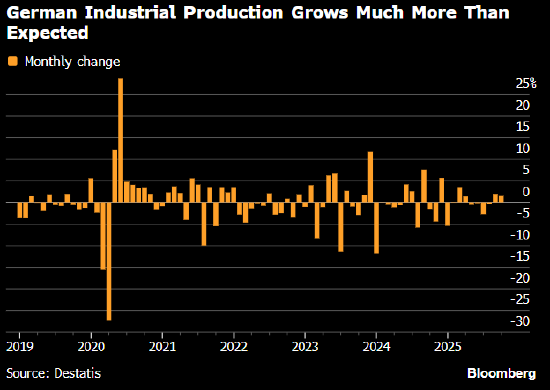
Group 1 - The core viewpoint of the article highlights a significant increase in German factory orders in October, suggesting a potential for growth in the last quarter of the year for Europe's largest economy [1][3]. - The Federal Statistical Office reported a month-on-month demand increase of 1.5%, with September's data revised upward to a growth of 2%, significantly surpassing the median forecast of 0.3% [1][3]. - The improvement in orders is primarily driven by large orders, particularly in the transportation sector, which saw an increase of 87% in orders for aircraft, ships, trains, and military vehicles [1][3]. Group 2 - The recovery of the industrial sector is viewed as crucial for overcoming economic weakness, with GDP expected to contract in both 2023 and 2024 [5]. - Germany faces challenges stemming from deeper issues such as increased tariffs from the U.S., intensified competition, and long-standing bureaucratic obstacles [5].
美关税政策反噬风险显现 沪金区间波动何时破局?
Jin Tou Wang· 2025-12-03 06:02
Group 1 - The core viewpoint of the article highlights concerns regarding the impact of the Trump administration's tariff policies on the U.S. labor market, suggesting that these policies may lead to job losses rather than job creation [3] - The U.S. labor market is showing signs of fatigue, characterized by a "no layoffs, no hiring" stalemate, raising concerns that tariffs on imported goods will increase operational costs for businesses, potentially leading to layoffs [3] - A report from the OECD indicates that while tariffs have not yet caused severe disruptions to the global economy, the full impact may not be fully realized until 2026, suggesting a more challenging labor market ahead [3] Group 2 - The latest gold futures trading indicates a range-bound movement between 950 and 955, with the market awaiting a new directional breakout [4] - The Bollinger Bands are narrowing, indicating a decrease in volatility, while the gold price has faced resistance around 953-954, suggesting persistent selling pressure above this level [4] - The MACD indicator shows limited bullish momentum, reinforcing the expectation of a range-bound market rather than a trend-driven increase in gold prices [4]