
资产管理

Search documents
商业不动产REITs启动申报!财通资管叶晓明:新年三主线掘金新资产
券商中国· 2026-01-07 08:22
Core Viewpoint - The recent announcement by the China Securities Regulatory Commission (CSRC) regarding the pilot program for Commercial Real Estate Investment Trusts (REITs) marks a significant shift from the design phase to market practice, indicating a strong demand for such financial instruments in the market [2][3]. Group 1: Market Demand and Structure - There is a substantial and urgent demand for commercial real estate REITs, with many state-owned enterprises, local government enterprises, and quality private commercial operators preparing to apply for projects [2]. - The commercial real estate REITs are expected to evolve into a mature form encompassing "all categories" and "all assets," moving beyond the previous focus on infrastructure [3]. - The market is anticipated to experience "structured expansion" rather than mere quantity growth, with a focus on mature, stable cash flow assets [3]. Group 2: Key Considerations for Establishment - Three critical issues must be addressed when establishing commercial real estate REITs: asset quality, governance mechanisms, and valuation models [4]. - It is essential to select assets with clear ownership, mature operations, and abundant cash flow to avoid introducing high-risk projects into the market [4]. - A robust governance structure is necessary to clarify the responsibilities and rights among fund managers, operational management, and original rights holders, protecting the interests of small investors [4]. Group 3: Financial Strategies and Innovations - The financial institution is focusing on integrating investment and financing activities related to commercial real estate REITs, aiming to cover a wide range of entities from state-owned to large private companies [5]. - Companies are shifting from merely recovering funds to strategic capital restructuring, learning from successful models like Singapore's dual-fund approach [5][6]. - The institution has already launched several REITs products and is actively pursuing multiple public REITs project applications [6]. Group 4: Investor Behavior and Market Dynamics - The introduction of commercial real estate REITs is expected to change investor logic, positioning REITs as "equity assets with dividend attributes" rather than fixed-income assets [7]. - REITs can provide sustainable cash flow and are seen as a stable investment option with low correlation to other asset classes, which is particularly appealing in a low-interest-rate environment [7]. Group 5: Future Outlook - By 2026, the REITs market is projected to balance "stock activation" and "high-quality development," with a focus on three main lines: core consumer assets, new assets supported by policy, and potential assets with improved operational efficiency [9][10]. - Core consumer assets, similar to mature shopping centers in Singapore, are expected to generate continuous cash flow and serve as a stabilizing force in the REITs market [9]. - New assets like affordable rental housing and data centers will benefit from policy support and align with national strategic development directions [10].


突破4500美元!达利欧:黄金才是真正赢家,美股高回报是"计价幻觉"
Sou Hu Cai Jing· 2026-01-07 06:19
Core Viewpoint - The rise in precious metals, particularly gold and silver, is driven by increasing geopolitical uncertainties, concerns over the dollar system, and expectations of interest rate cuts by the Federal Reserve, enhancing the attractiveness of precious metal investments [1][3] Group 1: Precious Metals Market - COMEX gold futures rose by 1.22% to $4505.70 per ounce, while COMEX silver futures increased by 5.95% to $81.22 per ounce [1] - The demand for gold is being propelled by ongoing inflation worries, geopolitical tensions, and a growing preference for assets outside traditional financial systems [3] - Morgan Stanley forecasts that gold prices will reach a new high of $4800 per ounce by Q4 2026, driven by declining interest rates, changes in Federal Reserve leadership, and increased purchases by central banks and funds [3] Group 2: Investment Insights - Ray Dalio, founder of Bridgewater Associates, emphasizes that the major investment narrative for 2025 will revolve around significant changes in currency value and global asset allocation, asserting that gold is the true winner amidst perceived stock market gains [1] - Dalio warns that the AI-driven surge in tech stocks has entered an early bubble phase, indicating potential risks in that sector [1] - Gold is increasingly viewed not just as a protective asset but as a core strategic holding, especially as confidence in paper assets fluctuates [3]

Ray Dalio:美股估值见顶,黄金跑赢一切,全球迈入多边主义向单边主义的危险转型
对冲研投· 2026-01-07 06:09
Group 1 - The core investment narrative for 2025 is not the strong performance of US stocks, but rather the significant changes in currency values and the global shift in asset allocation, with gold emerging as the true winner [1][4][12] - US stocks recorded an 18% return in USD terms, but this is largely attributed to the depreciation of fiat currencies, creating a "valuation illusion," while gold saw a 65% return [5][12] - The S&P 500 index actually declined by 28% when measured in gold, highlighting the disparity in performance when considering different currencies [5][12] Group 2 - The depreciation of fiat currencies has led to a re-evaluation of asset values, with the USD falling 13% against the Swiss Franc, 12% against the Euro, and 4% against the Chinese Yuan [6][11] - Gold has solidified its position as a major reserve asset, taking on the role of the second-largest reserve currency, which has significant implications for wealth transfer and purchasing power [6][11] - The interest of foreign investors in USD-denominated assets is waning, as evidenced by the negative returns of US Treasuries when measured in gold [6][16] Group 3 - The structural imbalance in profit distribution is evident, with the "Seven Giants" of the S&P 500 showing a 22% profit growth, while the remaining stocks only grew by 9% [7][21] - The improvement in profit margins is largely due to technological efficiencies, but the benefits are disproportionately accruing to capital owners rather than workers, raising concerns about political ramifications [7][22] - The current high valuations and low credit spreads indicate that there is little room for additional returns from risk premiums, suggesting a potential downturn in equity returns [7][23] Group 4 - Non-liquid markets such as venture capital and private equity are under pressure, facing significant debt rollover challenges and a potential rise in liquidity premiums [8][26] - The disparity in performance between liquid and non-liquid assets is expected to widen, as the latter struggles with higher financing costs and cash-out pressures [8][26] - The current environment of fiscal and monetary re-inflation has led to a broad increase in asset prices, but this expansion may not be sustainable, particularly for non-liquid investments [8][27] Group 5 - The political landscape is shifting from multilateralism to unilateralism, increasing military spending and sanctions, which diminishes the attractiveness of USD-denominated assets [9][35] - The affordability crisis driven by inflation is becoming a central political issue, with the wealth gap between the top 10% and the bottom 60% of the population leading to potential political unrest [9][35] - The upcoming elections in 2026 and 2028 are expected to be influenced by these wealth distribution conflicts, potentially leading to significant market impacts [9][35]

传KKR & Co.(KKR.US)豪掷10亿美元收购体育投资公司Arctos 剑指体育与二级市场
智通财经网· 2026-01-07 04:05
Group 1 - KKR & Co. has agreed to acquire Arctos Partners, valuing the sports and secondary market investment company at approximately $1 billion, while retaining the existing management team [1] - The deal includes incentives for Arctos executives, potentially increasing the company's valuation to nearly $1.5 billion [1] - KKR's acquisition of Arctos, which has an asset management scale of about $15 billion, allows KKR to establish a foothold in the growing private equity markets of sports and secondary market investments [1] Group 2 - Arctos is an early pioneer in sports investment, holding stakes in teams such as the NBA's Golden State Warriors and Utah Jazz, MLB's Los Angeles Dodgers and Houston Astros, as well as NFL's Los Angeles Chargers and NHL's New Jersey Devils [1] - The approval of the transaction by the leagues depends on several terms, including verifying potential conflicts of interest among athletes, such as serving as endorsers for KKR's companies [2] - KKR will utilize its balance sheet to acquire Arctos, which will become part of its asset management business [2]

资管行业分化加剧 差异化定位成中小机构破局关键
Zhong Guo Zheng Quan Bao· 2026-01-07 00:55
Core Insights - The asset management industry is undergoing significant transformation due to the implementation of new regulations, leading to a pronounced "Matthew Effect" where larger firms gain competitive advantages while smaller firms struggle to adapt [1][2][3] Industry Overview - The asset management sector is experiencing unprecedented adjustments, with active management becoming a central consensus for development [2] - Larger institutions leverage their comprehensive advantages in funding, branding, and research to solidify their market position, while smaller firms face dual pressures of survival and transformation [2][3] Challenges for Smaller Firms - Smaller institutions are hindered by their reliance on single product innovation for growth, facing challenges in cost control, talent acquisition, technology investment, and brand development [2][3] - The difficulty in building core competencies and meeting collaboration requirements exacerbates the challenges for smaller firms [2][3] Differentiation Strategies - Differentiation is crucial for smaller firms to break through market barriers, with a focus on activating unique capabilities and deepening expertise in specific areas such as fixed income and quantitative investments [3][4] - The integration of asset management with asset securitization and the exploration of unique business models like ABS and public REITs are recommended to create competitive advantages [3][4] Research and Development Framework - A shift towards a "scientific + digital" driven research framework is essential, moving away from reliance on individual star managers and emphasizing technology's role in enhancing research efficiency and risk control [3][6] - Establishing a long-term performance-oriented assessment mechanism is vital for supporting active management transformation [3][5] Case Study: Bohai Huijin - Bohai Huijin has established a "three-pronged" approach focusing on specialization, differentiation, and premium offerings, with a strong emphasis on fixed income and ABS [4][5] - The company aims to create a differentiated product system by focusing on "fixed income+" strategies and exploring unique investment avenues [4][5] Talent and Technology Integration - Addressing talent retention and development is critical, with Bohai Huijin implementing an "internal talent" system to enhance performance and adaptability [6] - The integration of AI technology into business processes is being pursued to standardize operations and improve research efficiency [6][8] Strategic Alignment with National Goals - The asset management business should align with national strategic initiatives, focusing on product innovation in areas like green finance and regional development [7][8] - The emphasis on "fixed income+" products is crucial in a low-interest-rate environment, necessitating a multi-dimensional research approach to enhance strategy stability [7][8] Building Core Competencies - Companies are advised to develop core capabilities through technology-driven risk management, flexible business models, and organizational resilience [8] - Emphasizing cultural cohesion and organizational values is essential for adapting to industry changes and ensuring rapid response to market dynamics [8]
渤海汇金总经理吴国威:资管行业分化加剧 差异化定位成中小机构破局关键
Zhong Guo Zheng Quan Bao· 2026-01-07 00:38
Core Insights - The asset management industry is undergoing significant transformation due to the implementation of new regulations, leading to a pronounced "Matthew Effect" where larger firms gain competitive advantages while smaller firms struggle to adapt [1][2][3] Industry Overview - The asset management sector is experiencing unprecedented adjustments, with active management becoming a central consensus for development [2] - Larger institutions leverage their comprehensive advantages in funding, branding, and research to solidify their market position, while smaller firms face dual pressures of survival and transformation [2][3] Challenges for Smaller Firms - Smaller institutions are hindered by their reliance on single product innovation for growth, facing challenges in cost control, talent acquisition, technology investment, and brand development [2][3] - The difficulty in building core competencies and meeting collaboration requirements exacerbates the challenges for smaller firms [2][3] Differentiation Strategies - Differentiation is crucial for smaller firms to break through market barriers, with a focus on activating unique capabilities and deepening expertise in specific areas such as fixed income and quantitative investments [3][4] - The integration of asset management with asset securitization and the exploration of specialized business models are essential for creating competitive advantages [3][4] Research and Development Framework - A shift towards a "scientific + digital" driven research framework is necessary, moving away from reliance on individual star managers and emphasizing technology's role in enhancing research efficiency and risk control [3][6] - Establishing a long-term performance-oriented assessment mechanism is vital for supporting active management transformation [3][5] Case Study: Bohai Huijin - Bohai Huijin has established a professional, specialized, and boutique development positioning, focusing on fixed income and related areas to create a replicable transformation model [4][5] - The company emphasizes a diversified product system, integrating fixed income with innovative strategies in areas like convertible bonds and asset-backed securities (ABS) [4][5] Cultural and Structural Support - To ensure effective implementation of its strategy, Bohai Huijin has built a support system across cultural, assessment, and compliance dimensions [5][6] - The company promotes a culture centered on long-term value creation and has developed a performance assessment system that prioritizes investor returns [5][6] Talent and Technology Integration - Addressing talent retention, Bohai Huijin has created an "internal talent" system that encourages performance-based advancement and flexibility in roles [6] - The integration of AI technology into business processes aims to enhance operational efficiency and compliance, ensuring a robust risk management framework [6][8] Strategic Opportunities - The asset management business should align with national strategic goals, focusing on product innovation in areas like green finance and regional development [7][8] - Bohai Huijin aims to optimize its research and service offerings through a multi-dimensional product system and collaborative partnerships tailored to client needs [7][8] Building Core Competencies - The company suggests constructing core capabilities through technology-driven risk management, flexible business models, and organizational resilience [8] - Emphasizing a culture of adaptability and responsiveness to industry changes is critical for maintaining competitive advantage [8]
渤海汇金总经理吴国威: 资管行业分化加剧 差异化定位成中小机构破局关键
Zhong Guo Zheng Quan Bao· 2026-01-06 21:59
Core Insights - The asset management industry is undergoing significant transformation due to the implementation of new regulations, leading to a pronounced "Matthew Effect" where larger firms gain competitive advantages while smaller firms struggle to adapt [1][2] - Differentiated positioning is crucial for smaller firms to navigate the challenges of transformation, emphasizing the need for a focus on unique strengths and capabilities [2][4] Industry Transformation and Challenges - The shift towards active management is a consensus in the industry, with larger firms leveraging their resources to dominate the market, while smaller firms face dual pressures of survival and transformation [1][2] - Smaller firms are increasingly challenged by the need to balance resource allocation across cost control, talent acquisition, technology, and brand development [2][3] Strategic Positioning for Smaller Firms - Smaller firms should activate their unique characteristics and focus on niche areas such as fixed income, quantitative investment, and derivatives to build a competitive edge [2][4] - The integration of asset management with asset securitization is essential for exploring unique business models and creating differentiated products [2][4] Research and Investment Framework - Building a robust research and investment framework is critical for the transition to active management, moving away from reliance on individual star managers to a more systematic approach [3][6] - Emphasizing a "scientific + digital" driven investment research framework can enhance efficiency and risk control [3][6] Implementation Strategies - The company has established a "three-pronged" approach focusing on specialization, differentiation, and premium offerings, particularly in fixed income and asset-backed securities [4][5] - A multi-dimensional assessment system prioritizing long-term investor returns over short-term gains is being implemented to support this strategic positioning [5][6] Talent and Technology Integration - Addressing talent retention and development is vital, with the establishment of an internal talent system that promotes performance-based advancement [6][7] - The integration of AI technology into business processes is being pursued to enhance operational efficiency and compliance [6][8] Strategic Opportunities and Core Competencies - Aligning asset management with national strategic goals is essential, focusing on areas like green finance and regional development [7][8] - A multi-faceted investment research and service model is being developed to adapt to market changes and enhance product offerings [7][8]
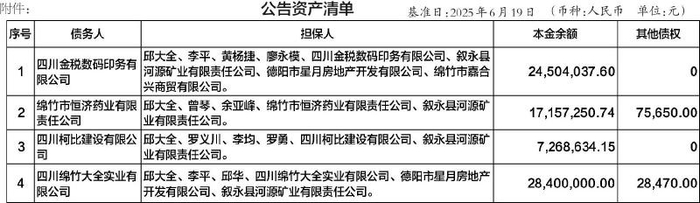
中国长城资产管理股份有限公司四川省分公司与德阳市鑫瑞泓商贸有限责任公司债权转让通知暨债务催收联合公告
Si Chuan Ri Bao· 2026-01-06 21:44
Core Viewpoint - China Great Wall Asset Management Co., Ltd. Sichuan Branch has transferred its rights to the debts listed in the asset announcement to Deyang Xinrui Hong Trading Co., Ltd. [1][2] Group 1: Debt Transfer Details - The principal balance of debts transferred includes amounts such as 24,504,037.60, 17,157,250.74, 7,268,634.15, and 28,400,000.00 [1] - Deyang Xinrui Hong Trading Co., Ltd. is now the assignee and requires all debtors and guarantors listed in the asset announcement to fulfill their repayment obligations immediately [1][2] Group 2: Legal and Contact Information - The interest on the debts will be determined based on relevant legal documents such as contracts and court judgments [2][3] - Contact information for Deyang Xinrui Hong Trading Co., Ltd. is provided, including a phone number and address [3]

科技加速重塑价值链 资管大咖共话投资新愿景
Zhong Guo Zheng Quan Bao· 2026-01-06 20:42
Core Insights - The 2025 Overseas Investment Development Conference highlighted the complex investment landscape for 2026, driven by converging monetary and fiscal policies, technological advancements, and geopolitical changes [1][2] Group 1: Macro Economic Drivers - The driving forces of global asset pricing are shifting from a singular focus on monetary policy to a new phase where both monetary and fiscal policies play significant roles, influenced by rapid technological advancements [2] - Key factors affecting the market in 2026 include the divergence in monetary policies among major economies, particularly the expected interest rate changes by the Federal Reserve and the Bank of Japan [2][3] - Long-term trends such as global order adjustments, the AI technology revolution, and a weak dollar cycle will continue to shape the macroeconomic landscape for asset allocation [2][3] Group 2: Investment Opportunities - Three main investment opportunities identified include: 1. Fixed income investments driven by expected interest rate cuts by the Federal Reserve, potentially lowering rates by 50 to 100 basis points [3] 2. Emerging markets as a source of excess returns, benefiting from global monetary easing and internal demand recovery due to supply chain shifts [3] 3. Certainty in growth within the technology sector, particularly as AI applications begin to materialize in 2026 [3] - The Chinese manufacturing sector is poised for growth, presenting both risks and opportunities as companies expand internationally [3] Group 3: Risks and Market Dynamics - Two major risk factors highlighted include: 1. Policy expectation risk, where deviations from anticipated Federal Reserve rate cuts could lead to asset price corrections [4] 2. Geopolitical risks that could disrupt global energy and trade chains, impacting corporate profitability [4] - Market pricing reflects a consensus that requires respect, with a focus on the sustainability of AI valuations and the gradual improvement in real estate and consumer sectors [4] Group 4: AI Investment Strategies - 2026 is anticipated to be a pivotal year for AI applications, necessitating a reevaluation of investment strategies [5] - Key investment areas in the AI sector include energy, computing power (chips and data centers), large models, and application/data layers, with specific companies like Nvidia and Google highlighted for their leadership [5] - The concept of a "year of application" emphasizes the shift from AI model training to real-world applications, suggesting a potential structural revaluation in the market [5]
SKAGI: Nýting kaupréttar að 14,1% hlut í Íslenskum verðbréfum
Globenewswire· 2026-01-06 19:50
Stjórn Skaga hefur tekið ákvörðun um að nýta kauprétt á alls 14,1% hlut í Íslenskum verðbréfum hf. („félagið“) af minnihlutaeigendum félagsins, sbr. tilkynningu Skaga þann 16. desember 2024. Kaupverðið reiknast út frá því að heildarvirði hluta sé 1,5% af eignum í stýringu félagsins þann 31. desember 2025. Gert er ráð fyrir að seljendur hlutanna fái kaupverðið greitt með 24.231.800 nýjum hlutum í Skaga sem lúta sölubanni til tveggja ára. Fjöldi hluta er reiknaður út frá meðalgengi hlutabréfa Skaga eins og þa ...
