货币价值变化

Search documents
突破4500美元!达利欧:黄金才是真正赢家,美股高回报是"计价幻觉"
Sou Hu Cai Jing· 2026-01-07 06:19
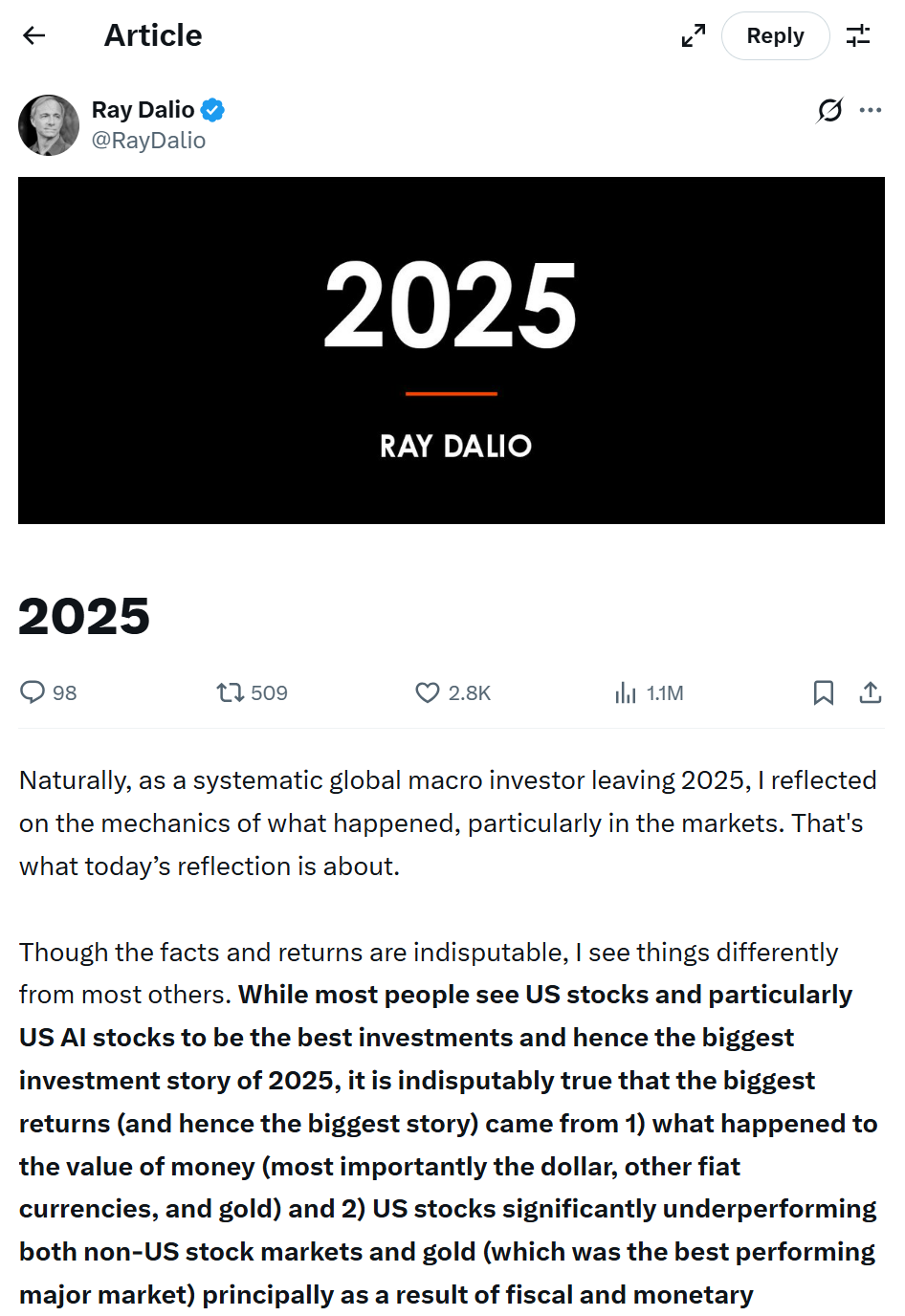
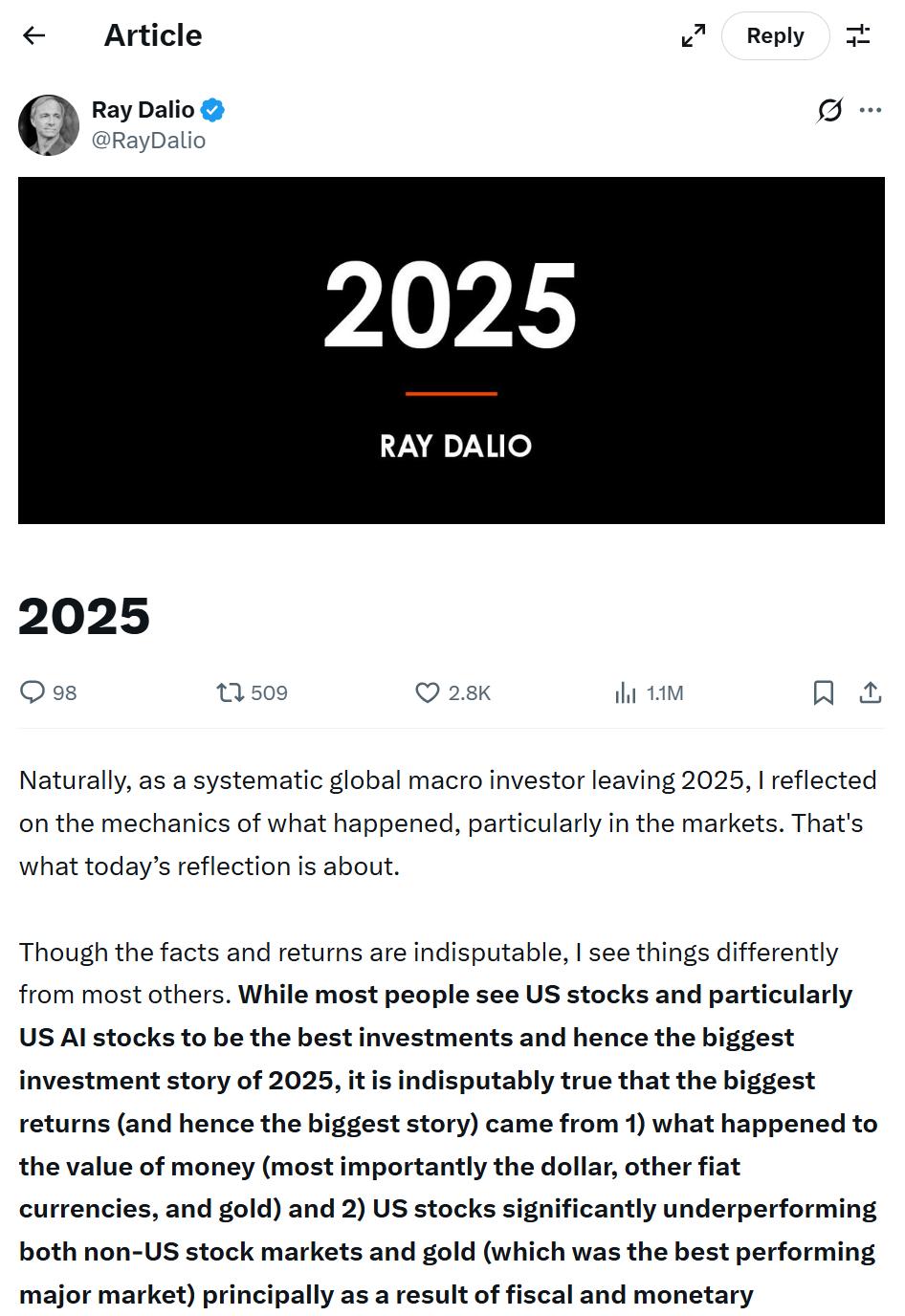
Core Viewpoint - The rise in precious metals, particularly gold and silver, is driven by increasing geopolitical uncertainties, concerns over the dollar system, and expectations of interest rate cuts by the Federal Reserve, enhancing the attractiveness of precious metal investments [1][3] Group 1: Precious Metals Market - COMEX gold futures rose by 1.22% to $4505.70 per ounce, while COMEX silver futures increased by 5.95% to $81.22 per ounce [1] - The demand for gold is being propelled by ongoing inflation worries, geopolitical tensions, and a growing preference for assets outside traditional financial systems [3] - Morgan Stanley forecasts that gold prices will reach a new high of $4800 per ounce by Q4 2026, driven by declining interest rates, changes in Federal Reserve leadership, and increased purchases by central banks and funds [3] Group 2: Investment Insights - Ray Dalio, founder of Bridgewater Associates, emphasizes that the major investment narrative for 2025 will revolve around significant changes in currency value and global asset allocation, asserting that gold is the true winner amidst perceived stock market gains [1] - Dalio warns that the AI-driven surge in tech stocks has entered an early bubble phase, indicating potential risks in that sector [1] - Gold is increasingly viewed not just as a protective asset but as a core strategic holding, especially as confidence in paper assets fluctuates [3]

Ray Dalio:美股估值见顶,黄金跑赢一切,全球迈入多边主义向单边主义的危险转型
对冲研投· 2026-01-07 06:09
Group 1 - The core investment narrative for 2025 is not the strong performance of US stocks, but rather the significant changes in currency values and the global shift in asset allocation, with gold emerging as the true winner [1][4][12] - US stocks recorded an 18% return in USD terms, but this is largely attributed to the depreciation of fiat currencies, creating a "valuation illusion," while gold saw a 65% return [5][12] - The S&P 500 index actually declined by 28% when measured in gold, highlighting the disparity in performance when considering different currencies [5][12] Group 2 - The depreciation of fiat currencies has led to a re-evaluation of asset values, with the USD falling 13% against the Swiss Franc, 12% against the Euro, and 4% against the Chinese Yuan [6][11] - Gold has solidified its position as a major reserve asset, taking on the role of the second-largest reserve currency, which has significant implications for wealth transfer and purchasing power [6][11] - The interest of foreign investors in USD-denominated assets is waning, as evidenced by the negative returns of US Treasuries when measured in gold [6][16] Group 3 - The structural imbalance in profit distribution is evident, with the "Seven Giants" of the S&P 500 showing a 22% profit growth, while the remaining stocks only grew by 9% [7][21] - The improvement in profit margins is largely due to technological efficiencies, but the benefits are disproportionately accruing to capital owners rather than workers, raising concerns about political ramifications [7][22] - The current high valuations and low credit spreads indicate that there is little room for additional returns from risk premiums, suggesting a potential downturn in equity returns [7][23] Group 4 - Non-liquid markets such as venture capital and private equity are under pressure, facing significant debt rollover challenges and a potential rise in liquidity premiums [8][26] - The disparity in performance between liquid and non-liquid assets is expected to widen, as the latter struggles with higher financing costs and cash-out pressures [8][26] - The current environment of fiscal and monetary re-inflation has led to a broad increase in asset prices, but this expansion may not be sustainable, particularly for non-liquid investments [8][27] Group 5 - The political landscape is shifting from multilateralism to unilateralism, increasing military spending and sanctions, which diminishes the attractiveness of USD-denominated assets [9][35] - The affordability crisis driven by inflation is becoming a central political issue, with the wealth gap between the top 10% and the bottom 60% of the population leading to potential political unrest [9][35] - The upcoming elections in 2026 and 2028 are expected to be influenced by these wealth distribution conflicts, potentially leading to significant market impacts [9][35]

达利欧年度复盘:美元贬值,美股高回报只是“计价幻觉”,黄金跑赢一切
3 6 Ke· 2026-01-07 02:44
Group 1 - The core investment narrative for 2025 is not the strong performance of the US stock market, but rather the significant changes in currency values and the global shift in asset allocation, with gold emerging as the true winner [1][4][5] - The US stock market recorded an 18% return in USD terms, but this is largely attributed to the devaluation of fiat currencies, creating a "valuation illusion" [4][11] - The dollar depreciated by 39% against gold, while the return on gold investments (in USD) reached 65%. When measured in gold, the S&P 500 index actually declined by 28% [4][11] Group 2 - There is a notable shift of funds towards non-US markets, with overall returns from emerging markets reaching 34%, significantly outperforming US stocks [4][16] - The valuation of US stocks appears to have peaked, with equity risk premiums at historically low levels, indicating that the potential for additional returns from risk premiums has diminished [4][19] - The political landscape is shifting, with inflation leading to a "affordability" crisis that is likely to incite conflict between extreme left and right factions in the US by 2027-2028 [4][8][24] Group 3 - The collective weakening of fiat currencies has established gold as a primary reserve asset, with the dollar declining against several currencies, including a 13% drop against the Swiss franc and a 12% drop against the euro [5][10] - The performance of the S&P 500 is driven by profit growth and P/E ratio expansion, with the "seven giants" contributing significantly to overall earnings growth [6][17] - Non-liquid markets such as venture capital and private equity are under pressure, facing significant debt extension challenges and a potential rise in liquidity premiums [7][22] Group 4 - The geopolitical landscape is transitioning from multilateralism to unilateralism, increasing military spending and sanctions, which diminishes the attractiveness of dollar-denominated assets [8][30] - The disparity in wealth distribution is becoming a central political issue, with the top 10% of income earners holding a disproportionate amount of stock assets, while the bottom 60% feel the burden of inflation [8][24] - The current political climate, influenced by the Trump administration, is characterized by aggressive leverage of capitalist forces, which has implications for market dynamics and investor sentiment [23][25]
桥水Ray Dalio:美股估值见顶,黄金跑赢一切,全球迈入多边主义向单边主义的危险转型
对冲研投· 2026-01-07 01:36
Group 1 - The core investment narrative for 2025 is not the strong performance of US stocks, but rather the significant changes in currency values and the global shift in asset allocation, with gold emerging as the true winner [1][4][12] - US stocks recorded an 18% return in USD terms, but this is largely attributed to the devaluation of fiat currencies, creating a "valuation illusion" [5][12] - The S&P 500 index, when priced in gold, actually declined by 28%, highlighting the disparity in performance when considering different currencies [5][12] Group 2 - The US stock market significantly underperformed compared to non-US markets, with European, Chinese, and Japanese stocks outperforming US stocks by 23%, 21%, and 10% respectively [18][20] - Emerging markets showed an overall return of 34%, indicating a substantial capital shift away from US assets [19][20] - The interest of foreign investors in USD-denominated assets is waning, as evidenced by the negative returns of US Treasuries when priced in gold, which saw a -34% return [5][6] Group 3 - The valuation of US stocks appears to have peaked, with long-term equity expected returns at 4.7%, which is lower than the 4.9% return on bonds, indicating a low equity risk premium [23][24] - The disparity in profit distribution, where capitalists benefit more than workers, is raising concerns among leftist political forces, potentially impacting future profit margins [7][22][23] Group 4 - The political landscape is shifting towards extreme left and right forces due to affordability crises driven by inflation, which is expected to lead to significant conflicts by 2027-2028 [5][9][35] - The transition from multilateralism to unilateralism is increasing military spending and sanctions, further diminishing the attractiveness of USD assets [9][35][36] Group 5 - Non-liquid markets such as venture capital, private equity, and real estate are under pressure, facing significant debt rollover challenges and a potential rise in liquidity premiums [8][26] - The current low liquidity premium in these markets may lead to a decline in value relative to liquid assets, indicating a potential liquidity trap for investors [8][26]

达利欧年度复盘:美元贬值,美股高回报只是“计价幻觉”,黄金跑赢一切
华尔街见闻· 2026-01-06 11:49
Core Insights - The main investment narrative for 2025 is not the strong performance of the US stock market, but rather the significant changes in currency values and the global shift in asset allocation, with gold emerging as the true winner [1][5][12]. Currency Value Changes - The US dollar has depreciated significantly against other currencies, with declines of 13% against the Swiss franc, 12% against the euro, and 4% against the Chinese yuan. This depreciation creates an illusion of asset appreciation when measured in local currency [6][12]. - Gold has established itself as a major reserve asset, taking on the role of the second-largest reserve currency, highlighting the critical impact of currency movements on wealth transfer [6][12]. Stock Market Performance - The S&P 500 index recorded an 18% total return in USD, driven by a 12% increase in earnings and a 5% rise in price-to-earnings ratios. However, when measured in stronger currencies, the performance appears significantly weaker [8][15]. - The "Seven Giants" within the S&P 500 saw a 22% earnings growth, while the remaining 493 stocks experienced a 9% growth, indicating a disparity in profit distribution favoring capital owners over workers [8][15]. Global Market Dynamics - Non-US markets, including Europe, China, and Japan, outperformed US stocks, with emerging markets showing an overall return of 34%. This reflects a significant capital shift away from US assets [5][14]. - The interest of foreign investors in US dollar-denominated assets is declining, leading to a preference for non-US equities and bonds [6][14]. Political and Geopolitical Factors - The political landscape is shifting from multilateralism to unilateralism, increasing military spending and sanctions, which diminishes the attractiveness of US dollar assets [10][25]. - The growing wealth gap, exacerbated by inflation, is likely to lead to political unrest and conflict between left and right factions in the US, impacting market stability [10][20]. Non-Liquid Markets - Non-liquid markets such as venture capital, private equity, and real estate are under pressure, facing significant debt rollover challenges and a potential rise in liquidity premiums [9][19]. - The current low liquidity premium may lead to a decline in the value of non-liquid assets compared to liquid ones, posing risks for investors [9][19].

达利欧年度复盘:美元等法币贬值,美股高回报只是“计价幻觉”,黄金跑赢一切
Hua Er Jie Jian Wen· 2026-01-06 07:33
Group 1: Core Insights - The core narrative emphasizes that the real value anchor is gold, with the U.S. stock market showing strong returns in 2025 (18%) primarily due to significant depreciation of the dollar and other fiat currencies, leading to a "pricing illusion" [1][4] - Gold has emerged as the second-largest reserve currency, highlighting a shift in asset allocation towards non-U.S. markets, as foreign investors show decreasing interest in dollar-denominated assets [5][10] - The U.S. stock market is experiencing peak valuations, with profit growth driven by sales and technological efficiency, but the benefits are disproportionately flowing to capital owners rather than workers [6][12] Group 2: Market Dynamics - The performance of the S&P 500 index, while showing an 18% total return in USD, masks a significant decline of 28% when measured in gold terms, indicating a stark contrast in asset performance based on currency valuation [1][10] - Non-liquid markets such as venture capital, private equity, and real estate are under pressure, facing severe debt extension challenges and a potential rise in liquidity premiums [7][14] - The political landscape is shifting from multilateralism to unilateralism, increasing military spending and sanctions, which further diminishes the attractiveness of dollar-denominated assets [8][18] Group 3: Economic and Political Context - The affordability crisis driven by inflation is causing unrest among the lower 60% of the population, with predictions of significant political conflict between extreme left and right forces in the U.S. by 2027-2028 [1][8] - The disparity in wealth distribution is widening, with the top 10% benefiting from stock ownership while the majority feel the burden of inflation, leading to potential political upheaval [15][16] - The current geopolitical climate is characterized by increased military expenditures and a shift towards protectionism and de-globalization, impacting investment flows and asset preferences [18][19]