太阳能电池

Search documents
济南起步区今年将新开工建设一批新能源汽车产业项目
Qi Lu Wan Bao Wang· 2025-08-28 03:12
Group 1 - Jinan city is implementing the "Industrial Strong City Development Strategy" with a focus on advanced manufacturing projects in the new energy vehicle sector, aiming to accelerate the emergence of a trillion-yuan industrial cluster [1] - The new energy vehicle base of BYD in Jinan has produced eight models, contributing nearly 100 billion yuan in output value since its establishment in 2022 [1] - The Aishuo Solar Energy project has achieved a light-to-electricity conversion efficiency of over 24.4%, leading the international commercial component efficiency rankings for 30 consecutive months [1] Group 2 - The National Power Investment's hydrogen energy industrial base project is operating three production lines with an annual capacity of 1,000 units each for various fuel cells, expanding hydrogen energy applications [2] - The "Hydrogen Teng" fuel cell has been successfully deployed at the Antarctic Qinling Station, and commercial vehicles using fuel cells from the start-up area have been promoted in Shandong, Henan, and Hebei [2]

晶采观察·解码“十四五”|“新三样”圈粉 中国出口“含新量”更足
Yang Guang Wang· 2025-08-27 06:05
Group 1 - The core achievement of the "14th Five-Year Plan" is the significant increase in the export of high-tech products, with the "new three samples" expected to grow 2.6 times by 2024 compared to 2020 [2] - The transition from traditional exports like clothing and furniture to high-tech products such as electric vehicles, lithium batteries, and solar cells indicates a structural optimization in China's foreign trade [3] - The performance of new energy vehicles, which have ranked first in global production and sales for ten consecutive years, highlights China's competitive advantage in the market and its complete industrial chain [3] Group 2 - Cultural products, represented by online literature, web series, and video games, are gaining popularity overseas, with works like "Nezha 2" and "Black Myth: Wukong" becoming global consumer favorites [3] - The development of the "new three samples" reflects a shift towards high-quality and innovative products that meet consumer demands for quality and new experiences, supported by a mature supply chain [4] - Customs authorities have intercepted 1.83 million counterfeit LABUBU products this year, demonstrating their commitment to protecting intellectual property rights for both domestic and foreign enterprises [4]
“新三样”圈粉 中国出口“含新量”更足
Yang Guang Wang· 2025-08-27 02:30
Core Insights - The "New Three Samples" reflect a significant transformation in China's manufacturing sector, indicating a shift from quantity and price competition to quality and innovation in exports [2][3] - The export of high-tech products such as electric vehicles, lithium batteries, and solar cells has increased by 2.6 times from 2020 to 2024, showcasing the growth of new advantageous industries in China [1] Group 1: Export Trends - The export landscape has transitioned from traditional products like clothing and furniture to high-tech items, marking a new growth point for China's foreign trade [1][2] - New energy vehicles have maintained the top position in global production and sales for ten consecutive years, supported by China's vast market and complete industrial chain [2] Group 2: Cultural Products - Cultural products, represented by online literature, web series, and video games, are gaining popularity overseas, contributing to the global appeal of Chinese culture [2] - Successful cultural exports like "Nezha 2" and "Black Myth: Wukong" are driving service trade growth, showcasing the potential of China's creative industries [2] Group 3: Innovation and Protection - The development of the "New Three Samples" is driven by consumer demand for high quality and new experiences, supported by mature supply chains and production capabilities [3] - Customs authorities have intercepted 1.83 million counterfeit LABUBU items this year, highlighting the importance of intellectual property protection in fostering innovation [3]
2025年1-6月中国太阳能电池(光伏电池)产量为37019万千瓦 累计增长18.2%
Chan Ye Xin Xi Wang· 2025-08-27 01:39
Core Viewpoint - The solar cell industry in China is experiencing significant growth, with production figures indicating a robust increase in output and a positive outlook for the coming years [1] Industry Summary - As of June 2025, China's solar cell (photovoltaic cell) production reached 67.39 million kilowatts, marking a year-on-year growth of 24.1% [1] - Cumulatively, from January to June 2025, the total production of solar cells in China was 370.19 million kilowatts, reflecting an 18.2% increase compared to the previous year [1] - The report by Zhiyan Consulting outlines the competitive landscape and investment recommendations for the solar cell industry in China from 2025 to 2031 [1] Company Summary - Key listed companies in the solar energy sector include Longi Green Energy (601012), Tongwei Co., Ltd. (600438), Sungrow Power Supply Co., Ltd. (300274), JA Solar Technology Co., Ltd. (002459), Trina Solar Limited (688599), TBEA Co., Ltd. (600089), Chint Electric Co., Ltd. (601877), and TCL Zhonghuan Renewable Energy Technology Co., Ltd. (002129) [1]








前7个月青海省外贸进出口同比增长49.3%
Zhong Guo Xin Wen Wang· 2025-08-20 16:30
Group 1 - The total import and export value of Qinghai Province reached 4.18 billion yuan in the first seven months of 2025, representing a year-on-year increase of 49.3% [1] - Exports amounted to 3.69 billion yuan, showing a significant year-on-year growth of 90.3%, while imports were 490 million yuan, down 43.2% [1] - Qinghai Province has maintained the highest growth rate in imports and exports for seven consecutive months nationwide [1] Group 2 - The number of foreign trade entities in Qinghai Province has steadily increased, with private enterprises being the main driving force behind foreign trade growth [1] - Key export products include solar cells, lithium-ion batteries, and electric passenger vehicles, contributing significantly to export growth [1] - Exports of salt lake chemical products surged, reaching 1.79 billion yuan, a year-on-year increase of 11.8 times, accounting for 48.4% of the province's total exports and contributing 94.2% to export growth [1] Group 3 - Qinghai Province's "Qing" branded specialty agricultural products have shown strong export momentum, totaling 450 million yuan to 46 countries and regions, a year-on-year increase of 47.6% [1] - The variety of exported agricultural products reached 95, with 56 new types added compared to the same period last year, maintaining the highest growth rate in exports for six consecutive quarters [1] - Notable agricultural exports include goji berries at 14.79 million yuan (up 34.8%), frozen trout at 3,875.7 tons (up 120%), and vegetables at 2,119.6 tons (up 170%) [1] Group 4 - Qinghai Province's market diversification continues to advance, with steady growth in trade with countries involved in the Belt and Road Initiative [2] - In the first seven months, trade with 100 countries and regions was conducted, with 75 being Belt and Road countries, resulting in a total import and export value of 3.45 billion yuan, a year-on-year increase of 66% [2] - Among the Belt and Road countries, trade with 17 countries doubled, with Hungary, Russia, and Vietnam being the top three trading partners, achieving import and export values of 1.68 billion, 330 million, and 270 million yuan, respectively, with year-on-year growth rates of 1,390%, 150%, and 460% [2]
特朗普失策了!印度面对50%关税,莫迪找了50国的出口退路?关键时刻,王毅访印点明出路
Sou Hu Cai Jing· 2025-08-19 07:53
Core Viewpoint - India is facing significant economic challenges due to the imposition of high tariffs by the United States, particularly a 50% tariff on certain goods, which has led to a reevaluation of its export strategies and markets [1][3][8] Group 1: Economic Impact - The U.S. has imposed a 25% punitive tariff on Indian goods, adding to an existing 25% tariff, resulting in a total of 50% on certain exports [1] - India's exports to the U.S. have historically accounted for about 18% of its total exports, making the U.S. its second-largest export destination [1] - High tariffs are compressing profits and causing orders to shift away from traditional Indian industries such as leather, textiles, and engineering machinery [1] Group 2: Strategic Response - The Indian government, led by Prime Minister Modi, is actively seeking to diversify its export markets, focusing on over 50 emerging countries that collectively account for nearly 45% of global trade [3] - The Indian agricultural export sector has seen a 17% increase in orders from the Middle East and over 23% growth in agricultural machinery exports to Africa [3] - India is also investing in high-value sectors such as solar cells, lithium batteries, and pharmaceuticals, with a significant initiative to produce silicon carbide chips [3][4] Group 3: Government Support - Modi announced the revival of a 225 billion INR export promotion fund to support small and medium enterprises affected by U.S. tariffs [4] - The National Development Bank has established a special credit window to assist companies in expanding into non-U.S. markets [4] Group 4: International Relations - Jeffrey Sachs emphasized the need for India to diversify its trade partnerships and reduce reliance on the U.S., aligning with India's current strategy to strengthen ties with countries like Russia, China, and various African nations [6] - China's Foreign Minister Wang Yi's upcoming visit to India is seen as an opportunity to enhance bilateral relations and provide India with alternative trade options amidst U.S. pressures [8] - Strengthening cooperation between India and China could help India mitigate the impact of U.S. tariffs and enhance its bargaining power on the global stage [8]

“新三样”领域2起偷骗税案件曝光!产业发展越火热,企业越要坚守合规底线
Xin Hua Cai Jing· 2025-08-18 11:39
Core Viewpoint - The Chinese government has implemented a series of tax and fee preferential policies to support the development of the "new three items" (electric passenger vehicles, lithium batteries, and solar batteries), but recent tax fraud cases in this sector highlight the need for compliance and integrity in tax practices [1][2]. Group 1: Tax Fraud Cases - The State Taxation Administration disclosed two tax fraud cases in the "new three items" sector, marking the first public exposure of such violations, emphasizing that any attempts to undermine tax fairness will face severe penalties [1]. - Jiangxi Nanshi Lithium Battery New Materials Co., Ltd. fraudulently claimed tax benefits by improperly including non-research personnel's salaries (totaling 6.6822 million yuan) as research expenses from 2021 to 2023 [1]. - Another case involved a tax fraud gang that obtained 149 million yuan in illegal export tax refunds by misrepresenting lead-acid batteries as refundable lithium batteries [1]. Group 2: Industry Implications - The crackdown on tax fraud in the "new three items" sector is expected to create a fair tax environment, enhance market rules, and promote healthy industry growth, ultimately improving overall competitiveness and curbing excessive competition [2]. - The misuse of tax incentives by some companies not only disrupts economic order but also hinders high-quality development in the industry, necessitating a shift from policy-driven to innovation-driven growth [2][3]. - Experts suggest that optimizing tax policies and adjusting fiscal subsidies based on industry development stages and cost changes is essential for fostering sustainable growth in the "new three items" sector [2].
首次披露“新三样”领域偷骗税案件 以税收公平助力“反内卷”
Zheng Quan Shi Bao Wang· 2025-08-18 09:26
Core Viewpoint - The exposure of tax evasion cases in the "New Three Items" (new energy vehicles, lithium batteries, solar cells) sector highlights the need for compliance and integrity in a rapidly growing industry, emphasizing that companies should focus on innovation rather than exploiting tax loopholes [1][2][3]. Group 1: Tax Evasion Cases - The National Taxation Administration revealed two tax evasion cases in the "New Three Items" sector, marking the first disclosure of such violations in this field [1]. - Jiangxi Nan's Lithium Battery New Materials Co., Ltd. was found to have improperly claimed R&D tax deductions by including non-R&D personnel's salaries, resulting in a tax penalty of 5.719 million yuan [2]. - A criminal gang led by Lin Jiayang was discovered to have fraudulently obtained export tax refunds amounting to 149 million yuan by misrepresenting products, leading to severe legal consequences for the involved parties [3]. Group 2: Impact on Industry Development - Tax evasion undermines the intended purpose of tax incentives designed to foster innovation and disrupts the fair tax environment, contributing to chaotic competition and overcapacity in the industry [2][3]. - The illegal activities not only distort market mechanisms but also harm compliant businesses, threatening the overall health of the "New Three Items" sector [1][2]. Group 3: Regulatory and Policy Recommendations - The central government emphasizes the importance of strict enforcement against tax evasion to ensure that tax benefits reach companies genuinely focused on innovation and quality improvement [4][5]. - Experts suggest that optimizing the policy framework is essential to prevent overcapacity and promote high-quality development, advocating for adjustments in fiscal subsidies and tax incentives based on industry dynamics [6].
山东城市观察 | 济南市委常委会“移师”起步区的战略深意
Xin Lang Cai Jing· 2025-08-15 07:43
Core Insights - The special meeting of the Jinan Municipal Standing Committee signifies a strong commitment to accelerate the development of the Jinan Start-up Zone, emphasizing its role as a strategic hub for high-quality development in Shandong [3][10][12] - The meeting adopted a unique format of "research first, then meeting," allowing decision-makers to gather firsthand data from various projects, enhancing the practical basis for policy decisions [5][4] Group 1: Meeting Highlights - The meeting was held in the Start-up Zone, highlighting its strategic importance as a key area for the Yellow River National Strategy and Shandong's green, low-carbon development [3][7] - The focus was solely on the development of the Start-up Zone, indicating a critical phase requiring concentrated resources to address key challenges [5][10] - Participants included city departments and district leaders, emphasizing accountability and ensuring seamless policy implementation [5][12] Group 2: Economic Growth and Development - In just four years, the Start-up Zone's GDP has surpassed 52.76 billion, with an annual growth rate of 18% from 2021 to 2024, and a remarkable GDP growth of 23.3% in the first half of 2025 [7][8] - The area has seen significant industrial development, with major projects like BYD's vehicle manufacturing and solar energy initiatives contributing to a robust industrial matrix [7][8] - Infrastructure improvements include 11 bridges and tunnels, enhancing connectivity and urban functionality, with educational and healthcare facilities now operational [8][10] Group 3: Future Development Directions - The meeting outlined a clear development blueprint focusing on ecological protection, high-quality urban development, and the introduction of innovative projects [10][11] - Key areas of focus include enhancing agricultural modernization, promoting green and low-carbon development, and ensuring safety and disaster prevention measures [11][12] - The strategic integration of resources among city departments aims to create a strong collaborative force for the development of the Start-up Zone [12][13]

湖南一大学生团队突破钙钛矿太阳能电池高柔韧性瓶颈
Zhong Guo Xin Wen Wang· 2025-08-15 06:13
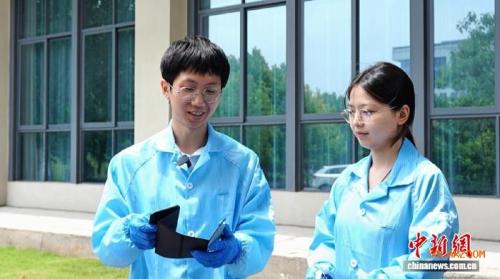
Core Viewpoint - The article highlights the development of a flexible perovskite solar cell phone case by a team at Nanhua University, which can charge devices using sunlight without the need for an external power source [1][3]. Group 1: Technology and Innovation - The flexible perovskite solar cell is lightweight, bendable, and can be applied to various surfaces such as backpacks and drone wings, addressing the limitations of traditional rigid solar panels [3][4]. - The project team focuses on overcoming three main technical challenges: the brittleness of ITO electrodes, the fragility of perovskite films, and the separation at the interlayer interface [3][4]. - Innovations include the development of a PEDOT:PSS transparent flexible electrode to replace brittle ITO materials, and the introduction of grain molecular bridging technology to enhance film durability [4][6]. Group 2: Market Potential and Applications - The technology has resulted in small-area battery devices and large-area flexible battery modules, with successful applications in three companies and an intention to order worth 10 million yuan [6]. - The global market for perovskite solar cells is projected to reach nearly $250 million by 2024, with a compound annual growth rate of 71.5% expected by 2032 [6]. - The project team aims to optimize material formulations and production processes to enhance efficiency and uniformity, targeting a future efficiency of 90% after 10,000 bends [6].