
矿产资源

Search documents
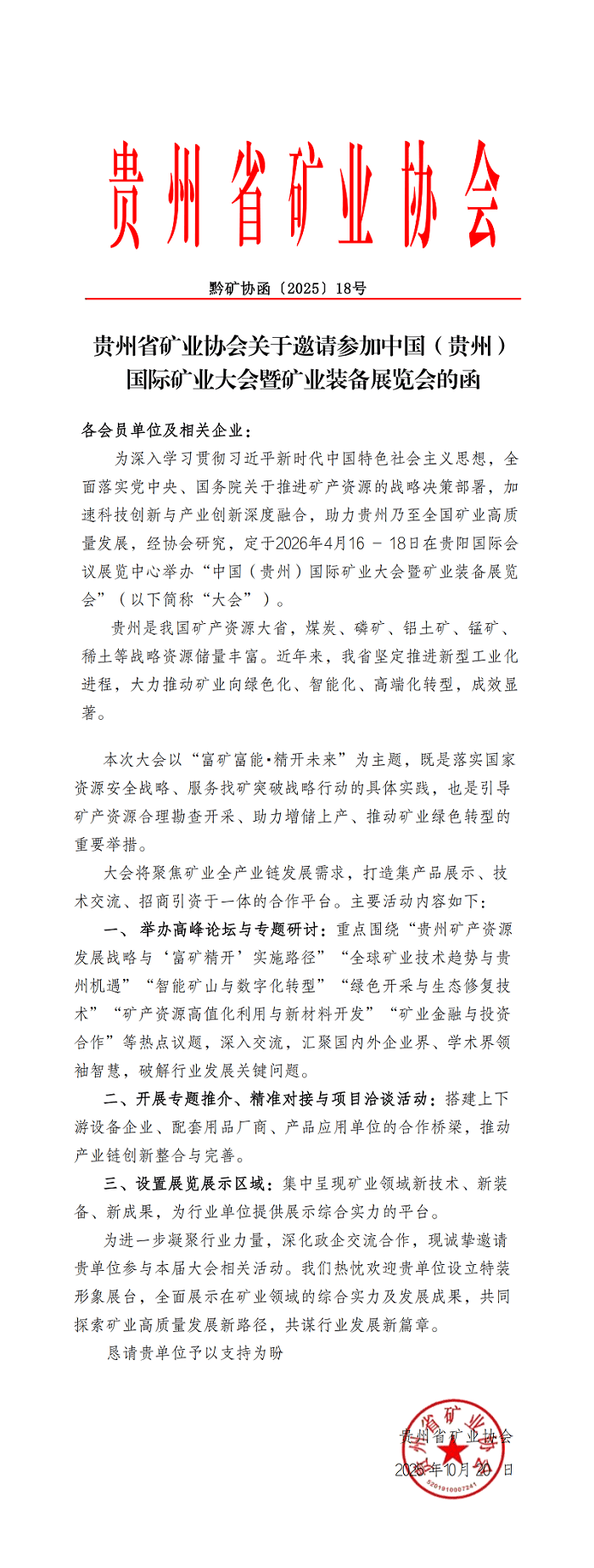
贵州矿业展|2026中国(贵州)国际矿业大会暨矿业装备展览会
Sou Hu Cai Jing· 2025-11-02 10:43
Core Viewpoint - The "China (Guizhou) International Mining Conference and Mining Equipment Exhibition" will be held from April 16 to 18, 2026, in Guiyang, aiming to promote high-quality development in the mining industry through technological innovation and sustainable practices [1][4]. Group 1: Event Details - The conference will focus on the theme "Rich Minerals, Rich Energy • Precise Development for the Future" [2]. - It is organized by the Guizhou Provincial Mining Association and supported by various media outlets [3]. - The event aims to create a platform for industry exchange, promoting technological innovation and equipment upgrades in the mining sector [4]. Group 2: Industry Context - Guizhou is a major province for mineral resources in China, with abundant reserves of coal, phosphate, bauxite, manganese, and rare earths [1][4]. - The province has been advancing new industrialization, pushing for a transformation towards greener, smarter, and higher-end mining practices [1][4]. - The conference will address the entire mining industry chain, focusing on resource exploration, sustainable extraction, and enhancing production capacity [1][4]. Group 3: Exhibition Features - The exhibition will showcase a wide range of mining technologies and equipment, including drilling, loading, and smart mining solutions [4]. - It will also cover topics such as geological exploration technologies, safety equipment, and clean coal processing technologies [4]. - The event will feature discussions on global mining technology trends and the opportunities for Guizhou's mineral resources [5]. Group 4: Concurrent Activities - The conference will include discussions on the development strategy for Guizhou's mineral resources and the implementation paths for high-value utilization [5]. - High-level dialogues will involve government, enterprise, and expert discussions on high-quality mining development [5]. - Awards will be presented for outstanding contributions in the mining sector, including the "New Quality Production Force Brand" and "Expert Recommended Award" [5].

【独家】“深地经济”战略意义凸显 多个省份拟将核心产业纳入相关“十五五”规划
Zheng Quan Shi Bao Wang· 2025-10-31 02:09
Group 1 - The "deep earth economy" is strategically significant for ensuring national energy security, with the Ministry of Natural Resources planning to accelerate the standardization of emerging industries during the 14th Five-Year Plan period [1] - Multiple provinces are incorporating the core direction of the "deep earth economy" into their respective 14th Five-Year Plans, indicating a broad regional commitment to this initiative [1] Group 2 - Sichuan province is actively implementing "deep earth economy" initiatives, focusing on the exploration and development of deep mineral resources and upgrading equipment [2] - In terms of deep earth equipment manufacturing, Sichuan plans to include deep resource exploration and detection technology in its 14th Five-Year Plan [2] - Yunnan province is supporting technological breakthroughs in the deep earth sector, encouraging collaboration between research institutions, geological exploration units, and mining enterprises for major scientific projects [2] - Inner Mongolia is developing its own 14th Five-Year mineral resource and geological survey plans, aligning with national and regional strategies [2]
【图解】“十四五”高质量发展答卷:山水林田湖草沙一体化 自然资源实现高质量发展
Zhong Guo Jing Ji Wang· 2025-10-30 00:09
Core Insights - The "14th Five-Year Plan" has led to significant advancements in the high-quality development of natural resources in China, with a focus on sustainable management and utilization [1][2]. Group 1: Agricultural Resources - As of the end of 2024, the cultivated land area reached 1.94 billion acres, an increase of 28 million acres since 2020, firmly maintaining the protection of arable land [1]. Group 2: Mineral Resources - A comprehensive assessment of 163 types of mineral resources has been conducted, revealing the quantity, distribution, and utilization status, with 534 new large and medium-sized oil and gas fields and mineral sites discovered [2]. Group 3: Water Resources - The total water resource volume is 31.1 trillion cubic meters, including 8.679 trillion cubic meters of groundwater [3]. Group 4: Marine Economy - By 2024, the marine production value increased by 34% compared to the end of the "13th Five-Year Plan," accounting for 7.8% of the national GDP, highlighting the marine economy's role in stabilizing economic growth [4]. Group 5: Forest and Ecological Resources - Forest coverage reached 25.09%, an increase of approximately 2 percentage points since 2020, making China the fastest-growing country in terms of greening; forest stock volume reached 20.988 billion cubic meters, achieving the 2030 climate change target ahead of schedule [5].

第八届油商大会全球矿产资源高质量发展专题会议在舟山召开
Zhong Guo Jin Rong Xin Xi Wang· 2025-10-23 08:25
Core Insights - The "Eighth Oil Merchants Conference on Global Mineral Resource High-Quality Development" was held in Zhoushan, Zhejiang, focusing on the theme of embracing future industries through traditional mineral resource development [1][3] - The conference aimed to establish a global cooperation platform in the mineral resources sector, promoting collaborative innovation and high-quality development across the industry chain [1][3] Group 1: Industry Developments - Zhoushan has begun to build a comprehensive mineral resource industry system, integrating storage, transportation, and trade, leveraging its deep-water coastline and strategic location [3] - The Zhejiang International Oil and Gas Trading Center has upgraded to a comprehensive commodity trading center, expanding its business scope beyond oil and gas to include iron ore and electrolytic copper [3] - The establishment of the first national commodity resource allocation hub in Zhejiang marks significant progress in serving national strategies and integrating into global supply chains [4] Group 2: Strategic Collaborations - A total of 12 strategic cooperation agreements were signed at the conference, covering areas such as mineral services, overseas expansion, green smelting, and supply chain services [5] - Companies like Zheshang Zhongtuo are focusing on creating a safe, efficient, and green modern mineral resource supply chain through strategic collaboration with local governments and partners [4][5] Group 3: Industry Trends and Innovations - Experts at the conference discussed the transition of the mining industry from resource-driven to innovation-driven, emphasizing the importance of open cooperation and technological empowerment for industry upgrades [6] - The conference served as a platform for in-depth discussions on topics such as renewable energy integration, low-carbon smelting technologies, and strategic metal supply chains, providing diverse perspectives for the industry's transformation [5][6]

美澳关键矿产协议目的是针对中国?外交部回应
中国能源报· 2025-10-21 09:20
Core Viewpoint - The article discusses a significant mineral agreement signed between Trump and Australian Prime Minister Albanese, aimed at countering China, highlighting the geopolitical implications of mineral supply chains [1][3]. Group 1 - The spokesperson from the Ministry of Foreign Affairs, Guo Jia Kun, emphasized that the formation of global supply chains is a result of market and enterprise choices [3]. - Key mineral resource countries should play a proactive role in ensuring the security and stability of industrial and supply chains, as well as maintaining normal economic and trade cooperation [3].

浙江五部门公开通报七起自然资源领域违法犯罪典型案例
Zhong Guo Zi Ran Zi Yuan Bao· 2025-10-21 07:17
Core Viewpoint - The joint announcement by multiple departments in Zhejiang Province regarding typical cases of illegal activities in the natural resources sector marks a significant step in enforcing laws and regulations, aiming to create a strong deterrent effect against such crimes [1] Group 1: Illegal Land Use Cases - Wei's case involved illegal occupation of 143.83 acres of forest land, leading to a two-year prison sentence and a fine of 3,000 RMB, along with ecological damage compensation totaling 1.7792 million RMB [2] - Li and Xu were sentenced for illegally dumping construction waste on 18.17 acres of farmland, resulting in severe damage to 17.81 acres of arable land, with Li receiving a seven-month prison sentence and Xu receiving six months of detention [3] - Xu was sentenced to 11 months in prison for illegally occupying 19.10 acres of forest land for waste dumping, with ecological damage compensation of 12.84 million RMB [4] Group 2: Illegal Mining Cases - Wu illegally mined 1,746.4 cubic meters of minerals without a license, receiving a sentence of one year and eight months, along with a fine of 5,000 RMB and confiscation of illegal gains worth 873,400 RMB [5][6] - A cooperative in Ningbo illegally extracted 37,800 cubic meters of building stone, leading to an administrative penalty including confiscation of illegal gains totaling 1.025 million RMB and a fine of 307,500 RMB [6] - Zhao was sentenced to six months in prison for illegal mining of 60 cubic meters of minerals, with a fine of 10,000 RMB, after previous administrative penalties for similar offenses [8] Group 3: Corporate and Individual Accountability - A company in Hangzhou was fined 500,000 RMB for illegal mining activities that caused significant environmental damage, with individual defendants receiving prison sentences ranging from two to five years and additional fines [9]
研报掘金丨东吴证券:维持藏格矿业“买入”评级,钾锂铜扩产同步推进
Ge Long Hui A P P· 2025-10-21 06:28
Core Viewpoint - Dongwu Securities report indicates that Cangge Mining's net profit attributable to shareholders for Q1-Q3 2025 reached 2.75 billion yuan, representing a year-on-year increase of 47.3% [1] Financial Performance - In Q3 2025, the net profit attributable to shareholders was 950 million yuan, showing a quarter-on-quarter increase of 66.5% but a decrease of 9.7% year-on-year [1] Lithium Business Outlook - Cangge Lithium officially resumed production, with the annual production and sales plan adjusted down by 2,490 tons, indicating strong support at the bottom for lithium prices [1] - The supply-demand landscape is expected to improve significantly next year, with the lithium business continuing to contribute to profit growth [1] Project Developments - The second phase of the Julong expansion project is set to commence production by the end of 2025, with annual copper production expected to reach 300,000 to 350,000 tons, and the company's equity output projected at 92,000 to 108,000 tons per year [1] Price Trends and Profit Forecast - With lithium prices rebounding from the bottom and copper prices remaining stable, the company's net profit forecasts for 2025-2027 have been raised to 3.82 billion, 5.73 billion, and 8.64 billion yuan respectively, reflecting year-on-year growth of 48%, 50%, and 51% [1] - The corresponding price-to-earnings ratios are projected at 22x, 15x, and 10x [1] Competitive Advantages - The company has a significant cost advantage in lithium carbonate, with simultaneous expansion in potassium, lithium, and copper production [1] - The "buy" rating is maintained for the company [1]


“十五五”规划前瞻之体制改革、产业政策
2025-10-20 14:49
Summary of Key Points from Conference Call Industry and Company Overview - The conference call discusses the "15th Five-Year Plan" (2021-2025) focusing on various reforms and policies in China, particularly in the context of high-quality development and market economy [1][5][6]. Core Insights and Arguments - **Supply-Side Reform**: The plan emphasizes deepening supply-side reforms to promote high-quality development, particularly in the new energy vehicle industry [1][6]. - **Market Economy**: A high-level market economy is highlighted as a key focus for the next fifteen years, stressing the decisive role of the market in resource allocation and the effective role of the government [1][5]. - **Integration of State-Owned Enterprises (SOEs)**: There will be a push for the integration of SOEs in sectors like mineral resources and electricity to enhance strategic execution capabilities [1][6]. - **Legal Protection for Private Enterprises**: The plan aims to legally safeguard the rights of private enterprises and encourage mixed-ownership reforms to optimize corporate governance [1][6][8]. - **Addressing Local Protectionism**: Local protectionism and disorderly competition are identified as obstacles to building a unified national market, with measures to address these issues through standards and safety technologies [1][7]. - **Social Welfare Expansion**: The government plans to expand social welfare and subsidies, including childcare and rural pension increases, starting in September 2025 [3][20]. Additional Important Content - **Challenges in Capital Markets**: The capital market faces challenges such as registration system reforms and cautious attitudes from large funds regarding market entry due to high valuations [18]. - **Real Estate Market Dynamics**: The real estate market is shifting from high demand to oversupply, with annual sales expected to stabilize between 8-10 trillion yuan, moving away from previous peaks [3][25]. - **Income Distribution and Common Prosperity**: The plan includes reforms in income distribution and policies aimed at common prosperity, focusing on reducing disparities through targeted subsidies and tax reforms [26]. - **Role of Artificial Intelligence**: AI is seen as a transformative force across industries, akin to the role of electricity in the past, driving efficiency and innovation [17]. - **Debt Management**: Local debt issues are to be managed by expanding local debt scales, with a focus on improving asset efficiency to support greater borrowing capacity [22][23]. This summary encapsulates the key points discussed in the conference call, providing insights into the strategic direction of China's economic policies and the implications for various sectors.
天风证券晨会集萃-20251020
Tianfeng Securities· 2025-10-20 00:11
Group 1 - The report highlights that the performance forecasts for Q3 2025 in the electronics and basic chemicals sectors are promising, with over 10 companies expected to achieve a profit growth rate exceeding 30% year-on-year [3][29] - In the electronics sector, the AI wave is driving high growth, with AI inference creating new demand, suggesting that the sector is likely to maintain a high prosperity level [3][29] - The basic chemicals sector is experiencing structural improvement due to supply constraints and demand support, with an overall balance of supply and demand expected to improve as capacity adjustments take place [3][29] Group 2 - The report indicates that as of October 15, 2025, 154 companies in the A-share market have disclosed their Q3 2025 performance forecasts or reports, with a disclosure rate of approximately 2.83% and a pre-positive forecast rate of about 83.06% [3][30] - The median net profit growth rate for the sample companies disclosing their performance forecasts is 71.2% under the median method and 65.6% under the overall method [3][30] - The report identifies that the sectors with the highest pre-positive forecast rates include comprehensive, non-bank financial, and social services, all at 100% [3][30] Group 3 - The medical device sector saw a decline in revenue and net profit in H1 2025, with overall revenue down 7.3% and net profit down 27.0% year-on-year [8] - However, the bidding process is recovering, with the total amount of domestic medical device bids in H1 2025 reaching 83.8 billion yuan, a year-on-year increase of 64% [8] - Companies like United Imaging and Mindray are experiencing growth in overseas revenues, indicating a trend towards globalization in the medical device market [8] Group 4 - The report emphasizes the importance of AI hardware and domestic computing power as key investment areas, suggesting that the market may continue to see structural slow growth with technology remaining a core focus [10] - The electronics sector is expected to see significant advancements in AI terminal ecosystems, with hardware innovation and computing power working in synergy, potentially leading to a boom in 2026 [12] - The report also notes that major companies like Apple are enhancing their collaboration in the AI space, which could lead to a reevaluation of industry valuations [12]





宁夏“十四五”期间精准保障建设用地23.18万亩 有力支撑区域高质量发展
Zhong Guo Xin Wen Wang· 2025-10-17 08:12
Group 1 - The core viewpoint of the article highlights Ningxia's effective land resource management during the "14th Five-Year Plan" period, ensuring the allocation of 231,800 mu (approximately 15,453 hectares) for various construction projects to support high-quality regional development [1][2] - Ningxia has established an annual planning indicator system for construction land, prioritizing land use for national and regional key projects, special industries, major infrastructure, and livelihood projects, achieving comprehensive coverage of reasonable land use demands [1][2] - The approval process for land use has been significantly optimized, reducing the approval levels from three tiers to direct reporting to the autonomous region, resulting in a 60% increase in efficiency compared to 2021 [1] Group 2 - Ningxia has successfully revitalized existing land resources, completing pilot projects for collective rural construction land in four counties, with a total of 32 plots covering 1,374 mu (approximately 91.6 hectares) and generating a transaction amount of 84.16 million yuan [2] - The area of construction land used per unit of GDP in Ningxia has decreased by 16.9%, exceeding the set target, while 200 plots of industrial land have been sold, covering 25,200 mu (approximately 1,680 hectares) to support new industries and business formats [2] - In the mineral resources sector, Ningxia has implemented 637 geological exploration projects and successfully auctioned 15 coal mining rights, adding nearly 30 million tons of coal production capacity, with total coal output surpassing 100 million tons for the first time [2]