
粮食

Search documents
国家粮食和物资储备局:同意在湖南启动2025年中晚稻最低收购价执行预案
Yang Shi Wang· 2025-10-20 14:56
Core Points - The National Grain and Material Reserve Bureau has announced the implementation of the minimum purchase price policy for mid-late rice in Hunan Province starting from October 21, 2025 [1] Group 1 - The decision is based on the relevant policy regulations regarding the minimum purchase price for wheat and rice [1] - The implementation will take place in eligible areas within Hunan Province [1]
我省粮食节约减损取得新成效
Xin Hua Ri Bao· 2025-10-16 21:12
Core Insights - Jiangsu Province is integrating grain-saving actions into its overall food security strategy, achieving new results in reducing waste and loss in grain production and consumption [1] Production Segment - Jiangsu is promoting mechanized harvesting techniques, achieving a wheat harvesting loss rate of 0.8% in 2024, which is below the national standard of 1% [1] Storage Segment - The province is improving grain storage conditions, with modern storage capacity coverage exceeding 90%, and it has the highest low-temperature and quasi-low-temperature storage capacity in the country. The comprehensive loss rate for policy grain storage is 0.53%, significantly lower than the national standard of 1% [1] Consumption Segment - Various educational campaigns are being conducted across the province to implement the Anti-Food Waste Law, with local regulations and increased supervision to curb food waste in the catering industry [1]
权威访谈丨全链条推进节粮减损 端牢中国饭碗——专访国家粮食和物资储备局局长刘焕鑫
Xin Hua She· 2025-10-16 14:13
Core Viewpoint - Food security is a national priority, and efforts are being made to enhance grain supply, emergency response, and reduce food waste across the entire supply chain [1] Grain Market Supply - The current grain market in China is stable with sufficient supply, achieving an annual grain production of over 1.3 trillion jin, projected to exceed 1.4 trillion jin in 2024, with a per capita grain availability of 500 kg [2] - The government has implemented market-oriented policies to protect farmers' interests and enhance market activity, while also conducting policy-based grain purchases in key production areas [2] - Grain circulation capabilities have significantly improved, with over 730 million tons of standard grain storage capacity, an increase of 58 million tons since the end of the 13th Five-Year Plan [2] Food Waste Reduction - Significant progress has been made in reducing food waste in the grain circulation sector, with the establishment of grain post-harvest service centers in major grain-producing counties [3] - The implementation of green storage initiatives has improved grain storage efficiency, with high-standard storage capacity increasing to 220 million tons, a rise of 7 million tons since the end of the 13th Five-Year Plan [3] - Efforts to optimize grain resource utilization include revising national standards for grain products and encouraging the use of by-products, enhancing overall resource efficiency [3] Emergency Response System - A comprehensive grain emergency response system has been established at national and regional levels, enhancing the ability to respond to natural disasters and emergencies [4] - The number of emergency processing enterprises has increased from 5,448 to 6,872, a growth of 26%, with daily processing capacity rising from 1.2 million tons to 1.78 million tons, an increase of 48% [5] - The number of emergency supply points has grown from 43,000 to 59,000, a 37% increase, improving daily supply capacity from 1.06 million tons to 1.67 million tons, a 57% increase [5] Food Quality Safety - Ensuring food quality safety is crucial for public health, with the establishment of regulatory frameworks and standards to enhance grain quality management [6] - Over 100 national standards and 50 industry standards have been revised since 2021, focusing on green, high-quality, and nutritious food [6] - The capacity for grain quality inspection and monitoring has been strengthened to ensure safety throughout the grain supply chain [6] Regulatory Oversight - Enhanced regulatory measures have been implemented to maintain order in grain circulation, including various enforcement actions and the establishment of a digital regulatory system [7] - A national hotline for grain and material reserves has been set up to address issues faced by farmers and grain enterprises [7] - The integration of human and technological oversight has improved the management of national grain reserves [7]
【“十四五”高质量发展答卷】“十四五”时期国家粮食安全得到有效保障
Yang Shi Wang· 2025-10-15 12:26
Core Insights - The "14th Five-Year Plan" period has seen significant progress in China's grain circulation reform and development, ensuring national food security effectively [1] - China's grain market supply is abundant and operates smoothly, with annual grain production stabilizing above 1.3 trillion jin, expected to exceed 1.4 trillion jin in 2024, and per capita grain availability increasing by 25 kg to 500 kg, surpassing the international safety line of 400 kg [3] - The grain circulation guarantee capacity has significantly improved, with national grain standard storage capacity exceeding 730 million tons, an increase of 5.8 million tons from the end of the "13th Five-Year Plan," and the industrial output value of grain enterprises expected to exceed 4 trillion yuan in 2024 [4] Summary by Categories Grain Production and Supply - Annual grain production is stable at over 1.3 trillion jin, with a projection to reach 1.4 trillion jin in 2024 [3] - Per capita grain availability has increased by 25 kg compared to the end of the "13th Five-Year Plan," reaching 500 kg, which is above the international recognized safety line of 400 kg [3] Grain Storage and Circulation - The capacity of national grain standard storage has surpassed 730 million tons, marking an increase of 5.8 million tons from the end of the "13th Five-Year Plan" [4] - The industrial output value of grain enterprises is anticipated to exceed 4 trillion yuan in 2024 [4] Emergency and Regulatory Measures - The grain reserve system has been further improved, with sufficient regulatory resources available at all government levels [4] - Emergency grain supply capabilities have been enhanced, with 36 major cities maintaining a supply of finished grain and oil for over 15 days [4]


【高端访谈】以创新与合作推动全球农业粮食体系可持续转型——访联合国粮农组织首席经济学家托雷罗
Xin Hua She· 2025-10-15 05:45
Core Viewpoint - Innovation, cooperation, and solidarity are essential for the sustainable transformation of the global agricultural food system in the face of multiple crises affecting food security [1][2]. Group 1: Global Food Security Challenges - Approximately 673 million people are projected to experience long-term hunger in 2024, accounting for 8.2% of the global population [1]. - Over 300 million people in Africa are facing hunger, while parts of Asia and South America show uneven improvements [1]. Group 2: Actions for Food Security - The international community should take five actions to reverse current trends: protect the purchasing power of low-income groups, avoid export restrictions and enhance market transparency, expand financing for climate-adaptive production, invest in local storage and processing systems, and connect humanitarian, development, and peacebuilding efforts [2]. Group 3: Future Goals and Collaboration - Achieving the 2030 global zero hunger goal requires better integration of data, policy, and financing to create a more transparent, coordinated, and accountable system [2]. - The Food and Agriculture Organization (FAO) aims to collaborate with various parties, including China, to build a fairer, more sustainable, and hunger-free world, emphasizing the importance of science, youth, and investment [2].
数说“十四五”丨“十四五”时期我国年均粮食收购量在4亿吨以上 粮食应急保障能力不断提升
Yang Guang Wang· 2025-10-15 01:41
Core Insights - China's grain market supply is sufficient and operates smoothly, with grain production stable at over 1.3 trillion jin (approximately 650 million tons) over the past five years [1] - During the 14th Five-Year Plan period, the average annual grain purchase volume exceeds 400 million tons, with per capita grain availability reaching 500 kg, surpassing the international safety line of 400 kg [1] - The grain purchase and storage management system has been further improved, with management measures continuously refined and a long-term mechanism gradually established [1] Group 1 - The number of grain emergency processing enterprises increased from 5,448 to 6,872, a growth of 26% [1] - Daily processing capacity of grain and oil for emergencies rose from 1.2 million tons to 1.78 million tons, an increase of 48% [1] - The number of emergency supply points for grain increased from 43,000 to 59,000, a growth of 37%, with daily supply capacity of finished grain and oil rising from 1.06 million tons to 1.67 million tons, a 57% increase [1] Group 2 - In 36 major cities, the reserve of finished grain and oil ensures market supply for over 15 days [2] - A four-level grain emergency response system has been established at the national, provincial, municipal, and county levels [2] - Seven regional grain emergency guarantee centers have been organized, covering areas such as Beijing-Tianjin-Hebei, Yangtze River Delta, Guangdong-Hong Kong-Macao, Chengdu-Chongqing, Central China, Northwest, and Northeast [2]
精准调控,推动粮食价格保持在合理水平
Qi Huo Ri Bao Wang· 2025-10-15 00:55
Core Insights - The National Food and Strategic Reserves Administration emphasizes the importance of market-oriented grain procurement and policy-based storage to enhance service for farmers and maintain a good purchasing order [1][3] Group 1: Grain Production and Procurement - National grain production has stabilized above 1.3 trillion jin over the past five years, with a target of reaching 1.4 trillion jin in 2024, resulting in an increase of 25 kg per capita compared to the end of the 13th Five-Year Plan, reaching 500 kg, which exceeds the international food security line of 400 kg [1] - Market-oriented procurement has become the dominant method, accounting for over 90% of total procurement, effectively enhancing market circulation and vitality [1] Group 2: Autumn Grain Harvest - As of October 10, over 50% of the autumn grain harvest has been completed, with significant progress in various crops: nearly 60% of mid-season rice, over 50% of corn, and 55% of soybeans harvested [2] Group 3: Key Focus Areas for Autumn Grain Procurement - The administration will focus on four key areas: promoting market-oriented procurement, organizing policy-based storage, optimizing services for farmers, and maintaining a good purchasing order [3] - Specific measures include ensuring adequate personnel, storage, funding, and transportation for grain procurement, implementing minimum purchase price policies for mid and late rice, and enhancing service efficiency for farmers [3] Group 4: Legal and Quality Assurance in Grain Management - The legal framework for grain safety has been gradually improved over the past five years, providing a strong legal guarantee for grain management and storage [4] - The administration is committed to enhancing the quality safety of grain through improved management systems and standards, emphasizing the importance of a comprehensive regulatory mechanism for food safety [4]
去年我国人均粮食占有量达500公斤
Mei Ri Jing Ji Xin Wen· 2025-10-14 13:37
Core Insights - The Chinese government has effectively ensured food security during the "14th Five-Year Plan" period, providing strong support for high-quality economic and social development [1] Group 1: Grain Production and Supply - National grain production has remained stable at over 1.3 trillion jin annually for the past five years, with a projected increase to 1.4 trillion jin in 2024, marking a significant milestone [3] - Per capita grain availability has increased by 25 kg compared to the end of the "13th Five-Year Plan," reaching 500 kg, which exceeds the internationally recognized safety line of 400 kg [3] - The capacity for grain storage has significantly improved, with the total capacity of standard grain warehouses exceeding 730 million tons, an increase of 58 million tons from the end of the "13th Five-Year Plan" [3] Group 2: Market and Government Collaboration - Market-oriented grain procurement has become predominant, accounting for over 90% of total grain purchases, enhancing market fluidity and vitality [4] - The government has implemented minimum purchase price policies for key grains like wheat and rice, effectively stabilizing expectations and safeguarding farmers' interests [4] - The autumn grain procurement process is underway, focusing on ensuring adequate resources, funding, and transportation to facilitate market participation [4][5] Group 3: Quality Assurance and Regulatory Measures - The safety of grain quality is crucial for public health, and the government has revised over 100 national standards and 50 industry standards to enhance food safety [6][7] - A comprehensive grain quality inspection and monitoring system has been established, improving the capacity for grain quality assurance and safety monitoring [7] - The government emphasizes the need for a collaborative regulatory mechanism to strengthen oversight across the entire food supply chain [7]
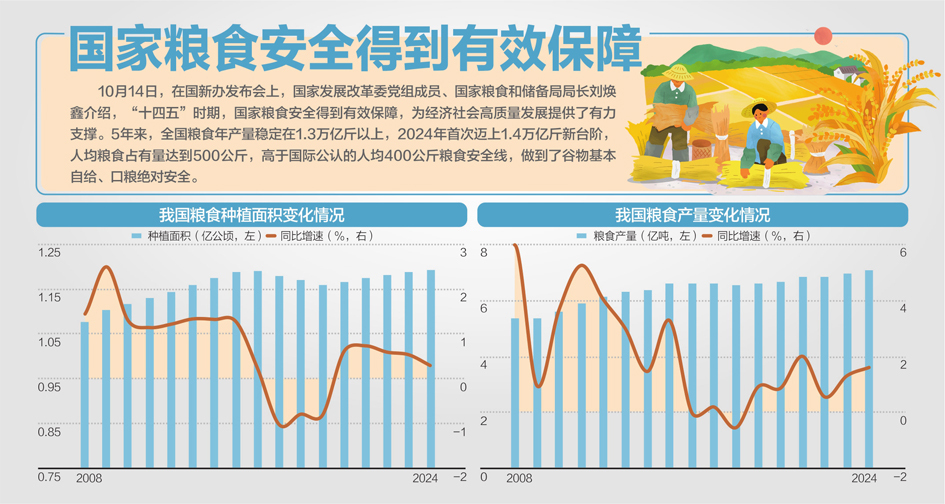
一组数据看牢牢端稳的“中国饭碗”
Xin Hua She· 2025-10-14 12:48
Core Viewpoint - The report highlights the achievements in China's grain production and storage capabilities during the "14th Five-Year Plan" period, emphasizing food security and supply stability. Group 1: Grain Production - National grain production has remained stable at over 1.3 trillion jin (approximately 650 million tons) annually for the past five years, with a projected increase to 1.4 trillion jin (approximately 700 million tons) in 2024 [5] - Per capita grain availability has increased by 25 kg compared to the end of the "13th Five-Year Plan," reaching 500 kg [5] - The average annual grain procurement volume exceeds 400 million tons [5] Group 2: Grain Storage and Distribution - The capacity of national grain standard warehouses has increased to over 730 million tons, an increase of 5.8 million tons compared to the end of the "13th Five-Year Plan" [6] - Low-temperature and near-low-temperature storage capacity has reached 220 million tons, up by 7 million tons [7] - The total industrial output value of national grain enterprises is expected to exceed 4 trillion yuan (approximately 570 billion USD) in 2024 [8] Group 3: Technological Advancements - China's grain storage technology is at a relatively advanced level globally, with five national-level technology innovation platforms and over 100 local research and development innovation platforms established [9] - The implementation of green storage technology has begun, with 30 demonstration points established and plans to increase to 100, covering seven grain storage ecological zones [10] Group 4: Emergency Response Capabilities - The number of grain emergency processing enterprises has increased from 5,448 to 6,872, a growth of 26% [10] - Daily processing capacity for grain and oil emergencies has risen from 1.2 million tons to 1.78 million tons, a 48% increase [10] - The number of emergency supply points for grain has grown from 43,000 to 59,000, a 37% increase [10] - Daily supply capacity for finished grain and oil has increased from 1.06 million tons to 1.67 million tons, a 57% increase [10]

“十四五”时期国家粮食安全得到有效保障
Zhong Yang Ji Wei Guo Jia Jian Wei Wang Zhan· 2025-10-14 10:12
Core Insights - During the "14th Five-Year Plan" period, China's annual grain production is expected to stabilize above 1.3 trillion jin, reaching 1.4 trillion jin in 2024, with per capita grain availability increasing by 25 kg to 500 kg, surpassing the international safety line of 400 kg [1] - The National Development and Reform Commission reported that grain circulation reforms have progressed as expected, effectively ensuring national food security and supporting high-quality economic development [1] Group 1: Grain Production and Supply - Grain storage capacity has increased, with standard grain warehouses exceeding 730 million tons, up by 58 million tons from the end of the "13th Five-Year Plan" [2] - The total industrial output value of national grain enterprises is projected to exceed 4 trillion yuan in 2024, with accelerated technological innovation in the grain industry [2] Group 2: Regulatory and Legal Framework - The implementation of the Food Security Law marks a new phase in comprehensive legal governance and information-based regulation of grain circulation [3] - A digital regulatory system for grain reserves has been established, achieving full coverage of government reserve monitoring [3] Group 3: Grain Purchase and Market Dynamics - The average annual grain purchase volume is over 400 million tons, with market-oriented purchases accounting for over 90% of total purchases [4] - Key measures for the autumn grain purchase include enhancing market-oriented purchasing, organizing policy-based storage, and optimizing services for farmers [5]