稀土

Search documents
渤海证券研究所晨会纪要(2025.12.17)-20251217
BOHAI SECURITIES· 2025-12-17 00:50
Macro and Strategy Research - The November 2025 economic data shows that the industrial added value increased by 4.8% year-on-year, below the expected 5.0% and previous value of 4.9% [4] - Retail sales of consumer goods grew by 1.3% year-on-year, significantly lower than the expected 2.9% [5] - Fixed asset investment cumulative year-on-year growth rate dropped to -2.6%, worse than the expected -2.3% and previous -1.7% [4] Fixed Income Research - The issuance rates for credit bonds increased by 1 to 4 basis points, while the overall credit bond issuance scale grew [8] - The net financing amount for credit bonds increased, with company bonds and medium-term notes seeing positive net financing [8] - The secondary market for credit bonds experienced a rise in transaction volume, with most credit bond yields declining [8] Fund Research - The total scale of the CSI A500 ETF surpassed 210 billion yuan, with notable performance in the communication and defense industries [11] - The average return of equity funds increased by 0.83%, with a positive return ratio of 57.63% [12] - The ETF market saw a net inflow of 12.827 billion yuan, with significant inflows into cross-border ETFs [13] Industry Research - The steel industry faces weakening demand as the off-season progresses, leading to downward pressure on steel prices [15] - Copper prices are expected to remain stable due to tightening supply forecasts for 2026, supported by macroeconomic conditions [16] - The aluminum sector is anticipated to see stable profits due to strict domestic production limits, with demand driven by new energy vehicles [17] - Gold prices are influenced by U.S. monetary policy and geopolitical factors, with a long-term bullish outlook due to central bank purchases [18] - The rare earth sector is expected to benefit from export controls and strategic importance, with a focus on companies with strong resource and processing capabilities [18]
2025年12月16日稀土市场:氧化镝涨2.39万元/吨 氧化铽跌4.97万元/吨
Jin Rong Jie· 2025-12-16 16:13
Core Viewpoint - The rare earth market is experiencing slight price adjustments, with mixed trends across different products, indicating a generally subdued market atmosphere [1] Price Adjustments - Praseodymium and neodymium oxide average price is 577,400 CNY/ton, down 1,000 CNY/ton - Praseodymium and neodymium metal average price is 702,300 CNY/ton, down 100 CNY/ton - Dysprosium oxide average price is 1,401,400 CNY/ton, up 23,900 CNY/ton - Terbium oxide average price is 6,241,700 CNY/ton, down 49,700 CNY/ton [1] Market Activity - Limited transaction information for products like neodymium oxide, praseodymium oxide, lanthanum cerium oxide, europium oxide, and yttrium oxide, suggesting cautious market participation - Praseodymium and neodymium products are maintaining a weak and stable operation, with market activity remaining generally low - The heavy rare earth market is seeing minimal demand-driven transactions, with recent positive rumors contributing to the price rebound of dysprosium [1] Stock Performance - A-share market performance for rare earth permanent magnet concept stocks shows mixed results: - Huicheng Environmental (300779) latest price: 137.53 CNY, change: +1.78%, turnover: 654 million CNY - Yahua Group (002497) latest price: 21.73 CNY, change: +1.78%, turnover: 969 million CNY - Xiamen Tungsten (600549) latest price: 39.26 CNY, change: +0.92%, turnover: 281 million CNY - Ximic Technology (920061) latest price: 29.40 CNY, change: +0.75%, turnover: 83.26 million CNY - Benlang New Materials (920807) latest price: 14.76 CNY, change: +0.75%, turnover: 4.26 million CNY [1]



创纪录!南向资金爆买!外资潜在回流 港股有望延续修复
Zheng Quan Shi Bao· 2025-12-16 13:03
今年以来,港股在全球主要股市中表现突出,恒生指数等年内涨幅超过20%。不过,自10月中旬以来, 港股市场进入调整阶段,波动有所加大,11月整体呈现震荡走势,12月以来的调整幅度有所加大。 港股作为典型的离岸市场,其流动性受海外环境影响显著,而基本面则与内地经济紧密相连。相比基本 面,流动性对港股行情的影响更为直接和迅速,其中科技类资产对利率变化更为敏感。 除了流动性,估值优势、资产质量提升与市场生态重塑多重因素,也将促使港股估值修复。多家券商机 构展望2026年港股行情时指出,随着港股基本面触底反弹,叠加其依旧显著的估值折价,港股市场在 2026年将迎来第二轮估值修复以及业绩进一步复苏的行情。 南向资金创纪录流入 中信证券也表示,考虑到理财和货基等产品收益率持续下滑,而今年以来中国资产的"赚钱效应"愈发显 著,居民"存款搬家"现象或将持续。特别考虑到港股的低配情况,预计南向资金将持续增配港股,尤其 散户资金有较大的增配空间。 回购热情升温 与南向资金涌入相呼应的是,港股市场回购热情出现升温。 数据显示,截至2025年12月15日,港股上市公司今年以来的回购金额为1693.45亿港元,相比2024年 2655. ...

创纪录!南向资金,爆买!
Zheng Quan Shi Bao· 2025-12-16 12:45
Group 1: Market Performance and Trends - The Hong Kong stock market has shown strong performance in 2025, with the Hang Seng Index rising over 20% year-to-date, but has entered a correction phase since mid-October, with increased volatility and a downward trend in December [1] - The market's liquidity is significantly influenced by the overseas environment, while its fundamentals are closely tied to the mainland economy, with liquidity having a more immediate impact on market performance [1] - Multiple factors, including valuation advantages and improved asset quality, are expected to drive valuation recovery in the Hong Kong market, with projections indicating a second round of valuation recovery and performance rebound by 2026 [1] Group 2: Southbound Capital Inflows - A notable feature of the Hong Kong market in 2025 is the record inflow of southbound capital, with a net buying amount reaching 1.39 trillion HKD by December 15, 2025, significantly surpassing the total for 2024 [2] - Southbound capital has provided substantial liquidity to the Hong Kong market, enhancing the pricing power of mainland investors, with the total market value of southbound holdings exceeding 6.3 trillion HKD, accounting for 12.7% of the total market capitalization [2] - The inflow of southbound capital is linked to a loose monetary policy environment, with a significant increase in trading volume, which reached a historical high of 57.5 trillion HKD in the first 11 months of 2025, a 94.5% increase year-on-year [2] Group 3: Future Projections for Southbound Capital - Future projections for southbound capital inflows suggest an increase of 600 billion HKD from public funds and insurance capital, with potential inflows from individual investors estimated between 2.5 billion HKD to 5 billion HKD over the next year [3] - The ongoing trend of "deposit migration" among residents, driven by declining yields on financial products, is expected to continue, with significant room for retail investors to increase their allocation to Hong Kong stocks [3] Group 4: Share Buyback Trends - The enthusiasm for share buybacks in the Hong Kong market has increased, with total buyback amounts reaching 169.35 billion HKD in 2025, although this is lower than the 265.51 billion HKD recorded in 2024 [4] - Monthly buyback amounts have surged since October, with 93.72 billion HKD in October, 117.42 billion HKD in November, and 115.24 billion HKD in the first half of December, indicating a strong upward trend [4][5] Group 5: External Capital Flows - In 2025, external capital flows into the Hong Kong market have turned positive, with inflows of 13.44 billion USD reported, and foreign cornerstone investors actively participating in IPOs [6] - The potential for further foreign capital inflows is contingent on domestic fundamentals and the RMB exchange rate, with expectations for a slight decrease in inflow scale compared to 2025 but still strong relative to southbound capital [6] Group 6: Market Recovery Outlook - The Hong Kong market is expected to benefit from a series of reforms and external economic policies, with projections for a rebound in 2026 driven by improved corporate earnings and continued inflows of southbound and foreign capital [7][8] - Key investment directions include technology sectors, healthcare, resource commodities, essential consumer goods, and industries benefiting from RMB appreciation [7]
创纪录!南向资金,爆买!
证券时报· 2025-12-16 12:42
Core Viewpoint - The Hong Kong stock market has shown strong performance in 2023, with the Hang Seng Index rising over 20% year-to-date, but has entered a correction phase since mid-October, with increased volatility and a significant adjustment in December [1] Group 1: Market Performance and Trends - The Hong Kong stock market is significantly influenced by overseas liquidity and closely tied to the mainland economy, with liquidity having a more immediate impact on market performance than fundamentals [1] - Multiple factors, including valuation advantages, improved asset quality, and market ecosystem restructuring, are expected to drive valuation recovery in the Hong Kong market [1] - Several brokerage firms predict that the Hong Kong market will experience a second round of valuation recovery and performance rebound by 2026, as fundamentals are expected to bottom out [1] Group 2: Southbound Capital Inflows - Southbound capital has been a key driver of the Hong Kong market's strong performance in 2025, with net inflows reaching a record 1.39 trillion HKD by December 15, 2025, significantly surpassing the total for 2024 [3] - The cumulative net inflow through the Stock Connect has reached 5.09 trillion HKD, nearing the 5.10 trillion HKD mark, providing substantial liquidity to the market and enhancing the pricing power of mainland investors [3] - The total trading volume in the Hong Kong market exceeded 57.5 trillion HKD in the first 11 months of 2025, marking a historical high and a 94.5% increase year-on-year [4] Group 3: Future Projections for Southbound Capital - Future inflows of southbound capital are expected to continue, with estimates suggesting an additional 600 billion HKD from public funds and insurance capital in 2026 [4] - If the proportion of Hong Kong stocks in new funds increases from 30.8% to 35%, there could be an additional inflow of 1 to 1.5 billion HKD [4] - Individual investors are projected to contribute significantly to the inflow, with potential purchases of 2.5 billion to 5 billion HKD in the coming year [5] Group 4: Share Buyback Trends - The enthusiasm for share buybacks in the Hong Kong market has increased, with total buyback amounts reaching 169.35 billion HKD in 2025, despite a decline from 2024 [8] - Monthly buyback amounts have surged since October, with 93.72 billion HKD in October, 117.42 billion HKD in November, and 115.24 billion HKD in the first half of December [8][10] - Major companies like Xiaomi and Tencent have contributed to the rising buyback trend, enhancing earnings per share and market confidence [9][10] Group 5: Foreign Capital Inflows - In 2025, foreign capital has stopped flowing out of the Hong Kong market, with inflows of 13.44 billion USD reported [12] - The demand for foreign capital in Chinese assets remains optimistic, driven by expectations of a stable or appreciating RMB and positive domestic fundamentals [12] - The inflow of foreign capital is expected to be slightly lower in 2026 compared to 2025, but remains strong compared to southbound capital inflows [12] Group 6: Outlook for 2026 - The Hong Kong market is anticipated to benefit from internal catalysts and external monetary easing policies, particularly from the US and Japan [14] - The market is expected to see a rebound in corporate earnings and continued inflows from southbound and foreign capital, driven by a "money-making effect" [15] - Key investment directions for 2026 include technology sectors, healthcare, resources benefiting from inflation, essential consumer goods, and industries benefiting from RMB appreciation [14][15]
白宫突发大动作!9国联手签协议,竟想废掉中国稀土王牌
Sou Hu Cai Jing· 2025-12-16 11:44
Core Viewpoint - The signing of the rare earth supply chain agreement by the U.S. and its allies is primarily a strategic move to challenge China's dominance in the rare earth sector, rather than a simple resource cooperation initiative [1][3][8]. Group 1: Political Intentions - The agreement is seen as a U.S.-led action aimed at weakening China's advantages in resources, technology, and supply chains [3][8]. - The U.S. is anxious about China's overwhelming control over the global rare earth industry, with 91% of rare earth refining and separation capacity concentrated in China [3][10]. - The U.S. aims to establish a supply chain that bypasses China, laying the groundwork for future competition in AI [8][10]. Group 2: Implications for AI and Technology - The U.S. government links the rare earth supply chain to the AI industry, indicating that control over rare earth resources is crucial for competing in AI [10][13]. - The U.S. recognizes that without a stable supply of rare earths, advancements in AI technology cannot be realized [13][15]. - The agreement is expected to benefit U.S. mining, military, and tech sectors, ensuring a stable supply chain for high-tech industries over the next decade [17][20]. Group 3: Global Supply Chain Dynamics - The agreement signifies a shift in global technology dynamics, where control over core resources will be as important as technological advancement [20][21]. - The U.S. is attempting to create a closed-loop supply chain with like-minded allies, injecting political factors into the industry chain [22][26]. - China's response emphasizes the importance of market principles and cooperation, highlighting its critical role in stabilizing the global rare earth supply chain [23][25]. Group 4: Future Competition - The competition between the U.S. and China in key minerals and AI is expected to continue, with China's rare earth advantages stemming from years of industrial accumulation [26][28]. - The outcome of this geopolitical struggle will depend on the strength and completeness of each country's supply chain rather than the size of their political alliances [28].


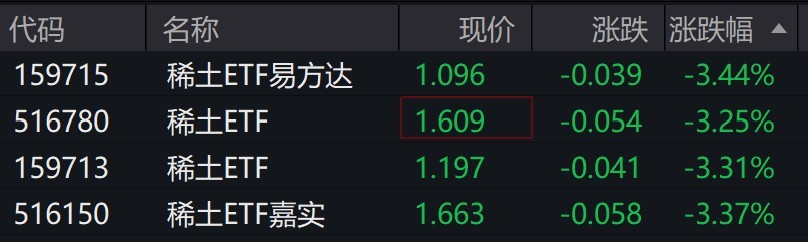
稀土概念股早盘走弱,稀土相关ETF跌超3%
Mei Ri Jing Ji Xin Wen· 2025-12-16 03:40
Core Viewpoint - Rare earth concept stocks weakened in early trading, with significant declines observed in companies such as Jin Feng Technology, China Rare Earth, and Northern Rare Earth, alongside a drop in related ETFs [1][2]. Group 1: Stock Performance - Jin Feng Technology fell over 6%, China Rare Earth dropped over 4%, and both Northern Rare Earth and Wolong Electric Drive decreased by more than 3% [1]. - Rare earth-related ETFs experienced a decline of over 3% [1]. Group 2: Market Analysis - Analysts indicate that rare earths, as core resources for high-end manufacturing and strategic emerging industries, are showing a resonant pattern on both supply and demand sides [2]. - The strategic position of the rare earth industry chain is expected to further solidify, providing long-term driving force for high-end manufacturing development due to increased supply concentration and upgraded demand structure [2].



2025年12月15日稀土市场行情:氧化镨钕57.84万元/吨下跌 氧化镝137.75万元/吨上涨
Jin Rong Jie· 2025-12-15 11:29
Core Viewpoint - The rare earth market is experiencing slight price adjustments, with a generally subdued trading atmosphere and limited demand from downstream sectors [1] Price Adjustments - Praseodymium and neodymium oxide average price is 578,400 CNY/ton, down 600 CNY/ton - Praseodymium and neodymium metal average price is 702,400 CNY/ton, down 2,100 CNY/ton - Dysprosium oxide average price is 1,377,500 CNY/ton, up 4,100 CNY/ton - Terbium oxide average price is 6,291,400 CNY/ton, down 17,400 CNY/ton [1] Market Activity - Limited transactions for products like neodymium oxide, praseodymium oxide, lanthanum cerium oxide, europium oxide, and yttrium oxide - The market is characterized by weak stability in praseodymium and neodymium products, with only a few essential transactions [1] Stock Performance - A-share market performance for rare earth permanent magnet concept stocks includes: - Tongcheng New Materials (603650) latest price 49.35 CNY, up 5.68%, transaction amount 2.175 billion CNY - Chifeng Gold (600988) latest price 32.69 CNY, up 4.78%, transaction amount 2.029 billion CNY - Zhangguang Co. (301092) latest price 35.93 CNY, up 4.54%, transaction amount 190 million CNY - Goldwind Technology (002202) latest price 17.53 CNY, up 3.06%, transaction amount 448.6 million CNY - Xiamen Tungsten (600549) latest price 38.91 CNY, up 2.29%, transaction amount 1.808 billion CNY [1]


商业航天、量子科技大涨,高手看好两大主线!
Sou Hu Cai Jing· 2025-12-15 11:01
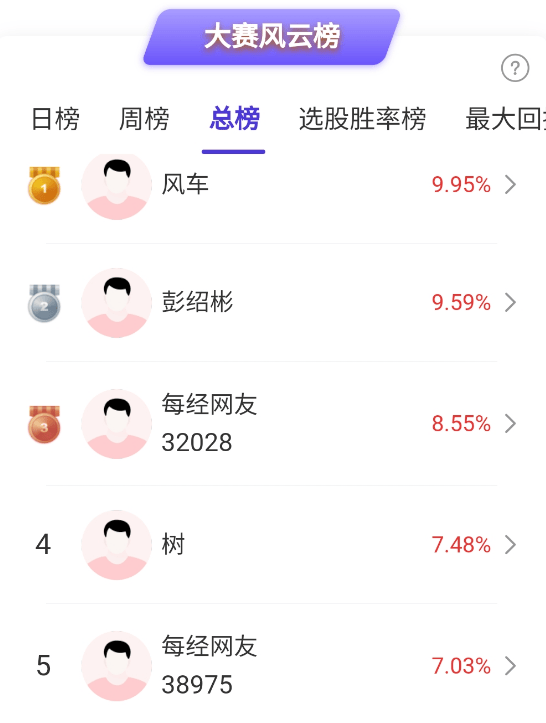
Market Overview - The Shanghai Composite Index experienced a pullback, closing down 0.55% at 3867.92 points, influenced by a decline in U.S. tech stocks [1] - The trading volume in the Shanghai and Shenzhen markets was 177.34 billion yuan, a decrease of 31.88 billion yuan compared to the previous Friday [1] Competition Insights - The 80th session of the "掘金大赛" (Gold Digging Competition) started on December 15, with registration open from December 13 to December 31, and the competition running until December 31 [1] - Participants in the competition are provided with a simulated capital of 500,000 yuan, and cash rewards are available for those with positive returns [1][3] Reward Structure - Cash rewards for the competition include: 688 yuan for the 1st place, 188 yuan for 2nd to 4th places, and 88 yuan for 5th to 10th places, with a total of 500 yuan distributed among other positive return participants [3] - Monthly leaderboard rewards include: 888 yuan for the 1st place, 288 yuan for 2nd to 4th places, and 188 yuan for 5th to 10th places, with additional smaller rewards for lower ranks [3] Market Sentiment - Some participants believe the A-share market's pullback is primarily due to external market influences, with the Shanghai Composite Index currently testing its 90-day moving average [4] - There is optimism regarding investment opportunities in humanoid robots and gold sectors among competition participants [4] Economic Context - U.S. President Trump indicated that Kevin Warsh is the leading candidate for the next Federal Reserve Chair, expressing a desire for the federal funds rate to be lowered to 1% or lower to alleviate the U.S. Treasury's high financing costs [4] - Trump suggested that the next Fed Chair should consult him on interest rate policies, although not necessarily follow his advice [4] Investment Highlights - Since April, sectors such as the Nvidia supply chain, electronic textiles, rare earths, tungsten, and silver have been highlighted, with companies like Industrial Fulian, Honghe Technology, and Xingye Silver Tin seeing stock prices double [5] - Other companies like Zhongtung High-tech, Shenghe Resources, and Northern Rare Earth have also experienced significant price increases [5]
稀土储量最多的国家!中国管制稀土,美国能找到替代国吗?
Sou Hu Cai Jing· 2025-12-15 08:44
Core Viewpoint - The article highlights the critical role of rare earth elements in modern military technology, particularly the F-35 fighter jet, and discusses the historical context of the U.S. reliance on China for these resources, which has led to a significant strategic disadvantage for the U.S. [1][10] Group 1: Historical Context - In 1949, the U.S. was a leader in both military technology and rare earth resources, with the Mountain Pass mine supplying 90% of the global rare earth market [1] - By the 1980s, due to intense competition and price wars among Chinese rare earth producers, U.S. companies found it cheaper to import rare earths from China rather than produce them domestically [6][8] - The Mountain Pass mine was closed in 2002 as U.S. companies shifted to relying on cheaper Chinese supplies, underestimating the long-term implications of this dependency [8] Group 2: Technological Developments - Professor Xu Guangxian from Peking University developed a cascade extraction technology in 1974, significantly improving the efficiency of rare earth extraction [3] - Despite having vast rare earth resources, China initially lacked the technology to refine them, leading to a situation where it sold raw materials at low prices to the U.S. and Japan, who then sold refined products back at high margins [4] Group 3: Current Situation - As of the 21st century, China controls 90% of the heavy rare earth production capacity, which is crucial for high-tech applications, while the U.S. has virtually no capacity in this area [10] - The U.S. is now seeking alternative sources for rare earths, looking at Mongolia, Vietnam, and Australia, but these options present logistical and processing challenges that do not resolve the underlying dependency on China [10] - The article concludes that the U.S. faces significant barriers in re-establishing its rare earth supply chain, including a lack of skilled labor and technological expertise, making it difficult to regain self-sufficiency [10]