水产养殖

Search documents
建设银行东营河口支行:300万小微快贷助力水产养殖企业焕新能
Qi Lu Wan Bao Wang· 2025-08-29 12:09
Core Viewpoint - Construction Bank's Dongying Hekou Branch successfully granted a loan of 3 million yuan to a local aquaculture enterprise, addressing the financing difficulties faced by small and micro enterprises and supporting the development of local特色农业 [1] Group 1: Financial Support - The loan of 3 million yuan is aimed at enhancing the financial services for local agriculture, particularly for small and micro enterprises [1] - The aquaculture enterprise plans to expand its breeding scale and upgrade facilities due to increased market demand, but faces short-term liquidity pressure [1] Group 2: Service Efficiency - Dongying Hekou Branch responded quickly to the enterprise's needs by understanding its operational status, funding requirements, and development plans [1] - The bank tailored the "Small Micro Fast Loan" product to meet the cyclical characteristics of the aquaculture industry and the urgent financing needs of small enterprises, simplifying the approval process and improving loan disbursement efficiency [1] Group 3: Commitment to Inclusive Finance - This loan support exemplifies Construction Bank's commitment to inclusive finance and its role in serving the local real economy [1] - The bank plans to continue focusing on the financing needs of small and micro enterprises, optimizing financial products and services to inject financial vitality into more market entities like the aquaculture enterprise [1]

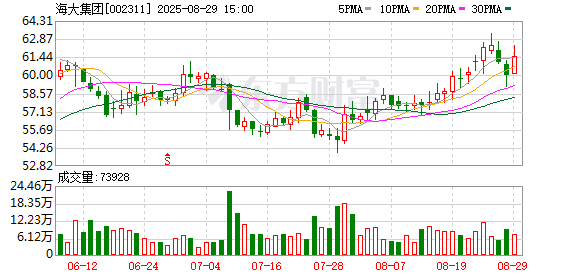
海大集团:公司已在越南、印尼等国家投建水产和禽类的种苗场
Zheng Quan Ri Bao· 2025-08-29 08:43
Core Viewpoint - The company has announced its investment in aquaculture and poultry seedling farms in countries such as Vietnam and Indonesia, indicating a strategic expansion into international markets [2] Group 1: Company Expansion - The company is establishing seedling farms for aquaculture and poultry in Vietnam and Indonesia [2] - Future operations will be tailored to the local breeding characteristics of these countries [2]


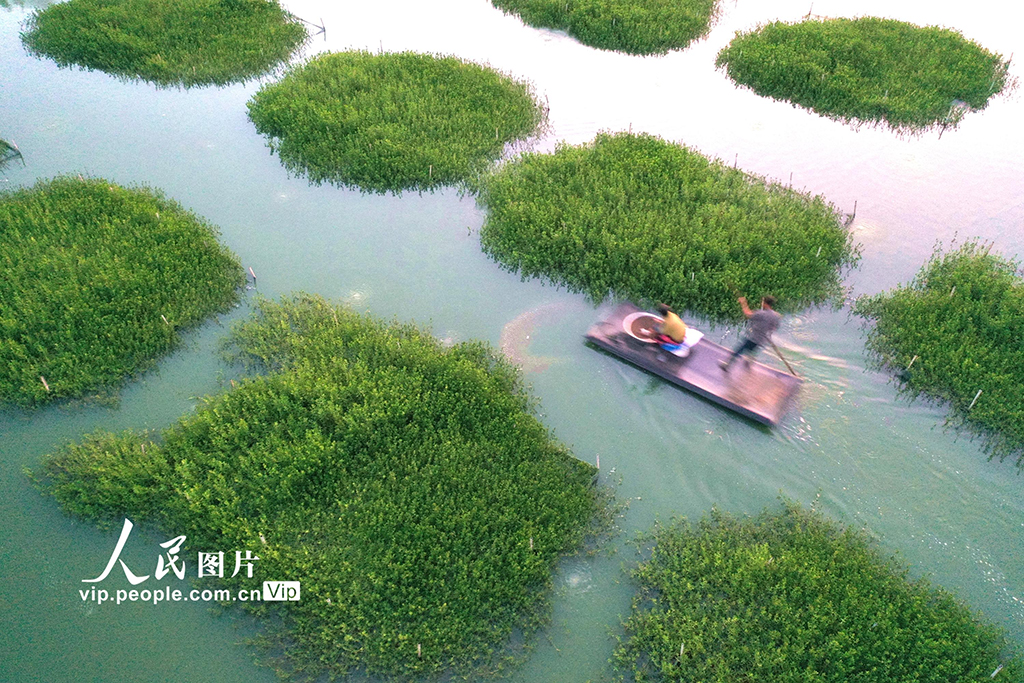
江苏淮安:“绿色家园”优质育蟹
Ren Min Wang· 2025-08-29 08:28
Core Viewpoint - The article highlights the development of a "green home" initiative in Huai'an, Jiangsu, focusing on high-quality crab farming practices that emphasize sustainability and environmental protection [1][2][3]. Group 1: Industry Overview - The crab farming industry in Huai'an is adopting eco-friendly practices to enhance the quality of its products while ensuring environmental sustainability [1][2]. - The initiative aims to position Huai'an as a leading region for premium crab production, leveraging its natural resources and favorable climate [3][4]. Group 2: Company Practices - Local farmers are implementing advanced aquaculture techniques that reduce pollution and promote biodiversity in crab farming [5][6]. - The "green home" initiative includes training programs for farmers to adopt sustainable practices and improve their production efficiency [4][5].
国联水产2025年中报简析:净利润同比下降3180.5%
Zheng Quan Zhi Xing· 2025-08-28 23:06
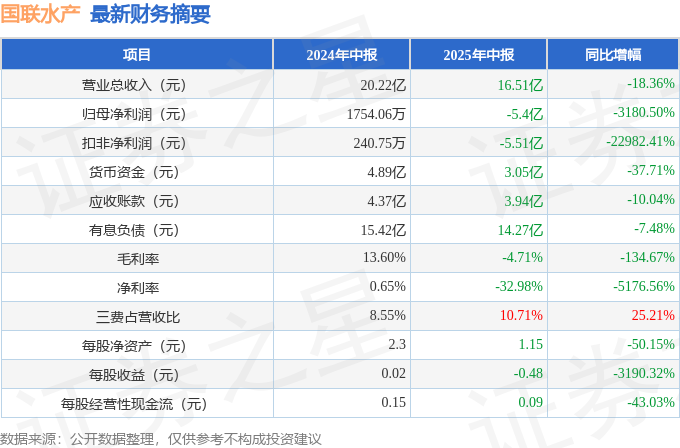
Core Viewpoint - Guolian Aquatic Products (300094) reported a significant decline in financial performance for the first half of 2025, with a net profit decrease of 3180.5% year-on-year, indicating severe operational challenges and financial distress [1]. Financial Performance Summary - Total revenue for the first half of 2025 was 1.651 billion yuan, down 18.36% from 2.022 billion yuan in the same period of 2024 [1]. - The net profit attributable to shareholders was -540 million yuan, a drastic decline from a profit of 17.54 million yuan in 2024, marking a year-on-year decrease of 3180.5% [1]. - The gross margin fell to -4.71%, a decrease of 134.67% compared to the previous year's 13.60% [1]. - The net margin plummeted to -32.98%, down 5176.56% from 0.65% in 2024 [1]. - Total expenses (selling, administrative, and financial) reached 177 million yuan, accounting for 10.71% of revenue, an increase of 25.21% year-on-year [1]. - Earnings per share dropped to -0.48 yuan, a decline of 3190.32% from 0.02 yuan in 2024 [1]. Cash Flow and Debt Analysis - Cash and cash equivalents decreased to 305 million yuan, down 37.71% from 489 million yuan in 2024 [1]. - The company's debt situation is concerning, with interest-bearing liabilities totaling 1.427 billion yuan, a decrease of 7.48% from 1.542 billion yuan [1]. - The cash flow situation is critical, with cash flow from operations per share at 0.09 yuan, down 43.03% from 0.15 yuan in 2024 [1]. Business Model and Historical Performance - The company's business model relies heavily on marketing, which requires further investigation into the underlying drivers of performance [3]. - Historical data shows a median Return on Invested Capital (ROIC) of 2.26% over the past decade, with a particularly poor ROIC of -17.87% in 2024, indicating weak investment returns [3]. - The company has reported losses in 7 out of 14 annual reports since its listing, suggesting a pattern of financial instability [3].

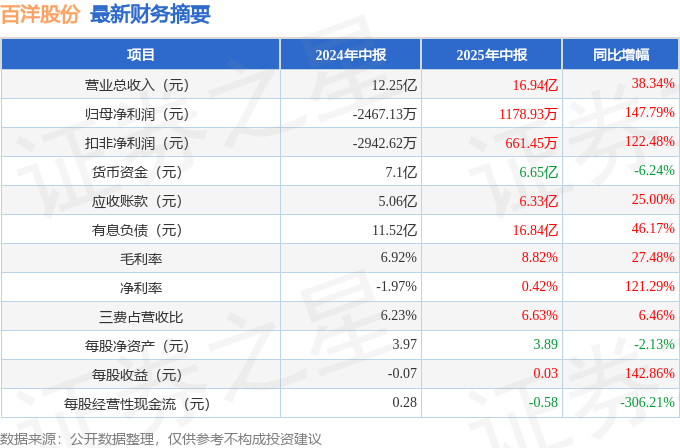
百洋股份2025年中报简析:营收净利润同比双双增长,盈利能力上升
Zheng Quan Zhi Xing· 2025-08-28 22:59
Core Viewpoint - Baiyang Co., Ltd. (002696) reported significant growth in its 2025 mid-year financial results, with total revenue and net profit showing substantial year-on-year increases, indicating improved profitability and operational efficiency [1] Financial Performance - Total revenue for the first half of 2025 reached 1.694 billion yuan, a year-on-year increase of 38.34% compared to 1.225 billion yuan in 2024 [1] - The net profit attributable to shareholders was 11.7893 million yuan, up 147.79% from a loss of 24.6713 million yuan in the previous year [1] - In Q2 2025, total revenue was 1.003 billion yuan, reflecting a 39.77% increase year-on-year, while net profit for the quarter was 7.2294 million yuan, up 134.57% [1] Profitability Metrics - The gross profit margin improved to 8.82%, a year-on-year increase of 27.48%, while the net profit margin turned positive at 0.42%, up 121.29% from -1.97% [1] - Total expenses (selling, administrative, and financial) amounted to 112 million yuan, accounting for 6.63% of revenue, which is a slight increase of 6.46% year-on-year [1] Balance Sheet Highlights - Cash and cash equivalents decreased to 666.5 million yuan, down 6.24% from 710 million yuan [1] - Accounts receivable increased to 633 million yuan, a 25% rise from 506 million yuan [1] - Interest-bearing debt rose significantly to 1.684 billion yuan, an increase of 46.17% from 1.152 billion yuan [1] Shareholder Metrics - Earnings per share (EPS) improved to 0.03 yuan, a 142.86% increase from a loss of 0.07 yuan [1] - The book value per share decreased slightly to 3.89 yuan, down 2.13% from 3.97 yuan [1] - Operating cash flow per share was -0.58 yuan, a significant decline of 306.21% from 0.28 yuan [1] Historical Performance Insights - The company's return on invested capital (ROIC) was 0.15% last year, indicating weak capital returns, with a historical median ROIC of 3.14% over the past decade [1] - The company has experienced three years of losses since its IPO, highlighting a fragile business model [1]

从革命老区到塞上明珠 特色产业绘就经济蓬勃向上新画卷
Yang Shi Wang· 2025-08-28 03:21
Core Insights - The article highlights the significant economic transformation of Yanchi County in Ningxia, which has shifted from relying on traditional resources to developing unique agricultural and renewable energy industries since the 18th National Congress of the Communist Party of China [1][9]. Group 1: Historical Context - During the Anti-Japanese War, Yanchi County was a crucial economic pillar for the Shaanxi-Gansu-Ningxia border area, producing essential resources such as salt, fur, and licorice, which were vital for the region's economy [3]. - From 1941 to 1945, the local population engaged in extensive agricultural and industrial activities to support the economy amidst military and economic challenges, contributing significantly to the region's development [3]. Group 2: Current Economic Development - Yanchi County has innovatively utilized its 12,000 acres of saline-alkali land for ecological aquaculture, successfully cultivating species like crabs, white shrimp, and spirulina, achieving both ecological and economic benefits [5]. - The traditional sheep farming industry has been modernized, with the number of sheep reaching 3.3 million in 2024, and the brand value of "Yanchi Sheep" surpassing 13 billion yuan [7]. - The county focuses on six key industries: specialty agriculture, new materials, green food, clean energy, cultural tourism, and logistics, aiming for high-end, green, intelligent, and integrated industrial development [9]. Group 3: Economic Indicators - In 2024, Yanchi County's GDP is projected to reach 21.54 billion yuan, with urban residents' per capita disposable income at 37,386 yuan (a 4.5% increase) and rural residents' per capita disposable income at 19,472 yuan (a 7.9% increase) [9].

国联水产8月27日获融资买入2701.07万元,融资余额2.79亿元
Xin Lang Cai Jing· 2025-08-28 02:18
Group 1 - The core viewpoint of the news highlights the financial performance and trading activity of Guolian Aquatic Products, indicating a significant decline in revenue and net profit for the first half of 2025 [2] - As of August 27, Guolian Aquatic Products experienced a 3.60% drop in stock price, with a trading volume of 336 million yuan and a net financing purchase of 5.87 million yuan [1] - The company has a financing balance of 279 million yuan, which accounts for 6.15% of its market capitalization, indicating a high level of financing activity compared to the past year [1] Group 2 - For the first half of 2025, Guolian Aquatic Products reported an operating income of 1.65 billion yuan, a year-on-year decrease of 18.36%, and a net profit attributable to shareholders of -540 million yuan, a significant decline of 3180.50% [2] - The company has not distributed any dividends in the past three years, with a total payout of 81.25 million yuan since its A-share listing [3] - As of June 30, 2025, the number of shareholders decreased by 3.98% to 56,800, while the average circulating shares per person increased by 4.14% to 19,461 shares [2]
海南民营经济:乘自贸东风闯出新天地
Sou Hu Cai Jing· 2025-08-28 01:12
Group 1: Industry Overview - Approximately 70% of allergy medications in China are produced in Hainan, with a significant contribution from Wante Pharmaceutical (Hainan) Co., Ltd, a private enterprise with over 20 years in the region [1] - Hainan Baolu Aquatic Technology Co., Ltd has developed the 21st generation of tilapia fry, achieving a growth rate improvement of 300% compared to the first generation, exporting 1 billion fry annually to global markets [1] - As of June 2023, Hainan has 3.6044 million private business entities, accounting for 97.54% of the province's total, contributing 60% of GDP, 80% of tax revenue, and nearly 90% of employment [1] Group 2: Innovation and R&D - Jindan Technology Co., Ltd has transformed from a single transformer product company to a smart manufacturing leader with nearly 7 billion yuan in annual revenue, investing 356 million yuan in R&D in 2024 [2] - Hainan Huayan Collagen Technology Co., Ltd focuses on high-value utilization of marine resources, converting fish by-products into small molecule peptides for various applications, supported by a highly educated R&D team [2] - In 2024, the top 20 private enterprises in Hainan are expected to invest a total of 3.763 billion yuan in R&D, holding 1,199 valid patents and participating in the formulation of 335 standards [2] Group 3: Policy Support - Jingrun Pearl, the first company in Hainan's pearl processing industry to benefit from a 30% processing value-added tax exemption, has imported 16,300 pearls this year, saving over 1 million yuan in taxes [3] - The 10.56 billion yuan lithium hydroxide project in Yangpu is expected to generate over 2 billion yuan in annual output value, benefiting from Hainan's zero-tariff policy [3] - Hainan has implemented a series of policies, including a 15% income tax reduction for businesses and individuals, to enhance the business environment and support private enterprises [4] Group 4: Business Environment - Hainan's first batch of soybean oil from AOSK International Grain and Oil was exported to India, showcasing the province's efficient business environment that allows rapid project completion [5] - The Hainan government has introduced measures to optimize the business environment, including a one-stop service platform for policies and direct communication channels between government and enterprises [5] - The Hainan Free Trade Port is set to enhance the global competitiveness of private enterprises, with companies like Hainan Shengsen Pharmaceutical Co., Ltd planning to establish R&D centers and expand international markets [6]
林武调研强县产业帮扶弱县工作时强调 促进产业互补协作共赢 推动县域经济高质量发展
Da Zhong Ri Bao· 2025-08-28 01:00
Group 1 - The core viewpoint emphasizes the importance of strong counties supporting weaker counties to promote economic development and ensure tangible results in county-level economic growth [1][2] - The provincial government has initiated a pairing assistance program involving 10 groups of counties (cities, districts) to foster cooperation and mutual benefits [1] - Key areas of focus include enhancing industry-academia-research collaboration, strengthening brand development, and improving safety in production processes [1][2] Group 2 - The provincial leadership acknowledges the achievements in county economic development but highlights issues such as uneven growth and insufficient industrial strength in some areas [2] - Strong counties are encouraged to leverage their industrial chains to facilitate orderly industrial transfer and expand development space through joint park construction and collaborative investment [2] - The assistance teams are tasked with acting as bridges to ensure effective implementation of support initiatives, while local governments are urged to create favorable investment environments and cultivate distinctive industries [2]
河南稻田的N种打开方式
He Nan Ri Bao· 2025-08-27 23:39
Core Insights - Rice is a significant autumn crop in Henan, with an area of approximately 9 million mu, and innovative farming methods are being explored to maximize its potential [1] - The introduction of regenerative rice farming, which allows for two harvests in one season, is gaining traction, leading to higher yields and reduced chemical usage [2][4] - The integration of aquaculture with rice farming, such as the "rice-shrimp-turtle" model, is enhancing both economic and ecological benefits [8][10] Regenerative Rice Farming - Regenerative rice farming allows for two harvests per year without replanting, with expected yields of over 1,800 pounds per mu annually [2] - The area dedicated to regenerative rice in Shangcheng County is projected to expand from 40 mu in 2014 to 180,000 mu by 2025, increasing production by over 300 million pounds and generating over 700 million yuan in value [2][4] - A combination of technology, scale, and branding is being employed to enhance the regenerative rice industry, with significant investment in training and infrastructure [4] Aquaculture Integration - The "rice-shrimp-turtle" model in Huangchuan County is a successful example of integrating aquaculture with rice farming, improving land and water resource efficiency by nearly 30% [8][10] - The establishment of a full industrial chain for shrimp and turtle processing has positioned Huangchuan as a leading player in the national market, with an annual output value of 2 billion yuan [9][10] Agricultural Tourism and Cultural Integration - The establishment of the Rice Field Town in Ruoyang County has transformed rice fields into cultural and tourism attractions, with over 230,000 visitors and significant revenue generation [12][14] - The integration of digital technology in rural operations is enhancing transparency and profitability for local farmers, fostering a sustainable tourism model [14][15] - The shift from traditional agriculture to a more diversified and culturally rich agricultural model is evident, showcasing the potential for rural revitalization [15][16]