
可再生能源

Search documents
二十国集团科技部长会议聚焦绿色转型
Yang Shi Xin Wen· 2025-09-27 18:36
Core Insights - The G20 Chief Scientific Advisors Roundtable and Science Ministers Meeting took place from September 21 to 24 in South Africa, serving as a significant platform for promoting technological innovation and green transformation [1] - The meeting's theme focused on "Equitable Science, Technology, and Innovation for Inclusive Human Development and Global Sustainability," emphasizing hydrogen innovation and green transition [1] Group 1: Technological Cooperation - South African experts believe that Sino-African technological cooperation is becoming a new highlight in promoting global green development [1] - South Africa is transitioning to a green economy, primarily relying on solar and wind energy, which is expected to create numerous jobs [1] - Collaboration projects exist between South African institutions and several Chinese universities in the technology sector [1] Group 2: Energy and Health Research - The South African Minister of Science and Innovation highlighted ongoing research in hydrogen energy, fuel cells, and green ammonia [1] - In the health sector, South Africa has established a foundation for vaccine production, addressing local needs [1] - There is extensive international cooperation with China across various fields, including the installation of China's Beidou navigation system in South Africa [1]
中国气候变化事务特使:全球能源转型进程不可逆转
Zhong Guo Xin Wen Wang· 2025-09-27 13:54
Group 1 - The 2025 Taiyuan Energy Low Carbon Development Forum opened in Shanxi, China, focusing on "green low-carbon transformation and building a new energy system" [1] - Global energy transition is progressing with renewable energy sources like solar and wind gradually replacing fossil fuels, gaining widespread recognition and support [1] - China has established the world's largest and fastest-growing renewable energy system, with wind and solar installed capacity reaching 1.68 billion kilowatts by the end of July 2025, maintaining the world's largest wind power capacity for 15 consecutive years and solar power capacity for 10 consecutive years [1] Group 2 - Cuba participated as the guest country, planning to develop wind and solar energy as supplementary sources and gradually transition them into pillar energy sources [2] - Cuba's Minister of Science, Technology, and Environment expressed gratitude for China's support over the years and emphasized the desire to collaborate on technological innovation for low-carbon energy development [2]
2020—2024年全球绿色投资超过1万亿美元
Shang Wu Bu Wang Zhan· 2025-09-27 03:31
Core Insights - The report by PwC's Strategy& Middle East indicates that global green investments will exceed $1 trillion from 2020 to 2024, with Saudi Arabia, UAE, and Oman attracting only $24 billion, accounting for approximately 2% of the total [1] - The three countries have invested a total of $132 billion in overseas green projects, completing 29 large-scale foreign and 10 domestic green investments, focusing on hydrogen, ammonia, and renewable energy [1] - Saudi Arabia received $12.6 billion and Oman $8.9 billion in investments, primarily from investors in China, India, and the United States [1] - The Gulf Cooperation Council (GCC) has significant advantages, such as the lowest solar power generation costs globally, with six of the world's ten lowest-cost projects located in the region [1] - Global green investments are projected to reach $158 billion in 2024, tripling from 2020 levels [1]
2022-2024年阿塞拜疆新能源行业吸引投资超6亿美元
Shang Wu Bu Wang Zhan· 2025-09-27 03:23
Core Viewpoint - The Eurasian Development Bank (EDB) reports that Azerbaijan's renewable energy sector is set to attract over $600 million in investments from international financial institutions between 2022 and 2024 [1] Investment Highlights - A significant project includes a $170 million loan approved by the Asian Infrastructure Investment Bank in 2024 for the construction of two solar power plants, Banka and Bilasuvar [1] - The total investment for this project amounts to $670 million, with joint financing from institutions such as the European Bank for Reconstruction and Development [1]
西澳州长也访华 再推新版“中国战略” 昆州政府投资机构QIC打造5亿澳元规模零售地产基金 看涨!策略师认为澳元有望升至70美分
Sou Hu Cai Jing· 2025-09-26 13:37
Group 1: Western Australia and China Trade Relations - Western Australia (WA) has established a direct communication platform with major Chinese investors through the "WA-China Strategic Dialogue" since 2018, with the latest dialogue held on September 22, 2023 [1] - In 2024, the bilateral trade volume between WA and China is projected to reach 134.5 billion AUD, accounting for 43.2% of Australia's total trade with China, which is 311.6 billion AUD [1] - China has been WA's largest trading partner for 15 consecutive years, contributing to approximately 220,000 jobs in WA, which represents 14.5% of the state's employment [1] Group 2: Economic Impact and Future Cooperation - WA's trade surplus with China was 11.7 billion AUD in 2023, and the state has provided energy subsidies of 400 AUD to each household using part of the surplus from mineral trade with China [1] - The WA Premier emphasized the state's role as a stable supplier of raw materials and energy for China's economic development, particularly in the battery and electric vehicle supply chain [1] - There are over 80 Chinese enterprises currently involved in projects or partnerships in WA, indicating strong ongoing collaboration [2] Group 3: Currency Outlook - The Australian dollar (AUD) has recently shown strength, reaching a 10-month high of 0.6707 USD after the Federal Reserve's interest rate cut, with predictions of further increases [3][4] - Major banks, including ANZ and CBA, forecast the AUD to rise significantly, with target prices ranging from 0.67 to 0.71 USD [4][5][6] - The consensus for the AUD's appreciation is based on the continued weakness of the USD and improvements in Australia's interest rate advantage [5][6] Group 4: Real Estate Investment - Queensland Investment Corporation (QIC) is restructuring its 5.26 billion AUD fund to focus on retail properties in areas with strong population growth and retail spending [8] - The fund aims to double its asset value over the next three years, with initial investments primarily in Queensland [8] Group 5: International Education Challenges - The Australian government's increase in non-refundable visa application fees has led to a 16% decline in new international student enrollments, with English language institutions seeing a 38% drop [9][10] - Despite the overall decline, Australia still has a strong total enrollment of 925,905 students, with China being the largest source country [10] Group 6: Renewable Energy Investments - Australia requires approximately 20 billion AUD annually in foreign investment to meet its clean energy goals by 2030, as stated by Prime Minister Albanese [11] - The government plans to host a foreign investment summit to attract funding for renewable energy and critical mineral projects [11] - Approximately 70% of the funding needed for new renewable energy projects in Australia is expected to come from overseas sources [12]
bp:世界能源转型加速但前路崎岖
中国能源报· 2025-09-26 12:48
Core Viewpoint - BP Group's "Energy Outlook 2025" report highlights that geopolitical tensions, slowing energy efficiency improvements, and delayed transitions pose significant risks to global energy transformation, warning that without decisive action, the world may face a "disordered transition" in the next decade [1][3]. Global Energy Demand Shift - Future global energy demand growth will be primarily driven by emerging economies (excluding China), with primary energy demand in these regions expected to increase by nearly 50% by 2050 under the "current trajectory" scenario [5]. - Emerging economies in Asia (excluding China) are projected to see a 70% increase, Africa 60%, and South America 30% by 2050, driven by ongoing economic development and population growth [6]. - In contrast, China's primary energy demand is expected to decline by over 10% by 2050 under the "current trajectory" scenario, and by more than one-third under the "below 2 degrees" scenario [6]. - The rapid development of digital technologies is creating new growth points for energy demand, with data centers accounting for about 10% of global electricity growth, and as high as 40% in the U.S. [6]. Renewable Energy Cost Reduction - Global oil demand is expected to peak by the late 2020s and decline by approximately 15% by 2050 under the "current trajectory" scenario, with a 70% decline under the "below 2 degrees" scenario [8]. - The report indicates a significant shift in oil demand from fuel applications to raw material applications, with petrochemical feedstocks becoming the most resilient part of oil demand, expected to rise from about 15% to nearly 30% by 2050 [8]. - Renewable energy is projected to be the fastest-growing energy source, with supply expected to increase more than two and a half times by 2050 under the "current trajectory" scenario, and three and a half times under the "below 2 degrees" scenario [8]. - The substantial decrease in renewable energy costs is enhancing its competitiveness, with renewables expected to account for 25% of global primary energy supply by 2050 under the "current trajectory" scenario [8]. Natural Gas Outlook - The outlook for natural gas is uncertain, with a projected 20% increase in global demand by 2035 under the "current trajectory" scenario, but a potential 50% decline by 2050 under the "below 2 degrees" scenario [9]. Challenges in Energy Transition - The report warns of multiple risks to global energy transition, particularly from geopolitical tensions and delayed actions [11]. - Increased geopolitical tensions may alter energy development paths, potentially leading to a focus on energy self-sufficiency that could suppress renewable energy shares [11]. - A continued slowdown in energy efficiency improvements could result in a 5% higher global energy demand by 2035 compared to the "current trajectory" scenario, primarily met by fossil fuels [11]. - The most severe risk arises from delayed transitions, with estimates indicating that the remaining carbon budget to limit global warming to 2 degrees Celsius could be exhausted by the early 2040s under the "current trajectory" scenario [11]. Opportunities Amid Challenges - Despite the challenges, the report emphasizes that declining renewable energy costs and technological advancements provide opportunities for accelerating the global energy system transition, particularly in solar, wind, and electric vehicle sectors [12].



财政部国际财经中心副主任林山:将完善多项绿色财税政策支持
Zheng Quan Shi Bao Wang· 2025-09-26 08:41
在财政政策支持下,和各部门共同努力下,中国构建起全球最大、发展最快的可再生能源体系,建成了 全球最大最完整的新能源产业链,经济发展的"含绿量"持续提升。林山同时指出,应意识到随着国内外 形势的发展变化,各种有利因素和不利因素转换、叠加,如能源结构调整仍面临诸多挑战、美欧等发达 经济体绿色政策出现回调等,都给绿色低碳发展带来不少压力和挑战。 林山表示,财政部门将继续加大生态环保资金投入、完善多项绿色财税政策支持,会同相关部门研究制 定相关绿色低碳战略和规范,强化政策措施引导,推动建立"政府引导、企业和社会各界参与、市场化 运作"的模式。 (文章来源:证券时报网) 2020年,财政部牵头设立国家绿色发展基金,总规模885亿元,聚焦长江经济带,并适当兼顾其他区 域,重点支持防污防治、能源资源节约利用、绿色交通、清洁能源等领域。基金采取市场化运作,目前 已实现沿江省市、投资领域和投资方式的全覆盖,有力带动社会资本投资生态环保和绿色低碳转型领 域。 着眼于强化激励约束,我国目前已构建起以环境保护税、资源税、耕地占用税、车船税等专门税种"多 税共治",以增值税、消费税、企业所得税、车辆购置税等专项政策"多策共促",涵盖生 ...
AI点燃新周期! 特朗普嗤之以鼻的可再生能源竟然涨势如虹
智通财经网· 2025-09-26 07:56
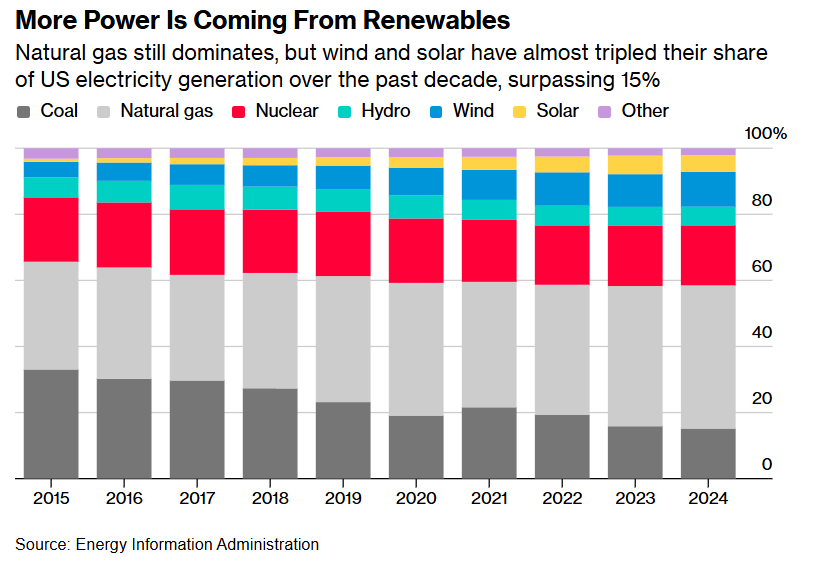
Group 1 - The stock market remains optimistic about the future of renewable energy despite the Trump administration's disinterest, driven by the belief that AI is ushering in a new cycle and that clean energy is the future of the global energy system [1][2] - The S&P Global Clean Energy Index has risen by 32% this year, led by strong performances from U.S. renewable energy giants Bloom Energy and First Solar, while popular clean energy ETFs have also shown significant gains [1] - By 2025, the U.S. is expected to see its largest solar installation capacity and battery storage capacity, contrasting with the S&P 500 Energy Sector Index, which has only increased by 5.5% this year [1] Group 2 - Fortescue Ltd. asserts that Trump's stance on climate change will not significantly suppress the long-term demand for clean electricity resources in the U.S., driven by AI's massive power needs and the pressure for emissions reduction [2][3] - The economic benefits of renewable energy are expected to outweigh political factors, as renewable energy has become more cost-effective than coal or natural gas in the U.S. [2][3] - Fortescue's CEO highlighted that the demand for clean energy will grow significantly due to cost pressures and the increasing scale of AI applications [3] Group 3 - The share of renewable energy in the global power mix has been expanding, with wind and solar systems in the U.S. nearly doubling their share over the past decade, surpassing 15% [7] - Since Trump's return to the presidency, significant delays and cancellations of renewable energy projects have occurred, amounting to nearly $42 billion [7] - Over 90% of new renewable power projects launched last year were more cost-effective than any new fossil fuel alternatives, with potential savings of up to $19 trillion in fuel costs by mid-century [7][4] Group 4 - The demand for electricity from AI data centers is expected to surge, with predictions indicating that global data center electricity demand will more than double by 2030, driven primarily by AI applications [9][10] - Major tech companies like Microsoft and Google are entering long-term power purchase agreements for renewable energy, indicating a strong demand for clean energy solutions [10][11] - UBS analysts note that the demand for utility-scale solar projects in the U.S. is gradually exceeding supply, providing significant growth potential for the solar industry [11]


第三届萨拉热窝能源与气候周开幕
Shang Wu Bu Wang Zhan· 2025-09-26 02:44
波黑联邦能矿部长拉基奇表示,能源与气候周活动将讨论在波黑乃至全世界都极 其重要的议题,让能源、气候变化领域的专家们能够共同应对挑战,提出解决方案。 拉基奇指出,当前的国家电力法草案已通过部长会议审议,希望该法很快能在议会表 决通过,这将进一步为波黑获得CBAM豁免创造条件。 欧盟驻波黑代表团副团长巴巴吉德表示,欧盟已开始实施到2050年实现碳中和的 计划,波黑已通过签署一系列协议显示了其与欧盟计划相同步的决心。他认为,波黑 正处于一个特殊的十字路口:一方面煤炭仍然占主导地位,另一方面在利用可再生能 源和提高能源效率方面潜力巨大。欧盟国家将持续支持波黑能源转型,迄今为止,欧 盟已在波黑能源领域投资超1.6亿欧元。(驻波黑使馆经商处) (原标题:第三届萨拉热窝能源与气候周开幕) 波黑国家台9月22日报道。2025年第三届萨拉热窝能源与气候周开幕。波黑联邦总 理尼克希奇在开幕式上表示,波黑正在经历能源转型期,已经从电力出口国变成了电 力进口国。波黑当前需要采取紧急措施,包括保障火电站的煤炭供应充足。当前矿场 的煤炭产量无法满足电力公司的需求,导致波黑必须高价购买电力。尼克希奇强调了 投资水电和风电等可再生能源的重要 ...
中国新一轮国家自主贡献目标呈现革命性升级 首次覆盖全经济范围和所有温室气体种类
Shang Hai Zheng Quan Bao· 2025-09-25 18:14
Core Points - China announced new national contribution targets at the UN Climate Change Summit on September 24, aiming for a 7% to 10% reduction in greenhouse gas emissions by 2035, with non-fossil energy consumption exceeding 30% of total energy consumption [1][3] - The total installed capacity for wind and solar power is targeted to exceed 360 million kilowatts, which is more than six times the capacity in 2020 [1][2] - The new targets represent a significant upgrade from previous commitments, covering all greenhouse gases and emphasizing the need to decouple economic growth from carbon emissions [3] Group 1 - As of August 2023, China's total installed capacity for wind and solar power surpassed 1.69 billion kilowatts, contributing to 80% of new power installations since the start of the 14th Five-Year Plan [2] - To meet the new targets, an additional 2 billion kilowatts of capacity must be added annually over the next decade, requiring a doubling of installed capacity from the 2024 baseline of 1.41 billion kilowatts [2] - The new targets are seen as a scientific response to China's energy transition strategy, with expectations of continued economic growth and rising energy demand across various sectors [2] Group 2 - By 2024, China's energy consumption per unit of GDP is expected to decrease by 11.6%, making it one of the fastest countries in terms of energy intensity reduction globally [3] - The proportion of non-fossil energy consumption reached 19.8%, an increase of 7.8 percentage points since 2015, with projections to exceed the 20% target by 2025 [3] - The national contribution targets are aligned with the UN Climate Change Framework, signaling a clear policy direction for the next decade to achieve economic growth while reducing emissions [3] Group 3 - China's carbon market is expanding its coverage to include major emitting industries such as steel, cement, and aluminum, with plans to extend to petrochemical, chemical, and aviation sectors by 2027 [4]