
可控核聚变

Search documents
【基金经理内参】下一个“商业航天”迎拐点、军工还有一个“价值洼地”、“光进柜内”或成为今年最大产业机遇、港股互联网估值修复在望
第一财经· 2026-01-12 09:37
Group 1 - The next "commercial space" opportunity is emerging with the approaching inflection point in the controllable nuclear fusion industry, highlighting the importance of focusing on core segments [2] - The military industry is identified as a "value pit," with investment opportunities in the accelerating delivery of the large aircraft industry chain [2] - Overseas computing power may be undervalued, with "light entering the cabinet" potentially becoming the largest industrial opportunity this year [2] Group 2 - Improved antitrust expectations combined with AI applications are expected to catalyze a valuation recovery for Hong Kong's internet sector [2] - The discussion includes perspectives on Alibaba, particularly regarding its traditional business pressures and the resilience of its AI cloud services [2]

脑机接口板块,利好
Zhong Guo Zheng Quan Bao· 2026-01-12 08:40
Group 1: AI Applications and Brain-Computer Interface (BCI) Sector - The AI application sector is leading the market, with significant gains observed in stocks such as Zhiyu, Weimeng Group, and Kingsoft Cloud [2] - The brain-computer interface sector is experiencing a strong performance, driven by positive news from the Tianjin University BCI laboratory focusing on non-invasive BCI technology [2][3] - The Tianjin University BCI laboratory has developed a comprehensive chain from high-performance devices to clinical applications, including products for stroke rehabilitation and emotional state detection in astronauts [6] Group 2: Commercial Aerospace Sector - The commercial aerospace sector continues to show strong activity, with related stocks performing well [7] - Recent government initiatives in Zhejiang and Shanghai are aimed at promoting low-orbit satellite internet and advanced manufacturing in the aerospace sector [10] Group 3: Stock Performance Highlights - Notable stock performances in the BCI sector include: - Yinkang Life: +12.16% [5] - Beiyikang: +11.89% [5] - Aipeng Medical: +10.94% [5] - Hai Ge Communication: +10.00% [5] - The commercial aerospace sector also saw significant gains, with stocks like Tianli Composite up by 24.96% and Zhongtai Co. up by 20.02% [8]

脑机接口板块,利好!
Zhong Guo Zheng Quan Bao· 2026-01-12 08:23
Group 1: AI Applications and Brain-Computer Interface (BCI) - The AI application sector is leading the market, with stocks like Zhiyu, Weimeng Group, and Kingsoft Cloud showing significant gains [2] - The brain-computer interface sector is experiencing a boost, driven by positive news from the Tianjin University team focusing on non-invasive BCI technology [2][3] - The Tianjin University BCI lab has developed a comprehensive chain from high-performance devices to clinical applications, including products for stroke rehabilitation and emotional state monitoring in astronauts [6] Group 2: Commercial Aerospace - The commercial aerospace sector remains active, with related stocks continuing to rise [7] - Recent government initiatives in Zhejiang and Shanghai are promoting investment in low-altitude economy and commercial aerospace, indicating a supportive regulatory environment for these industries [10] Group 3: Company-Specific Developments - Tianpu Co. (605255) faced a trading halt and subsequently a limit down, closing at 196.22 CNY per share, following a significant price increase of 1663.2% in 2025 [11] - The company issued a clarification regarding rumors about its actual controller, stating that the claims were unfounded and did not involve any official statements [12][13]
两市成交额突破3.6万亿,再创历史新高
Sou Hu Cai Jing· 2026-01-12 08:01
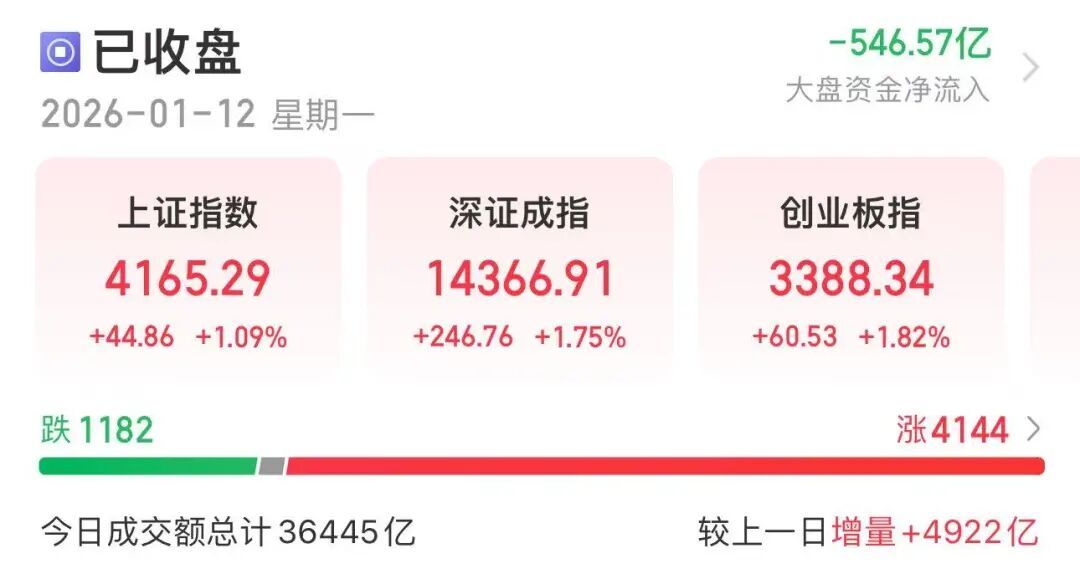
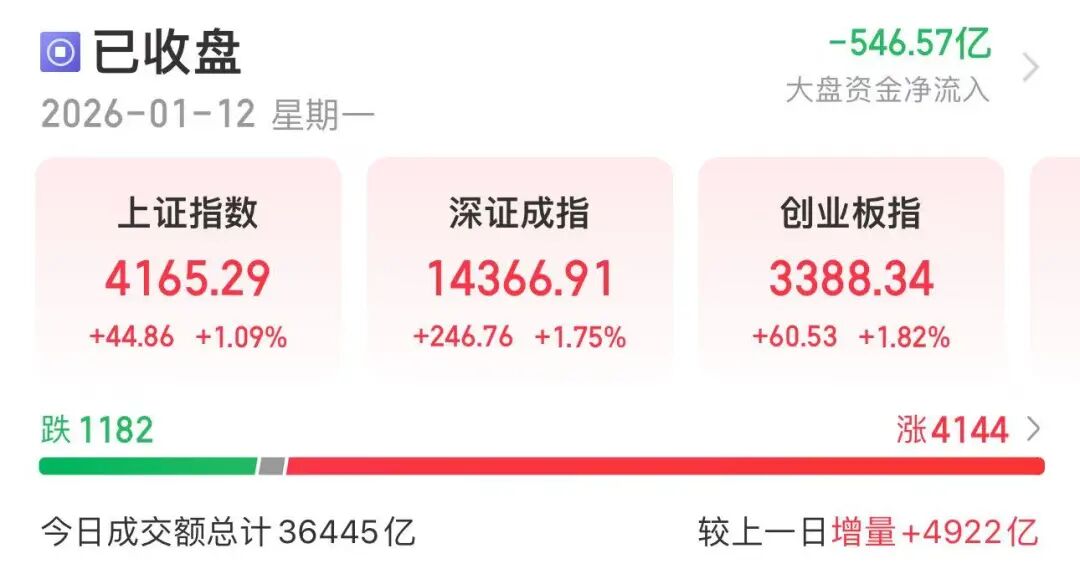
Market Overview - On January 12, the total trading volume of the Shanghai and Shenzhen stock markets reached 3.6 trillion yuan, an increase of 478.7 billion yuan from the previous trading day, setting a new historical record [2][10] - This marks the second time in 2026 and the sixth time in history that the trading volume has exceeded 3 trillion yuan [10] - The Shanghai Stock Exchange accounted for 1.45 trillion yuan, while the Shenzhen Stock Exchange accounted for 2.16 trillion yuan [10] Stock Performance - The A-share indices all rose by over 1%, with the Shanghai Composite Index increasing by 1.09%, achieving a rare 17 consecutive days of gains, the longest streak since 1993 [4][12] - The Shenzhen Component Index rose by 1.75%, and the ChiNext Index rebounded by 1.82% after previously dropping over 1% [4][12] Sector Highlights - AI application themes surged across the board, with e-commerce and short drama games leading the market [5][12] - Over 4,100 stocks rose, with 201 stocks hitting the daily limit [5][12] - Notable stocks included Ingrity Media with five consecutive limit-ups, and other companies like Liou Co., Meian Health, and Tianxia Show also performed well [5][12] Market Dynamics - The current market rally is characterized by structural and thematic trading, with sectors like satellite communication, aerospace, and robotics attracting significant capital since December [5][13] - Some previously high-performing sectors have seen corrections, indicating a rotation of market hotspots that may extend the upward cycle [13] Economic Outlook - Goldman Sachs' macro report suggests overweighting Chinese stocks in 2026, predicting annual growth of 15% to 20% for the Chinese stock market in 2026 and 2027, supported by earnings growth and valuation re-rating [7][15] - Factors driving accelerated earnings growth include AI applications, the "going out" trend, and policies aimed at reducing competition [15] - The report emphasizes the importance of building a modern industrial system and enhancing technological self-reliance as priorities in China's development plan [15][16]

收评:沪指高开高走涨1.09%,A股成交额超3.6万亿元,创历史新高
Zheng Quan Shi Bao Wang· 2026-01-12 07:26
Core Viewpoint - The A-share market experienced a strong performance with the Shanghai Composite Index rising by 1.09%, and the total trading volume exceeding 3.64 trillion yuan, marking a historical high [1]. Market Performance - The three major indices opened strong and closed higher, with the Shanghai Composite Index up by 1.09%, the Shenzhen Component Index up by 1.75%, and the ChiNext Index up by 1.82% [1]. - Over 4,100 stocks in the market saw an increase in value [1]. Sector Performance - The commercial aerospace sector showed robust performance, with companies like China Satellite and Aerospace Electronics hitting the daily limit [1]. - Brain-computer interface concept stocks surged, with Nanjing Panda achieving five consecutive daily limits [1]. - Controlled nuclear fusion concept stocks were active, with Falunsheng hitting the daily limit and Haheng Huaton rising over 11% [1]. - Sectors such as digital media, military electronics, software services, and cloud services had significant gains [1]. - Conversely, sectors like insurance, petrochemicals, and coal experienced declines [1].
星环聚能10亿元融资背后:可控核聚变加速奔向商业化
2 1 Shi Ji Jing Ji Bao Dao· 2026-01-12 06:37
Core Viewpoint - The startup company, Star Ring Fusion, has successfully completed a new round of financing amounting to 1 billion yuan, indicating strong market confidence in the future of next-generation energy sources and the company's engineering progress in controlled nuclear fusion [1]. Financing and Investment - The recent financing round was led by Shanghai Guotou Company and Shanghai Future Industry Fund, with participation from various investment firms including CICC Capital and Bank of China Asset Management [1]. - This funding is seen as a validation of the company's engineering advancements and reflects ongoing optimism in the capital market regarding the potential of controlled nuclear fusion [1]. Company Development and Milestones - Founded only four years ago, Star Ring Fusion has efficiently completed the construction and operation of the SUNIST-2 experimental device in collaboration with Tsinghua University and is steadily advancing the CTRFR-1 engineering validation device [1][2]. - The company aims to complete engineering validation and initiate the construction of a commercial demonstration reactor by around 2028, with a goal to establish a fusion reactor capable of generating electricity by approximately 2032 [1]. Technical Approach - Star Ring Fusion employs a compact, repeatable fusion technology based on high-temperature superconducting strong magnetic field spherical tokamaks, which is believed to have strong commercial potential [3]. - The estimated budget for the CTRFR-1 engineering validation device is around 1 billion yuan, reflecting the company's philosophy of proving feasibility with minimal expenditure [3]. Talent and Resource Advantages - Xi'an, where the company is based, has a rich pool of engineering talent due to its focus on military, aerospace, and precision manufacturing sectors, providing a stable supply of skilled professionals [4]. - Local universities contribute a significant number of graduates in mechanical, electrical, and electronic fields, ensuring a continuous influx of talent [4]. - The cost structure in Xi'an is advantageous, with lower labor costs for engineering talent compared to major cities like Beijing, Shanghai, and Shenzhen, which is crucial for long-term investments in fusion startups [4]. Future Applications and Market Positioning - The envisioned future applications of the fusion reactor include serving as energy sources for AI computing centers or community power supply, as well as powering medium to large offshore platforms [5]. - The company is positioned to leverage its unique technology and regional advantages to accelerate the commercialization of fusion energy [9]. Strategic Planning and Execution - Star Ring Fusion recognizes the changing external environment, with increased interest from investors and a shift towards the engineering phase of the fusion industry [9]. - The company plans to build the next-generation fusion device in Shanghai, focusing on engineering validation of fusion technology and breakthroughs in core technologies such as high-temperature superconductors and plasma control [9][10]. - The collaboration between Xi'an and Shanghai is expected to enhance the company's capabilities in commercializing fusion energy [10].
21专访|星环聚能10亿元融资背后:可控核聚变加速奔向商业化
2 1 Shi Ji Jing Ji Bao Dao· 2026-01-12 06:32
Core Viewpoint - The startup company Xinghuan Fusion has completed a new round of financing amounting to 1 billion yuan, indicating strong market confidence in the future of controllable nuclear fusion as it transitions from experimental to engineering stages [1] Financing and Investment - The financing round was led by Shanghai Guotou Company and Shanghai Future Industry Fund, with participation from multiple investors including CICC Capital and Bank of China Asset [1] - This funding reflects the capital market's ongoing optimism regarding next-generation energy prospects [1] Company Development and Milestones - Founded only four years ago, Xinghuan Fusion has successfully built and operated the SUNIST-2 experimental device in collaboration with Tsinghua University and is advancing the CTRFR-1 engineering validation device [1] - The company aims to complete engineering validation and start construction of a commercial demonstration reactor by around 2028, with a goal to establish a fusion reactor capable of generating electricity by 2032 [1] Technical Approach and Innovation - Xinghuan Fusion employs a compact, repeatable fusion technology based on high-temperature superconducting strong magnetic field spherical tokamaks, which is considered to have strong commercial potential [6][7] - The company’s engineering philosophy emphasizes proving feasibility with minimal investment, with a budget of approximately 1 billion yuan for the CTRFR-1 project [7] Strategic Location and Talent Pool - The choice of Xi'an as the base for the startup is attributed to its supportive industrial structure and innovation environment, as well as access to a skilled workforce from local universities [6][12] - The company benefits from a deep talent pool in engineering, particularly in military, aerospace, and precision manufacturing sectors [12] Future Plans and Market Positioning - Following the recent financing, Xinghuan Fusion plans to build the next-generation fusion device in Shanghai, focusing on engineering validation of fusion technology [17] - The company aims to leverage the collaborative advantages of both Xi'an and Shanghai to accelerate the commercialization of fusion energy [18] - The competitive landscape is intensifying, with both domestic and international players targeting key milestones around 2027-2028 [15]
“制造强国”实干系列周报-20260112
Shenwan Hongyuan Securities· 2026-01-12 04:41
Group 1: Commercial Aerospace - China has submitted applications for over 200,000 satellite constellations, with the largest being CTC-1 and CTC-2, each comprising 96,714 satellites[6] - The commercial aerospace sector is expected to see significant growth, with a focus on satellite payloads, platforms, and application terminals[3] - Key companies to watch include Xinke Mobile, Fenghuo Communication, and China Satellite Communications[21] Group 2: Space Photovoltaics - The focus from 2024 to 2026 will be on P-type HJT and perovskite tandem batteries, with companies like Dongfang Risen and Junda Co. highlighted for their capabilities[33] - P-type HJT batteries are expected to penetrate low Earth orbit applications due to their superior radiation resistance and cost advantages[40] - The global photovoltaic market is dominated by China, which holds over 90% of the production capacity in polysilicon, wafers, and battery cells[46] Group 3: Controlled Nuclear Fusion - 2025 is projected to be a pivotal year for nuclear fusion development in China, marking the start of significant capital expenditure[51] - Key players in the nuclear fusion sector include Hezhong Intelligent and Lianchuang Optoelectronics, focusing on core components and supporting technologies[51] - The BEST project in Anhui has made significant progress, with key components successfully installed, indicating a shift towards engineering validation[50] Group 4: Robotics and Automation - The CES 2026 showcased advancements in cleaning robots and intelligent lawn mowers, indicating a trend towards embodied intelligence in consumer products[54] - The cleaning robot market is experiencing rapid growth, benefiting from government subsidies, with major players like Ecovacs and Roborock leading the market[60]
首席经济学家看开年新局 政策稳、产业兴、资本活 中国资产迈入系统性重估周期
Shang Hai Zheng Quan Bao· 2026-01-11 18:51
Core Viewpoint - The 2026 China Chief Economist Forum highlighted a significant shift in the perception of Chinese assets, moving from "overseas optional" to "globally unavoidable," driven by policy certainty, industrial innovation, and unprecedented support from capital markets [2] Policy Determination - The high degree of policy certainty is seen as a core support for Chinese assets, with foreign investors shifting their views from "China is not investable" to "Chinese assets are unavoidable" as they recognize the successful achievement of strategic goals set in the 14th Five-Year Plan [2] - The "15th Five-Year Plan" is characterized by clearer future directions and specific deployments across traditional and emerging industries, indicating a strong internal momentum for the modern industrial system [3] Capital Market Development - The development of capital markets is crucial, with unprecedented policy support for the stock market and a favorable liquidity environment expected to lead to a stable and healthy market operation in 2026 and beyond [4] Industrial Innovation - A robust traditional manufacturing sector is essential for nurturing emerging industries, with the ability to transform technology potential into commercial value being a key advantage for China [5] - The AI sector exemplifies this, where a complete industrial ecosystem is necessary to create a positive economic cycle from substantial initial capital investments [5] Investment Opportunities - Investment focus areas include development, people, and security, emphasizing the need for new productive forces and the importance of investing in human capital and safety across various sectors [7] - Specific investment opportunities identified include mergers and acquisitions, overseas expansion of Chinese companies, technology innovation, and real estate investment trusts (REITs) [7] Market Focus - The stock market remains a focal point, with a core strategy centered around technology sectors, which are expected to continue their structural trends in the first half of the year [8]

两只公募基金率先披露2025年四季报
Zheng Quan Ri Bao· 2026-01-11 17:11
Group 1 - The core viewpoint of the news is the performance and investment strategies of two equity funds managed by Tongtai Fund, focusing on high stock positions and specific sectors like nuclear fusion and digital economy [1][2][3] - As of the end of 2025, the stock positions of Tongtai New Energy 1-Year Holding Stock and Tongtai Digital Economy Stock were 88.39% and 93.42% respectively, indicating a high level of investment commitment [1] - Both funds achieved net value growth in the fourth quarter and the entire year of 2025, with Tongtai New Energy 1-Year Holding Stock A and C shares recording growth rates of 26.28% and 26.16%, while Tongtai Digital Economy Stock A and C shares recorded growth rates of 3.49% and 3.38% [1] Group 2 - The funds are managed by Chen Zongchao, with a significant focus on the technology sector, particularly in controllable nuclear fusion and the broader digital economy [2] - The top ten holdings of Tongtai New Energy 1-Year Holding Stock include companies like Yongding Co., Ltd. and Dongfang Electric, while Tongtai Digital Economy Stock includes firms such as Zhongji Xuchuang and Cambrian [2] - Chen Zongchao anticipates that the nuclear fusion industry will see substantial investment growth in the next 3 to 5 years, supported by policies and planning in various regions [2] Group 3 - Looking ahead to 2026, the industry is expected to experience structural opportunities driven by AI, with a focus on AI large models and computing power [3] - The investment strategy for Tongtai Digital Economy Stock will involve multi-track investments in the technology sector to enhance risk-return ratios for investors [3] - The controllable nuclear fusion sector is still in its early stages, and Tongtai New Energy 1-Year Holding Stock will focus on selecting individual stocks to minimize portfolio volatility and create long-term returns [3]