
钛白粉

Search documents
A股策略周报20260111:趋势仍在,结构再平衡-20260111
SINOLINK SECURITIES· 2026-01-11 13:41
Group 1: Market Liquidity and A-Share Performance - The improvement in market liquidity has been a direct catalyst for the recent rise in A-shares, with margin trading balances increasing by over 125 billion yuan in just half a month, leading to a more than 35% increase in trading volume across the A-share market [3][13][22] - Historical data shows that similar situations, where the A-share market rose by nearly 10% over 16 trading days with trading volume expanding by over 30%, have occurred six times in the past decade, predominantly at the beginning of the year [3][18][22] - The recent surge in the commercial aerospace index has led to a significant increase in turnover rates and trading volume proportions, indicating a potential structural overheating in the market [3][22] Group 2: AI Impact on Employment and Economic Policy - The U.S. job market continues to face pressure, with December's non-farm payrolls adding only 50,000 jobs, below expectations, and a downward revision of 76,000 jobs for October and November [4][26][33] - The adoption of AI by large U.S. companies has significantly suppressed employment growth, particularly in the information, finance, and professional services sectors, which have collectively lost 344,000 jobs over the past three years [4][26][33] - The Federal Reserve's extended rate-cutting cycle is expected to benefit commodity markets, as inflation concerns related to AI investments are easing [4][40][41] Group 3: Domestic Economic Recovery and Policy Optimization - The Producer Price Index (PPI) for industrial enterprises in December showed a year-on-year increase, indicating a shift from price drag to price support for corporate revenues [5][56] - The Consumer Price Index (CPI) has also risen, with the core CPI maintaining its highest level in five years, reflecting a smoother transmission of prices from enterprises to consumers [5][56] - The ongoing anti-involution policies are expected to enhance corporate profitability, with regulatory measures aimed at preventing monopolistic practices and promoting fair competition [5][62] Group 4: Rebalancing and Investment Recommendations - The report suggests a positive outlook for A-shares, driven by improved liquidity and favorable domestic and international economic conditions [6][63] - Recommended investment areas include industrial resource products like copper, aluminum, and lithium, as well as sectors benefiting from the recovery of domestic manufacturing and consumer spending [6][63] - The report emphasizes the importance of capturing opportunities in sectors such as aviation, duty-free, and food and beverage, which are expected to benefit from increased consumer income and tourism recovery [6][63]
国金策略:趋势仍在,结构再平衡
Sou Hu Cai Jing· 2026-01-11 10:59
Group 1 - The recent improvement in market liquidity has driven the A-share market's rise, with historical patterns suggesting a strong performance in the upcoming period [1][5] - The A-share market has seen a significant increase in trading volume, with a 35% growth in total trading volume and a 10% rise in the overall A-share index over the past 16 trading days [2][14] - There is a notable structural overheating in the market, particularly in the commercial aerospace index, which has seen a sharp increase in turnover and trading volume [2][14] Group 2 - AI's negative impact on the U.S. employment market is becoming evident, with December's non-farm payrolls falling short of expectations and a downward revision of previous months' data [3][20] - The prolonged interest rate cut cycle by the Federal Reserve is expected to benefit commodity markets, as the demand for resources related to AI and new energy industries is increasing [3][33] - Geopolitical tensions are altering inventory behaviors among market participants, leading to increased stockpiling and a rise in copper and silver inventories [3][35] Group 3 - Domestic policies aimed at reducing "involution" are being implemented, with industrial prices showing signs of recovery, leading to improved corporate profitability [4][43] - The recent regulatory focus on the photovoltaic industry has raised concerns about the commitment to anti-involution policies, but the overall direction remains focused on improving corporate fundamentals [4][49] - The government is actively working on regulatory frameworks to support innovation while preventing monopolistic practices, which is expected to enhance corporate profitability in the long run [4][51] Group 4 - The report maintains an optimistic outlook for the A-share market, suggesting that the combination of improved liquidity, AI investments, and domestic policy support will lead to a favorable investment environment [5][52] - Recommended sectors include industrial resource products like copper, aluminum, and lithium, as well as equipment exports and consumer sectors benefiting from recovery trends [5][52]

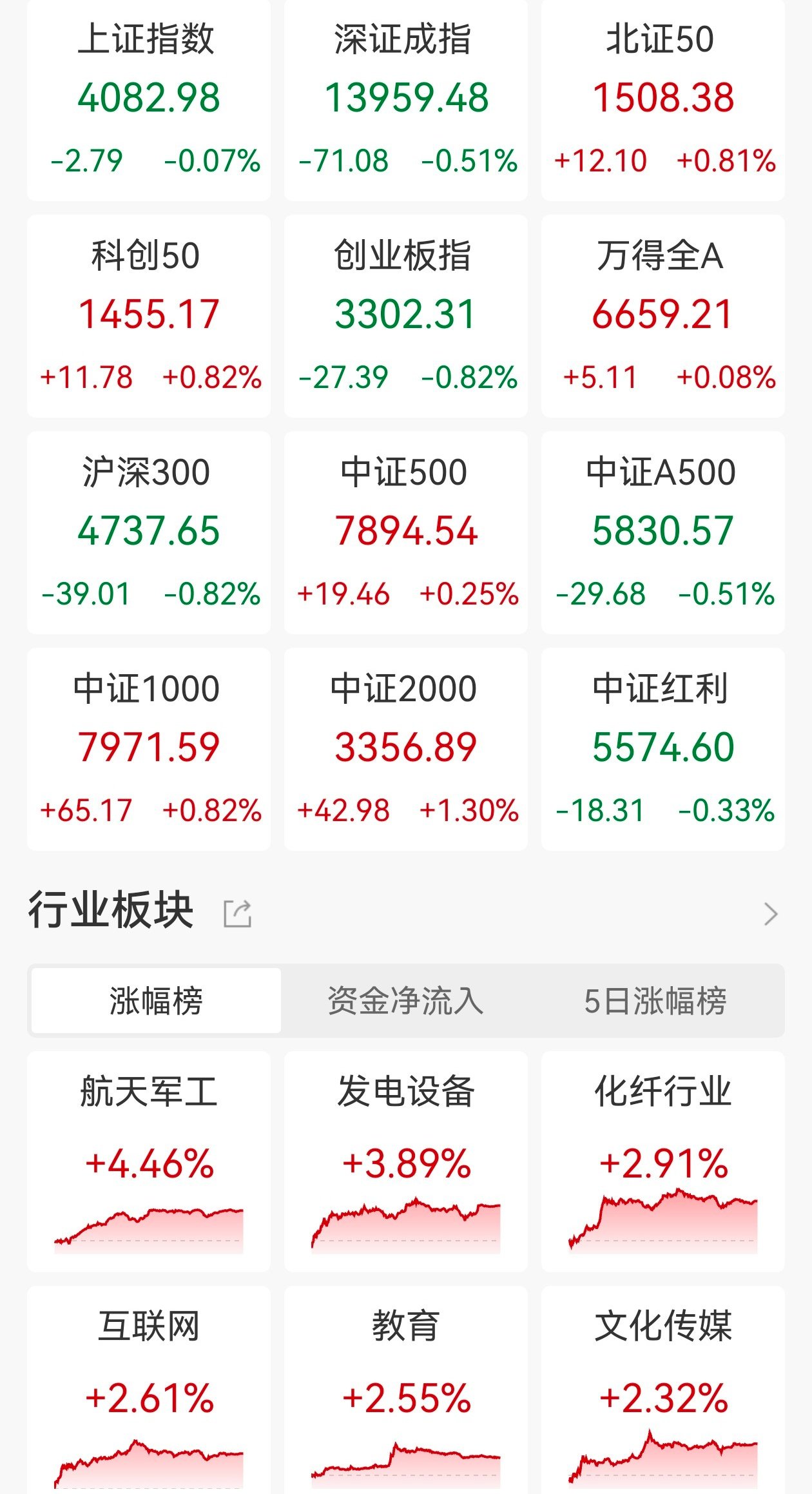
A股收评:沪指微跌录得15连阳!全市场成交额2.82万亿元,军工、商业航天板块爆发
Ge Long Hui· 2026-01-08 07:08
Market Overview - The three major A-share indices experienced fluctuations and closed lower, with the Shanghai Composite Index slightly down by 0.07% at 4082.98 points, marking a 15-day consecutive rise [1] - The Shenzhen Component Index fell by 0.51%, while the ChiNext Index decreased by 0.82% [1] - Total market turnover was 2.82 trillion yuan, a decrease of 568 billion yuan compared to the previous trading day, with over 3700 stocks rising and more than 100 stocks hitting the daily limit [1] Sector Performance - The U.S. significantly increased its military budget to 15 trillion yuan, leading to a surge in military, large aircraft, and aircraft carrier sectors, with multiple stocks such as Hailanxin and China First Heavy Industries hitting the daily limit [1] - The commercial aerospace and satellite internet sectors were actively traded, with stocks like Aerospace Electronics and Tongyu Communication also reaching the daily limit [1] - The brain-computer interface sector saw gains, with stocks like Sairui Medical hitting the daily limit [1] - Sectors related to 6G, controllable nuclear fusion, and AI pharmaceuticals showed strong performance [1] Declining Sectors - The large financial sector collectively retreated, with insurance and brokerage stocks leading the decline, including Hualin Securities hitting the daily limit down [1] - The lithium mining sector experienced a downturn, with Zhongmin Resources dropping over 7% [1] - The CPO concept weakened, with Dekeli falling nearly 7% [1] - Other sectors such as titanium dioxide, small metals, and fluorochemical industries also faced significant declines [1] Top Gainers - The top gainers included sectors such as chemical fibers, aerospace and military, and power generation equipment, with respective increases of 4.46%, 3.89%, and 2.91% [2] - Other notable sectors with gains included education, internet, and cultural transmission, with increases of 2.61%, 2.55%, and 2.32% respectively [2]
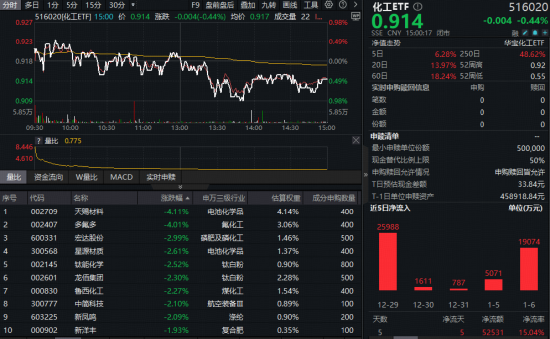
化工板块午后回落,锂电、氟化工领跌!资金逆市加码,哪些细分方向被机构看好?
Xin Lang Cai Jing· 2026-01-07 11:48
Group 1 - The chemical sector experienced a slight pullback on January 7, with the Chemical ETF (516020) fluctuating around the waterline before closing down 0.44% [1][7] - Key stocks in the sector, including Tianqi Lithium and Duofu, saw declines exceeding 4%, while several others dropped over 2%, negatively impacting the overall sector performance [1][7] - Despite the pullback, the basic chemical sector attracted significant capital inflow, with a net inflow of 5.915 billion yuan on the day, ranking fourth among 30 primary industries [9][10] Group 2 - The Chemical ETF (516020) has been a popular investment tool, with a net subscription of 525 million yuan over the past five trading days [10] - A meeting was held by multiple departments to discuss the regulation of competition in the power and energy storage battery industry, with participation from over ten leading companies [10] - Dongxing Securities forecasts a potential recovery in the chemical industry, expecting improvements in supply-demand dynamics and a decrease in raw material costs by 2026, presenting investment opportunities [11][12] Group 3 - The Chemical ETF (516020) tracks the CSI sub-industry index, with nearly 50% of its holdings concentrated in large-cap leading stocks, including Wanhua Chemical and Salt Lake Chemical [11][12] - The ETF also includes investments in sub-sectors such as phosphate and fluorine chemicals, nitrogen fertilizers, and high-end chemical new materials, aiming to capture comprehensive investment opportunities in the chemical sector [11][12]




股市三点钟丨14连阳!沪指收涨0.05% 两市成交额2.85万亿元
Bei Jing Shang Bao· 2026-01-07 07:58
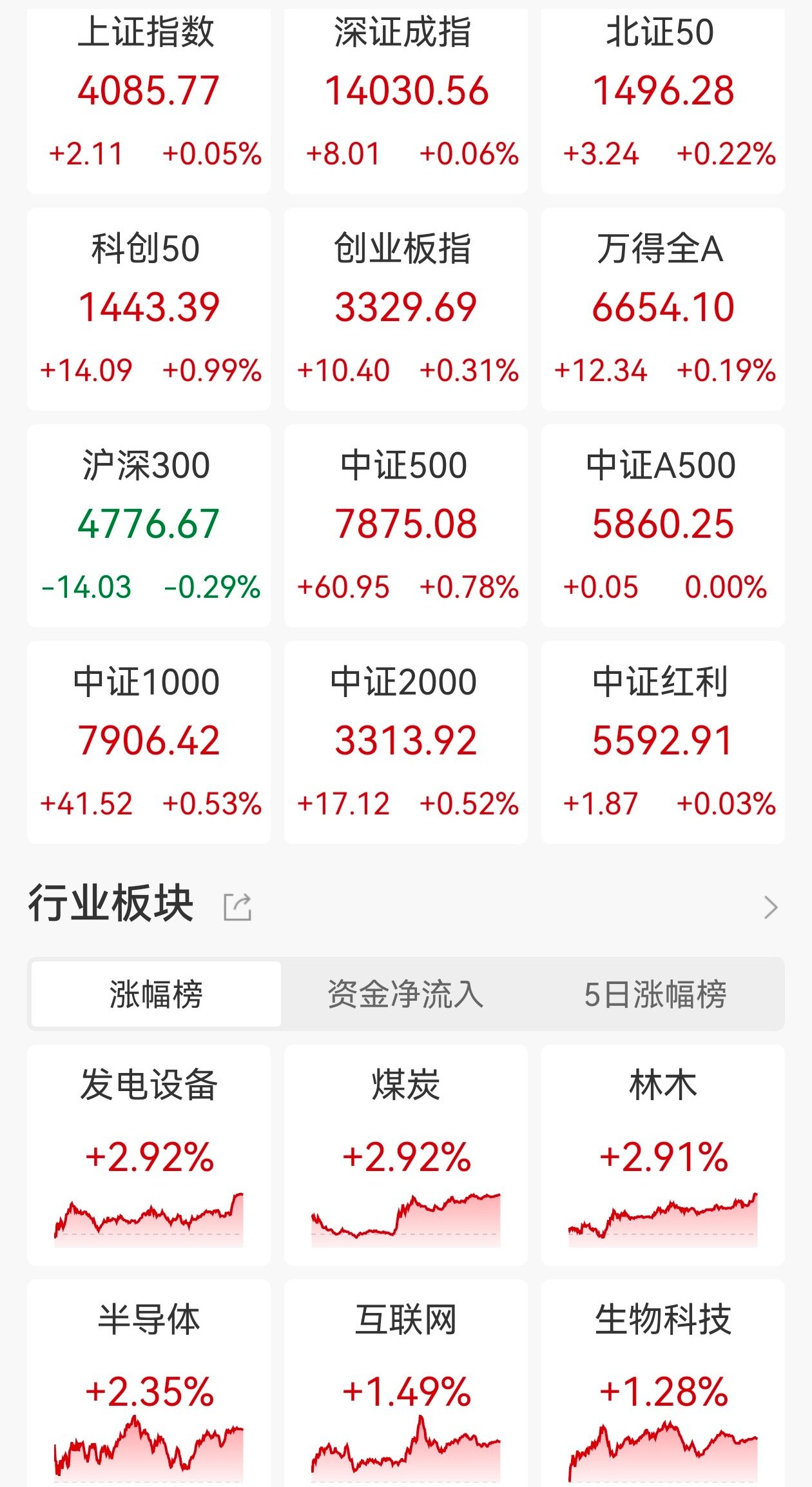
Core Viewpoint - The A-share market experienced a stable trading day with the Shanghai Composite Index reaching a new record for consecutive gains, marking the longest streak in A-share history [1] Market Performance - The Shanghai Composite Index opened flat and closed up by 0.05% at 4085.77 points, achieving a 14-day consecutive rise [1] - The Shenzhen Component Index and the ChiNext Index increased by 0.06% and 0.31%, closing at 14030.56 points and 3329.69 points respectively [1] - The trading volume for the Shanghai Stock Exchange was approximately 1.197 trillion yuan, while the Shenzhen Stock Exchange recorded about 1.657 trillion yuan, totaling around 2.85 trillion yuan for both markets [1] Sector Performance - Sectors such as electronic chemicals, fourth-generation semiconductors, and photolithography (gel) showed significant gains [1] - Conversely, sectors like DRG/DIP, titanium dioxide, and under-screen cameras experienced declines [1] Individual Stock Movement - A total of 2173 stocks in the A-share market rose, with 97 stocks hitting the daily limit up [1] - Conversely, 3190 stocks declined, with 7 stocks hitting the daily limit down [1]
A股收评:沪指14连阳!全市场成交额2.88万亿元,存储芯片板块爆发
Ge Long Hui A P P· 2026-01-07 07:11
Market Overview - The three major A-share indices experienced slight increases, with the Shanghai Composite Index rising by 0.05% to close at 4085 points, marking a 14-day consecutive gain [1] - The Shenzhen Component Index increased by 0.06%, while the ChiNext Index rose by 0.31% [1] - The total market turnover reached 2.88 trillion yuan, an increase of 493 billion yuan compared to the previous trading day, with nearly 3200 stocks declining [1] Sector Performance - The storage chip sector saw a significant surge in prices, leading to explosive growth, with stocks like Tongcheng New Materials and Hengkun New Materials hitting the daily limit [1] - The electronic chemicals sector also performed well, with Guanggang Gas hitting the daily limit [1] - The photolithography machine (gel) sector strengthened, with multiple stocks such as Nanda Optoelectronics reaching the daily limit [1] - The media sector experienced a rally, with stocks like Dayou Energy and Shaanxi Black Cat hitting the daily limit [1] - Other sectors with notable gains included semiconductors, controllable nuclear fusion, CPO concepts, and rare earth permanent magnets [1] Declining Sectors - The DRG/DIP concept saw a decline, with Rongke Technology hitting the 20% daily limit down [1] - The brain-computer interface sector faced a significant pullback, with stocks like Chengyitong and Aipeng Medical dropping over 10% [1] - The titanium dioxide sector weakened, with Zhenhua Holdings leading the decline [1] - Sectors such as digital currency, under-screen photography, and brokerage concepts also experienced notable declines [1]
2026年化工双登共振向上-再推化工板块
2026-01-07 03:05
Summary of Conference Call Records Industry Overview - The basic chemical sector is likely at the bottom of its cycle, with no need to wait for significant improvements in fundamentals before investing. Stock prices often lead the market, indicating potential investment opportunities when future fundamental changes are anticipated [2][4]. Key Investment Opportunities - Investment opportunities in 2026 are concentrated in traditional cyclical industries and technology materials, particularly in AI-related sectors such as energy storage materials (e.g., lithium carbonate) and storage materials (e.g., Yake Technology) [1][6]. - Recommended leading companies in the chemical industry include Wanhua Chemical, Hualu Hengsheng, and Juhua Co., due to their low valuations and high profit elasticity [1][8]. Company-Specific Insights Wanhua Chemical - Strongly recommended as a top investment choice due to its outlier effect and continuous growth catalysts. Expected revenue for 2026 is projected to reach 400 billion yuan, with a net profit forecast of 16 billion yuan [1][12][14]. - The company has a significant profit increase potential with every 1,000 yuan increase in MDI and TDI prices, translating to a net profit increase of 3.4 billion yuan [12][14]. Hualu Hengsheng - The company is expected to achieve annualized quarterly performance exceeding 5 billion yuan in 2026, supported by multi-category layout and technological upgrades [1][17][18]. Dongcai Technology - Notable for its advantages in new energy materials, with expectations to turn losses into profits as the overall profitability in the new energy sector improves [1][13][15]. Baofeng Energy - Expected to maintain stable annual profits between 12 billion to 13 billion yuan following the release of new capacity at its Ningxia base. The company benefits from the cyclical changes in the coal chemical industry and has diversified its product offerings [3][19][20]. Industry Trends and Signals - The potassium fertilizer industry is expected to experience tight supply and demand in 2026, maintaining high prices, while the phosphate market outlook remains stable with manageable supply increases [3][22][23]. - The tire industry is impacted by EU anti-dumping policies, prompting leading companies to expand overseas to increase market share [3][27][28]. - The spandex industry is at a cyclical bottom, with potential supply-side clearing effects anticipated due to the bankruptcy of a major player, which could improve market conditions [3][34][35]. Additional Insights - Investment in underperforming sectors is justified as they have likely reflected most negative factors in their stock prices, presenting potential for positive marginal changes [11]. - The refrigerant industry, while considered an "old story," shows strong certainty and potential for long-term investment due to ongoing price support [24]. - The organic silicon industry is expected to see price increases driven by domestic demand and external supply constraints, with companies like Dongyue showing significant elasticity [25][26]. Conclusion - The conference call highlighted a range of investment opportunities across various sectors within the chemical industry, emphasizing the importance of leading companies and emerging trends. Investors are encouraged to consider both cyclical recovery and technological advancements when making investment decisions.


印度市场重启,钛白粉压力暂缓
Zhong Guo Hua Gong Bao· 2026-01-07 02:40
Core Viewpoint - The Indian government's decision to terminate anti-dumping duties on titanium dioxide (TiO2) imports from China is expected to significantly benefit the Chinese TiO2 industry, allowing it to regain market share in India, which is a crucial export destination [1][2]. Group 1: Impact on Chinese TiO2 Industry - The cancellation of anti-dumping duties will reduce export costs to India by 15% to 20%, which had previously led to a significant decline in export volumes [1]. - In 2024, China's TiO2 production is projected to be 4.7 million tons, with exports reaching 1.9 million tons, of which approximately 307,500 tons (17%) are destined for India [1]. - The geographical proximity between China and India provides a logistical advantage, enabling quicker delivery times and lower shipping costs, which will help Chinese companies regain lost market share [1]. Group 2: Long-term Benefits and Industry Dynamics - The policy change alleviates short-term pressures and addresses long-term challenges for the Chinese TiO2 industry, enhancing profit margins that were previously squeezed [2]. - Chinese TiO2 companies possess a complete supply chain and stable production capacity, which strengthens their resilience in the international market [2]. - The cancellation of duties is expected to drive industry upgrades and optimize the domestic market, allowing Chinese firms to increase the export ratio of high-end TiO2 products, thus transitioning from scale expansion to quality enhancement [2]. Group 3: Market and Economic Implications - The reopening of the Indian market provides a vital channel for capacity digestion, supporting domestic TiO2 prices and preventing a price war, which promotes overall industry health [2]. - The recovery in TiO2 export markets is likely to stimulate related industries, such as titanium ore mining and paint manufacturing, improving the supply-demand balance within the sector [2]. - The favorable environment created by the policy change is expected to facilitate the orderly release of new production capacities in 2026 [2].
印度市场重启,钛白粉压力暂缓
Zhong Guo Hua Gong Bao· 2026-01-07 02:40
Core Viewpoint - The Indian government's decision to terminate anti-dumping duties on titanium dioxide (TiO2) imports from China is expected to significantly benefit the Chinese TiO2 industry, allowing it to regain market share in India, which is a crucial export destination [1][2]. Group 1: Impact on Chinese TiO2 Industry - The cancellation of anti-dumping duties will reduce export costs to India by 15%-20%, which had previously led to a significant decline in export volumes [1]. - In 2024, China's TiO2 production is projected to be 4.7 million tons, with exports reaching 1.9 million tons, of which approximately 307,500 tons (17%) are destined for India [1]. - The geographical proximity between China and India offers logistical advantages, enabling quicker delivery times and lower shipping costs, which will help Chinese companies regain lost market share [1]. Group 2: Long-term Benefits and Industry Dynamics - The policy change alleviates short-term pressures and addresses long-term challenges for the Chinese TiO2 industry, enhancing profit margins that were previously squeezed [2]. - Chinese TiO2 companies possess a complete supply chain and stable production capacity, providing them with strong risk resilience in the international market [2]. - The cancellation of duties is expected to drive industry upgrades and optimize the domestic market, as Indian production capacity is insufficient for high-performance rutile products [2]. - Chinese firms can optimize product structures and increase the export ratio of high-end TiO2, transitioning from traditional scale expansion to quality enhancement, thereby improving global competitiveness [2]. - The reopening of the Indian market will provide a vital channel for capacity digestion in China, supporting domestic TiO2 prices and preventing low-price competition, which promotes overall industry health [2]. - The recovery in TiO2 exports is likely to stimulate related industries, such as titanium ore mining and paint manufacturing, improving the supply-demand balance and creating a favorable environment for the orderly release of new capacities in 2026 [2].
金浦钛业:截至2025年12月31日股东人数为71236户
Zheng Quan Ri Bao Wang· 2026-01-06 14:11
Core Viewpoint - Jinpu Titanium Industry (000545) reported that as of December 31, 2025, the number of shareholders is expected to reach 71,236 households [1] Summary by Category - Company Information - Jinpu Titanium Industry has communicated to investors that the projected number of shareholders will be 71,236 households by the end of 2025 [1]
