
保险业

Search documents
北京“十四五”建设筹集67万套保障房
Bei Jing Shang Bao· 2025-11-23 15:32
Group 1: Housing Supply and Urban Renewal - During the "14th Five-Year Plan" period, Beijing has constructed and collected over 670,000 units of various types of affordable housing, with 430,000 units completed [1] - A total of 78 million square meters of old residential area have been renovated, achieving a 98% implementation rate [5] - The city has initiated the reconstruction of 1.04 million square meters of dilapidated housing and has fully advanced the resolution of D-grade dangerous buildings [1][5] Group 2: Public Rental Housing - The public rental housing registration family guarantee rate has reached 85.5%, up from 42.5% in 2020, meeting the target set for the end of the "14th Five-Year Plan" [3] - Over the past five years, 240 batches of public rental housing allocations have been conducted, providing approximately 136,000 units [3] - A total of 33 billion yuan in market rent subsidies and 24 billion yuan in public rental housing rent subsidies have been distributed to enhance the rental burden capacity of beneficiaries [3] Group 3: Affordable Rental Housing for New Citizens - Since 2022, Beijing has actively developed affordable rental housing to meet the needs of new citizens and young people, exceeding the target of 400,000 units set for the "14th Five-Year Plan" [4] - The city has utilized collective construction land to build nearly 130,000 units of affordable rental housing, the largest total in the country [4] Group 4: Financial Sector Development - The financial sector's added value in Beijing increased from 6,804.1 billion yuan at the end of 2020 to 8,154.2 billion yuan by the end of 2024, contributing significantly to the city's economic stability [8] - The financial industry contributes approximately 20% to the city's GDP, local public budget revenue, and local tax revenue, with a 40% contribution to total tax revenue [7][8] Group 5: Risk Management in Financial Sector - Over the past five years, the disposal of non-performing loans in Beijing has increased by 1.4 times compared to the "13th Five-Year Plan" period, with a non-performing loan rate of 0.7% [10] - The capital adequacy ratio of banks in Beijing stands at 16.58%, exceeding the national average by 1.22 percentage points [10]


“报行合一”向实向深,人身险产品费用分摊再出细则
Bei Jing Shang Bao· 2025-11-23 12:46
Core Viewpoint - The newly released guidelines by the China Actuarial Association aim to optimize the cost-sharing mechanism in the life insurance industry, transitioning from a "cost-driven" to a "value-driven" sales approach, enhancing long-term service and professional capabilities of intermediaries and sales personnel [1][4][7] Summary by Sections Guidelines Overview - The "Guidelines for Cost Sharing of Life Insurance Products" were published on November 21, focusing on the practical aspects of cost sharing in life insurance products and aligning with the "reporting and operation integration" requirements [1][4] Cost Definitions and Classifications - The guidelines categorize costs into variable costs and fixed costs for sharing, with variable costs including commissions and fees directly related to sales, while fixed costs encompass business and management fees not directly tied to sales [3][5] Exclusions from Cost Sharing - Four types of expenses are explicitly excluded from the cost-sharing framework: non-sales related expenses, asset management and custody fees, costs not directly attributable to insurance contracts, and identifiable non-recurring expenses [3][5] Need for Detailed Cost Sharing Mechanism - The guidelines respond to the increasing demand for a refined cost-sharing mechanism in the life insurance sector, particularly following the implementation of related policies in 2023, which have further regulated market order [4][6] Cost Recognition and Sharing Methods - The guidelines emphasize a "recognition before sharing" principle, detailing methods for cost recognition and sharing, including time survey methods, activity-based methods, and other reasonable approaches [5][6] Long-term Industry Impact - The implementation of these guidelines is expected to lead to a more transparent cost structure, reduce the mixing of non-insurance business costs into product costs, and enhance regulatory traceability of actual expense levels, ultimately promoting fair competition and high-quality development in the industry [5][7]

蔬菜贷、民宿贷、水果贷 金融服务“精准滴灌”到田间地头
Yang Shi Xin Wen Ke Hu Duan· 2025-11-23 07:24
Group 1 - Financial institutions are increasing support for agriculture, particularly in the context of the autumn and winter planting season, with a focus on enhancing farmers' income through comprehensive insurance coverage [1][9] - In Hunan's Chenzhou, a large-scale farmer, Wang Tingwu, has diversified his crops by switching 300 acres from rice to vegetables, benefiting from timely financial support [1][3] - Agricultural loans are being offered with minimal collateral requirements, allowing farmers to apply based on creditworthiness for various agricultural activities [5] Group 2 - Local financial regulatory bodies report significant growth in agricultural loans, with Guangdong's agricultural loan balance reaching 122.5 billion yuan, a 15.7% increase since the beginning of the year [11] - Chongqing's agricultural loan balance in food security has increased by 36.63% year-on-year, totaling approximately 41.49 billion yuan [11] - Insurance coverage for agricultural production has been enhanced, with Chongqing raising the insurance amount for major grain crops to 1,100 yuan per mu, and achieving a 100% coverage rate in key autumn grain production areas [13]

借鉴国际经验,建设中国国情“三支柱”养老保障体系
Sou Hu Cai Jing· 2025-11-23 02:47
Group 1: International Experiences - The U.S. OASDI program calculates pensions based on indexed monthly average wages, which helps to narrow income disparities [1] - Germany's statutory pension insurance combines "pay-as-you-go" and "personal accounts" models to enhance risk resistance [1] - Australia's Superannuation scheme mandates employer contributions, achieving a coverage rate exceeding 90% [1] - Canada's Registered Pension Plan (RPP) offers tax incentives to encourage corporate participation [1] Group 2: China's Practices and Innovations - China is advancing nationwide coordination of basic pensions to address regional fund imbalances, aiming for a "single reservoir" approach [1] - The exploration of a dual-track system of "basic pension + personal accounts" seeks to increase subsidies for low-income groups [1] - A pilot program for long-term care insurance is set to cover 45 million disabled elderly individuals, with cumulative expenditures exceeding 85 billion yuan by 2024 [1] - The expansion of personal pension trials will raise the annual contribution limit to 30,000 yuan, with enhanced tax incentives [3] - The nationwide rollout of the personal pension system starting in 2025 is expected to attract long-term capital into the market, with over 18 million accounts opened in the first month [3] - Development of "age-friendly" financial products, such as retirement target funds and commercial care insurance, is underway [3] - Financial institutions are encouraged to collaborate with elderly care service providers to offer integrated "finance + service" solutions [3]
行业重要指引出台!
Jin Rong Shi Bao· 2025-11-23 02:07
Core Viewpoint - The China Actuarial Association has released the "Guidelines for Cost Allocation of Life Insurance Products," aimed at enhancing the scientific and rational nature of cost allocation in life insurance product pricing, in line with government policies for high-quality development in the insurance industry [1][2]. Group 1: Cost Definition and Classification - The guidelines define product costs as expenses incurred by insurance companies in operating life insurance businesses, excluding taxes and additional charges, and categorize them into variable costs and allocated fixed costs [1][2]. - Variable costs are further divided into those paid to intermediaries or insurance sales personnel and other variable costs, while allocated fixed costs refer to business and management fees that need to be allocated to products [2]. Group 2: Cost Allocation Scope and Methods - The guidelines specify the scope of cost allocation based on the reasons for incurring costs and their nature [3]. - They outline methods for collecting, recognizing, and allocating costs, emphasizing a principle of "recognition first, allocation later," to ensure a scientific and rational approach to cost recognition and allocation in insurance products [3]. - The guidelines provide a unified standard for cost allocation in the industry, promoting better cost management and refined operations for insurance companies, which can lead to more accurate product pricing and reduced price irregularities in the market [3].
周延礼:保险业可撬动社会资本参与气候适应性与韧性投融资
2 1 Shi Ji Jing Ji Bao Dao· 2025-11-22 10:30
"'十五五'时期是我国基本实现社会主义现代化夯实基础、全面发力的关键时期,也是实现'双碳'的关键 时期。处于这样的时代方位,站在历史交汇点,新时代风险管理的任务要求赋予了保险业新的内涵。" 11月22日,十三届全国政协委员,原中国保监会党委副书记、副主席周延礼在由南方财经全媒体集团指 导、21世纪经济报道主办的"第二十届21世纪金融年会"上如是说道。 周延礼指出,在全球气候变化加剧的大背景下,提升气候适应性与韧性成为了应对气候变化挑战的关键 举措,而绿色保险和保险资金投资可撬动社会资本参与气候适应性与韧性投融资协同发展。 此外,针对当前气候适应性与韧性建设面临巨大的资金缺口和结构性失衡等问题,周延礼建议通过政策 支持体系、优化税收财政补贴、加强资金监管与跨部门协调等措施,完善气候适应性与韧性投融资的政 策环境。 气候适应性与韧性建设亟需资金与风险保障 在全球气候变化的大背景下,极端天气事件愈发频繁,如暴雨洪涝、高温干旱、超强台风等,给人类社 会的生产生活以及生态系统带来了巨大冲击,保险公司理赔金额逐年上升。 瑞士再保险公司数据,2022年全球自然灾害导致的保险赔付为1250亿美元。 目光回到国内,2020年我 ...
【财闻联播】小米王化首次回应转岗!储蓄国债(电子式)纳入个人养老金产品范围
券商中国· 2025-11-21 15:04
Macro Dynamics - In the first ten months of 2025, China attracted foreign investment of 621.93 billion RMB, a year-on-year decrease of 10.3% [2] - The number of newly established foreign-invested enterprises reached 53,782, marking a 14.7% increase year-on-year [2] - The manufacturing sector attracted 161.91 billion RMB, while the service sector attracted 445.82 billion RMB [2] - High-tech industries received 192.52 billion RMB in foreign investment, with significant growth in e-commerce services (173.1%), medical equipment manufacturing (41.4%), and aerospace manufacturing (40.6%) [2] - Investment from the UAE, UK, and Switzerland increased by 48.7%, 17.1%, and 13.2% respectively [2] Financial Institutions - Xinhua Insurance has been approved to increase its capital by 154.45 million HKD in Xinhua Asset Management (Hong Kong) [8] - The independent director of Xi'an Bank, Cao Huitao, resigned due to work reasons [9][10] - Huang Zhiwei has been approved to serve as the chairman of China Merchants Renhe Life Insurance [11] Market Data - The Hang Seng Index fell by 2.38%, and the Hang Seng Tech Index dropped by 3.21% on November 21 [12] - The Shanghai Composite Index decreased by 2.45%, closing below 3900 points, with significant declines in lithium, titanium dioxide, and energy metal sectors [13] Company Developments - China Nuclear Power announced a share buyback of 37.99 million shares, utilizing a total of 345 million RMB [17] - Changsha Beidou Industry Safety Technology Research Institute's IPO on the Sci-Tech Innovation Board has been accepted, aiming to raise 709 million RMB for various projects [18] - Xiaomi Group's public relations manager Wang Hua confirmed his transfer to the Xiaomi Wuhan headquarters [19]




利好“报行合一”落实!中国精算师协会发布《人身保险产品费用分摊指引》
Bei Jing Shang Bao· 2025-11-21 14:54
Core Viewpoint - The China Actuarial Association has released the "Guidelines for Expense Allocation of Life Insurance Products" to enhance the scientific and rational allocation of expenses in life insurance product pricing, aligning with the "reporting and operation integration" policy [1][2]. Group 1: Guidelines Overview - The guidelines define and categorize expenses related to life insurance business, distinguishing between variable expenses and fixed expenses to be allocated [2]. - Variable expenses are further divided into those paid to intermediaries or insurance sales personnel and other variable expenses, while fixed expenses refer to business and management fees excluding variable costs [2]. Group 2: Implementation and Impact - The guidelines specify the scope of expense allocation based on the nature and cause of expenses, providing methods for expense collection, identification, and allocation [2]. - By adhering to the principle of "identify first, allocate later," insurance companies are encouraged to scientifically and rationally conduct expense recognition and allocation [2]. - The implementation of these guidelines is expected to improve the efficiency of resource allocation, enhance expense management levels, and support the overall goal of reducing costs and increasing efficiency in the insurance industry [2].
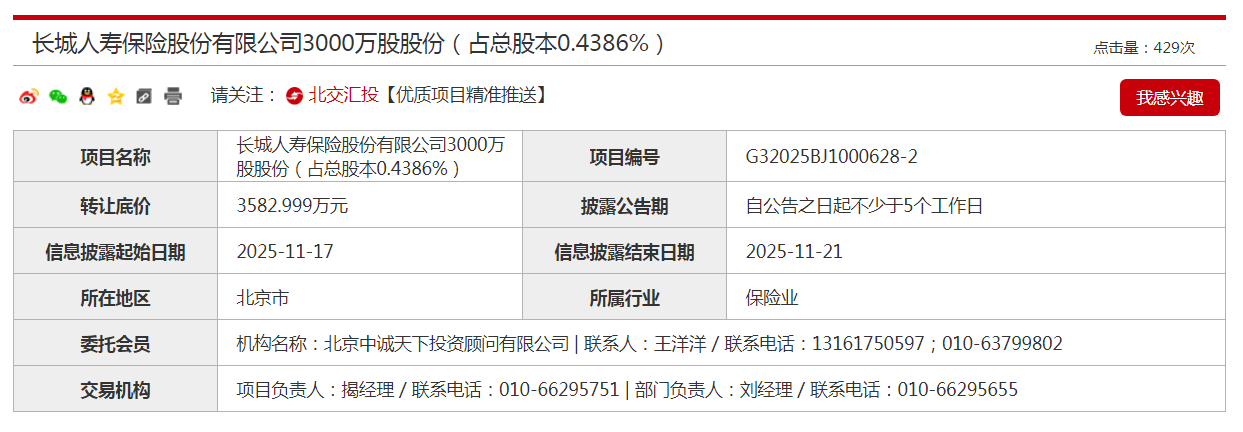
创始股东拟清仓!长城人寿6000万股股权再次挂牌转让
Guo Ji Jin Rong Bao· 2025-11-21 13:36
Core Viewpoint - China Twenty-Two Metallurgy Group Co., Ltd. and China State Construction Engineering Corporation Second Bureau Third Construction Co., Ltd. are transferring their 30 million shares in Great Wall Life Insurance Co., Ltd. at a base price of 35.82999 million yuan each, reflecting a strategic exit from the insurance sector in response to government policies [1][4]. Group 1: Share Transfer Details - Both companies are listed as founding shareholders of Great Wall Life, each originally holding 10% of the shares, which have now been diluted to 0.4386% due to multiple rounds of capital increases [3][4]. - The shares were previously listed for transfer in October 2025 at a base price of 39.8111 million yuan, indicating a 10% price drop in the recent offering [4]. Group 2: Regulatory Context - The transfer aligns with the "retreat from finance" directive issued by the State-owned Assets Supervision and Administration Commission (SASAC), which restricts state-owned enterprises from investing in financial institutions that do not align with their core business [4]. - Following the issuance of these policies, several state-owned enterprises have begun divesting from insurance companies, including China Bank Samsung Life and Minsheng Life Insurance [4]. Group 3: Company Performance - Great Wall Life reported an insurance business revenue of 21.455 billion yuan for the first three quarters of 2025, a year-on-year decline of 5.92%, with net profit dropping over 70% to 156 million yuan [5]. - As of the end of the third quarter, the company's core solvency adequacy ratio stood at 102.21%, while the comprehensive solvency adequacy ratio was at 153.84% [5].
“报行合一”落实再迎新要求 人身保险产品费用精算有了新“准绳”
Shang Hai Zheng Quan Bao· 2025-11-21 09:37
来源:上海证券报·中国证券网 上证报中国证券网讯(记者 韩宋辉)"报行合一"落实再迎新要求。上证报记者从相关渠道获悉,中国 精算师协会11月21日下发《人身保险产品费用分摊指引》(下称《指引》),明确人身保险产品费用分 摊细则,包括明确费用定义、分类和分摊范围等,以进一步提升人身保险产品定价中费用分摊的科学性 与合理性,推动保险公司更好落实"报行合一"监管要求,也可提升人身保险行业费用管理的科学性与合 理性。 自2023年以来,金融监管总局持续推进"报行合一"相关政策,要求保险公司严格执行备案的保险条款和 费率。业内人士称,自相关政策实施以来,人身保险市场秩序持续规范,保险公司内控管理水平不断提 高,行业整体降本增效成果显著。 《指引》下发后,将推动保险公司主动压降变动和固定成本,将产品定价、预算费用和实际费用进行有 机联动,有利于科学管理经营成本,向精细化经营管理转型。 业内人士表示,在人身保险产品开发和向监管部门备案时,需要对各项费用作出假设和安排,是人身保 险产品精算定价的重要一环。《指引》下发后,人身保险产品在费用精算上有了"准绳",将进一步强化 人身保险开发和算账经营理念,促进保险公司向精细化管理转 ...