AI

Search documents
逾116万手封单!千亿龙头 涨停
Zhong Guo Zheng Quan Bao· 2025-11-05 04:56
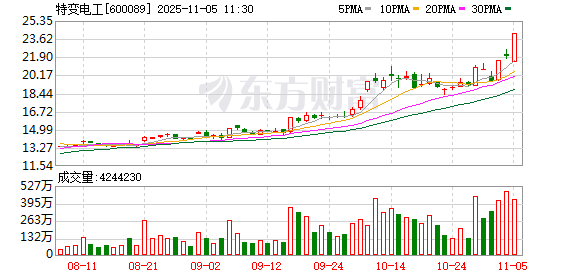
Market Performance - A-shares demonstrated resilience despite external negative influences, with major indices initially opening lower but recovering during trading [2] - By the end of the morning session, the Shanghai Composite Index rose by 0.05%, while the Shenzhen Component Index fell by 0.15%, and the ChiNext Index increased by 0.17% [2] Consumer and Power Sectors - The consumer sector, particularly the duty-free store segment, showed strong performance, with leading stocks like China Duty Free Group rising over 4% [3][5] - The power sector saw a surge, with TBEA Co., Ltd. hitting its daily limit and reaching a historical high market capitalization of 121.82 billion [3] Duty-Free Policy Changes - Recent favorable policies for the duty-free store sector include the expansion of product categories, effective from November 1, which will now include items like mobile phones and health foods [5] - The new duty-free shopping policy in Hainan led to a significant increase in sales, with a reported shopping amount of 78.549 million yuan on the first day of implementation, marking a 6.1% rise compared to the previous day [5] Tourism and Ice-Snow Industry - The tourism and hotel sectors, along with the ice-snow industry, experienced gains, driven by increased interest in winter travel and upcoming holiday arrangements [6] - The announcement of the 2026 holiday schedule, including a nine-day Spring Festival break, resulted in a spike in travel bookings [6] Technology Sector Adjustments - The technology sector faced a pullback, particularly in semiconductor and AI stocks, with notable declines in companies like Industrial Fulian and Cambricon Technologies [8] - Market sentiment shifted following reports of significant short positions taken by prominent investors against major AI companies, indicating growing skepticism about the AI narrative [8]

Market correction ahead? Fed moves and tech weakness could be key triggers, strategist warns
Youtube· 2025-11-05 02:36
Market Outlook - The market has experienced significant gains, leading to concerns that it may be overdue for a correction of 10% to 15% [2][3] - A shakeout could be healthy for sustaining the current bull market [2] Economic Concerns - Uncertainty exists regarding the Federal Reserve's ability to deliver expected rate cuts, which could lead to multiple compression in tech stocks if the economy proves stronger than anticipated [3][4] - The shadow banking system poses potential risks, with recent collapses in auto lenders highlighting underlying issues [4][5] Employment and Corporate Earnings - Corporate earnings have surged by approximately 80% since 2021, while private sector employment has only increased by about 8%, indicating a "jobless profit boom" [8][9] - The rise of AI and labor market displacement is contributing to job losses, creating a disparity between soaring corporate profits and stagnant employment [9][10] Government Spending and Economic Impact - A significant drop in federal government spending, potentially linked to a government shutdown, could lead to demand-side issues in the economy [11][12] - The government spending accounts for about 23% of US GDP, and prolonged shutdowns may exacerbate economic challenges [12] Market Valuation Risks - Equity valuations are at historically high levels, with a concentration of market cap in a few major companies, such as Nvidia, which accounts for about 8% of market cap [14] - A stumble by any of the major companies could lead to significant market declines, indicating a precarious market structure [14][15] Federal Reserve's Role - The Federal Reserve's policy decisions are critical, as a shift from easing to hiking rates could trigger a major market correction [16][17] - Current conditions suggest that any upcoming corrections are likely to be shakeouts rather than the beginning of a bear market, as the Fed remains on an easing path [17]
U.S. Stock Market Navigates Mixed Signals: Tech Volatility Amidst AI Optimism and Economic Data Delays
Stock Market News· 2025-11-04 19:07
Market Performance - The U.S. stock market showed mixed performance on November 4, 2025, with the S&P 500 and Nasdaq Composite closing higher, while the Dow Jones Industrial Average finished lower [1][2] - The S&P 500 gained 0.2% to close at 6,851.97 points, and the Nasdaq Composite rose 0.5% to 23,834.72 points, despite earlier declines [2] - The Dow Jones Industrial Average declined 0.5%, marking its third consecutive day of losses, closing at 47,336.68 points [2] Sector Performance - Sector performance was mixed, with six of the 11 S&P 500 sectors ending in negative territory, while consumer discretionary and technology stocks were the biggest gainers [3] - The Technology Select Sector SPDR (XLK) increased by 0.4%, and the Consumer Discretionary Select Sector SPDR (XLY) rose by 0.9% [3] - The positive movement in tech was driven by renewed optimism surrounding AI investments, although several mega-cap tech companies faced significant pullbacks [3] Company News and Stock Movements - Palantir Technologies (PLTR) shares fell 7.4% despite exceeding earnings expectations and raising revenue guidance, due to concerns over high valuation and lack of visibility for 2026 [4] - Nvidia (NVDA) experienced mixed performance, with reports indicating both a 3.2% fall and a 2.2% gain, reflecting ongoing volatility in high-growth AI stocks [5] - Microsoft (MSFT) dipped 1% despite announcing a $9.7 billion AI-compute agreement and significant data center investments [5] - Amazon (AMZN) gained 4% following a $38 billion deal to support OpenAI's AI workloads via AWS [5] - Tesla (TSLA) dropped 4% after a major investor opposed CEO Elon Musk's compensation package, while Yum Brands (YUM) rose 6.1% on potential sale of its Pizza Hut unit [6] Economic Outlook and Upcoming Events - The ongoing U.S. government shutdown is delaying key economic data releases, impacting market sentiment [7][8] - The ISM manufacturing PMI declined to 48.7 in October, marking the eighth consecutive month of contraction in the manufacturing sector [9] - Investors are closely watching the upcoming ADP employment report and consumer confidence data from the University of Michigan [9] - The Federal Reserve's next FOMC meeting is scheduled for December 9-10, 2025, with speculation of a 70% chance of another rate cut [10] Earnings Season - Over 300 S&P 500 companies have reported earnings, with Advanced Micro Devices (AMD) set to release its report after the market close [11] - Other notable companies reporting this week include McDonald's (MCD), Expedia Group, and Qualcomm (QCOM) [11]


Why Bernstein Just Boosted Its Price Target for Bitcoin Miner IREN
Yahoo Finance· 2025-11-04 18:08
Core Insights - Bernstein has given IREN an outperform rating and raised its price target to $125 per share following a $9.7 billion cloud services agreement with Microsoft, indicating strong potential for the company in the AI sector [1][2]. Company Developments - IREN will provide Microsoft with access to Nvidia's GB300 GPUs as part of a five-year deal, highlighting the advantageous position of Bitcoin miners due to their power access in a constrained energy environment [3]. - IREN shares were trading at over $69, reflecting a 2% increase on the day and a remarkable 1,000% rise over the past six months [2]. Industry Trends - The deal between IREN and Microsoft is part of a broader trend where Bitcoin miners are leveraging their infrastructure to meet the growing demand for AI, as seen with Cipher Mining's $5.5 billion lease agreement with Amazon Web Services [4][5]. - Google has increased its investment in Bitcoin miner Terawulf to $3.2 billion, further illustrating the intersection of the crypto mining and AI industries [5]. Market Sentiment - Despite the optimism surrounding Bitcoin miners' pivot to AI, experts caution that the energy requirements for AI operations are significantly higher, which may pose challenges [6].
“牛散”操作曝光!章建平大幅加仓这只股票(附名单)
Zhong Guo Zheng Quan Bao - Zhong Zheng Wang· 2025-11-04 15:13
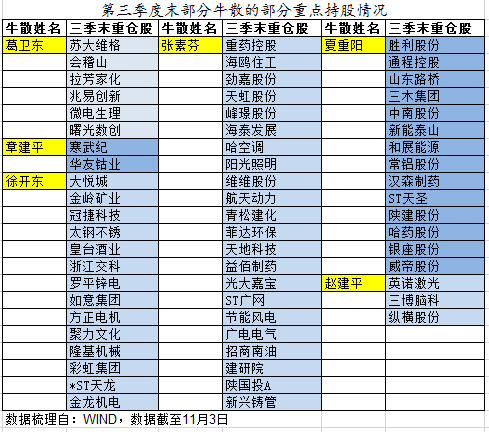
Core Viewpoint - The recent disclosure of A-share listed companies' Q3 2025 reports reveals significant trading activities among prominent investors, particularly in the technology sector, highlighting divergent strategies among key players [1][2]. Group 1: Key Investor Activities - Investor Ge Weidong slightly reduced his holdings in semiconductor leader Zhaoyi Innovation by 1.6953 million shares, yet still holds over 17 million shares valued at over 3 billion yuan at the end of Q3 [1][2]. - Investor Zhang Jianping increased his stake in AI stock Cambricon by 320,200 shares, bringing his total holdings to approximately 6.4065 million shares, with a market value exceeding 8 billion yuan [1][3]. - Zhang Jianping also entered the non-ferrous metals sector by acquiring 18.5 million shares of Huayou Cobalt, becoming its fifth-largest circulating shareholder [1][3]. Group 2: Market Trends and Performance - The technology sector has seen a robust performance in the A-share market this year, with some investors achieving substantial gains from leading tech stocks [2]. - Cambricon's stock surged over 120% in Q3, yet Zhang Jianping opted to increase his position rather than take profits, indicating a unique investment approach [3]. - The overall investment strategy among the "bull investors" reflects a blend of traditional industry preferences and a trend towards diversified holdings, with some investors holding over 40 different stocks [5][7]. Group 3: Investor Profiles and Holdings - Ge Weidong's portfolio includes a mix of traditional industries such as liquor and household products, indicating a balanced investment strategy [2]. - Zhang Jianping's concentrated investments in Cambricon and Huayou Cobalt represent his focus on high-growth sectors, contrasting with the broader trend of "bull investors" favoring established companies [4][5]. - Many of the stocks held by these investors are older listings, with a significant number priced below 10 yuan, showcasing a preference for low-cost stocks [7].


美联储降息与中美会谈双利好!A股却跳水,三大原因戳破市场预期
Sou Hu Cai Jing· 2025-11-04 11:00
Group 1 - The core point of the article is that despite two significant external positive events (the Federal Reserve's interest rate cut and the China-U.S. meeting in Busan), the A-share market did not respond positively and instead experienced a decline [3][30]. - The market had already priced in the expected interest rate cut by the Federal Reserve, leading to a lack of momentum when the announcement was made [5][16]. - The ambiguity surrounding future interest rate cuts from the Federal Reserve created uncertainty in the financial markets, contributing to the negative reaction [7][30]. Group 2 - The Busan meeting did not yield significant breakthroughs on key strategic issues, which led to a lack of positive surprises for the market [11][13]. - The performance of high-tech sectors, which had previously driven the A-share market's rise, fell short of expectations in their quarterly reports, leading to a broader market decline [19][21]. - The overall market reaction was a result of external positive news being fully digested and internal performance not meeting high expectations, highlighting the importance of actual earnings supporting stock prices [28][32].

独家丨张迪离职B站,已确定新去向
雷峰网· 2025-11-04 10:06
Core Insights - Zhang Di, former head of Kuaishou's Keling AI, has reportedly returned to Alibaba after a brief stint at Bilibili [2][4]. Group 1: Zhang Di's Career Path - Zhang Di graduated from Shanghai Jiao Tong University and initially joined Alibaba as a senior technical expert, contributing to the transition of search promotion to deep learning technologies [2]. - In 2020, Zhang Di joined Kuaishou, where he became the head of the large model and multimedia technology team in early 2023 [2]. - By April 2025, Keling AI was officially established, with Zhang Di as the head of the technology department, leading the development and application of the Keling model's underlying architecture [2]. Group 2: Keling AI's Performance - As of September 2025, Keling AI has completed over 30 version iterations, with global users surpassing 45 million and generating over 200 million videos and 400 million images [3]. - Kuaishou's Q2 2025 financial report indicated that Keling AI's revenue surged to 250 million RMB, a 66% increase from the previous quarter's 150 million RMB [3].

股市“慢牛”背后的隐性治理
3 6 Ke· 2025-11-04 08:22
Group 1 - The Shanghai Composite Index broke the 4000-point mark for the first time since August 2015, signaling a positive development in the A-share market [1] - In 2025, global stock markets experienced an average increase of around 15%, with notable performances from various indices, including a 33.9% rise in the Hang Seng Index and a 57% increase in the MSCI Korea 20/35 Index [1][2] - The surge in global stock markets is primarily driven by the high-tech sector, particularly semiconductor and AI stocks, which have become the core driving force behind market trends [2][3] Group 2 - The trading volume in the Chinese stock market surged by 106% year-on-year in the first three quarters of 2025, compared to 47.7% in the U.S. and only 9.2% in Japan, highlighting the unique characteristics of the Chinese market [2] - A-share companies recorded a modest profit increase of 2.5%, contrasting with a 9.2% average profit growth for global listed companies, indicating a divergence in market performance [3] - The A-share market's high valuation, with a price-to-earnings ratio of approximately 14 times for the CSI 300, is not significantly lower than Japan's 15.2 times, yet it remains a point of contention regarding the market's perceived undervaluation [3] Group 3 - The Chinese stock market's rise is characterized by significant gains in sectors such as non-ferrous metals, communications, and electronics, which collectively contributed to about 70% of the CSI 300's increase [5] - The high proportion of retail investors in the Chinese market, estimated at around 70%, contrasts sharply with the 20% in both the U.S. and Japan, reflecting deeper institutional and cultural differences in investment behavior [7][8] - The introduction of policies aimed at guiding resident funds into the stock market is crucial for establishing long-term market support, as institutional funds tend to have longer holding periods and lower volatility [8] Group 4 - The "national team" led by Central Huijin has been actively investing in ETFs to stabilize the market, creating a perception that indices will not decline, which has encouraged more funds to enter the market [10][11] - The focus on index-based investment strategies has led to a situation where individual stock performance is increasingly overshadowed by ETF composition changes, diminishing the market's price discovery function [11][12] - The concentration of funds in large-cap stocks and popular themes has marginalized smaller enterprises and innovative companies, potentially hindering long-term economic growth and innovation [12]

Palantir's bull run stalls as Burry bets against the AI darling
Yahoo Finance· 2025-11-04 07:16
Core Insights - Palantir Technologies experienced a 6% decline in stock price despite a strong quarterly update and a forecast for fourth-quarter revenue exceeding market expectations, driven by increased demand for data analytics services due to rapid AI adoption [1][4] Company Performance - The company's stock has more than doubled in value this year and is up over 170% year-to-date, following a remarkable 1,000% increase over the past two years, significantly outperforming major tech firms [1][4] - Palantir's daily retail cash turnover reached approximately $302 million, making it the third highest among U.S.-listed shares monitored by Vanda Track Research [4] Market Position and Valuation - Palantir's valuation is notably high, trading at nearly 250 times its 12-month forward earnings estimates, in stark contrast to Nvidia's 33 and Microsoft's 29.92 [5] - The company has established a strong relationship with the U.S. government, securing multiple contracts that leverage its data and AI technology for defense applications [2] Investor Sentiment - Investor sentiment has been influenced by bearish bets placed by notable investor Michael Burry on both Nvidia and Palantir, raising concerns about potential market bubbles in the AI and tech sectors [2][3]
欧洲经济大洗牌!外资逃离、增长失速,民粹势力要“摘桃”?
Sou Hu Cai Jing· 2025-11-04 06:07
Group 1 - The European investment market has experienced a significant shift, with foreign capital decreasing by 25% in just six months, negatively impacting global markets [1] - Despite some localized improvements, such as Germany attracting foreign investment, the overall sentiment in Europe remains cautious among both factory owners and workers [1] Group 2 - Companies in Europe are becoming increasingly conservative due to rising cost pressures, particularly in energy, which is heavily reliant on imports, affecting factory profitability [3] - The external market is challenging, with U.S. tariffs reducing European export profits, leading to a cautious consumer environment where spending is restrained [3] Group 3 - Europe, once a leader in technology, is falling behind in emerging fields like AI and the internet due to insufficient R&D funding and a focus on traditional industries like automotive manufacturing [5] - The bureaucratic inefficiencies and regulatory hurdles in Europe hinder the progress of new projects, stifling innovation and market vitality [5] Group 4 - Economic and technological pressures are creating significant social impacts, with decision-makers in Brussels struggling to implement reforms due to internal disagreements among member states [7] - The lack of consensus on budgetary spending and subsidies among countries is slowing down progress and reform efforts [7] Group 5 - The internal conflicts and hesitations within the EU are leading to collective anxiety among the populace, resulting in a loss of confidence in the future and increased support for populist parties [10] - The divergence in expectations among different social groups, such as the younger generation seeking high-tech advancements and older individuals desiring stable welfare, reflects a fragmented societal outlook [10] Group 6 - The pervasive anxiety and risk aversion in Europe are causing a stagnation in investment and innovation, with stakeholders hesitant to take action due to fears of disrupting the status quo [12] - The combination of investor withdrawal, lagging innovation, policy fragmentation, and public anxiety represents the most significant challenges facing Europe today [12]