新能源发电

Search documents
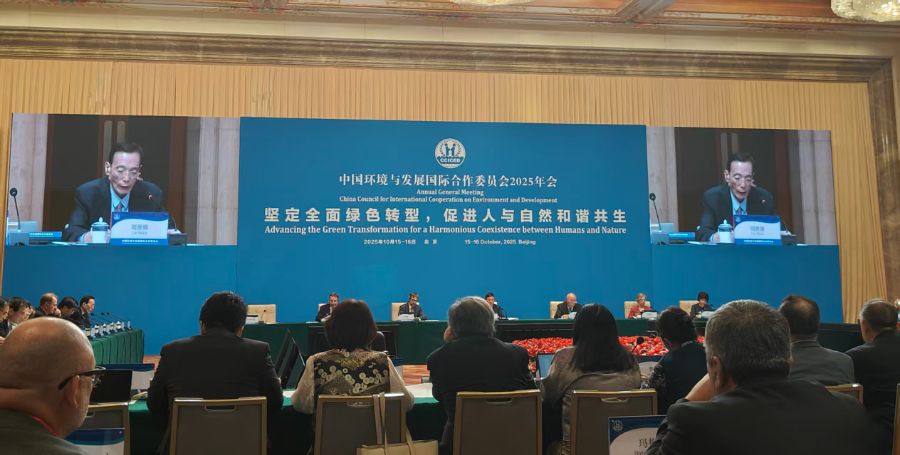
国合会年会提六大政策建议 聚焦绿色需求、绿色消费等
2 1 Shi Ji Jing Ji Bao Dao· 2025-10-15 15:39
Core Insights - The article discusses the policy recommendations presented by the China Environment and Development International Cooperation Committee (CEDD) for the Chinese government, focusing on green transformation and sustainable development strategies for the upcoming "15th Five-Year Plan" period [1][2]. Group 1: Policy Recommendations Overview - The recommendations are categorized into six areas, comprising a total of 22 specific policy suggestions aimed at enhancing green demand, technological support, green consumption, supply chain finance, energy transition, and high-level openness [2][3]. Group 2: Green Demand Expansion - Accelerate the construction of a new power system, aiming to stop new coal power installations and achieve a renewable energy generation share of 33%-38% by 2030 [3]. - Improve industrial electrification, targeting an electrification rate exceeding 34% by the end of the "15th Five-Year Plan" [3]. - Establish a comprehensive carbon reduction mechanism, expanding the coverage of the carbon market to include industries like chemicals and aviation [3]. Group 3: Technological Support and Ecosystem - Enhance coordination between renewable energy development and ecological protection [5]. - Promote high-quality development of the blue economy, integrating sustainable marine energy into national and local development plans [5]. - Establish a proactive climate adaptation governance system to build climate-resilient socio-ecological systems [5]. Group 4: Sustainable Production and Consumption - Strengthen the top-level design of the circular economy, setting specific goals for resource productivity and recycling rates [6]. - Promote solid waste management in synergy with the circular economy, encouraging pilot projects for "waste-free cities" [6]. - Accelerate the cultivation of the recycled materials market through consumer incentives and digital technology integration [6]. Group 5: Supply Chain Finance for Low-Carbon Innovation - Drive green innovation in supply chains through the financing needs of leading enterprises [7]. - Encourage financial institutions to incorporate carbon emission indicators into their services [7]. - Promote debt replacement tools linked to the retirement of high-carbon assets to support low-carbon transitions [7]. Group 6: Just Transition in Traditional Energy Regions - Develop the coal triangle area as a national low-carbon transition demonstration zone, focusing on inclusive employment support [8]. - Establish zero-carbon trade zones centered on new energy systems and carbon removal technologies [8]. - Enhance diversified funding support for low-carbon and disruptive technology innovations [8]. Group 7: High-Level Openness and International Cooperation - Strengthen international cooperation mechanisms for green development, establishing a global green development initiative [9]. - Create a risk management system for overseas green financing [9]. - Participate constructively in building an international green financial system, increasing climate investment scales [9].
可再生能源消费征求意见稿解读及行业近况交流
2025-10-15 14:57
Summary of Renewable Energy Consumption and Industry Insights Industry Overview - The document discusses the renewable energy sector, focusing on the implementation of a renewable energy consumption responsibility weight system and minimum consumption ratio targets in the context of subsidy-free era and carbon neutrality goals [1][2]. Key Points and Arguments - **Importance of Renewable Energy Consumption**: The responsibility weight system for renewable energy consumption has gained significance, especially under the dual carbon goals, highlighting the need for local governments and grid companies to prioritize renewable energy consumption despite uncertainties in green electricity supply [1][2]. - **Two-Dimensional Renewable Energy Assurance System**: The document outlines a dual-dimensional assurance system for renewable energy, addressing previous policy gaps and promoting high-quality development through institutional guarantees and market mechanisms such as green certificates and pricing mechanisms [1][3]. - **Minimum Consumption Ratio Targets**: The introduction of minimum consumption ratio targets for renewable energy is a key feature, emphasizing comprehensive constraints on renewable energy consumption [2][5]. - **Inclusion of Non-Electric Consumption**: The document marks the first time non-electric consumption has been included in the renewable energy target system, expanding the utilization space for renewable energy and focusing on the commercialization of hydrogen, biomass, and geothermal energy [1][6]. - **Monitoring and Accountability Mechanisms**: A quarterly monitoring, annual evaluation, and accountability mechanism will be established to ensure compliance with the new policies, with clear communication of reasons for any failures to meet targets [3][13]. - **Market Mechanisms**: The importance of market mechanisms is emphasized, with green certificates serving as a core tool to facilitate consumption and absorption of renewable energy, while also linking to carbon accounting and carbon footprints [3][12]. - **Sector-Specific Targets**: Key energy-consuming industries such as steel, cement, and aluminum have been identified as targets for achieving green consumption ratio goals, with additional requirements for flexibility [11]. - **Future of Non-Electric Utilization**: The document discusses the potential for non-electric utilization, particularly in high-energy-consuming sectors, to achieve significant applications and contribute to carbon reduction [26]. Additional Important Insights - **Development of Hydrogen and Ammonia**: The emphasis on developing green hydrogen and ammonia is linked to their relationship with energy storage, with many projects expected to adopt off-grid or storage configurations to reduce reliance on grid capacity [18]. - **Carbon Market Expansion**: The establishment of a national carbon market by 2025 is expected to cover high-energy-consuming industries by 2027, promoting a green transition in these sectors [15]. - **Storage Development**: The document highlights the rapid growth of new energy storage, with an expected compound annual growth rate of 169% during the 14th Five-Year Plan period, significantly outpacing the growth of wind and solar installations [21]. - **Regional Policy Variations**: Local governments are encouraged to tailor their policies based on regional conditions, with specific targets for renewable energy consumption being allocated to different provinces and cities [27]. - **Future Policy Support for Green Hydrogen**: Future policies are anticipated to support the development of green hydrogen through various means, including price policies and technological advancements, rather than direct subsidies [24][25]. - **Projected Installation Capacity**: For 2025, solar installation capacity is expected to exceed 300 GW, while wind installation is projected to be between 90 to 100 GW, with further growth anticipated in 2026 [30].
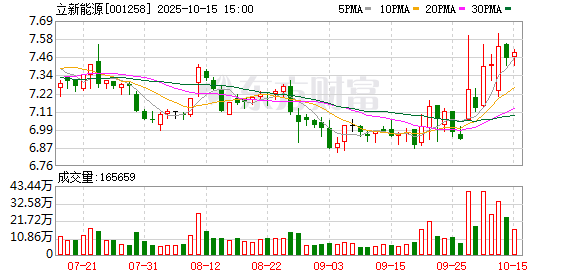
立新能源:公司始终重视成本管控与运营效率提升,目前各项业务经营稳健、推进有序
Zheng Quan Ri Bao· 2025-10-15 14:13
Core Insights - The company, Lide New Energy, reported its wind power installed capacity to be 1720.5 MW and solar power installed capacity to be 853.50 MW as of June 30, 2025 [2] - The company's net profit is influenced by multiple factors including industry policy changes, grid consumption conditions, fluctuations in on-grid electricity prices, the progress of renewable energy subsidy payments, and wind-solar resource conditions [2] - The company emphasizes cost control and operational efficiency, indicating that its various business operations are stable and progressing in an orderly manner [2]

国合会年会提六大政策建议,聚焦绿色需求、绿色消费等
2 1 Shi Ji Jing Ji Bao Dao· 2025-10-15 12:32
Core Viewpoint - The China Environment and Development International Cooperation Committee (CEDD) has proposed 22 specific policy recommendations to the Chinese government, focusing on achieving carbon neutrality and sustainable development during the 14th and 15th Five-Year Plans [1][2]. Group 1: Policy Recommendations Overview - The recommendations are categorized into six areas: green demand, technological support, green consumption, supply chain finance, energy transition justice, and high-level opening-up [2][3]. Group 2: Green Demand - Accelerate the construction of a new power system, aiming to stop new coal power installations and achieve a 33%-38% share of wind and solar power generation by 2030 [3]. - Enhance industrial electrification, targeting an electrification rate of over 34% by the end of the 15th Five-Year Plan [3]. - Establish a comprehensive carbon reduction mechanism and expand the coverage of the carbon market to include industries like chemicals and aviation [3][4]. Group 3: Technological Support - Strengthen the coordination between renewable energy development and ecological protection [5]. - Promote the establishment of a multilateral cooperation mechanism for biodiversity [7]. - Accelerate the development of a sustainable blue economy and integrate it into national and local development plans [8]. Group 4: Circular Economy - Enhance the top-level design of the circular economy, setting specific goals for resource productivity and recycling rates [10]. - Promote solid waste management in conjunction with circular economy initiatives [10]. - Encourage consumer choices towards more circular products through labeling and subsidy mechanisms [10]. Group 5: Supply Chain Finance - Drive green innovation in supply chains through the green demands of leading enterprises [11]. - Encourage financial institutions to incorporate carbon emission indicators into their services [11]. - Promote debt replacement tools linked to the retirement of high-carbon assets [11]. Group 6: Just Transition for Traditional Energy Regions - Develop the coal triangle area into a national low-carbon transition demonstration zone [12]. - Establish zero-carbon trade zones focusing on new energy systems and carbon removal technologies [12]. - Create a diversified funding support system for low-carbon and disruptive technology innovations [12]. Group 7: High-Level Opening-Up - Strengthen international cooperation mechanisms for green development and establish a global green development initiative [13]. - Develop a risk management system for overseas green financing [14]. - Participate in building an international green finance system, increasing climate investment through multilateral banks [14].
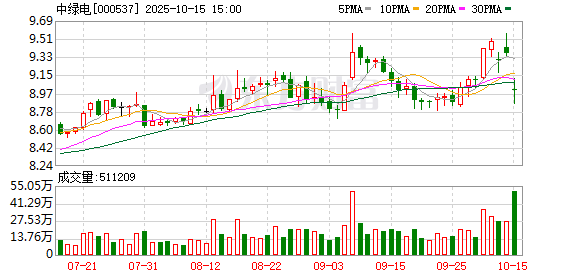
中绿电:截至2025年6月末,公司的新能源发电业务收入总额为23.15亿元
Zheng Quan Ri Bao· 2025-10-15 08:12
Group 1 - The core viewpoint of the article is that Zhonglv Electric has projected its total revenue from renewable energy generation to reach 2.315 billion yuan by the end of June 2025 [2] - Wind power revenue is expected to account for approximately 63.5% of the total revenue, while solar power revenue is projected to make up about 35% [2]

中广核新能源:9月集团按合并报表口径完成发电量同比减少14.9%
Ge Long Hui A P P· 2025-10-15 04:36
Core Viewpoint - China General Nuclear Power Corporation (CGN) announced a projected decrease in power generation for 2025, with a total of 1,356.3 GWh, representing a 14.9% decline compared to 2024 [1] Summary by Category Power Generation Performance - For the nine months ending September 30, 2025, CGN's cumulative power generation reached 14,206.8 GWh, a 3.0% decrease year-on-year compared to 2024 [1] - Breakdown of power generation changes includes: - Wind power projects in China decreased by 2.2% - Solar power projects in China increased by 26.1% - Gas power projects in China increased by 7.9% - Hydropower projects in China decreased by 13.0% - Projects in South Korea decreased by 11.4% [1] Project-Specific Changes - In the 2025 projection: - Wind power projects in China are expected to decrease by 37.4% - Solar power projects in China are expected to increase by 47.7% - Gas power projects in China are expected to increase by 69.5% - Hydropower projects in China are expected to increase by 8.1% - Projects in South Korea are expected to increase by 2.1% [1]
中广核新能源(01811)前9个月累计完成发电量14206.8吉瓦时 同比减少3.0%
智通财经网· 2025-10-15 04:11
Core Viewpoint - China General Nuclear Power Corporation (CGN) New Energy reported a decrease in power generation for 2025 compared to 2024, with specific changes across various energy projects [1] Group 1: Power Generation Performance - For the period ending September 2025, the company and its subsidiaries achieved a total power generation of 1,356.3 GWh, a decrease of 14.9% year-on-year compared to 2024 [1] - Cumulative power generation for the nine months ending September 30, 2025, was 14,206.8 GWh, reflecting a 3.0% decrease year-on-year compared to 2024 [1] Group 2: Project-Specific Changes - Chinese wind power projects saw a significant reduction of 37.4% in generation [1] - Chinese solar power projects experienced an increase of 47.7% [1] - Chinese gas projects increased by 69.5% [1] - Chinese hydropower projects increased by 8.1% [1] - Korean projects saw a slight increase of 2.1% [1] Group 3: Year-on-Year Changes for Nine Months - Chinese wind power projects decreased by 2.2% [1] - Chinese solar power projects increased by 26.1% [1] - Chinese gas projects increased by 7.9% [1] - Chinese hydropower projects decreased by 13.0% [1] - Korean projects decreased by 11.4% [1]
中广核新能源前9个月累计完成发电量14206.8吉瓦时 同比减少3.0%
Zhi Tong Cai Jing· 2025-10-15 04:10
Core Insights - China General Nuclear Power Corporation (CGN) announced a projected electricity generation of 1,356.3 GWh for the consolidated group by September 2025, representing a 14.9% decrease compared to 2024 [1] Generation Performance Summary - For the nine months ending September 30, 2025, the group achieved a cumulative electricity generation of 14,206.8 GWh, a 3.0% decrease year-on-year compared to 2024 [1] - Breakdown of generation performance: - Chinese wind power projects decreased by 2.2% [1] - Chinese solar power projects increased by 26.1% [1] - Chinese gas projects increased by 7.9% [1] - Chinese hydropower projects decreased by 13.0% [1] - Korean projects decreased by 11.4% [1]
中广核新能源(01811.HK)9月完成发电量1356.3吉瓦时 同比减少14.9%
Ge Long Hui· 2025-10-15 04:06
Core Viewpoint - China General Nuclear Power Corporation (CGN) New Energy reported a decrease in power generation for the year ending September 2025, with a total of 1,356.3 GWh, representing a 14.9% decline compared to 2024 [1] Summary by Category Power Generation Performance - For the nine months ending September 30, 2025, CGN New Energy achieved a cumulative power generation of 14,206.8 GWh, which is a 3.0% decrease year-on-year compared to 2024 [1] - Breakdown of power generation changes includes: - Chinese wind power projects decreased by 2.2% - Chinese solar power projects increased by 26.1% - Chinese gas projects increased by 7.9% - Chinese hydropower projects decreased by 13.0% - Korean projects decreased by 11.4% [1] Project-Specific Changes - For the year ending September 2025: - Chinese wind power projects saw a significant decrease of 37.4% - Chinese solar power projects experienced a notable increase of 47.7% - Chinese gas projects increased by 69.5% - Chinese hydropower projects increased by 8.1% - Korean projects increased by 2.1% [1]
大唐发电、远景能源等新设能源开发公司
Zheng Quan Shi Bao Wang· 2025-10-15 03:09
Core Viewpoint - Recently, the establishment of Datang (Binhai) Energy Development Co., Ltd. has been reported, focusing on renewable energy services such as wind and solar power [1] Company Summary - Datang (Binhai) Energy Development Co., Ltd. has been founded with Chen Tianxiao as the legal representative [1] - The company’s business scope includes wind power generation technology services, solar power generation technology services, and research and development related to wind farm systems [1] - The company is jointly held by Datang Power (601991) and Envision Energy Co., Ltd. among others [1]