
燃气

Search documents
午评:沪指半日跌0.51% 电池、半导体等热门赛道股集体调整
Zhong Guo Jin Rong Xin Xi Wang· 2025-10-10 04:18
Market Overview - A-shares experienced a collective adjustment on October 10, with the ChiNext Index leading the decline [1] - The Shanghai Composite Index closed at 3913.80 points, down 0.51%, with a trading volume of 742.5 billion [1] - The Shenzhen Component Index fell 1.85% to 13471.74 points, with a trading volume of 901.4 billion [1] - The ChiNext Index dropped 3.40% to 3150.78 points, with a trading volume of 403.5 billion [1] - The STAR 50 Index decreased by 4.64% to 1467.74 points, with a total trading volume of approximately 78.1 billion [1] Sector Performance - Gas stocks showed resilience, with companies like Dazhong Public Utilities and Hongtong Gas hitting the daily limit [1] - Consumer sectors such as clothing and dairy were active, with stocks like Anzheng Fashion and Zhuangyuan Pastoral also reaching the daily limit [1] - The semiconductor sector faced significant declines, with companies like Dongxin Co., Huahong Semiconductor, and Jinghe Integration dropping over 10% [1] - Solid-state battery concept stocks also fell, with companies like Xian Dao Intelligent and Liyuan Heng decreasing by more than 10% [1] - Gold stocks experienced a pullback, with Western Gold, Xiaocheng Technology, and Chifeng Gold leading the declines [1] Institutional Insights - CITIC Securities noted that the recent export controls on superhard materials could accelerate domestic industry consolidation, with potential price increases in the long term [3] - CITIC Securities also highlighted the strong performance of AI applications, particularly with OpenAI's Sora 2 model and its impact on the Sora App, which topped the US App Store [3] - The demand for AI computing power remains robust, with significant capital expenditure opportunities across various sectors, including advanced processes and GPU/ASIC technologies [3] - CICC pointed out the strong structural characteristics of the market, with growth sectors attracting attention amid a period of consolidation [4] Policy Updates - The average standard for urban and rural subsistence allowances has increased by 19.6% and 21.3% respectively since 2020, as reported by the Ministry of Civil Affairs [5] - The central government has allocated 1.16 billion for the first batch of elderly care service consumption subsidies, marking a significant step in supporting elderly individuals with moderate to severe disabilities [6] Financing Activity - The net financing amount in A-shares reached 50.8 billion, marking the second-highest record in history [7] - As of October 9, the margin trading balance in the Shanghai and Shenzhen markets rose to 2.45 trillion, setting a new historical high [8]
港股午评:恒指跌1.14%录得5连跌,半导体、黄金等热门板块回落,两只新股上市大涨
Ge Long Hui· 2025-10-10 04:08
Market Overview - The Hong Kong stock market experienced a collective decline in the morning session, with the Hang Seng Tech Index falling the most by 2.45%, barely holding above 6300 points. The Hang Seng Index and the Hang Seng China Enterprises Index dropped by 1.14% and 1.2% respectively, marking a five-day losing streak for both indices [1] Sector Performance - Major technology stocks, which serve as market indicators, saw a significant downturn. Baidu fell by 5.39%, Alibaba dropped nearly 4%, while Tencent and Xiaomi decreased by nearly 3%. JD.com and Meituan also saw declines of over 1% [1] - Popular sectors such as semiconductor chips, lithium battery stocks, and gold stocks all retreated. Ganfeng Lithium plummeted over 8%, CATL fell more than 7%, and notable declines were observed in SMIC and China Gold International [1] - Other sectors including Apple concept stocks, photovoltaic stocks, stablecoin concept stocks, gambling stocks, biomedicine stocks, and automotive stocks also experienced declines [1] Consumer and New Listings - Conversely, consumer concept stocks such as Xiaocaiyuan, Nayuki Tea, and Yum China showed resilience and increased in value [1] - Additionally, two new stocks debuted in the Hong Kong market, with Jinye International Group soaring by 466% and Zhida Technology rising by 183% [1]
午评:三大指数早间震荡调整 燃气板块涨幅居前
Zhong Guo Jing Ji Wang· 2025-10-10 03:44
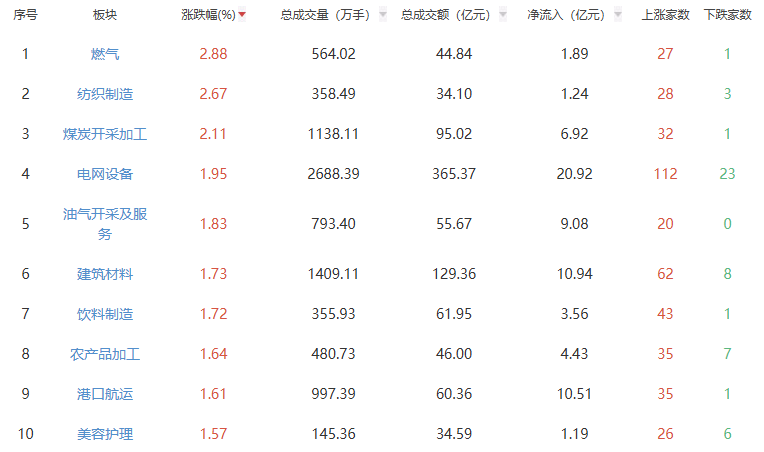
Core Viewpoint - The A-share market experienced a decline in the morning session, with all three major indices falling, indicating a bearish sentiment among investors [1] Market Performance - The Shanghai Composite Index closed at 3913.80 points, down 0.51% - The Shenzhen Component Index closed at 13471.74 points, down 1.85% - The ChiNext Index closed at 3150.78 points, down 3.40% [1] Sector Performance Gaining Sectors - Gas sector increased by 2.88% with a total trading volume of 564.02 million hands and a net inflow of 1.89 billion - Textile manufacturing sector rose by 2.67% with a trading volume of 358.49 million hands and a net inflow of 1.24 billion - Coal mining and processing sector grew by 2.11% with a trading volume of 1138.11 million hands and a net inflow of 6.92 billion [2] Declining Sectors - Energy and related sectors fell by 4.29% with a trading volume of 414.72 million hands and a net outflow of 22.28 billion - Battery sector decreased by 4.21% with a trading volume of 2539.91 million hands and a net outflow of 94.34 billion - Precious metals sector dropped by 4.13% with a trading volume of 613.04 million hands and a net outflow of 12.15 billion [2]

A股午评:沪指跌0.51%,创业板指跌3.4%,半导体、电池、黄金板块集体回调
Ge Long Hui A P P· 2025-10-10 03:40
Market Overview - The three major A-share indices collectively declined in the morning session, with the Shanghai Composite Index down 0.51% at 3913.8 points, the Shenzhen Component Index down 1.85%, and the ChiNext Index down 3.4% [1] - The total trading volume in the Shanghai and Shenzhen markets reached 165.61 billion yuan, a decrease of 70.8 billion yuan compared to the previous day, with over 2300 stocks declining across the market [1] Sector Performance - The semiconductor sector experienced significant losses, with stocks such as Dongxin Technology, Yandong Micro, Jinghe Integrated, and Huahong Semiconductor all dropping over 10%, and many stocks seeing their margin financing ratios fall to 0 [1] - The precious metals sector saw a retreat, with spot gold falling below 4000 USD per ounce, leading to declines in gold and non-ferrous metal stocks, including Xibu Gold and Xiaocheng Technology, which fell over 8%, and Chifeng Gold, which dropped over 6% [1] - The battery sector also faced declines, with stocks like Liyuanheng and Tianhong Lithium Battery falling over 10%, and Yiwei Lithium Energy down over 9% [1] Gaining Sectors - Conversely, the gas sector saw collective gains, with stocks such as Dazhong Public Utilities and Hongtong Gas hitting the daily limit [1] - The electric grid equipment sector strengthened, with stocks like Sifang Co., Guodian Nanzi, and Shenneng Electric also reaching the daily limit [1] - The military industry stocks rose against the trend, with companies like Jieqiang Equipment and Beifang Changlong increasing over 16%, and Changcheng Military Industry hitting the daily limit [1]

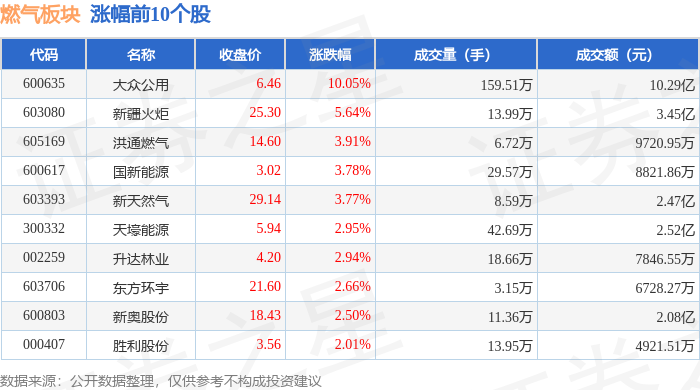
燃气板块震荡拉升,大众公用2连板
Xin Lang Cai Jing· 2025-10-10 01:51
燃气板块震荡拉升,大众公用2连板,洪通燃气涨停,长春燃气、凯添燃气、南京公用、新疆火炬、万 憬能源跟涨。 ...


新奥股份:2025年半年度权益分派实施公告
Zheng Quan Ri Bao Zhi Sheng· 2025-10-09 12:41
Group 1 - The core point of the article is that New Hope Liuhe Co., Ltd. announced its cash dividend distribution plan for the first half of 2025, which includes a cash dividend of 0.18 yuan per share (tax included) for A-shares [1] - The record date for the dividend distribution is set for October 15, 2025, while the ex-dividend date and the date of cash dividend payment are both scheduled for October 16, 2025 [1]

燃气板块10月9日涨2.04%,大众公用领涨,主力资金净流入1.13亿元
Zheng Xing Xing Ye Ri Bao· 2025-10-09 09:03
证券之星消息,10月9日燃气板块较上一交易日上涨2.04%,大众公用领涨。当日上证指数报收于 3933.97,上涨1.32%。深证成指报收于13725.56,上涨1.47%。燃气板块个股涨跌见下表: | 代码 | 名称 | 主力净流入(元) | 主力净占比 游资净流入 (元) | | 游资净占比 散户净流入(元) | | 散户净占比 | | --- | --- | --- | --- | --- | --- | --- | --- | | 600635 大众公用 | | 1.57亿 | 15.24% | -7336.97万 | -7.13% | -8343.07万 | -8.11% | | 603393 新天然气 | | 2631.58万 | 10.67% | -342.10万 | -1.39% | -2289.47万 | -9.29% | | 600617 国新能源 | | 1827.15万 | 20.71% | -864.35万 | -9.80% | -962.79万 | -10.91% | | 605169 洪通燃气 | | 756.82万 | 7.79% | -78.50万 | -0.81% | -6 ...
中国船燃成功完成浙江省首单船用绿色甲醇加注业务,关注四季度聚变装备招标需求释放 | 投研报告
Zhong Guo Neng Yuan Wang· 2025-10-09 02:06
Core Viewpoint - The report highlights the successful completion of China's first ship-based green methanol refueling operation at Ningbo Zhoushan Port, marking a significant milestone in the development of green fuel capabilities in the region [3]. Market Review - In September, the CSI 300 Index rose by 3.20%, while the public utility index increased by 0.41% and the environmental index by 0.77%. The relative monthly returns for these indices were -2.80% and -2.43% respectively [2]. - Among the 31 primary industry sectors, public utilities and environmental sectors ranked 13th and 11th in terms of growth. The environmental sector saw a 0.77% increase, while the electricity sector's thermal power rose by 2.34%, and hydropower fell by 3.08% [2]. Important Events - The successful refueling of the "COSCO Shipping Libra" with 230 tons of green methanol at Ningbo Zhoushan Port signifies the port's capability to handle LNG, biofuels, and methanol, enhancing its status as an international hub [3]. - This operation involved collaboration between China Ship Fuel, Zhejiang Port Group, and Ningbo Zhoushan Port Group, utilizing seven specialized methanol transport tankers and explosion-proof refueling equipment [3]. Investment Strategy - Public Utilities: Recommendations include Huadian International for thermal power, Longyuan Power and Three Gorges Energy for renewable energy, and China Nuclear Power for stable nuclear power operations [4][5]. - Environmental Sector: Focus on companies like China Everbright Environment and Zhongshan Public Utilities, as well as opportunities in the domestic waste oil recycling industry due to upcoming EU SAF policies [5].





新疆洪通燃气股份有限公司关于为控股子公司提供担保的进展情况公告
Shang Hai Zheng Quan Bao· 2025-10-08 19:40
登录新浪财经APP 搜索【信披】查看更多考评等级 证券代码:605169 证券简称:洪通燃气 公告编号:2025-036 重要内容提示: ● 担保对象及基本情况 (一)担保的基本情况 2025年9月30日,新疆洪通燃气股份有限公司(以下简称为"公司")的控股子公司新疆交投洪通能源有 限公司(以下简称为"交投洪通")与昆仑银行股份有限公司库尔勒分行(以下简称为"昆仑银行库尔勒 分行")签署《产业链贷款合同》,向银行申请人民币借款3,000万元,借款期限为十二个月。 公司对上述银行借款提供连带责任保证担保,并于2025年9月30日与昆仑银行库尔勒分行签订了《保证 合同》。本次担保无反担保,交投洪通其他股东未提供担保。 (二)内部决策程序 公司分别于2025年4月17日、2025年5月8日召开了第三届董事会第十六次会议、2024年年度股东大会, 审议通过了《关于公司及子公司2025年度担保额度预计的议案》,同意根据公司控股子公司融资需求, 公司在2025年度预计拟为控股子公司提供不超过人民币60,000万元的担保,担保额度授权期限自公司 2024年年度股东大会审议通过之日起至2025年年度股东大会召开日止。公司在上 ...
公用环保2025年10月投资策略:中国船燃成功完成浙江省首单船用绿色甲醇加注业务,关注四季度聚变装备招标需求释放
Guoxin Securities· 2025-10-08 14:36
Core Insights - The report maintains an "Outperform" rating for the public utilities and environmental sectors, highlighting the successful completion of China's first ship-based green methanol refueling operation in Zhejiang Province and the anticipated demand for fusion equipment in Q4 [1][2][3] Market Review - In September, the CSI 300 index rose by 3.20%, while the public utilities index increased by 0.41% and the environmental index by 0.77%. The relative performance of public utilities and environmental sectors ranked 13th and 11th among 31 first-level industry classifications [1][13][23] - The environmental sector saw a 0.77% increase, with the power sector's thermal power rising by 2.34%, while hydropower and new energy generation fell by 3.08% and 1.36%, respectively. The water sector increased by 1.27%, and the gas sector rose by 5.65% [1][26][32] Important Events - China Ship Fuel successfully completed the first ship-based green methanol refueling operation in Zhejiang Province, marking a significant milestone for the Ningbo-Zhoushan Port as a hub for LNG, biofuels, and methanol refueling capabilities [2][14] - The BEST fusion energy project achieved a key milestone with the successful installation of its first critical component, the Dewar base, indicating progress in the construction of fusion devices in China [3][15][16] Sector Analysis Public Utilities - Coal and electricity prices are declining simultaneously, allowing thermal power profitability to remain reasonable. Recommendations include major thermal power companies such as Huadian International and Shanghai Electric [4][21] - Continuous government support for renewable energy development is expected to stabilize profitability in the sector, with recommendations for leading companies like Longyuan Power and Three Gorges Energy [4][21] - Nuclear power companies are expected to maintain stable profitability due to growth in installed capacity and generation, with recommendations for China National Nuclear Power and China General Nuclear Power [4][21] Environmental Sector - The water and waste incineration industries are entering a mature phase, with significant improvements in free cash flow. Recommendations include companies like China Everbright Environment and Zhongshan Public Utilities [22] - The domestic scientific instrument market, valued at over $9 billion, presents substantial opportunities for domestic replacements, with recommendations for companies like Focused Photonics [22] - The EU's SAF blending policy is expected to increase demand for raw materials, benefiting the domestic waste oil recycling industry, with recommendations for companies like Shanggou Environmental Energy [22] Investment Strategy - The report emphasizes the importance of integrating renewable energy with smart energy management, recommending investments across the renewable energy supply chain and companies involved in comprehensive energy management [21][22]


