
商业火箭

Search documents
商业火箭勇闯A股 已有IPO进入辅导验收
Xin Lang Cai Jing· 2025-12-28 23:38
Core Viewpoint - The release of the fifth set of listing standards for commercial rocket companies by the Shanghai Stock Exchange on December 26 accelerates the IPO process for these companies, making the market eager to see which company will become the first commercial rocket stock in A-shares [1] Group 1: IPO Progress - At least five commercial rocket companies are currently advancing their IPO counseling work [1] - Blue Arrow Aerospace Technology Co., Ltd. has submitted its counseling completion report 10 days ago and is awaiting acceptance from the local securities regulatory bureau [1] - Three other commercial rocket companies submitted their counseling filing materials between August and October [1] Group 2: Industry Outlook - Analysts believe that with the clear listing standards for commercial rocket companies on the Sci-Tech Innovation Board, the process for reusable rocket launches and company listings is expected to accelerate [1] - The commercial aerospace industry is anticipated to experience rapid development [1] - Some analysts predict that 2026 will be a pivotal year for commercial aerospace development, with the industry likely to experience a "Davis Double-Click" [1]
商业火箭上市标准明确,行业有望迎来规模化爆发时期
Xuan Gu Bao· 2025-12-28 23:33
Group 1 - The Shanghai Stock Exchange has released guidelines for commercial rocket companies to apply for IPOs under the Sci-Tech Innovation Board's fifth listing standard, which requires a market value of at least 4 billion yuan, core technological breakthroughs, and phased achievements without revenue or profit thresholds [1] - The new policy is a significant implementation of the CSRC's "1+6" reform and aims to align with the long development cycles and high investment requirements of the commercial rocket industry [1] - Recent successful launches of rockets by companies like Blue Arrow Aerospace and China Aerospace Science and Technology have laid a foundation for the maturity of industry technology, which supports the implementation of the new guidelines [1] Group 2 - The guidelines emphasize four specific requirements: technological advantages, phased achievements, qualification approvals, and industry status, enhancing the predictability of the listing process for companies [1] - The policy is seen as a milestone for the capital market to actively support the national strategy for commercial aerospace, injecting long-term capital into the industry's critical growth phase [1] - According to Zhongyin International, the phased achievements requirement reflects a balance between technical authenticity and operational inclusivity, which is more aligned with the current technological development stage of commercial rocket companies [1] Group 3 - Open Source Securities believes that national support for quality commercial rocket companies will usher in a golden era for commercial aerospace, with the strategic direction of the policy having more structural significance than short-term market reactions [2] - The industry chain may see short-term focus on components like rocket structures, engine materials, and aerospace electronics, while long-term benefits will favor companies with stable supply capabilities and established partnerships with commercial rocket manufacturers [2] Group 4 - Companies like Zhongheng Design have secured multiple high-end manufacturing base design projects related to commercial rockets, indicating a growing demand for infrastructure in the sector [3] - Tianjian Technology is focusing on the development of core components such as microwave solid-state power amplifiers, which are applicable in commercial rocket telemetry and communication systems, showcasing its technological advantages in the aerospace electronics field [3]
商业火箭勇闯A股!已有IPO进入辅导验收
券商中国· 2025-12-28 23:30
Core Viewpoint - The introduction of the fifth set of listing standards for commercial rocket companies by the Shanghai Stock Exchange on December 26 is expected to accelerate the IPO process for these companies, with a focus on which company will become the first commercial rocket IPO in A-shares [1][2]. Group 1: IPO Progress of Commercial Rocket Companies - At least five commercial rocket companies are currently advancing their IPO counseling work, with Blue Arrow Aerospace being the most advanced, having submitted its counseling completion report on December 18 [1][2]. - Other companies, such as China Aerospace Technology Co., Ltd. and Tianbing Aerospace Technology Co., Ltd., have also submitted counseling materials but are at different stages of the process [2][3]. - Star River Power Aerospace Technology Co., Ltd. and Starry Glory Aerospace Technology Group have also initiated their IPO counseling, with varying degrees of progress [3][4]. Group 2: Impact of New Listing Standards - The new listing standards provide a clear path for commercial rocket companies that have not yet formed significant revenue, potentially accelerating innovation and development in the commercial aerospace sector [5][7]. - The standards emphasize the importance of successfully launching payloads with reusable medium to large rockets, which is seen as a critical milestone for validating the commercial viability of these companies [6][7]. - Analysts predict that 2026 will be a pivotal year for the commercial aerospace industry, with expectations of significant growth in satellite bidding, manufacturing, and launches, driven by the new standards and increased competition [7].


科创板第五套上市标准扩围商业火箭企业迎来资本市场政策东风
Xin Lang Cai Jing· 2025-12-28 19:25
Core Viewpoint - The release of the "Guidelines" by the Shanghai Stock Exchange marks a significant step in facilitating financing for commercial rocket enterprises, which are in a critical phase of large-scale commercialization, thereby promoting breakthroughs in core technologies and contributing to the construction of a space power nation [1][4]. Group 1: Guidelines Overview - The "Guidelines" consist of fourteen articles that refine the core requirements of the fifth set of listing standards for the Sci-Tech Innovation Board, tailored to the realities of technological innovation in the commercial rocket sector [2]. - The main business focus is on "independent research, manufacturing, and provision of space launch services for commercial rockets," emphasizing the "hard technology" aspect and prioritizing support for companies undertaking national tasks and projects [2]. Group 2: Industry Context - The commercial rocket development and launch business is a key link in the midstream of the entire commercial aerospace industry chain, playing a crucial role in connecting upstream and downstream activities [2]. - Currently, there is a phenomenon of "many satellites but few rockets and insufficient capacity" in China's commercial aerospace sector, making technological breakthroughs and capacity enhancements in commercial rockets essential for large-scale satellite constellation development [2]. Group 3: Market Impact - The release of the "Guidelines" is expected to profoundly reshape the valuation logic of long-cycle, heavy-asset hard technology enterprises in the capital market, providing clear, quantifiable technology validation milestones [3]. - The "Guidelines" emphasize "significant technological advantages" and "large market space," guiding the capital market to shift its evaluation focus towards breakthroughs in key technology nodes, continuous innovation capabilities, and long-term market prospects [3]. Group 4: Financial Support - The "Guidelines" open a clear financing path in the domestic capital market for commercial rocket enterprises, allowing those that are not yet profitable but possess core technologies and growth potential to access equity financing earlier [3]. - The introduction of the "Guidelines" sends a strong signal of support from the national level and regulatory agencies for the development of strategic emerging industries like commercial aerospace, fostering a more inclusive and friendly investment environment [3]. Group 5: Strategic Development - With the ongoing implementation of the "1+6" reform measures of the Sci-Tech Innovation Board, the capital market will provide stronger support for commercial rocket enterprises, accelerating the realization of key core technologies that are self-controllable and gradually narrowing the gap with international leaders [4]. - The commercial rocket industry, linked through the Sci-Tech Innovation Board, will further drive the collaborative upgrade of upstream and downstream sectors such as advanced materials and precision manufacturing, providing solid support for national strategies like satellite internet networking and space resource development [4].
市场点评报告:科创板“开闸”商业火箭
Bank of China Securities· 2025-12-28 11:27
Core Insights - The report highlights the acceleration of the "1+6" reform measures for the Sci-Tech Innovation Board, which provides predictable capital support for future industries such as commercial aerospace, facilitating the scaling development of hard technology companies [1][2]. Policy Changes - The new guidelines from the Shanghai Stock Exchange focus on the "hard technology" attributes of commercial rocket enterprises, emphasizing the need for significant technological advantages and breakthroughs in core technologies [2]. - A milestone requirement is set for companies to achieve the successful launch of a medium to large reusable rocket payload into orbit at the time of application, reflecting a balance between technical authenticity and operational capability [2]. - The guidelines do not prioritize short-term revenue or profit but instead emphasize a clear market target and competitive advantages in the commercial rocket business [2]. Market Impact - The policy is expected to have a long-term structural impact on the A-share market, confirming the industrial logic of the commercial aerospace sector and potentially enhancing the valuation and risk appetite for hard technology assets on the Sci-Tech Innovation Board [2]. - Short-term market sentiment may focus on components related to rocket structures, engine materials, and aerospace electronics, while long-term beneficiaries are likely to be companies with stable supply relationships and integration into the model system of commercial rocket manufacturers [2]. Strategic Direction - The introduction of these guidelines reflects a proactive approach by the capital market to support national strategies and the cultivation of new productive forces, embedding capital market capabilities into the critical growth phase of the commercial rocket industry [2].
2025年最后三个交易日 股民需要注意什么?
Mei Ri Jing Ji Xin Wen· 2025-12-28 02:48
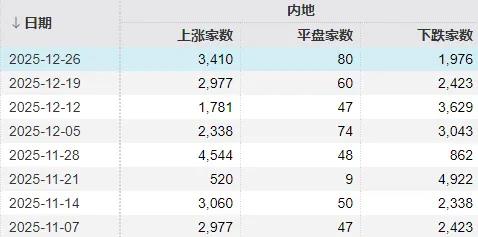
Core Viewpoint - The A-share market has shown unexpected strength, initiating a "New Year red envelope" trend, with 3,410 stocks rising in the last trading week, marking the best week in December [1][2]. Group 1: Market Performance - The average stock price across A-shares increased by 3.15% over the week, reaching a mid-week high of 27.03 yuan, matching the year's peak from September 18 [3]. - The Shanghai Composite Index has achieved an eight-day winning streak since December 17, raising investor expectations for a potential rise above 4,000 points before the year ends [7]. - Other major indices have also shown optimistic trends, with the CSI 2000 index reaching a new high [5]. Group 2: Fund Flows and Market Drivers - A significant net inflow of funds into the A500 ETF has been noted, with a total net inflow of 110.6 billion yuan in December, of which 101.9 billion yuan (92.2%) came from the A500 ETF [10]. - The strong inflow of new funds is seen as a driving force behind the market's late December rally, contributing to the eight consecutive days of gains in the Shanghai Composite Index [10]. - Historical analysis suggests that early spring market rallies typically lead to strong performances in January, influenced by policy expectations and external factors [11]. Group 3: Sector Insights - The upcoming spring market rally is expected to favor technology growth and certain cyclical industries, with recommendations for balanced investments in these sectors [11]. - High-growth sectors such as optical modules and PCB are highlighted as key areas of focus, alongside short-term supply constraints in light chips and high-speed copper cables [14]. Group 4: Economic Indicators - The National Bureau of Statistics reported a 0.1% increase in profits for industrial enterprises above designated size over the first 11 months [15]. - The total scale of China's ETFs has reached 6.03 trillion yuan, reflecting a more than 60% increase from the beginning of the year [19].
上交所明确商业火箭科创板上市新规 “发射载荷成功入轨”成核心门槛
Feng Huang Wang· 2025-12-27 12:46
此次新规的出台,标志着资本市场对商业航天的评价体系从"技术突破"向"可靠交付"转型。《指引》强 制要求企业证明其技术自主性与产业链地位,倒逼商业火箭公司必须跨越从技术示范到规模化商用的鸿 沟,只有真正具备将商业卫星准确送入轨道并产生经济效益的能力,才能通过科创板的上市"大考"。 凤凰网科技讯(作者/刘毓坤)12月27日,凤凰网科技独家获悉,上交所于昨日正式发布《上海证券交易所 发行上市审核规则适用指引第9号——商业火箭企业适用科创板第五套上市标准》,即日起正式施行。 这也是监管层首次针对商业火箭企业登陆科创板设立明确的细分审核依据。该指引的核心变化在于, 将"采用可重复使用技术的中大型运载火箭发射载荷首次成功入轨"确立为上市的核心门槛,并对"载 荷"的定义进行了严格限定。 新规显著提高了对商业化实战能力的考核权重,明确要求"发射载荷"必须是具备功能性的有效载荷,而 非仅仅证明运力的模拟配重。此举旨在剥离单纯的工程技术验证与具备可持续盈利预期的商业交付能 力。在行业实践中,仅搭载模拟配重的飞行试验虽然能验证基础入轨能力,但无法检验星箭接口、分离 释放及在轨运行等商业任务中的关键高风险环节,因此不能直接等同于具备 ...
科创板“火箭上市标准”来了!
Xin Lang Cai Jing· 2025-12-27 03:04
图片来 源:视觉中国 智通财经记者|马悦然 商业火箭企业适用科创板第五套上市的标准,有了更为细化的规定。 12月26日晚,为支持尚未形成一定收入规模的优质商业火箭企业在科创板发行上市,上交所发布《上海 证券交易所发行上市审核规则适用指引第9号——商业火箭企业适用科创板第五套上市标准》(下称 《指引》)。 其中提出,出台有关规定,是为了鼓励商业火箭企业开展关键核心技术产品研发创新,增强制度的包容 性、适应性,加快推进商业航天创新发展、主动服务航天强国战略。 上述《指引》共有十四条,主要内容涵盖业务范围以及"硬科技"属性要求、明显技术优势、阶段性成 果、取得批准、行业地位、市场空间、商业化安排等方面。 片来源:上交所官网 图 《指引》指出,发行人的核心技术产品,应当属于国家商业航天领域科技创新战略和相关产业政策鼓励 支持的范畴,主营业务为商业火箭自主研发、制造和提供航天发射服务。承担国家任务、参与国家工程 项目的商业火箭企业予以优先支持。 《指引》第五条,对发行人的业务能力作出明确要求。 其规定,发行人的主要业务或产品应当处于持续研发或科技成果转化阶段,在申报时至少实现采用可重 复使用技术的中大型运载火箭发射载荷 ...

商业火箭IPO政策来了!上交所:适用科创板第五套标准,申报时至少实现首次成功入轨
Hua Xia Shi Bao· 2025-12-27 01:13
Core Viewpoint - The Shanghai Stock Exchange (SSE) has released guidelines for commercial rocket companies to apply for listing on the Sci-Tech Innovation Board, emphasizing support for technology-driven enterprises and innovation in the aerospace sector [2] Group 1: Guidelines Overview - The guidelines, titled "Guidance No. 9 on the Application of the Shanghai Stock Exchange Listing Review Rules for Commercial Rocket Enterprises," align with the fifth set of listing standards for the Sci-Tech Innovation Board [2] - The guidelines specify four key areas: significant technological advantages, phased achievements, approvals from relevant national departments, and large market potential [2] - A key requirement for phased achievements is that companies must have successfully launched a medium to large reusable rocket payload into orbit at least once by the time of application [2] Group 2: Strategic Implications - The SSE aims to leverage the release of these guidelines to promote the listing of commercial rocket companies that meet the specified standards on the Sci-Tech Innovation Board [2] - This initiative is part of a broader effort to support the development of technology-driven enterprises that can break through critical core technologies [2] - The SSE intends to enhance the inclusiveness, adaptability, attractiveness, and competitiveness of its regulatory framework to better serve technological innovation and the development of new productive forces [2]

上交所发布指引 支持优质商业火箭企业登陆科创板
Zhong Guo Zheng Quan Bao· 2025-12-27 01:12
12月26日,上交所发布《上海证券交易所发行上市审核规则适用指引第9号——商业火箭企业适用 科创板第五套上市标准》,支持正处于大规模商业化关键时期的商业火箭企业适用第五套上市标准登陆 科创板。 指引共十四条,对商业火箭企业适用科创板第五套上市标准作出了细化规定。一是细化明显技术优 势要求。明确主营业务为"商业火箭自主研发、制造及航天发射服务",更加看重发行人的"硬科技"属 性。要求企业需在拥有关键核心技术基础上具备明显技术优势或重大突破,关注核心技术产品以及关键 部件的自主研发情况,以及运载能力及一箭多星能力等关键指标。对于承担国家任务、参与国家工程项 目的商业火箭企业予以优先支持。 三是规定取得国家有关部门批准。要求企业在商业火箭的研发、制造过程具备相关承研承制资质, 在商业火箭发射前应取得发射许可。 (责任编辑:华青剑) 四是明确市场空间具体要求。要求商业火箭企业排名靠前、在产业链中占据重要地位,取得相关市 场主体的较高认可。发行人的商业火箭业务或产品应该有清晰的目标市场,相较于竞争对手具有先发优 势,在研发进度、关键指标等方面位于行业前列。发行人应当为商业火箭业务或产品从技术验证到规模 运营制定清晰明确 ...