环卫

Search documents
劲旅环境:无人环卫车主要在内部存量项目上小批量投放
Zheng Quan Shi Bao Wang· 2025-09-15 11:49
Group 1 - The core viewpoint of the article is that the company, Jinglv Environment, has launched its self-developed unmanned sanitation vehicles, but their current deployment is limited to small-scale trials within existing projects and will not significantly impact the company's performance [1] Group 2 - The unmanned sanitation vehicles are primarily being tested in internal projects, indicating a cautious approach to market introduction [1] - The company does not anticipate any major effects on its financial results from this initial deployment of unmanned vehicles [1]
无人环卫机器人爆单 ,无人环卫服务市场订单迎爆发期
Xin Lang Cai Jing· 2025-09-15 11:42
Core Insights - The sanitation industry is undergoing a significant transformation driven by automation, particularly with the large-scale deployment of unmanned sanitation robots in Shenzhen, Guangdong [1] - The use of unmanned cleaning robots has drastically reduced the time required for cleaning tasks, with a specific example showing a reduction from four workers over half a day to just two and a half hours [1] - The manufacturing companies involved in this sector are experiencing a surge in production orders, with one company reporting an order value exceeding 35 million yuan, representing over 100% growth compared to the previous year's sales [1] - The "Low-speed Unmanned Cleaning Vehicle Industry Development Blue Book" predicts that the market size for unmanned sanitation services in China will reach 280 billion yuan by 2025 [1]

劲旅环境(001230) - 2025年9月15日投资者关系活动记录表
2025-09-15 11:16
Group 1: Market Value Management - The company plans to enhance market value through operational improvements, focusing on core business, market expansion, cost control, and increased R&D efforts [2] - Cash dividends will be actively implemented based on the company's actual situation, with potential increases in frequency and proportion [2] - The company has repurchased 1,000,040 shares, accounting for 0.75% of the total share capital [2] Group 2: Accounts Receivable and Cash Flow - The accounts receivable to revenue ratio has risen to 150.03%, with net cash flow from operating activities declining by 171.14% to -12.166 million [3] - The accounts receivable balance at the end of the reporting period was 1.26 billion, a 13% increase from the beginning of the year [3] - Measures to improve cash flow include strengthening accounts receivable management, monthly aging analysis, and aligning with debt resolution policies [3] Group 3: Business Performance and Profitability - Revenue growth for the first half of 2025 was only 1.7%, but gross margin increased by 5.05% and net margin by 10.96% [4] - The overall gross margin increased by 1.30 percentage points, contributing approximately 13.5 million to gross profit [4] - Key contributors to gross profit growth include improved order quality and effective cost control [4] Group 4: Smart Sanitation Strategy - The smart sanitation system has been successfully applied in over 95% of projects, enhancing operational efficiency and reducing labor costs [5] - The system has led to significant reductions in production energy consumption and management costs through data-driven optimization [5] - The implementation of IoT and AI technologies has improved operational efficiency and waste collection effectiveness [5] Group 5: New Projects and Future Outlook - The Changzhou New Energy Special Vehicle and Intelligent Equipment Industrial Base project was established in May 2025, with updates to be provided in future announcements [6]
玉禾田(300815.SZ):公司人形机器人仅应用于物业清洁、公共区域垃圾捡拾等特定场景的示范运营与数据采集工作
Ge Long Hui· 2025-09-15 07:29
Core Viewpoint - Yuhua Tian (300815.SZ) focuses on technology-driven services, utilizing intelligent cleaning robots to create smart sanitation operation scenarios [1] Group 1 - The company operates through its subsidiary, Shenzhen Yushu Intelligent Robot Co., Ltd., emphasizing the integration of technology and service [1] - The humanoid robots are currently deployed in specific scenarios such as property cleaning and public area waste collection for demonstration and data collection [1] - This approach aims to accumulate valuable data and operational experience for future commercialization [1]
东吴证券晨会纪要-20250908
Soochow Securities· 2025-09-07 23:30
Macro Strategy - The report highlights the need to monitor domestic economic policy changes due to the upcoming Fourth Plenary Session and the focus on countering "involution" [1] Fixed Income - The report discusses why domestic commercial banks are unlikely to reduce their balance sheets, citing factors such as the need to support the economy during a slowdown, the current accommodative monetary policy, and the role of state-owned capital in maintaining financial services to the real economy [2][22] - It emphasizes that the probability of a sector-wide balance sheet reduction is low, despite some smaller banks potentially facing this situation [22] Industry Analysis - The environmental industry report indicates that the waste incineration sector saw a revenue increase of 1% year-on-year in H1 2025, with net profit rising by 8% and an improvement in cash flow [4][6] - The report notes that operational efficiency improvements and reduced financial costs are driving performance growth, with a significant increase in return on equity (ROE) for pure waste operation companies [4][6] - It highlights the importance of enhancing operational efficiency and expanding both B-end and C-end markets to boost profitability and cash flow [6] Food and Beverage Industry - The beer industry report suggests that the sector is expected to benefit from a recovery in consumption, particularly in dining and retail scenarios, with a focus on high-growth companies like Yanjing Beer and Qingdao Beer [7] - The health supplement sector is noted for its potential valuation reconstruction, with a focus on quality stocks [8] Company-Specific Insights - The report on Yingke Recycling indicates strong growth in the decorative building materials business, with a focus on expanding its recycling capabilities and global presence [9] - The analysis of Magmi Te highlights a revenue increase of 16.5% year-on-year in H1 2025, despite a significant drop in net profit due to increased strategic investments [10][11] - The report on Weirgao emphasizes its leadership in the power PCB sector, projecting significant revenue growth driven by AI server demand and production capacity expansion [12] - The analysis of Dacilin shows a revenue increase of 1.33% year-on-year in H1 2025, with a notable profit growth of 21.38% [13] - The report on Dazhu CNC highlights its position as a leader in PCB equipment, benefiting from the demand for high-layer PCB devices driven by AI server needs [14]
东吴证券环保行业2025中报总结:运营稳健增长、现金流改善,环卫无人化迎发展机遇
Soochow Securities· 2025-09-05 11:51
Investment Rating - The report provides a positive outlook on the environmental industry, highlighting robust operational growth and improved cash flow, particularly in waste incineration and water services [2][6]. Core Insights - The environmental industry is experiencing steady growth in operations and cash flow improvements, with significant opportunities arising from the automation and electrification of sanitation services [5][29]. - Waste incineration companies have shown enhanced return on equity (ROE) and cash flow, leading to consistent dividend payouts [3][6]. - Water services are witnessing stable performance with declining capital expenditures and accelerated water price increases [4][6]. - The sanitation sector is rapidly adopting electric vehicles, with a notable increase in sales of new energy sanitation equipment [5][6]. Summary by Sections Waste Incineration - The average waste incineration companies reported a 1.8% increase in waste processed per ton and a 1.2% increase in electricity sold per ton in the first half of 2025 [6]. - Significant growth in heating services was observed, with top companies like Haichuang and Green Power showing increases of 170% and 115% respectively [6]. - The sector is focusing on operational efficiency and expanding B-end and C-end services to enhance profitability and cash flow [6]. Water Services - The water services sector reported a 2% decline in revenue but a 6% increase in net profit in the first half of 2025, with notable performance from Zhongshan Public Utilities due to high investment returns [14][15]. - Major cities have implemented water price increases, which are expected to drive a new round of water price reforms [6][15]. - Key recommendations include companies like Yuehai Investment and Xingrong Environment, which are expected to benefit from price adjustments and stable growth [6][15]. Sanitation - The penetration rate of electric sanitation vehicles is accelerating, with a 77.6% increase in sales of new energy sanitation vehicles in the first half of 2025 [5][6]. - The rise of automation in sanitation is evident, with over 290 new projects in the autonomous driving sector, of which more than 90 are focused on automated cleaning [6]. - Recommended companies in this sector include Yutong Heavy Industry and others that are well-positioned to capitalize on these trends [6].
玉禾田:公司高度重视市值管理,聚焦价值创造
Zheng Quan Ri Bao· 2025-09-01 09:41
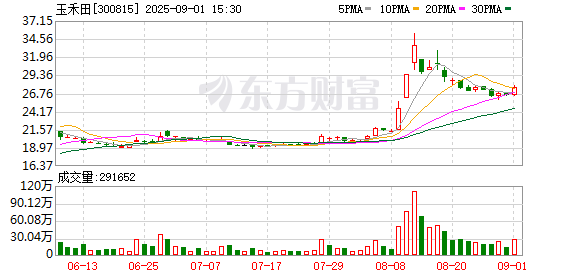
Core Viewpoint - Yuhua Tian emphasizes its commitment to value creation and shareholder returns through enhanced operational efficiency and profitability [2] Group 1: Company Strategy - The company focuses on integrating technology and services, particularly through the use of intelligent unmanned cleaning equipment to create smart sanitation operation scenarios [2] - Yuhua Tian is exploring operational data in specific scenarios such as sanitation, indicating a targeted approach to data utilization [2] Group 2: Market Influence - The company's stock price fluctuations are influenced by multiple factors, including macroeconomic conditions, industry cycles, and market sentiment [2] - Yuhua Tian places a high priority on market capitalization management, reflecting its awareness of external market dynamics [2]

福龙马:2025年8月预中标环卫服务项目数1个
Mei Ri Jing Ji Xin Wen· 2025-09-01 09:29
Group 1 - The company, Fulongma, announced on September 1 that it has pre-won one sanitation service project in August, with a first-year service fee amounting to 25.307 million yuan, accounting for 0.50% of the company's audited revenue for 2024 [1] - The total contract amount for the pre-won project is 75.9211 million yuan. As of the announcement date, the company has won 27 sanitation service projects this year, with a total first-year amount of 434.1092 million yuan and a total contract amount of 1.245895 billion yuan, which will positively impact the company's operating performance in 2025 and beyond [1] - The annualized contract amount for the sanitation service projects currently being executed by the company is 4.032 billion yuan, with a total contract amount of 33.463 billion yuan, including project extension service contract amounts and supplementary contract amounts for already won projects [1] Group 2 - For the year 2024, the company's revenue composition is as follows: sanitation industry services account for 75.88%, sanitation equipment manufacturing accounts for 21.4%, other main businesses account for 1.76%, and other businesses account for 0.96% [1] - As of the time of reporting, the company's market capitalization is 7.7 billion yuan [2]

劲旅环境(001230) - 2025年8月28日投资者关系活动记录表
2025-08-28 13:38
Group 1: Order and Revenue Insights - The company has a robust order reserve in sanitation operations, with long-term orders accounting for a significant portion, totaling nearly 10 billion yuan in contract value [3] - As of June 2025, the equipment manufacturing segment has pending orders amounting to 270 million yuan, with expectations for significant sales growth following the implementation of special government bonds [3] Group 2: Technological Advancements in Sanitation - The transition to unmanned sanitation technology has evolved from simple equipment replacement to a comprehensive system reconstruction, enhancing operational efficiency [4][5] - Unmanned cleaning vehicles can achieve operational efficiencies of 6,000 to 10,000 square meters per hour, compared to the 3,000 square meters per hour achieved by human workers [3][4] - The cost structure of traditional sanitation operations, where labor costs account for 50%-60% of total expenses, can be reduced to 30%-35% with the adoption of human-machine collaboration [5] Group 3: Future Developments and Market Position - The company is set to launch its third-generation autonomous driving system in the fourth quarter, with a focus on integrating equipment, services, and data for a comprehensive operational model [6] - The company emphasizes a strong competitive edge through integrated service offerings, cost control, and rapid technological iteration, positioning itself favorably against competitors [6][7] - The company plans to invest significantly in R&D for intelligent and unmanned technologies, with no upper limit on budget constraints, ensuring steady progress in line with external technological advancements [7]
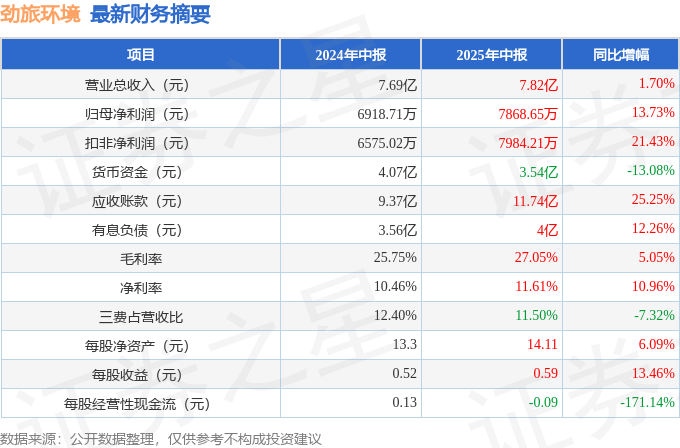
劲旅环境2025年中报简析:营收净利润同比双双增长,盈利能力上升
Zheng Quan Zhi Xing· 2025-08-27 22:56
Financial Performance - The company reported a total revenue of 782 million yuan for the first half of 2025, an increase of 1.7% year-on-year [1] - The net profit attributable to shareholders reached 78.69 million yuan, reflecting a year-on-year growth of 13.73% [1] - In Q2 2025, total revenue was 402 million yuan, up 2.77% year-on-year, while net profit for the quarter was 39.92 million yuan, an increase of 7.26% [1] - The gross margin improved to 27.05%, up 5.05% year-on-year, and the net margin increased to 11.61%, up 10.96% year-on-year [1] - Total expenses (selling, administrative, and financial) amounted to 89.95 million yuan, accounting for 11.5% of revenue, a decrease of 7.32% year-on-year [1] Key Financial Metrics - Earnings per share (EPS) increased to 0.59 yuan, a rise of 13.46% year-on-year [1] - The company's net asset value per share was 14.11 yuan, up 6.09% year-on-year [1] - Operating cash flow per share was -0.09 yuan, a significant decrease of 171.14% year-on-year [1] - The company's return on invested capital (ROIC) was 7.89% last year, indicating average capital returns [3] Business Model and Strategy - The company initially focused on equipment manufacturing, particularly in the large-scale sanitation equipment sector, and has since expanded into sanitation investment and operation management services [4] - The current strategy is centered around a "one core, two wings" approach, with two main business segments: sanitation equipment manufacturing and environmental sanitation investment operation management [4] - The company has developed a smart sanitation management platform, offering a comprehensive solution through a six-product matrix, including government regulatory platforms and intelligent connected devices [5]