
纺织制造

Search documents
——纺织服装行业2025年报业绩前瞻:品牌服饰表现分化,澳毛周期、无纺布制造可期
Shenwan Hongyuan Securities· 2026-01-21 10:45
Investment Rating - The textile and apparel industry is rated as "Neutral" for the upcoming period, indicating that the industry is expected to perform in line with the overall market [9]. Core Insights - The report highlights a divergence in performance within the textile and apparel sector, with high-end outdoor and niche sports brands showing strong potential despite an overall slowdown in demand [3]. - Domestic retail sales for clothing and textiles reached 1.52 trillion yuan in 2025, reflecting a year-on-year growth of 3.2%, with a notable slowdown in December due to warmer winter temperatures [3]. - Export figures for the textile and apparel sector showed a decline, with total exports amounting to 293.8 billion USD, down 2.6% year-on-year, indicating a shift in supply chain dynamics towards countries like Vietnam [3]. Summary by Sections Domestic Demand - Retail sales for clothing and textiles in China reached 1.52 trillion yuan in 2025, with growth rates of 6.3%, 3.5%, and 0.6% in October, November, and December respectively [3]. - The warmer winter led to a slowdown in winter clothing sales, impacting overall performance [3]. International Demand - Textile and apparel exports totaled 293.8 billion USD in 2025, with textiles at 142.6 billion USD (up 0.4%) and apparel at 151.2 billion USD (down 5.2%) [3]. - Vietnam's textile exports grew by 7.0%, indicating a shift in orders due to tariff policies affecting different production regions [3]. Brand Performance - High-end outdoor brands and niche sports brands are expected to maintain strong growth, while traditional brands like Anta and Li Ning are projected to see varied performance, with Anta's revenue expected to decline slightly [3]. - Women's apparel is facing challenges, but companies like Xinha and Ge Li Si are expected to show improvements in profitability due to prior adjustments [3]. Home Textiles - Companies like Luolai and Water Mercury are expected to perform steadily, while Fuanna is still in a destocking phase [3]. Non-woven Fabric Industry - The non-woven fabric sector is anticipated to benefit from quality upgrades and expanding demand, with companies like Nuo Bang and Yan Jiang expected to see significant revenue growth [3]. Textile Manufacturing - The report notes that the performance of the sports manufacturing chain is under pressure due to fluctuations in brand orders, but the Australian wool industry is expected to see a rebound in demand and pricing [3]. Investment Recommendations - The report suggests focusing on high-performance outdoor brands, discount retail, personal care, and sleep economy sectors for potential investment opportunities [3].


纺织服装行业2025年报业绩前瞻:品牌服饰表现分化,澳毛周期、无纺布制造可期
Shenwan Hongyuan Securities· 2026-01-21 09:11
Investment Rating - The textile and apparel industry is rated as "Overweight" indicating an expectation for the industry to outperform the overall market [4][10]. Core Insights - The report highlights a divergence in performance within the brand apparel sector, with expectations for growth in the non-woven fabric manufacturing segment and opportunities in the Australian wool cycle [4]. - Domestic demand for apparel has shown a modest increase, with retail sales of clothing, shoes, and textiles reaching 1.52 trillion yuan in 2025, reflecting a year-on-year growth of 3.2% [4]. - Export figures indicate a decline, with textile and apparel exports totaling $293.8 billion in 2025, down 2.6% year-on-year, while Vietnam's textile exports grew by 7% [4]. Summary by Sections Domestic Demand - Retail sales for clothing, shoes, and textiles in China reached 1.52 trillion yuan in 2025, with monthly growth rates of 6.3%, 3.5%, and 0.6% in October, November, and December respectively [4]. - The warm winter weather has negatively impacted winter apparel sales [4]. Export Demand - Textile and apparel exports amounted to $293.8 billion in 2025, with textiles at $142.6 billion (up 0.4%) and clothing at $151.2 billion (down 5.2%) [4]. - Vietnam's textile exports were $39.6 billion (up 7%) and footwear exports were $24.2 billion (up 5.8%), indicating a shift in the textile supply chain [4]. Brand Performance - High-end outdoor and niche sports brands are expected to maintain strong growth despite overall industry slowdowns [4]. - Anta, FILA, and outdoor brands are projected to see sales declines in Q4 2025, while brands like 361 Degrees are expected to grow by 10% [4]. Children and Women's Apparel - Women's apparel is facing challenges, but companies like Xinha and Ge Li Si are expected to show improvements in revenue and profitability [4]. - Men's apparel, particularly Haian, is projected to grow by 5% in revenue [4]. Home Textiles - Fuanna is still in a destocking phase, while companies like Luolai and Water Mercury are expected to perform steadily [4]. Non-Woven Fabric Industry - The non-woven fabric sector is benefiting from quality upgrades and expanding demand, with companies like Wanjian and Nuo Bang expected to see revenue growth of 10% to 20% [4]. Textile Manufacturing - The report notes that brands like Nike are experiencing performance fluctuations, impacting the manufacturing chain, while the Australian wool industry is expected to see price increases due to reduced supply and rising demand [4]. Investment Recommendations - The report suggests focusing on high-performance outdoor brands, discount retail, personal care, and sleep economy sectors for potential investment opportunities [4]. - Companies like Anta, Li Ning, and Tebu are highlighted as key players to watch [4].

纺织制造板块1月21日跌0.01%,云中马领跌,主力资金净流出6133.09万元
Zheng Xing Xing Ye Ri Bao· 2026-01-21 08:53
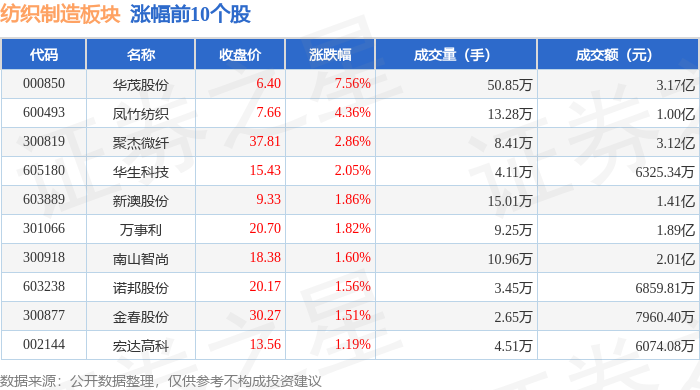
Core Viewpoint - The textile manufacturing sector experienced a slight decline of 0.01% on January 21, with Yunzhongma leading the losses, while the Shanghai Composite Index rose by 0.08% and the Shenzhen Component Index increased by 0.7% [1]. Group 1: Market Performance - The textile manufacturing sector's performance was mixed, with notable gainers including Huamao Co., which rose by 7.56% to close at 6.40, and Fengzhu Textile, which increased by 4.36% to 7.66 [1]. - The overall trading volume in the textile manufacturing sector showed significant activity, with Huamao Co. recording a transaction volume of 508,500 shares and a turnover of 317 million yuan [1]. Group 2: Individual Stock Performance - The top performers in the textile sector included: - Huamao Co. (6.40, +7.56%, 508,500 shares, 317 million yuan) - Fengzhu Textile (7.66, +4.36%, 132,800 shares, 100 million yuan) - Jujie Zuo Xian (37.81, +2.86%, 84,100 shares, 312 million yuan) [1]. - Conversely, Yunzhongma saw a decline of 3.21%, closing at 57.53, with a trading volume of 29,300 shares and a turnover of 170 million yuan [2]. Group 3: Capital Flow Analysis - The textile manufacturing sector experienced a net outflow of 61.33 million yuan from institutional investors, while retail investors saw a net inflow of 33.63 million yuan [2]. - Notable capital movements included: - Huali Group with a net inflow of 32.60 million yuan from institutional investors, despite a net outflow from retail investors [3]. - Huamao Co. also had a significant net inflow of 23.01 million yuan from institutional investors [3].


龙头股份:截至2025年三季度对欧盟出口额987万美元,占整体营业收入比重5.54%
Sou Hu Cai Jing· 2026-01-20 09:37
有投资者在互动平台向龙头股份提问:"公司产品销往欧盟市场,请问欧盟地区业务收入在公司整体营 业收入中的占比大致为多少?此外,公司对欧盟市场的销售主要通过哪种方式实现:是以境内主体直接 向欧盟客户出口为主,还是通过在欧盟国家设立的子公司进行销售,或通过第三方贸易商、代理商转销 至欧盟市场?" 针对上述提问,龙头股份回应称:"尊敬的投资者,您好!公司国际贸易业务涵盖欧盟市场,截至2025 年三季度(9月30日),公司对欧盟出口额为987万美元,按当日央行美元兑人民币中间价(1美元 =7.1055元人民币)换算后,占同期公司整体营业收入12.66亿元人民币的比重为5.54%。公司对欧盟市 场的销售方式主要是境内主体直接向欧盟客户出口,或者通过第三方贸易商代理商转销至欧盟市场。感 谢您的关注!" 声明:市场有风险,投资需谨慎。本文为AI基于第三方数据生成,仅供参考,不构成个人投资建议。 来源:市场资讯 ...

纺织制造板块1月20日跌0.02%,云中马领跌,主力资金净流出2.61亿元
Zheng Xing Xing Ye Ri Bao· 2026-01-20 08:51
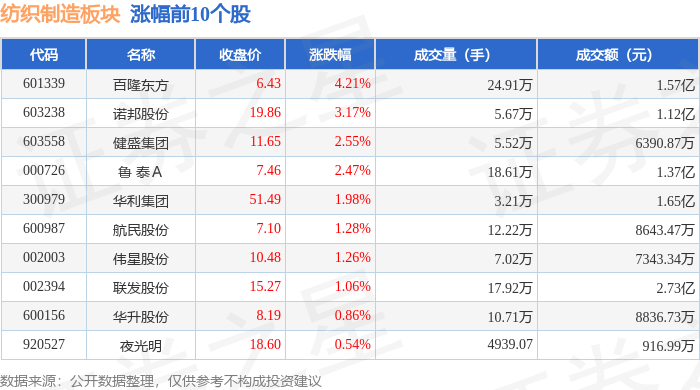
从资金流向上来看,当日纺织制造板块主力资金净流出2.61亿元,游资资金净流出666.86万元,散户资金 净流入2.67亿元。纺织制造板块个股资金流向见下表: | 代码 | 名称 | 主力净流入(元) | | 主力净占比 游资净流入 (元) | | 游资净占比 散户净流入(元) | | 散户净占比 | | --- | --- | --- | --- | --- | --- | --- | --- | --- | | 301066 | 万事利 | | 1012.25万 | 5.63% | 638.71万 | 3.55% | -1650.97万 | -9.18% | | 002394 联发股份 | | | 846.01万 | 3.10% | 711.23万 | 2.60% | -1557.24万 | -5.70% | | 600156 华升股份 | | | 834.10万 | 9.44% | -41.18万 | -0.47% | -792.92万 | -8.97% | | 002098 清兴股份 | | | 683.42万 | 7.18% | 51.10万 | 0.54% | -734.52万 | -7.72% | ...
轻工制造、纺织服饰行业周报:着力培育服务消费,体育赛事、IP+消费将直接受益-20260119
BOHAI SECURITIES· 2026-01-19 10:47
Investment Rating - The investment rating for the light industry manufacturing and textile apparel sectors is "Neutral" [5][52]. Core Insights - The report emphasizes the cultivation of service consumption, with sports events and IP+ consumption expected to benefit directly from new policies aimed at boosting service consumption [4][51]. - Recent government measures, including the "Several Measures to Promote the Quality Improvement and Efficiency Enhancement of the Service Industry" in Shanghai, aim to stimulate service consumption and enhance supply quality [12][51]. - The report highlights the expected performance of key companies, with Jia Mei Packaging forecasting a decline in net profit for 2025 by 43.02%-53.38%, while Wo Le Home is expected to see a growth of 40.78%-56.42% in the same period [41][42]. Industry News - The State Council is focusing on accelerating the cultivation of new growth points in service consumption, particularly in sectors like transportation, home services, performances, and sports events [4][12]. - The Shanghai government has introduced 28 measures targeting six key industries to enhance service quality and stimulate consumption [12][51]. Important Company Announcements - Jia Mei Packaging anticipates a significant decline in net profit for 2025, projecting a profit of 85.44 million to 104.42 million yuan, a decrease of 43.02%-53.38% year-on-year [41]. - Wo Le Home expects a net profit increase for 2025, estimating a profit of 171 million to 190 million yuan, representing a growth of 40.78%-56.42% year-on-year [41]. Market Review - From January 12 to January 16, the light industry manufacturing sector underperformed the CSI 300 index by 0.54 percentage points, while the textile apparel sector outperformed it by 0.02 percentage points [2][42]. - The light industry manufacturing index decreased by 1.11%, while the textile apparel index decreased by 0.55% during the same period [2][42]. Weekly Strategy - The report suggests continuous attention to sectors benefiting from the new service consumption policies, particularly in sports equipment, athletic apparel, and related fields [4][51].


轻工制造及纺服服饰行业周报:361度Q4流水稳健增长,关注李宁边际改善
ZHONGTAI SECURITIES· 2026-01-19 10:45
Investment Rating - The industry investment rating is "Overweight (Maintain)" [3] Core Views - The report highlights that 361 Degrees has shown steady growth in revenue, while Li Ning's revenue decline has narrowed, with profit margins exceeding expectations. The company has opened 33 new stores, bringing the total to 126, which is above initial expectations for the year [5][6] - The report suggests focusing on leading home textile brands such as Water Star Home Textile and Luolai Home Textile, as well as sports brands like Anta Sports, Li Ning, 361 Degrees, and Bosideng, which are expected to benefit from major sporting events in 2026 [5][6] - The report also emphasizes the potential of AI applications in consumer products, particularly in the context of AI smart glasses and 3D printing, indicating a significant growth opportunity in these areas [6] Summary by Sections Market Overview - The light industry index decreased by 1.11%, ranking 20th among 28 Shenwan industries, while the textile and apparel index decreased by 0.55%, ranking 15th [10] - The report notes that the revenue growth for 361 Degrees' main brand and children's clothing is approximately 10%, with e-commerce revenue growing at a high double-digit rate [5][6] Key Company Performance - 361 Degrees reported a healthy revenue increase, while Li Ning's retail revenue saw a slight decline in the low single digits across various channels [5][6] - The report recommends monitoring companies with strong growth potential, including those in the AI and consumer goods sectors, as well as established brands in textiles and home goods [6] Industry Trends - The report indicates a recovery in the paper industry, with prices for certain types of paper expected to rebound after recent declines. It suggests focusing on companies with high wood pulp procurement costs and those with integrated advantages in cultural paper production [6][41] - The furniture manufacturing sector is experiencing a decline, with a reported 9.1% decrease in revenue year-on-year, and a significant number of companies facing losses [66][69]

周观点:中国纺织品出口12月再次回落,澳洲羊毛复拍大涨-20260119
INDUSTRIAL SECURITIES· 2026-01-19 09:30
Investment Rating - The industry investment rating is Neutral (maintained) [1] Core Insights - In December 2025, China's textile product exports weakened again, with yarn, fabrics, and products amounting to USD 12.58 billion, down 4.2% year-on-year; clothing and accessories exports were USD 13.41 billion, down 10.2%; and footwear exports were USD 3.91 billion, down 17.4% [2] - The recent stability of the RMB exchange rate has alleviated concerns about rapid appreciation, suggesting a focus on quality OEM companies such as Huali Group, leading auxiliary material supplier Weixing Co., and steadily expanding Kai Run Co. [2] - The report highlights a significant increase in wool auction prices due to strong demand, with the Eastern Market Index (EMI) for Australian wool rising by 107 Australian cents/kg [2] - The report suggests monitoring companies like New Australia Co. and Baolong Oriental, which have high dividend intentions, as well as Taihua New Materials, which may benefit from anti-involution policies in the chemical industry [2] Summary by Sections Section 1: Market Review - The textile and apparel sector underperformed against the CSI 300 index, with the Jiangsu textile index declining by 0.82% compared to a 0.57% drop in the CSI 300, resulting in a 0.25 percentage point underperformance [9] Section 2: Major Raw Material Prices and Industry Tracking (1) Major Raw Material Price Trends - As of January 16, 2026, cotton prices were at CNY 16,002/ton, with a week-on-week increase of 0.09%; polyester POY was CNY 6,700/ton, up 2.29%; and nylon POY remained stable at CNY 11,600/ton [21][23] (2) Export Data Tracking - In December 2025, China's textile exports were USD 12.58 billion, down 4.2% year-on-year; clothing exports were USD 13.41 billion, down 10.2%; and footwear exports were USD 3.91 billion, down 17.4% [29][31] - Vietnam's textile exports in December 2025 reached USD 3.65 billion, up 8.4% year-on-year, while footwear exports were USD 2.20 billion, up 4.3% [35][37] (3) Domestic and Overseas Apparel Consumption Tracking - In November 2025, China's retail sales growth was 1.3%, with apparel and footwear sales growing by 3.5% [39] - In October 2025, U.S. apparel wholesale inventory was USD 28.04 billion, with a stock-to-sales ratio of 2.04 [40]
纺织制造板块1月19日涨0.76%,华茂股份领涨,主力资金净流出5923.9万元
Zheng Xing Xing Ye Ri Bao· 2026-01-19 08:52
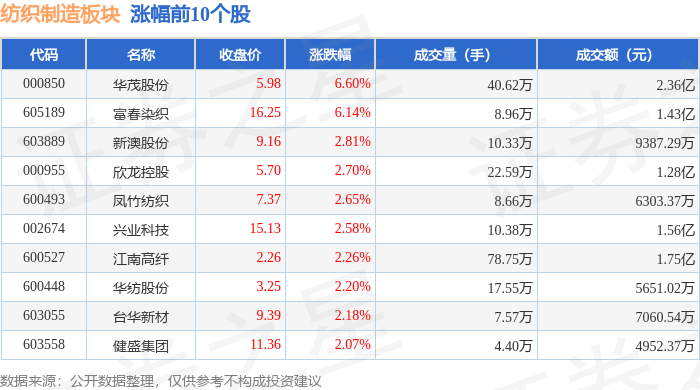
Market Overview - The textile manufacturing sector increased by 0.76% compared to the previous trading day, with Huamao Co., Ltd. leading the gains [1] - The Shanghai Composite Index closed at 4114.0, up by 0.29%, while the Shenzhen Component Index closed at 14294.05, up by 0.09% [1] Key Performers - Huamao Co., Ltd. (000850) closed at 5.98, with a rise of 6.60% and a trading volume of 406,200 shares, amounting to a transaction value of 236 million yuan [1] - Lixing Youxin (605189) closed at 16.25, up by 6.14%, with a trading volume of 89,600 shares and a transaction value of 143 million yuan [1] - New Australia Co., Ltd. (603889) closed at 9.16, increasing by 2.81%, with a trading volume of 103,300 shares and a transaction value of approximately 93.87 million yuan [1] Fund Flow Analysis - The textile manufacturing sector experienced a net outflow of 59.239 million yuan from institutional investors, while retail investors saw a net inflow of 61.334 million yuan [2] - The main stocks with significant net inflows included Huamao Co., Ltd. with a net inflow of 27.297 million yuan, accounting for 11.55% of the total [3] - Other notable stocks with net inflows included Wanshili (301066) with 18.227 million yuan and Yunzhongma (603130) with 17.715 million yuan [3]


2026年海外消费策略:聚焦高端消费
Guohai Securities· 2026-01-19 08:35
Group 1: Manufacturing Sector - The report highlights a positive outlook for the textile manufacturing sector as tariff impacts are easing, leading to improved export conditions. The demand side shows a mixed performance in global apparel retail, with domestic recovery being weak while overseas apparel demand remains stable. The export decline has narrowed following progress in US-China trade negotiations, and manufacturing orders are expected to improve in 2026 due to a healthy inventory level among downstream brand clients [3][6][13]. - Key companies to watch include Shenzhou International, which has a lower exposure to the US market and is expected to see marginal improvements from major clients, and Huayi Group, which is experiencing strong growth from new clients and is ramping up production capacity [3][21][29]. Group 2: Sportswear Sector - The domestic sportswear market is showing signs of weak recovery, with high-end brands like Li Ning and Tebu International demonstrating resilience. The report anticipates a recovery in 2026 driven by macroeconomic improvements and policy catalysts, particularly with the upcoming Olympic events [3][6][19]. - Internationally, high-end sports brands are experiencing differentiated growth dynamics. ON is maintaining a strong brand image and expanding in the Asia-Pacific market, while Amer Sports is benefiting from its multi-brand strategy. However, brands like Lululemon and Deckers are facing short-term pressures in the North American market [3][6][19]. Group 3: Luxury Goods Sector - The luxury goods market in China is showing signs of gradual recovery, driven by wealth effects from the capital market and stabilization in the real estate market. Sales from luxury groups like LVMH and Richemont have improved significantly in Q3 2025, indicating a positive trend in the luxury sector [3][7]. - The report notes a shift in consumer behavior, with a loss of "aspirational consumers" and an increase in the importance of top-tier customers. This shift is leading to a focus on value, experience, and cost-effectiveness in luxury consumption, which is benefiting local high-end brands [4][7].


