
种植业

Search documents
全国冬小麦播种超四成
Jing Ji Ri Bao· 2025-11-04 22:15
Core Insights - The national winter wheat sowing has exceeded 40% completion, while the autumn grain harvest has surpassed 90% completion [1] Group 1: Winter Wheat Sowing - Winter wheat sowing in the northwest region is nearly complete, with the Huang-Huai-Hai region at nearly 40% and the Yangtze River middle and lower reaches over 30% [1] - By province, Hebei has nearly completed sowing, Shaanxi over 50%, Shanxi over 40%, Anhui at 35%, Shandong over 30%, Henan over 20%, and Jiangsu at 15% [1] Group 2: Winter Oilseed Rape Sowing - Winter oilseed rape sowing has exceeded 80% completion, with the northwest region completed, the Yangtze River middle and lower reaches over 90%, and the southwest region nearly 70% [1] Group 3: Autumn Grain Harvest - The national autumn grain harvest has surpassed 90% completion, with the northeast and northwest regions in the final stages, Huang-Huai-Hai, Yangtze River middle and lower reaches, and southwest regions over 90%, and South China nearly 60% [1]
把“科技种粮经”送到农户手中
Ren Min Ri Bao· 2025-11-04 22:12
Core Viewpoint - The article emphasizes the importance of agricultural technology promotion and its impact on farmers' productivity and income, highlighting the role of practical demonstrations and accessible guidance in overcoming farmers' skepticism towards new techniques [1] Group 1: Agricultural Technology Promotion - The company has been promoting agricultural technology for over 30 years, witnessing many farmers achieve wealth through new techniques [1] - A specific case illustrates the effectiveness of deep fertilization technology, where a farmer who initially resisted learning new methods saw significant benefits after observing a demonstration [1] - The company aims to establish a pest and disease monitoring network, allowing farmers to access information about crop diseases and appropriate treatments via mobile phones [1] Group 2: Educational Initiatives - Dedicated agricultural technology instructors have been assigned to each village, and short videos have been created to explain techniques in an understandable manner [1] - The company encourages farmers to ask questions online and provides hands-on teaching for those who need further clarification [1] Group 3: Future Goals - The company plans to continue promoting practices such as straw returning and organic fertilizer substitution to protect the soil [1] - The overarching goal is to make farming easier and more profitable for farmers, contributing to the construction of a strong agricultural nation [1]
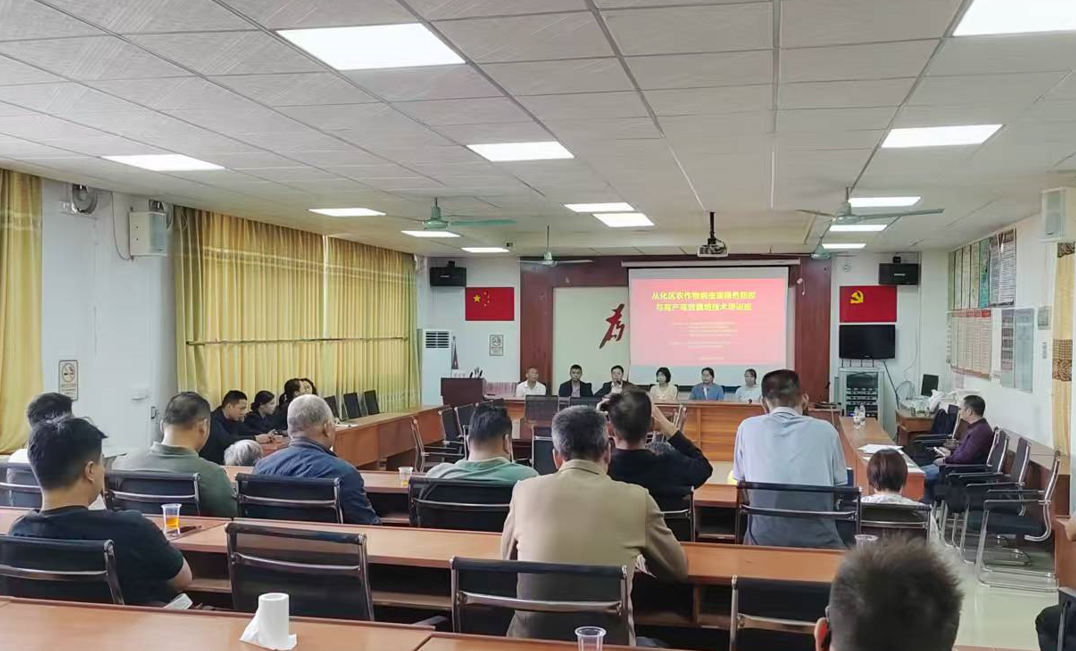
从化区农作物病虫害绿色防控与绿色高产高效技术培训班圆满举办
Nan Fang Nong Cun Bao· 2025-11-04 13:53
Core Insights - The article highlights the agricultural significance of Conghua District in Guangzhou, focusing on the cultivation of rice and passion fruit, and the ongoing efforts to enhance pest and disease management among local farmers [1][3]. Group 1: Agricultural Production - Conghua District has an annual rice planting area of approximately 180,000 mu and a fruit planting area of nearly 460,000 mu [1]. - Most late-season rice is reaching maturity and will soon be harvested, while passion fruit is also maturing and entering the critical harvesting period [1]. Group 2: Training and Education - A training session on green pest control and high-efficiency agricultural techniques was held, attended by 57 local agricultural staff, technicians, and growers [3]. - Experts provided training on efficient cultivation and pest control for rice and passion fruit, enhancing participants' understanding of crop management and pest characteristics [3][5]. Group 3: Practical Application and Recommendations - Following the training, experts conducted field investigations at local passion fruit and rice farms, offering technical guidance based on observed pest conditions [3]. - In a specific passion fruit farm, over 60 acres of "Qinmi 9" variety are thriving, with recommendations for timely harvesting and strict adherence to pesticide safety intervals to prevent pesticide residue [3].

海南橡胶(601118):25年三季报点评:亏损显著收窄,期间费用创10年新低
ZHONGTAI SECURITIES· 2025-11-04 10:48
Investment Rating - The report maintains a "Buy" rating for Hainan Rubber, expecting a relative performance increase of over 15% against the benchmark index in the next 6 to 12 months [7] Core Views - The company reported a significant reduction in losses, with a notable decrease in period expenses reaching a 10-year low [2] - The revenue for the first three quarters of 2025 was 33.96 billion yuan, a year-on-year increase of 3.23%, while the net profit attributable to shareholders was a loss of 0.275 billion yuan, but this represented a 40.24% improvement year-on-year [5] - The report highlights the impact of typhoons on production, estimating a total reduction of approximately 0.53 million tons in dry rubber output for 2024 [5] Financial Performance Summary - Revenue projections for Hainan Rubber are as follows: 2023A at 37.687 billion yuan, 2024A at 49.673 billion yuan, 2025E at 52.467 billion yuan, 2026E at 63.329 billion yuan, and 2027E at 79.520 billion yuan, with growth rates of 145%, 32%, 6%, 21%, and 26% respectively [2][6] - The net profit attributable to shareholders is projected to be 297 million yuan in 2023A, declining to 103 million yuan in 2024A, then recovering to 213 million yuan in 2025E, 503 million yuan in 2026E, and 1.175 billion yuan in 2027E, with growth rates of 289%, -65%, 106%, 136%, and 134% respectively [2][6] - The earnings per share (EPS) is expected to be 0.07 yuan in 2023A, 0.02 yuan in 2024A, 0.05 yuan in 2025E, 0.12 yuan in 2026E, and 0.27 yuan in 2027E [2][6] Market Context - The report notes that the natural rubber prices are currently in an upward trend, influenced by slow supply contraction and rising labor costs, while the production capacity optimization in the tire and automotive sectors may limit short-term price increases [5] - The company is expected to benefit from the revaluation of land resources in Hainan and the easing of high-interest pain points due to cross-border capital flows [5]

全国冬小麦播种过四成
Xin Hua Wang· 2025-11-04 06:48
Core Viewpoint - The national winter wheat sowing has surpassed 40% completion, indicating significant agricultural activity as the season progresses [1] Group 1: Winter Wheat Sowing - Winter wheat sowing in the northwest region is nearly complete, while the Huang-Huai-Hai region has reached nearly 40% completion and the Yangtze River middle and lower reaches have exceeded 30% [1] - By province, Hebei has nearly completed sowing, Shaanxi has surpassed 50%, Shanxi over 40%, Anhui at 35%, Shandong over 30%, Henan over 20%, and Jiangsu at 15% [1] Group 2: Winter Oilseed Rape Sowing - Winter oilseed rape sowing has exceeded 80% completion, with the northwest region fully completed, the Yangtze River middle and lower reaches over 90%, and the southwest region nearly 70% [1] Group 3: Autumn Grain Harvesting - The national autumn grain harvest has surpassed 90% completion, with the northeast and northwest regions in the final stages, and the Huang-Huai-Hai, Yangtze River middle and lower reaches, and southwest regions also over 90%, while southern China is nearing 60% completion [1]
种足、种好、种优 “稻麦衔接”抢农时夯实2026年夏粮丰收基础
Yang Shi Wang· 2025-11-04 04:57
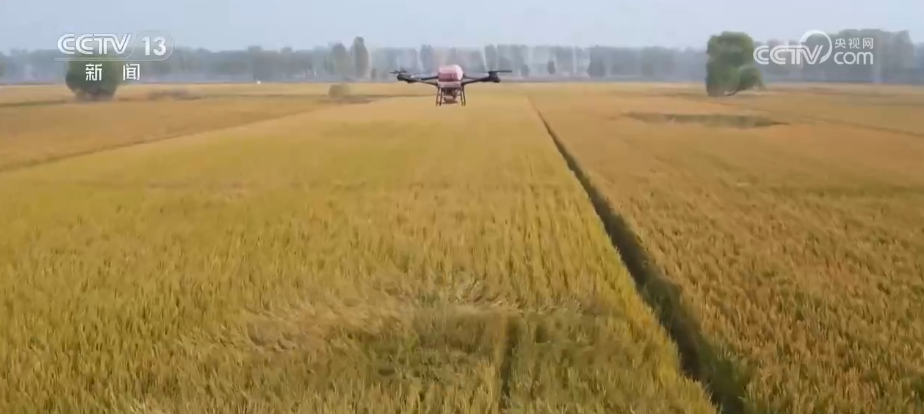
Core Viewpoint - The article discusses the challenges and solutions related to winter wheat planting in the Huang-Huai-Hai region of China, particularly due to delayed rice harvesting caused by continuous rainy weather. Group 1: Agricultural Challenges - The Huang-Huai-Hai region is a significant winter wheat production area in China, facing delays in rice harvesting due to prolonged rainy weather, impacting the planting schedule for winter wheat [1] - In Yuanyang County, the rice harvest has been delayed by nearly 20 days compared to previous years due to insufficient accumulated temperature, compressing the winter wheat planting window [5] Group 2: Technological Solutions - The use of drones for sowing winter wheat is being promoted, with plans to implement this technology by 2025, allowing for sowing 10 to 15 days before rice harvesting [8] - Advanced precision sowing machines equipped with Beidou navigation systems are being utilized to ensure accurate sowing and simultaneous fertilization [7] Group 3: Implementation and Support - In Huai County, over 1.8 million acres of winter wheat planting is progressing smoothly, with local agricultural departments organizing technical personnel to guide farmers on adjusting sowing depth and density based on soil moisture conditions [9] - The promotion of suitable late-sowing varieties and key technologies is being emphasized to ensure a solid foundation for summer grain harvests in 2026 [9]
(走进中国乡村)辽宁彰武“麦豆轮作”:麦浪固沙 豆香富农
Zhong Guo Xin Wen Wang· 2025-11-04 03:47
Core Viewpoint - The article highlights the successful implementation of a "wheat-soybean rotation" model in Zhangwu County, Liaoning Province, which not only combats land desertification but also increases farmers' income through double cropping [1][2]. Group 1: Agricultural Practices - Zhangwu County has initiated a "wheat-soybean rotation" model starting in 2023, allowing for two harvests in one year, which effectively reduces wind erosion and enhances soil protection [1]. - The rotation model involves precise timing, with spring wheat sowing advanced to early March, allowing seedlings to protect the soil during peak wind periods in April [1]. - After harvesting wheat in July, soybeans are immediately planted, benefiting from nitrogen-fixing bacteria and providing a protective barrier for the soil [1]. Group 2: Soil Improvement - The soil quality in Zhangwu County has improved, with organic matter content increasing from 0.8% to 1% in most areas, and some regions reaching 1.2% [2]. - The promotion of this agricultural technique is set to expand to 500 acres in five townships in 2024, and to 11,000 acres in 12 townships by 2025, demonstrating significant ecological and economic benefits [2]. Group 3: Economic Impact - The economic benefits of the "wheat-soybean rotation" are notable, with an average profit of over 800 RMB per mu from planting wheat and local black soybeans [2]. - The successful trial of 500 acres of fresh soybeans this year has led to plans for expanding the planting area in the following year [2]. Group 4: Environmental Strategy - The rotation model contributes to food security while establishing a robust ecological barrier, providing a new approach for desertification control in northern sandy regions [3].
江苏泰兴:一线巡察推动“抛荒地”变“富民田”
Zhong Yang Ji Wei Guo Jia Jian Wei Wang Zhan· 2025-11-04 01:49
Group 1 - The core issue addressed is the mismanagement of land rental agreements in Jinbao Village, where villagers reported not receiving rental income from land leased to a large-scale grower [1] - The village committee had leased approximately 500 acres of land to a grower for walnut and rice cultivation, but due to unsuitable soil and poor management, the land became overgrown and unproductive [1] - Following the inspection, the local government took action to ensure that the grower paid the overdue rental fees to the villagers and facilitated the diversification of crop planting [1] Group 2 - Since the initiation of community inspections, the municipal government has resolved over 150 urgent issues raised by the public, enhancing community welfare [2] - The focus of the inspections is to involve the community actively and improve their sense of happiness and satisfaction [2]
全国秋粮收获过九成 各地多举措筑牢丰收基础
Zhong Guo Jing Ji Wang· 2025-11-04 01:20
Group 1 - The core viewpoint of the articles highlights the significant progress in the harvest of autumn crops across various regions in China, with over 90% of the autumn grain harvested by October 30, and the winter wheat sowing also advancing well [1][2][3]. - The Northeast region, particularly Heilongjiang, is expected to achieve a bumper harvest, with the area and yield of autumn crops accounting for nearly 40% of the national total. The province has seen improvements in crop yields due to the adoption of high-yield varieties and advanced agricultural practices [2][3]. - In the Huang-Huai-Hai region, innovative techniques such as drone-assisted sowing are being implemented to optimize the timing of winter wheat planting, especially after delays caused by adverse weather conditions [4][5]. Group 2 - In Liaoning, the promotion of high-efficiency rice cultivation techniques has led to significant yield increases, with average yields reaching 770 kg per mu [3]. - Jilin province has also reported a record high in grain production, with over 93 million mu of autumn crops planted and innovative farming practices contributing to yield improvements [3]. - In Shaanxi, the agricultural sector is facing challenges due to continuous autumn rain, but efforts are being made to ensure timely harvesting and sowing through coordinated logistics and advanced machinery [6][9][10].
德州|德州科学有序推进冬小麦播种
Da Zhong Ri Bao· 2025-11-04 00:50
Group 1 - Continuous rainy weather has made the autumn grain harvest and timely wheat sowing difficult, prompting various regions to take action to ensure proper sowing and agricultural production for the next year [1] - In Wucheng County, the autumn sowing work has been delayed by about 20 days compared to previous years, with efforts focused on ensuring timely and suitable conditions for winter wheat sowing [1] - Agricultural experts are advising farmers on the appropriate amount of organic and compound fertilizers to use, emphasizing the importance of soil moisture and sowing depth for late-sown wheat [1][2] Group 2 - In Lingcheng District, agricultural experts are actively providing on-site guidance for autumn sowing, including recommendations on sowing depth and fertilization techniques [2] - The use of various agricultural machinery is being promoted in Leiling City to enhance the efficiency of tillage and sowing operations, with a focus on the importance of good seed and method pairing [2] - Dezhou City has released guidelines for selecting late-sown wheat varieties, recommending high tillering and root development varieties that are resistant to wet conditions and low temperatures [3]