
矿业

Search documents
利润破200亿 5000亿洛阳钼业要成为下一个紫金矿业?
2 1 Shi Ji Jing Ji Bao Dao· 2026-01-16 23:38
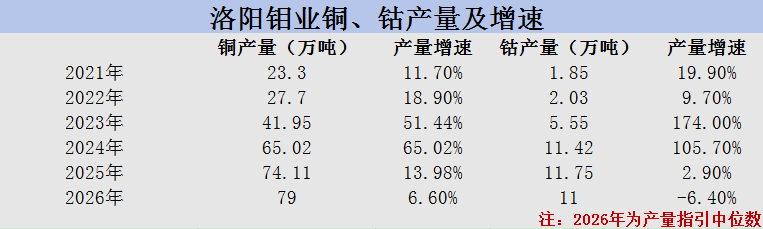
Core Viewpoint - Luoyang Molybdenum (603993.SH) has solidified its position among the top ten global mining companies, with a market capitalization reaching 530 billion yuan, reflecting a significant increase from 487.4 billion yuan a week prior [1][19]. Financial Performance - The company forecasts a net profit attributable to shareholders of 20 billion to 20.8 billion yuan for 2025, representing a year-on-year growth of 47.8% to 53.7% [2][19]. - Luoyang Molybdenum will become the fourth mining company in A-share history to achieve an annual profit exceeding 20 billion yuan [20]. Production and Revenue Drivers - The rise in market value is closely linked to the company's stable growth in performance, primarily driven by the KFM and TFM mines, which are significant sources of copper and cobalt profits [4][21]. - For the first half of 2025, copper and cobalt products are expected to contribute approximately 67.8% to the company's gross profit [22]. - However, copper production is projected to be 741,100 tons in 2025, with a growth rate dropping from 65% to around 14%, while cobalt production is expected to be 117,500 tons, with a growth rate of 2.9% [6][24]. Price Dynamics - Price increases for copper and cobalt are anticipated to be the main drivers of profit growth, with copper prices expected to rise by 42.3% in 2025 and cobalt prices by 36.6% [7][25]. - The company attributes its expected profit increase to both volume and price growth, alongside effective cost management [7][25]. Future Growth Potential - In 2026, Luoyang Molybdenum plans to increase copper production to between 760,000 and 820,000 tons, reflecting a growth of approximately 50,000 tons [8][26]. - The company will also add gold business to its portfolio, with an acquisition of Equinox Gold Corp. expected to yield 6 to 8 tons of gold, valued at around 7.3 billion yuan [9][27]. Strategic Positioning - If the company maintains its profit growth, it could set a new record in the non-ferrous metal industry by achieving two consecutive years of net profits exceeding 20 billion yuan [11][29]. - Luoyang Molybdenum's strategy mirrors that of diversified mining companies, focusing on multiple metal resources to mitigate risks associated with price fluctuations [13][32]. Comparison with Peers - The company is narrowing the production gap with Zijin Mining, with copper production differences decreasing to around 350,000 tons by 2025 [14][32]. - However, Luoyang Molybdenum's gold production remains significantly lower than Zijin Mining's, which is projected to reach 900 tons in 2025 [15][33]. Financial Flexibility - The company has accumulated substantial funds, allowing for more flexible future acquisitions, including a recent board approval for using idle funds for structured deposits up to 20 billion yuan [16][34][35].

有色金属海外季报:艾芬豪2025Q4铜产量同比减少48.1%至6.94万吨,锌产量环比增加16.6%至6.14万吨
HUAXI Securities· 2026-01-16 13:04
Investment Rating - Industry rating: Recommended [5] Core Insights - In Q4 2025, copper production at the Kamoa-Kakula mine decreased by 48.1% year-on-year to 69,419 tonnes, while zinc production increased by 16.6% quarter-on-quarter to 61,444 tonnes [2][4] - The Kamoa-Kakula mine achieved a total copper production of 389,000 tonnes in 2025, aligning with the revised annual production guidance of 380,000 to 420,000 tonnes [2][9] - The Kipushi project saw a significant increase in zinc production, with a year-on-year growth of 89.1% in Q4 2025, attributed to capacity enhancements and improved power supply [4][6] Production and Operational Highlights - Copper production in 2025 included a record output of 144,000 tonnes from the Phase III concentrator, which processed 6.4 million tonnes of ore, exceeding the design capacity by approximately 30% [3][9] - The average copper recovery rate for the Kamoa-Kakula mine was 85.6% for the year, with the Phase III concentrator achieving a record recovery rate of 88.2% in Q4 [11] - The Kipushi concentrator's zinc production reached 61,444 tonnes in Q4 2025, with a notable increase in ore processing capacity following a successful technical upgrade [4][11] Future Production Guidance - The Kamoa-Kakula mine's 2026 production guidance is based on various assumptions and estimates, with a median copper production target of 400,000 tonnes, representing about 80% of the smelter's total capacity [9][12] - The smelter is expected to ramp up to an annual capacity of 500,000 tonnes by the end of 2026, prioritizing the processing of concentrates from the Phase I, II, and III operations [9][12]
中广核矿业(01164):看好贸易修复及价格弹性兑现
HTSC· 2026-01-16 12:08
Investment Rating - The report maintains an "Overweight" rating for the company with a target price of HKD 4.05 [7][5]. Core Views - The company is expected to benefit from a recovery in trade and price elasticity, with a significant increase in uranium prices anticipated due to global nuclear energy revival [1]. - The overall production and operational performance for 2025 is in line with expectations, with a notable recovery in uranium trade prices in the second half of 2025 [1][3]. - The company is one of the most elastic uranium producers in terms of performance relative to spot prices, with 70% of its sales framework agreements tied to spot pricing mechanisms from 2026 to 2028 [1]. Summary by Sections Production and Sales Outlook - The company's total uranium production for 2025 is projected at 2,699.0 tons, a slight decrease of 2% year-on-year. The Ortalyk mine shows a significant increase of 68%, while the Semizbay-U mine experiences an 18% decline [2]. - Looking ahead, the sales framework agreements for 2026 and 2027 indicate production increases to approximately 2,935 tons and 3,300 tons, respectively, with Ortalyk mine expected to grow by 15% and 18% [2]. Trade and Pricing - The uranium trade delivery prices have shown a clear recovery, with prices increasing from $56.44/lbs in Q1 to $79.90/lbs in Q4 of 2025. The average receiving price for the year was $73.95/lbs, with a similar average for deliveries [3]. - The report anticipates that the recovery in trade prices will lead to a restoration of profits in the international trade business for the entire year [3]. Strategic Developments - The inclusion of uranium in the U.S. Section 232 critical minerals list is expected to accelerate the replenishment cycle, tightening supply and potentially driving prices higher [4]. - The U.S. government's actions to ensure sufficient uranium supply are likely to bolster long-term confidence in nuclear power development [4]. Profit Forecast and Valuation - Due to adjustments in production plans, the company's net profit for 2025 has been revised down by 34% to HKD 231 million. However, profit forecasts for 2026 and 2027 have been adjusted upwards to HKD 1.039 billion and HKD 1.363 billion, respectively [5]. - The report assigns a price-to-earnings (P/E) ratio of 29.6x for 2026, leading to a target price increase from HKD 3.01 to HKD 4.05 [5].

新金路(000510.SZ):子公司栗木矿业收到复工通知
Ge Long Hui A P P· 2026-01-16 12:01
格隆汇1月16日丨新金路(000510.SZ)公布,子公司广西有色栗木矿业有限公司(简称"栗木矿业")于 2026年1月16日收到桂林市应急管理局出具的《关于同意广西有色栗木矿业有限公司复工的通知》。公 司及子公司栗木矿业将严格按照计划和要求推进采矿、选矿、冶炼项目建设,尽早实现投产达效,切实 提升公司的核心竞争力与可持续发展能力。 ...

5000亿矿业巨头年利润冲刺200亿,剑指紫金矿业
21世纪经济报道· 2026-01-16 11:48
记者丨 董鹏 编辑丨朱益民 洛阳钼业(603993.SH),全球矿业市值十强的地位愈发稳固。 1月16日早盘,该公司股价小幅上涨,最新市值增至5300亿元。一周前,mining.com网站发布的全球矿业50强榜单中,洛阳钼业曾以4874亿元 的总市值升至第10位。 1月16日, 洛阳钼业股价一度涨超4%,截至收盘涨幅收窄至0.83%,最新市值为5030亿元。 不断抬升的市值,与公司稳定增长的业绩密不可分。 根据15日晚间披露的业绩预告,公司预计2025年归属上市公司股东的净利润将达到200亿元到208亿元,同比增长47.8%到53.7%。 这也是A股市场有史以来,第四家年度盈利突破200亿元的矿业公司。 2022年,紫金矿业(601899.SH)、天齐锂业(002466.SZ)与赣锋锂业(002460.SZ)盈利曾达到这一水平,但受到金、铜、锂价格波动影响,这几 家公司盈利走势、市值表现差异越来越大。 这背后,也是企业发展路径上的差异,是选择单一品种向产业链上下游纵向延伸,还是将业务重心集中在上游矿端,通过多个矿种资源的布局 进行横向拓展。 不同时期,评价标准不同,答案也不相同,只能说主流的全球化矿业龙头更倾 ...


盛达资源(000603.SZ):银都矿业完成矿业权部分整合工作,取得新《采矿许可证》
Ge Long Hui A P P· 2026-01-16 11:15
Core Viewpoint - Shengda Resources (000603.SZ) has completed the partial integration of mining rights for the Baiyinda Silver Polymetallic Mine, which is expected to enhance the company's mining capacity and extend the lifespan of the mine [1] Group 1: Mining Rights Integration - The company’s subsidiary, Inner Mongolia Yindu Mining Co., Ltd., has received the mining rights certificates and licenses for the Baiyinda Silver Polymetallic Mine [1] - The mining area has increased from 5.1481 square kilometers to 5.5395 square kilometers, which is beneficial for increasing the mine's exploitable reserves [1] Group 2: Long-term Development - The integration of mining rights is expected to provide resource security for the long-term development of the company [1] - The development and utilization of mineral resources are influenced by various factors, including natural conditions, mining technology, market demand, and policy changes, which introduce uncertainties regarding the expected outcomes [1]

广汇能源:2026年拟投资37.78亿元并新增融资不超30亿元
Xin Lang Cai Jing· 2026-01-16 09:32
广汇能源公告称,公司2026年度投资框架总额37.78亿元,涉及旗下多家子公司多个项目,在投资总额 未突破前提下,具体项目投资金额可内部调剂。其中,巴里坤广汇马朗矿业有限公司计划投资最多,达 16.25亿元。2026年公司拟净新增融资总额不超30亿元,融资方式包括向金融机构及非金融机构申请综 合授信等。该计划已获董事会通过,尚需提交公司股东会审议。 ...

西部矿业:2026年第一次临时股东会将审议利润分配议案
Xin Lang Cai Jing· 2026-01-16 09:20
Core Viewpoint - The company has announced the timing and location for its first extraordinary general meeting of shareholders in 2026, which will include the review of a profit distribution proposal for the first three quarters of 2025 [1] Group 1 - The meeting will take place in Xining, Qinghai Province, at the West Mine Ha Lake Business Center [1] - The network voting will occur on the day of the meeting during specified time slots through both trading system and internet voting platforms [1] - The profit distribution proposal has already been approved by the company's board meeting held on January 12, 2026 [1]

利润破200亿,5000亿洛阳钼业要成为下一个紫金矿业?
2 1 Shi Ji Jing Ji Bao Dao· 2026-01-16 09:12
Core Viewpoint - Luoyang Molybdenum (603993.SH) has solidified its position among the top ten global mining companies, with a market capitalization reaching 530 billion yuan, following a recent ranking by mining.com that placed it at the 10th position with a total market value of 487.4 billion yuan [1][2]. Financial Performance - The company expects its net profit attributable to shareholders to reach between 20 billion to 20.8 billion yuan in 2025, representing a year-on-year growth of 47.8% to 53.7% [2]. - Luoyang Molybdenum is the fourth mining company in A-share history to achieve an annual profit exceeding 20 billion yuan [3]. Production and Revenue Drivers - The rise in market value is closely linked to the company's stable growth in performance, primarily driven by the large-scale output from the KFM and TFM mines, which are significant sources of copper and cobalt profits [4]. - In the first half of 2025, copper and cobalt products are expected to contribute approximately 67.8% of the company's gross profit [5]. Production Forecasts - For 2025, the company forecasts copper production of 741,100 tons, with a growth rate dropping to around 14% from the previous year's 65% [7]. - The cobalt production is projected to be 117,500 tons, with a growth rate of 2.9% [7]. Price Dynamics - Price increases for copper and cobalt are anticipated to be the main drivers of profit growth, with copper prices expected to rise by 42.3% in 2025 and cobalt prices by 36.6% [9][10]. - The company benefits from stable production costs due to its position at the upstream of the supply chain, allowing it to convert price increases into profits effectively [10]. Strategic Development - Luoyang Molybdenum's growth strategy involves a diversified approach, focusing on multiple metal resources rather than a single commodity, similar to other leading global mining companies [3][18]. - The company plans to enhance its production capacity, targeting an increase in copper output to between 760,000 and 820,000 tons in 2026, along with the introduction of gold production following a recent acquisition [12][13]. Competitive Positioning - The company is narrowing the production gap with Zijin Mining, with copper production differences expected to decrease to around 350,000 tons by 2025 [22]. - Luoyang Molybdenum's gold production is currently lower than Zijin Mining, but the company is likely to pursue further acquisitions to enhance its gold resource base [23][24].
大为股份:公司现阶段正通过各级国土资源管理部积极推进办理探转采相关手续
Zheng Quan Ri Bao Wang· 2026-01-16 08:41
Core Viewpoint - The company has made significant progress in transitioning its exploration rights to mining rights for the Guiyang Dachongli mine, with key milestones achieved in 2023 and 2024 [1] Group 1: Exploration and Mining Rights - The company obtained exploration rights for the Guiyang Dachongli mine in 2023 [1] - By 2024, the company completed exploration and submitted the necessary documentation for the transition from exploration rights to mining rights to the Hunan Provincial Department of Natural Resources [1] - The Hunan Provincial Department of Land and Resources is expected to complete the reserve filing and recognize the exploration results by June 2025, marking a crucial step in the rights transition process [1] Group 2: Regulatory Process - The company is actively working with various levels of land resource management departments to expedite the processing of the transition from exploration to mining rights [1] - The timeline for obtaining the mining license will depend on the approval process of the relevant government departments [1]
