无人机

Search documents
每日投行/机构观点梳理(2025-11-25)
Jin Shi Shu Ju· 2025-11-25 10:39
Group 1: Federal Reserve and Economic Outlook - Goldman Sachs economists expect the Federal Reserve to cut interest rates in December, bringing rates to just above 3% due to a potential economic slowdown [1] - UBS highlights the awkward timing of the Fed's December meeting, which will occur before two key employment reports that could influence the decision to lower rates [3] - Morgan Stanley suggests that if the Fed continues to cut rates amid signs of economic slowdown, the Japanese yen could appreciate by nearly 10% against the dollar in the coming months [6] Group 2: Commodity and Market Predictions - Bank of America forecasts that gold prices could reach $5,000 per ounce by 2026, driven by tight mineral supply and low inventory [2] - Deutsche Bank predicts that the S&P 500 index could surpass 8,000 points by the end of next year, driven by rapid investments and applications in artificial intelligence [3] - JPMorgan warns that Brent crude oil prices could fall to $30-40 per barrel by 2027 due to a significant oversupply in the global oil market [4] Group 3: Investment Strategies and Market Sentiment - HSBC believes that now is a good time to increase exposure to risk assets, particularly in the tech sector, despite recent market volatility [4] - CICC reports that the global central bank's allocation of gold may still have room for growth, despite some central banks reducing their gold holdings due to rising prices [5] - CICC also notes that drones are reshaping the engineering operation and maintenance service ecosystem in China's infrastructure market, presenting investment opportunities [6] Group 4: Industry Developments - CITIC Construction indicates that powder metallurgy technology could transfer cost-saving and lightweight advantages from the automotive sector to humanoid robots [7] - CITIC Securities highlights the establishment of the Commercial Space Administration, which is expected to enhance coordination in the satellite industry and improve efficiency in key processes [9]
今年我国低空经济市场规模预计将达1.5万亿元 无人机物流、载人出行、低空旅游等多领域新业态迭出
Yang Guang Wang· 2025-11-25 07:25
Core Insights - The low-altitude economy market in China is projected to reach 1.5 trillion yuan by 2025, with potential to exceed 2 trillion yuan by 2030, driven by new business models in drone logistics, manned travel, and low-altitude tourism [1][2]. Industry Developments - Multiple regions in China are forming clusters in the low-altitude industry, fostering new business models in drone logistics, manned travel, and low-altitude tourism [2]. - As of now, there are 969 registered companies in the civil unmanned aerial vehicle product information system, with 3,191 registered products and over 478,000 drones [2]. Technological Innovations - Drones are being utilized for agricultural purposes, such as transporting harvested fruits, demonstrating efficiency by moving approximately 30,000 jin (15 tons) of oranges daily, which helps farmers reduce costs [1]. - Shared drone services are being introduced in tourist areas, allowing users to experience aerial views with minimal technical knowledge, enhancing accessibility to aerial sightseeing [1]. Regulatory Framework - The establishment of a comprehensive management service platform for low-altitude flights in Guangdong province aims to monitor the status, trajectory, weather, and airspace dynamics of flying vehicles [2][3]. - The development of low-altitude economy requires not only innovative scenarios but also systematic guarantees, including reforms in air traffic rules and safety management [3].
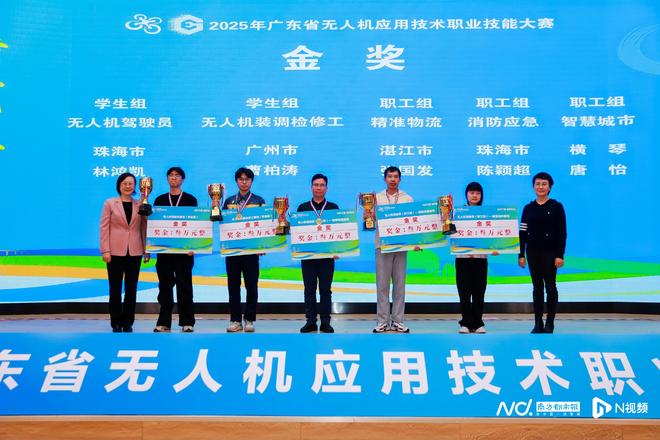
珠海收获2金!广东省无人机应用技术职业技能大赛结果揭晓
Nan Fang Du Shi Bao· 2025-11-25 03:25
Core Points - The 2025 Guangdong Province Drone Application Technology Vocational Skills Competition concluded in Zhuhai, focusing on real-world applications of the low-altitude economy and assessing participants' comprehensive response and task execution abilities [1] - A total of 15 winners were awarded gold, silver, and bronze medals, sharing a prize pool of 300,000 yuan, with teams from Zhuhai, Zhanjiang, and the Hengqin Guangdong-Macao Deep Cooperation Zone winning in various categories [1][3] - The event served as a platform to deepen the integration of education and industry, promoting seamless connections between teaching scenarios and real industry applications [3][10] Industry Development - The competition showcased various applications of drones, including police operations, power inspections, and logistics solutions, highlighting the industry's potential and the need for skilled operators [7][14] - The Guangdong government plans to support the establishment of a "skills ecological chain" involving enterprises, educational institutions, and evaluation bodies to enhance talent cultivation in drone operations and maintenance [10][8] - The event marked a significant step in promoting collaboration among Guangdong, Hong Kong, and Macao in the low-altitude economy, facilitating technology sharing and standard mutual recognition [11][13] Educational Initiatives - Zhuhai Technician College aims to transform competition standards into curriculum content, fostering a talent cultivation model that integrates basic education, practical training, and industry connections [3][14] - The local human resources department is encouraging more enterprises to collaborate with educational institutions to create "craftsman colleges" and "order classes," enhancing the training and employment pipeline [3][10] - The focus on vocational education is critical for developing high-skilled talent necessary for the growth of the low-altitude economy, with plans to strengthen partnerships between technical schools and industry [16][14]

无人机飞手 可获评市技术能手
Hang Zhou Ri Bao· 2025-11-25 02:36
Group 1 - The 2025 Hangzhou Vocational Skills Competition for drone pilots attracted 36 participants from various districts and counties, showcasing both professionalism and entertainment in aerial competition [1] - The competition consisted of two main modules: operational skills and theoretical knowledge, requiring participants to assemble, debug, and test drones within 160 minutes while ensuring quality and troubleshooting potential faults [1] - Participants demonstrated not only flying skills but also comprehensive abilities in maintenance and adjustment, with theoretical knowledge covering task planning, execution, and the latest industry trends [1] Group 2 - Zhu Qiang from Hangzhou Qicai Technology Co., Ltd. won the first prize, emphasizing the importance of precise control and anticipation during flight tests, and highlighting the broad application prospects of the drone industry supported by government initiatives [2] - The competition provided a platform for professionals to exchange skills and underscored Hangzhou's commitment to cultivating high-skilled talent in the low-altitude economy [2] - Winners of the first and second prizes will be recognized as "Hangzhou Technical Experts," reflecting the city's focus on skill development in the drone sector [2]
中金 | 低空科技系列产业篇:基建巡检提效能
中金点睛· 2025-11-25 00:06
Core Viewpoint - Drones are reshaping the engineering operation and maintenance service ecosystem in China's infrastructure sector, addressing the significant operational needs and enhancing efficiency while reducing costs and safety risks [2][3]. Group 1: Infrastructure Market Overview - China's infrastructure investment continues to grow steadily, with a leading global position in fixed asset investment, particularly in electricity, transportation, oil and gas, and telecommunications [3][7]. - According to Deloitte, Chinese companies accounted for over 50% of the revenue among the top 100 global infrastructure firms in 2024, highlighting China's scale advantage and international competitiveness [7][9]. Group 2: Challenges of Traditional Inspection Methods - Traditional manual inspection methods face challenges such as low efficiency, high costs, and significant safety risks, making them inadequate for modern infrastructure maintenance needs [14][15]. - The demand for inspections is driven by the vast and complex infrastructure network in China, which requires timely detection of equipment anomalies to ensure stable operations and prevent accidents [14][15]. Group 3: Advantages of Drone Inspections - Drones offer significant advantages in efficiency, cost reduction, and safety over traditional methods, with AI capabilities enhancing standardization and reducing errors [18][23]. - For example, drone inspections can reduce the time required for tasks significantly, such as compressing a 4-hour manual inspection into just 10 minutes [18][21]. Group 4: Policy Support for Drone Technology - A multi-level policy framework is in place to support the deployment of drone technology in infrastructure inspection, with national and local governments encouraging the expansion of drone services [3][22]. - Key policies include the "14th Five-Year Plan" for civil aviation and various local initiatives aimed at promoting the use of drones in inspection and maintenance [22]. Group 5: Market Potential for Drone Inspections - The total potential market for infrastructure inspection drones is estimated to reach 4.9 billion yuan, with an annual potential market space of approximately 2.4 billion yuan after considering depreciation [34][37]. - The market is driven by the dual forces of accelerating new infrastructure projects and the upgrading of traditional maintenance practices [35][37]. Group 6: Industry Chain Development - The drone industry chain is evolving with decreasing hardware costs and rapid advancements in AI algorithms, facilitating large-scale applications in China's extensive infrastructure sector [39][40]. - Key players in the supply chain include core hardware suppliers, midstream manufacturers, and downstream service providers, all benefiting from the industry's growth [39][41]. Group 7: Applications Across Various Sectors - Drones are being utilized in multiple sectors, including electricity, oil and gas, water conservancy, transportation, and telecommunications, with specific adaptations for each field [44][45]. - The end users primarily consist of large state-owned enterprises and government agencies, which require high reliability and precision in drone operations [44].
数读低空
Zhong Guo Zheng Quan Bao· 2025-11-24 20:13
Market Outlook - The low-altitude economy market in China is expected to reach 1.5 trillion yuan by 2025 and is projected to exceed 2 trillion yuan by 2030 [1] Certification Progress - A total of 969 companies have completed registration in the civil unmanned aerial vehicle product information system, with 3,191 types of products filed, totaling over 4.78 million aircraft. The world's first four-seat electric aircraft has received a type certificate from the Civil Aviation Administration of China [2] Flight Activity Growth - In the third quarter of 2025, the flight duration of drones in China reached 19.841 million hours, nearly three-quarters of the total flight duration for the entire year of 2024. The number of registered drones is increasing steadily at a rate of approximately 300,000 units per quarter [3] Industry Ecosystem Development - As of the third quarter of 2025, there are 1,073 registered drone manufacturing companies and 34,800 drone operating companies nationwide [4] Potential in Logistics - More than 140 new low-altitude logistics routes are expected to be opened nationwide in 2024. The industry forecasts that the value of drone logistics in China could exceed 1 trillion yuan by 2035, with an average annual growth rate of around 20% [5]
大疆打响农业无人机“价格战”,极飞科技等对手如何应对?
Mei Ri Jing Ji Xin Wen· 2025-11-24 12:55
Core Insights - DJI's agricultural drone segment has seen significant growth, with operational acreage increasing from less than 500 million acres in 2019 to 3.2 billion acres in 2023, representing a substantial transformation in traditional agricultural practices [1] - The global agricultural drone market is dominated by two Chinese companies, DJI holding a 59% market share and XAG with 17.1% [1] - XAG has submitted a prospectus for its IPO, showing a turnaround to profitability with a net profit of 134 million yuan in the first half of 2023, compared to the previous year's total [1][2] Market Dynamics - DJI has launched new models at competitive prices, with the T100S starting at 40,999 yuan, aiming to capture market share amid XAG's IPO efforts [2] - The agricultural drone market is evolving from reliance on manual labor to automated solutions, significantly improving efficiency and reducing labor costs [3][4] - The average price of agricultural drones has decreased significantly, with XAG's average selling price dropping to 37,500 yuan, a 10% reduction from the previous year [4][5] Technological Advancements - The introduction of advanced sensors in DJI's new models enhances obstacle detection, addressing challenges in complex agricultural environments [7] - The ability to operate in challenging conditions, such as night or adverse weather, is crucial for expanding the market for agricultural drones [7] International Expansion - Both DJI and XAG are targeting international markets, with XAG's overseas revenue growing significantly from 1.46 billion yuan in 2022 to an expected 3.71 billion yuan in 2024 [8] - Entering foreign markets presents challenges, including regulatory hurdles and varying agricultural practices, necessitating tailored approaches for each region [8]
深圳无人机企业吹响“集结号” 将抱团亮相珠海AIE
Zheng Quan Shi Bao Wang· 2025-11-24 09:45
在应用落地方面,深圳低空经济产业表现尤为突出。据了解,深圳已实现载货飞行超百万架次,建成各 类起降点超过1000个,应用场景覆盖物流、农业、应急救援等多个领域,飞行规模与场景多样性居全国 领先位置。 这些成绩离不开政策的支持。深圳率先构建以《深圳经济特区低空经济产业促进条例》为核心 的"1+3"低空政策体系,并配套出台多项支持措施与建设方案,系统推进基础设施建设和产业生态培 育。以本次AIE为契机,深圳将加快无人机在物流、城市管理、应急救援等领域的规模化应用,进一步 强化其在全球低空经济领域的技术研发与高端制造地位。 证券时报记者获悉,上述展示活动汇聚了大疆创新、道通智能、联合飞机、影翎科技、零零科技、大漠 大、高度创新、天鹰兄弟、火烈鸟、英武智能等十家深圳本土无人机企业,这些企业将展出近20款代表 性产品和5款首次亮相的新品。 "抱团式"亮相AIE的背后,是深圳低空经济产业的持续领跑。作为全国低空经济的重要策源地和产业集 聚区,深圳已形成涵盖研发设计、核心制造、场景应用与运营服务的无人机全产业链体系。2025年,深 圳低空经济相关企业已突破2000家,无人机年产量超过500万架,消费级无人机占全球市场份额的 ...
清华孵化的机器人公司融资 10 亿,冲击独角兽;一汽为何 36 亿投资这家智驾公司? | 每周十大股权投资
Sou Hu Cai Jing· 2025-11-24 08:27
Group 1: xAI and Strategic Financing - xAI completed a strategic financing round of $15 billion, with undisclosed investors, focusing on using AI to solve complex scientific and mathematical problems to "understand the universe" [1] - The company aims to leverage synergies with Elon Musk's other ventures like SpaceX and Tesla, enhancing its potential in the research field [1] Group 2: Zhuoyue Technology and Investment - Zhuoyue Technology secured a strategic investment of 3.6 billion RMB from China FAW, achieving a valuation exceeding 10 billion RMB [1][2] - The investment indicates strong recognition of its "Chengxing Platform" solution by top automotive manufacturers, providing a solid foundation for technology implementation and commercialization in the competitive smart driving sector [1] Group 3: Star Motion Era and Robotics - Star Motion Era completed an A+ round financing of 1 billion RMB, with investors including BAIC Investment and Geely Capital [3] - The company, incubated by Tsinghua University, focuses on humanoid robotics and represents a significant step from laboratory technology to industrial application, highlighting strong synergies with the automotive industry [3] Group 4: United Aircraft and Drone Technology - United Aircraft completed an E round financing, amounting to hundreds of millions RMB, with investors like Keli Investment and Yueda Group [4][5] - The company is a leader in the unmanned helicopter sector, emphasizing its strategic value in the low-altitude economy and its role in national aviation infrastructure [4] Group 5: SenseTime Medical and AI in Healthcare - SenseTime Medical raised several hundred million RMB in a Pre-A round financing, with investors including Legend Capital and Lenovo Ventures [6] - The company aims to commercialize advanced computer vision technologies in the healthcare sector through its SenseCare platform, which is crucial for the profitability of AI in medical applications [6] Group 6: Ling Universe and Companion Robots - Ling Universe secured 200 million RMB in Pre-A round financing, with investors including GF Xinde and Didi Chuxing [7] - The company focuses on developing companion robots for home and personal use, utilizing multi-modal AI interactions to meet emotional needs, representing a challenging yet promising market [7] Group 7: Accelerated Evolution and Robotics - Accelerated Evolution completed a B round financing of 100 million RMB, led by IDG Capital and Shenzhen Capital Group [8] - The company specializes in high-mobility robotic bodies and control platforms, addressing the practical application of humanoid robots in complex environments [8] Group 8: Ruisi Chip and RISC-V CPUs - Ruisi Chip raised several hundred million RMB in a B+ round financing, with investors including Renjun Capital and Huaxu Fund [9] - The company focuses on high-end CPU design based on the RISC-V architecture, aiming to break the dominance of ARM and x86 in high-performance computing [9] Group 9: Kalshi and Predictive Markets - Kalshi completed a strategic financing round of $1 billion, with investors including Andreessen Horowitz and Sequoia Capital [10][11] - The platform innovatively reshapes the predictive market model through compliant "event betting," reflecting significant market interest in its data-driven economic model [10] Group 10: Lambda Labs and AI Cloud Services - Lambda Labs raised $1.5 billion in an E round financing, with investors including TWG Global and the U.S. Innovation Fund [12] - The company provides on-demand AI computing cloud services, positioning itself as a key player in the AI infrastructure sector amid rising demand for specialized AI cloud computing services [12]

江苏淮安:无人机破解港区物流难题 低空经济展现多重实效
Xin Hua She· 2025-11-24 04:08
0:00 如今,无人机的身影已活跃在淮安各个角落,从港口配送、农林植保到景区共享项目,低空经济正从概 念飞入现实,以科技之力提升着城市管理与生活效率。 摄制:徐琦 新华社音视频部制作 在淮安市清江浦区黄码港,无人机驾驶员袁梓皓操作FC-30运载无人机,将生活物资精准送达船民手 中。这条"空中快线"自1月投入使用以来已飞行近300架次,载着30公斤的米面油,破解了港区"最后一 公里"的物流难题。 ...