芯片制造

Search documents
机器人动力系统芯片“再添新成员”
半导体行业观察· 2025-07-26 01:17
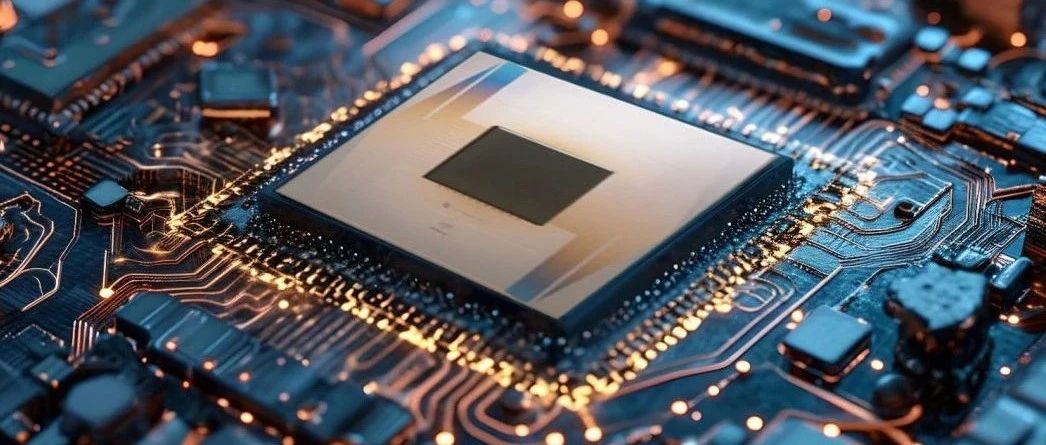
公众号记得加星标⭐️,第一时间看推送不会错过。 2025 年 中 科 无 线 半 导 体 公 司 首 次 发 布 和 提 出 " 具 身 智 能 机 器 人 动 力 系 统 芯 片 " 概 念 , 采 用 了 FPGA+氮化镓ASIC芯片技术,重构了机器人动力系统芯片架构。目前公司已推出基于机器人动 力系统芯片家族系列,其中(包括 :机器人仿生小脑系列、机器人关节系列、机器人智能充电 系列、机器人BMS电池管理系列)"四个系列的定制化ASIC芯片,目前多款芯片已进入规模化 商用。 近日发布的是"机器人智能快充系列",该系列芯片包括了1000W、200W、100W、65W四种规格, 芯片内置了快充协议,为响应1000W超充场景下即时监测电池状态、通过多模态人工智能管理技术对 电子迁移过程,形成全周期充电闭环监控和管理。对电池充电过程的电压、电流、电池热失控、过充 保护、电流突变和劣质电池进行安全监测,降低异常电流引起的电子迁移风险和极端工况下的断充响 应,以降低"高倍率大容量电池"在家庭环境下的充电安全,是专业为家庭机器人、工业机器人、医疗 机器人等高功率、高倍率电池充电应用场景设计的专用智能超充ASIC芯片解 ...


晶圆代工业务前景不明 英特尔(INTC.US)暴跌超8% 几乎抹去年内涨幅
智通财经网· 2025-07-25 23:09
Core Viewpoint - Intel's latest earnings report exceeded market expectations, but the announcement of significant cuts to its foundry business and warnings about potential suspension led to an over 8% drop in its stock price, nearly erasing its gains for the year [1] Financial Performance - In Q2, Intel reported an adjusted earnings per share of $0.10, significantly higher than the market expectation of $0.01 [1] - Revenue also surpassed analyst estimates, and the company provided an optimistic sales outlook for Q3 [1] - However, the company experienced a net loss of $2.9 billion, translating to a loss of $0.67 per share, worsening from a loss of $1.61 billion (or $0.38 per share) in the same quarter last year [2] Strategic Changes - Intel warned that it may "pause or terminate" its foundry business if it fails to secure customers in the next generation of process technology [1] - The company has not yet secured any major external customer orders and expressed uncertainty about future prospects for its 14A process node [1] - New CEO Pat Gelsinger emphasized a more cautious approach, stating that future advancements in chip manufacturing will be based solely on confirmed customer demand [1] Cost Management - Intel announced plans to terminate certain chip facility projects in Germany and Poland and slow down the construction of a new plant in Ohio [1] - The company is implementing significant cost-cutting measures, including a workforce reduction of approximately 15%, bringing total employees down to 75,000 [2] - Gelsinger acknowledged that the company had previously invested heavily without clear demand, leading to a dispersed capacity layout and underutilization [2] Market Position and Competition - Analysts from Barclays noted that management's strategy to seek external customer commitments before advancing process nodes increases uncertainty in the product roadmap and reduces the likelihood of customer adoption [2] - Despite the negative market reaction, JPMorgan analysts viewed Intel's reassessment of its foundry business as a positive first step, although they cautioned about ongoing market share losses, particularly in the AI chip market dominated by Nvidia [2]

黄金、比特币跳水,特朗普施压鲍威尔降息
21世纪经济报道· 2025-07-25 15:53
值得关注的是英特尔,截至23:40发稿,英特尔跌逾9%。 消息面上,英特尔首席执行官陈立武表示,英特尔将进一步裁员,计划通过裁员和自然减员在 今年年底前把核心员工总数降至7.5万人;并不再推进公司先前计划的在德国和波兰项目。 (详见→) 英特尔发出警告,称其可能由于财务问题停止研发下一代芯片14A。分析称,一旦英特尔放弃 14A,将对美国芯片制造业造成沉重打击,并进一步加剧美国对海外芯片生产业的依赖。 7月25日晚间,美股开盘后集体飘红,黄金突然跳水。 比特币等加密货币也集体走低,截至发稿,比特币跌近2%。 特朗普施压鲍威尔降息 据央视新闻报道,当地时间7月24日,美国总统特朗普访问了美国联邦储备委员会,这是近20 年来美国现任总统首次正式造访美联储。 特朗普与美联储主席鲍威尔一同参观了耗资约25亿美元的大楼改造项目。途中,特朗普称美联 储大楼翻新工程"严重超支"。鲍威尔则当场反驳,称他把5年前竣工的第三座大楼成本也一并 算了进来。 在回答现场记者提问时,特朗普称"最希望鲍威尔降息"。对此,鲍威尔只是"一笑而过"。 据 央视新闻援引美国媒体评论,特朗普本次参观是一场"政治表演",旨在加大对美联储的压力。 中概 ...

福建泉州:数字赋能传统产业 激活民企发展新动能
Ren Min Wang· 2025-07-25 15:46
Core Viewpoint - Fujian Province's Quanzhou City is leveraging digital transformation and technological innovation to enhance traditional industries, transitioning from "manufacturing" to "intelligent manufacturing" and stimulating new growth in private enterprises [2][4][6][8][12] Group 1: Digital Economy Growth - The overall scale of Quanzhou's digital economy is projected to exceed 700 billion yuan in 2024, accounting for over 56% of the city's GDP [2][4][6][8][12] Group 2: Technological Innovation - Quanzhou is focusing on technological innovation to improve industry quality and efficiency, providing sustainable support for traditional industry upgrades [2][4][6][8][12] Group 3: Private Enterprise Development - The initiatives in digital transformation are aimed at activating new momentum for the development of private enterprises in Quanzhou [2][4][6][8][12]
贸易协议乐观情绪点燃市场 全球股票基金周度资金流入再回升
智通财经网· 2025-07-25 13:37
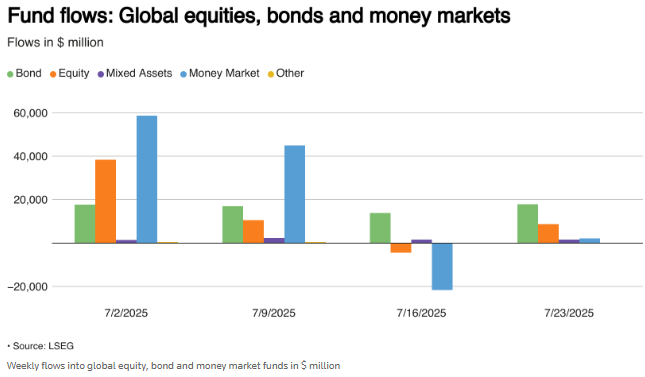
Market Overview - Global stock funds saw a net inflow of $8.71 billion for the week ending July 23, reversing the previous week's outflow of $4.4 billion, driven by optimistic expectations regarding U.S. trade agreements and strong economic data [1][4] - European stock funds recorded a net inflow of $8.79 billion, the highest in 11 weeks, while Asian stock funds attracted $1.17 billion [4] Sector Performance - The technology sector attracted $1.61 billion, reversing a previous outflow of $576 million, while the financial and industrial sectors saw net inflows of $1.13 billion and $1.61 billion, respectively [4] Bond Market Activity - Global bond funds experienced a net inflow of $17.94 billion for the week, marking the 14th consecutive week of inflows [7] - Short-term bond funds received $4.14 billion, the largest inflow in 13 weeks, while euro-denominated and high-yield bond funds attracted $3.89 billion and $2.51 billion, respectively [7] Emerging Markets - Emerging market bond and equity funds saw renewed investor interest, with bond funds gaining $2.19 billion and equity funds $250 million, reversing previous outflows [9][10]
全球股市疯涨!驱动市场的不再是“贪婪”,而是对AI的“FOMO”
华尔街见闻· 2025-07-25 09:57
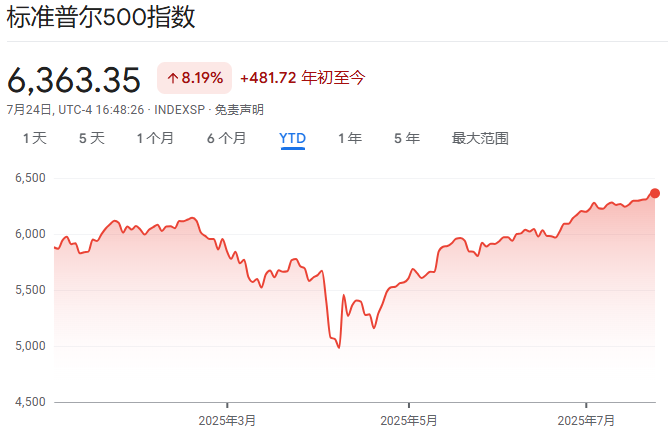
Core Viewpoint - The article highlights the remarkable surge in global stock markets driven by investor fear of missing out (FOMO) on transformative opportunities presented by the artificial intelligence revolution, despite facing multiple challenges such as trade disputes and geopolitical risks [1][4]. Group 1: Market Dynamics - The U.S. stock market's market capitalization to GDP ratio has reached a historical high, with the FTSE 100 index in the UK also hitting record levels, indicating a state of market euphoria [1]. - Investor reactions to risks have become increasingly muted, suggesting a normalization of responses to threats like tariffs [1]. - The current market environment is compared to historical bubbles, characterized by extraordinary public delusions and collective madness [1][3]. Group 2: AI and Technology Stocks - The AI boom has led to a significant rise in technology stocks, with companies like Nvidia seeing their market value exceed $4 trillion [3]. - There are concerns about market bubbles, with excess liquidity fueling speculative behavior in cryptocurrencies and the accumulation of crypto assets by various companies [3]. Group 3: Emotional Drivers in Investment - The article discusses how FOMO and loss aversion are becoming the primary emotional drivers of investment behavior, overshadowing traditional greed [4]. - Historical lessons from past market crashes, such as the 49% real loss experienced by UK investors during the internet bubble, are cited to emphasize the risks of forgetting past mistakes [4]. Group 4: Investment Strategies - Investors are advised to diversify their portfolios and consider allocating to less exciting assets, particularly as cash has regained real returns post-inflation [7]. - The article suggests that cryptocurrencies should be approached with caution, as their potential losses could be catastrophic, despite the current enthusiasm surrounding them [8]. Group 5: Caution Against FOMO - While AI represents a significant technological advancement, investors are urged to remain vigilant against the excessive influence of FOMO and to return to fundamental analysis and risk assessment [9].


全球股市疯涨!驱动市场的不再是“贪婪”,而是对AI的“FOMO”
Hua Er Jie Jian Wen· 2025-07-25 07:36
Group 1 - The core viewpoint of the article highlights the remarkable surge in global stock markets this year, driven by investor fears of missing out on transformative opportunities presented by the artificial intelligence revolution, rather than traditional greed [1][5] - The article notes that the current market state is nearing a "floating" condition, with the U.S. stock market's market capitalization to GDP ratio reaching a historical high, and the FTSE 100 index in the UK also hitting record levels [1][3] - There is a growing indifference among investors towards various risks, seemingly accustomed to the trade threats posed by former President Trump [1][3] Group 2 - The article discusses the irrational exuberance in the market, fueled by widespread expectations that AI will fundamentally alter the labor market and capital operations, potentially redefining "humanity" itself [3][4] - It warns that the current market phenomena bear striking similarities to historical bubbles characterized by "extraordinary public delusions and collective madness" [3][4] - The AI boom has led to soaring valuations in tech stocks, with companies like Nvidia reaching a market cap exceeding $4 trillion, raising concerns about market bubble signs [4][6] Group 3 - The article emphasizes that "fear of missing out" has replaced "greed" as the dominant market sentiment, with investors driven more by emotional factors than rational pricing theories [5][6] - Historical lessons from past market bubbles, such as the internet bubble collapse in 2000, which caused a 49% real loss for UK investors, are highlighted to illustrate the potential risks of current market behavior [6][7] - Research indicates that both "fear of missing out" and "fear of loss" are significant emotional drivers of investment behavior, especially during periods of revolutionary change narratives [6][7] Group 4 - The article warns of increasing bubble risks, suggesting that while a financial crisis may not be imminent, the current high valuation environment poses risks that may not yield corresponding risk premium returns [7] - It advocates for portfolio diversification and increasing allocations to "boring" assets, particularly as cash has regained real returns post-inflation [7] - The article advises caution regarding cryptocurrencies, suggesting they should be left to speculators and fraudsters, as historical trends indicate that losses in this area can be devastating [7]
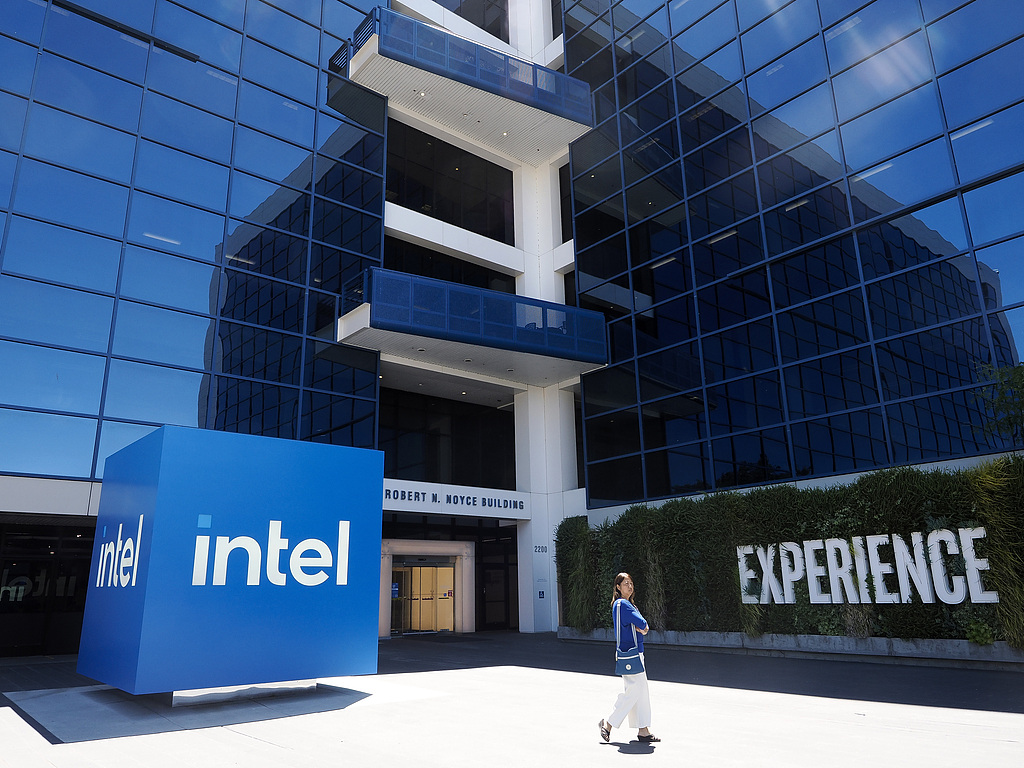
英特尔首次警告考虑放弃研发下一代尖端芯片,美媒:可能是美芯片制造业末日的开端
Huan Qiu Wang· 2025-07-25 04:41
Core Viewpoint - Intel has issued a warning regarding potential financial issues that may lead to the halt of its next-generation 14A chip development, which could significantly impact the U.S. semiconductor industry and increase reliance on overseas production [1][3]. Group 1: Intel's Warning - Intel's regulatory filing indicates a focus on 14A development while seeking large customers, stating that failure to secure significant external clients could render the project economically unfeasible [3]. - This is the first time Intel has warned about the consequences of potentially failing the 14A project, which could be a critical blow to the U.S. semiconductor industry [3]. Group 2: Implications for the U.S. Semiconductor Industry - If Intel abandons the 14A development, it may signify the beginning of the end for U.S. semiconductor manufacturing, as most advanced semiconductors are currently produced outside the U.S., particularly in regions influenced by China [3]. - SemiAnalysis has noted that this is the first time Intel is evaluating its ability to maintain a competitive edge, raising concerns about the complete disappearance of U.S. semiconductor manufacturing [3].
AI领域为何成全球反垄断执法的新战场?监管利剑指向何方
Nan Fang Du Shi Bao· 2025-07-25 03:37
Group 1 - The report highlights that antitrust practices in the global digital economy are at a historical crossroads, with artificial intelligence (AI) becoming a core focus of antitrust enforcement [1][6] - Antitrust enforcement agencies are intensifying scrutiny of the entire AI value chain to identify potential competitive bottlenecks, particularly concerning large tech companies' control over critical resources like data and computing power [2][3] - The report indicates that major cloud service providers like Amazon, Microsoft, and Google are facing stricter reviews due to their dual role in providing infrastructure and developing AI models, raising concerns about their market power [3][4] Group 2 - The report notes a shift in antitrust goals, moving beyond traditional consumer welfare standards to encompass broader social values such as fairness, opportunity, wealth distribution, sustainability, and innovation protection [5][6] - It emphasizes that the rise of digital services, often provided for free, complicates the application of price-based harm theories in antitrust assessments [5][6] - The report outlines four future trends in digital economy antitrust practices, including the need for a balance between preventing market power concentration and fostering innovation in AI [6][7] Group 3 - The report discusses the global fragmentation of governance rules in digital trade and data flow, which complicates operations for startups compared to resource-rich tech giants [6][7] - It highlights the evolution of antitrust remedies, with increasing importance placed on data portability and interoperability as key components of antitrust relief [7] - The report anticipates a deepening collaboration between data protection and antitrust agencies, with privacy violations potentially serving as evidence of market dominance abuse [7]
国际芯片巨头,预计下半年裁员超20000人!
第一财经· 2025-07-25 02:29
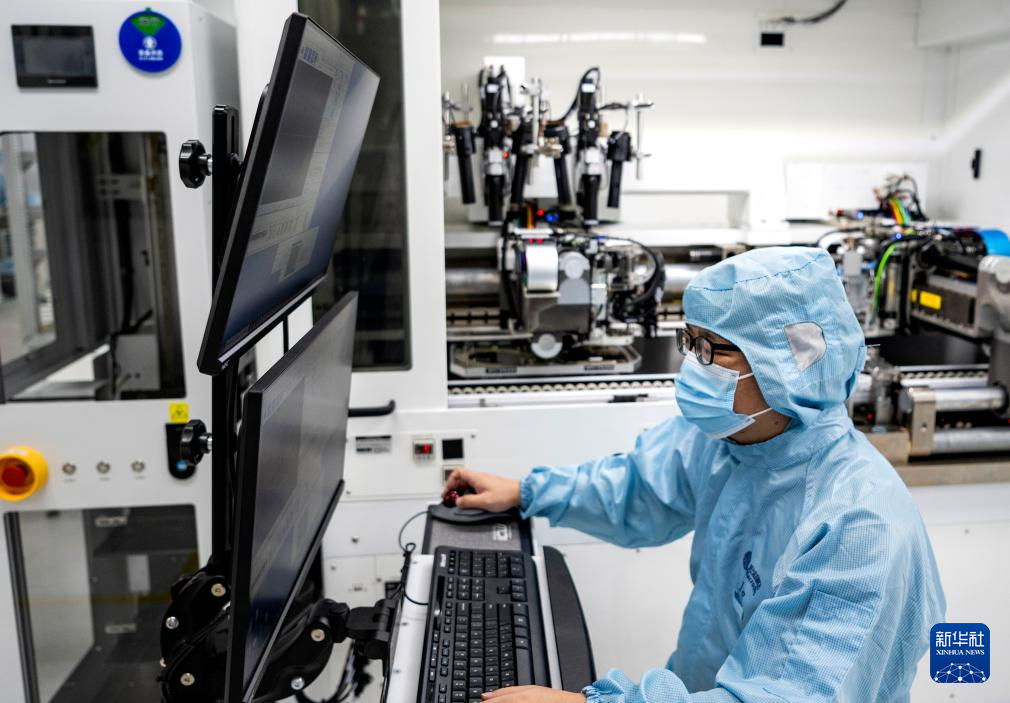
Core Viewpoint - Intel has announced a significant restructuring plan, including a 15% workforce reduction and cancellation of multi-billion dollar investments in Europe, focusing on AI chip development and core process technologies to regain market share [1][3]. Group 1: Workforce and Organizational Changes - As of June 30, Intel had 96,400 employees, and plans to reduce this to 75,000 by the end of the year, representing a 22% decrease from the end of 2024 [3]. - The layoffs will primarily target middle management, with nearly 50% of organizational layers being eliminated to enhance efficiency and streamline decision-making [3]. - Intel will pause the construction of a new factory in Ohio and cancel planned projects in Germany and Poland, shifting to a model that only expands capacity when there is confirmed demand [3]. Group 2: Financial Performance and Market Position - In Q2, Intel reported total revenue of $12.9 billion, which was in line with the previous year but exceeded market expectations of $11.92 billion; however, the company experienced a net loss of $2.9 billion, marking its sixth consecutive quarter of losses [5]. - The PC chip division saw revenue decline by 3% to $7.9 billion, while the data center and AI chip business grew by 4% to $3.9 billion [5]. - The contract manufacturing segment's revenue increased by 3% to $4.4 billion, but it also faced an expanded loss of $3.2 billion [5]. Group 3: Future Strategy and Focus Areas - Intel aims to advance its 18A and 14A process technologies, with 18A focused on in-house products and 14A intended to attract external clients [6]. - The company acknowledges that if it cannot secure sufficient external orders for 14A, it may have to exit certain manufacturing operations [6]. - Intel's AI strategy will concentrate on developing chips for complex task processing models, although specific product roadmaps have not been disclosed [6].