
二次电池

Search documents
OpenAI首席执行官:中国科技进步速度“快得惊人”!
Xin Lang Cai Jing· 2026-02-23 09:21
Group 1 - OpenAI's CEO Sam Altman highlighted the rapid development of Chinese technology companies, particularly in artificial intelligence and other fields, noting their impressive achievements [1] - The speed of progress in humanoid robots in China was described as "magical" by Evrim Kanbur, a part-time professor at several Chinese universities, emphasizing the remarkable advancements made within just one year [2] - A report indicated that the technological gap between South Korea and China in key scientific fields is widening, with China surpassing South Korea in secondary battery technology, which was previously a stronghold for South Korea [2]
韩国“唯一领先战略技术”被中国反超
Guan Cha Zhe Wang· 2026-02-22 10:31
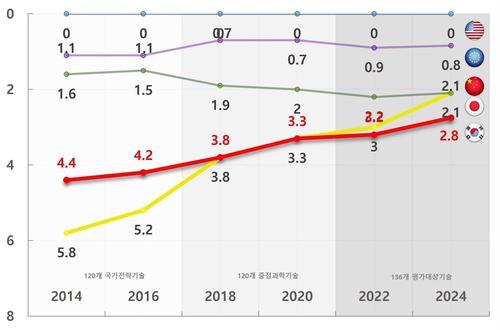
Core Insights - The technology gap between South Korea and China in key strategic sectors is widening, particularly in the secondary battery sector where China has overtaken South Korea [1][3] - South Korea's overall technology level is assessed at 82.8% compared to the United States, with a significant gap of 2.8 years behind the U.S. and 0.7 years behind China [3] Group 1: Technology Assessment - In the secondary battery sector, South Korea was leading by 0.9 years in 2022 but has now fallen behind China by 0.2 years in 2024 [1] - South Korea ranks second in the semiconductor and display sectors but is now lagging behind the U.S. by 0.7 years and China by 0.8 years [3] - The report evaluates 136 core technologies across 11 sectors, analyzing papers and patents from South Korea, China, Japan, Europe, and the U.S. [1] Group 2: Market Dynamics - The global market share of South Korean electric vehicle batteries has decreased from 35% in 2020 to 23% in 2023, with projections to drop further to 16% by October 2025 [5] - Despite a growing global electric vehicle market, the growth rate is expected to decline significantly from 25%-28% to around 15% by 2025 [4] - South Korean battery companies are facing intense competition from Chinese firms like CATL and BYD, which have a substantial lead in revenue and market share [5] Group 3: Domestic Market Disparities - The domestic market for South Korean secondary batteries is only about 2% of China's, with the energy storage market at just 1% of China's [6] - South Korean companies have over 90% of their production facilities located overseas, while Chinese companies like CATL and BYD have about 97% of their capacity concentrated domestically [6] - The market share of South Korean companies in Europe has dropped from over 60% in 2022 to below 40% recently due to strong competition from Chinese firms [6] Group 4: Material Dependency - South Korean battery manufacturers are heavily reliant on China for core materials that constitute 60% of the cost of secondary batteries [7] - Chinese companies dominate the global supply of four key materials used in battery production, holding an 80% market share [7]


“曾在战略技术领域中唯一保持领先”,韩媒:数据显示,韩国二次电池技术水平也被中国反超
Huan Qiu Wang· 2026-02-22 06:53
Core Insights - The technology gap between South Korea and China is widening, particularly in key strategic technologies, with South Korea losing its lead in secondary battery technology to China [1][2] - As of 2024, the technology gap between South Korea and the United States is 2.8 years, while the gap between China and the United States is 2.1 years, indicating a narrowing of the gap for South Korea by 0.4 years since 2022 [1] - South Korea's technology level is assessed at 82.8% compared to the United States, which is set at 100%, while China stands at 86.8% [1] Technology Assessment - In the evaluation of 136 core technologies, South Korea's gap with the United States in strategic technologies has decreased from 3 years in 2022 to 2.6 years in 2024, while China's gap has decreased by 0.8 years during the same period [2] - South Korea was previously leading in the secondary battery sector by 0.9 years in 2022, but by 2024, China has taken the lead with a 0.2-year advantage [2] - In the semiconductor and display sectors, South Korea is lagging behind the United States by 0.7 years and China by 0.8 years, with technology levels at 91.2% for South Korea and 91.5% for China [2]
去年韩国专利申请量超26万件 位居世界第四
Shang Wu Bu Wang Zhan· 2026-02-02 09:00
Core Insights - South Korea's patent applications reached 267,997 in the previous year, marking a 5.9% increase, making it the fourth country to surpass 260,000 annual patent applications after Japan, the United States, and China [1] Group 1: Patent Application Growth - The information technology and communication sector, including artificial intelligence, saw a significant increase of 21.1% in patent applications, totaling 27,033 [1] - The secondary battery sector experienced a growth of 14.4%, with 10,624 patent applications filed [1] Group 2: International Patent Submissions - South Korean companies increased their overseas patent submissions by 17.6%, reaching a total of 67,025 [1]
韩敲定2026年252万亿韩元金融支持计划,其中尖端产业获150万亿
Shang Wu Bu Wang Zhan· 2025-12-29 02:57
Core Viewpoint - The South Korean Financial Commission has finalized a financial support plan for 2026, with a total of 252 trillion KRW allocated by major policy financial institutions, marking an increase of approximately 1.8% from the previous year [1] Group 1: Financial Support Allocation - The financial support for advanced strategic industries will reach 150 trillion KRW, an increase of 12 trillion KRW or about 8.9% compared to this year [1] - Specific allocations include 42.5 trillion KRW for sectors such as semiconductors, secondary batteries, biotechnology, and artificial intelligence (AI) [1] - An additional 24.7 trillion KRW will be directed towards emerging industries like nanotechnology, hydrogen energy, aerospace, military, agricultural food, and wind power [1] Group 2: Additional Financial Support - Funds for enhancing industrial structure and restructuring existing industries will amount to 32.2 trillion KRW [1] - Support for nurturing unicorn companies and small to medium-sized enterprises (SMEs) will total 19 trillion KRW [1] - To mitigate the impact of exchange rate fluctuations on business operations, a support fund of 31.8 trillion KRW will be established [1]
韩国8.6代OLED FMM企业启动出售程序
WitsView睿智显示· 2025-12-22 04:51
Group 1 - Fine One, a South Korean company specializing in OLED and secondary battery equipment components, has officially initiated a sale process to find a strategic partner with synergistic effects [1] - Established in 2018, Fine One has rapidly grown its revenue from 2 billion KRW to 67.2 billion KRW in 2023, achieving a compound annual growth rate of over 100%, with a target of reaching 100 billion KRW in 2024 [1] - The company has successfully broken the long-standing monopoly of foreign firms on key components for OLED deposition, offering a complete solution from 8.6-generation large-size OLED masks to high-precision deposition components [1] Group 2 - Despite rapid business expansion, Fine One faces liquidity challenges due to significant investments in 8.6-generation OLED production lines and the recent deterioration of the Korean IPO market, leading to a restructuring process in October [2] - Analysts suggest that the global OLED market is expected to reach 31 trillion KRW, and Fine One remains a valuable acquisition target due to its strong technical barriers and position in the supply chains of major companies like Samsung Display and BOE [2] - The equity transfer facilitated by professional institutions is anticipated to alleviate Fine One's financial bottlenecks and promote deeper integration and sustained growth in the display and new energy sectors [2]

标普预测明年韩国经济增长率将反弹至2.3%
Shang Wu Bu Wang Zhan· 2025-12-19 15:49
Core Viewpoint - S&P predicts South Korea's economic growth rate will rebound from 1.1% in 2023 to 2.3% in 2026, indicating an improving overall economic environment and recovery in corporate credit conditions [1] Group 1: Economic Outlook - The global macroeconomic environment is stabilizing, which is a major positive factor for economic growth [1] - The structural differentiation among industries is intensifying, showcasing a typical "K-shaped recovery" [1] Group 2: Industry Performance - Industries benefiting from AI investment expansion, such as semiconductors, electronics, and electrical equipment, are expected to continue improving, with potential upgrades in credit ratings [1] - Conversely, sectors like construction, finance, petrochemicals, and secondary batteries are facing pressures for credit rating downgrades due to weak demand, oversupply, or slow structural adjustments [1]
韩国政府拟明年投入超30万亿韩元支持AI和芯片等产业
Xin Lang Cai Jing· 2025-12-16 00:31
Group 1 - The South Korean government plans to invest over 30 trillion KRW (approximately 20.4 billion USD) next year to support artificial intelligence (AI) and other advanced sectors through a newly established large fund [1][3] - The Public Growth Fund, amounting to 150 trillion KRW, was officially launched as part of President Yoon Suk-yeol's key economic commitments, focusing on accelerating AI adoption across various industries over the next five years and directing resources to critical sectors such as semiconductors, secondary batteries, and biotechnology [1][3] - The initial investment scale for next year is projected to exceed 30 trillion KRW, with specific allocations of 6 trillion KRW for AI, 4.2 trillion KRW for semiconductors, and 3.1 trillion KRW for future mobility [1][3] Group 2 - The investment will include 3 trillion KRW in direct investments and 10 trillion KRW in infrastructure investments, with the Financial Services Commission (FSC) indicating that around 10 trillion KRW will be provided at low interest rates [1][3] - The fund consists of a government-backed strategic industry fund of 75 trillion KRW and 75 trillion KRW from private investments, encompassing direct and indirect financing, government-guaranteed bonds, and low-interest loans [1][3] - The government has received over 100 investment proposals from local governments and the economic sector, amounting to 153 trillion KRW [2][4]
韩今年十大制造业投资为122万亿韩元,呈逐年增长趋势
Shang Wu Bu Wang Zhan· 2025-12-10 18:23
Core Insights - South Korea's top ten manufacturing industries are projected to invest 122 trillion won in domestic equipment this year, reflecting a year-on-year growth trend [1] Group 1: Investment Overview - The investment plan for the top ten manufacturing industries has been increased by 3 trillion won from the beginning of the year, reaching 122 trillion won [1] - The investment amounts for 2023 and 2024 are set at 100 trillion won and 110 trillion won, respectively, indicating a consistent upward trajectory [1] - The investment execution rate for the first three quarters of this year stands at 68%, maintaining a stable development momentum compared to the same period last year [1] Group 2: Sector-Specific Insights - The semiconductor and automotive sectors dominate the investment landscape, accounting for approximately 80% of the total investment plan [1] - Investment in the semiconductor sector is focused on high-end memory chips to meet the rising global demand driven by artificial intelligence [1] - The automotive industry is expanding investments to facilitate the transition to electric vehicles [1] Group 3: Government and Industry Collaboration - Participating companies have urged the government to expedite the implementation of electric vehicle subsidies, expand policy financial support, introduce investment tax credits, and reduce electricity costs [1]
韩全年出口额或破7000亿美元大关,半导体产业带动作用明显
Shang Wu Bu Wang Zhan· 2025-12-10 14:13
Core Insights - South Korea's cumulative export value from January to November reached $640.2 billion, marking a 2.9% increase, with a strong likelihood of surpassing $700 billion for the entire year, potentially setting a historical record [1] Group 1: Export Performance - Semiconductor exports totaled $152.6 billion, exceeding last year's total of $141.9 billion [1] - Excluding semiconductors, other product exports amounted to $487.6 billion, reflecting a decline of 1.5% [1] - Among 15 major export categories, 10 experienced negative growth [1] Group 2: Sector Analysis - In November, semiconductors accounted for a record 28.3% of total exports [1] - The Ministry of Trade anticipates ongoing challenges in the steel, petrochemical, and secondary battery sectors next year [1] - Strong demand for semiconductors driven by AI and data centers is expected to maintain high export ratios for this category [1]