
低空经济与航空航天

Search documents
广州加快建设先进制造业强市 力争十年工业增加值翻一番 到2035年建成万亿级“智车之城”
Nan Fang Ri Bao Wang Luo Ban· 2026-01-09 07:44
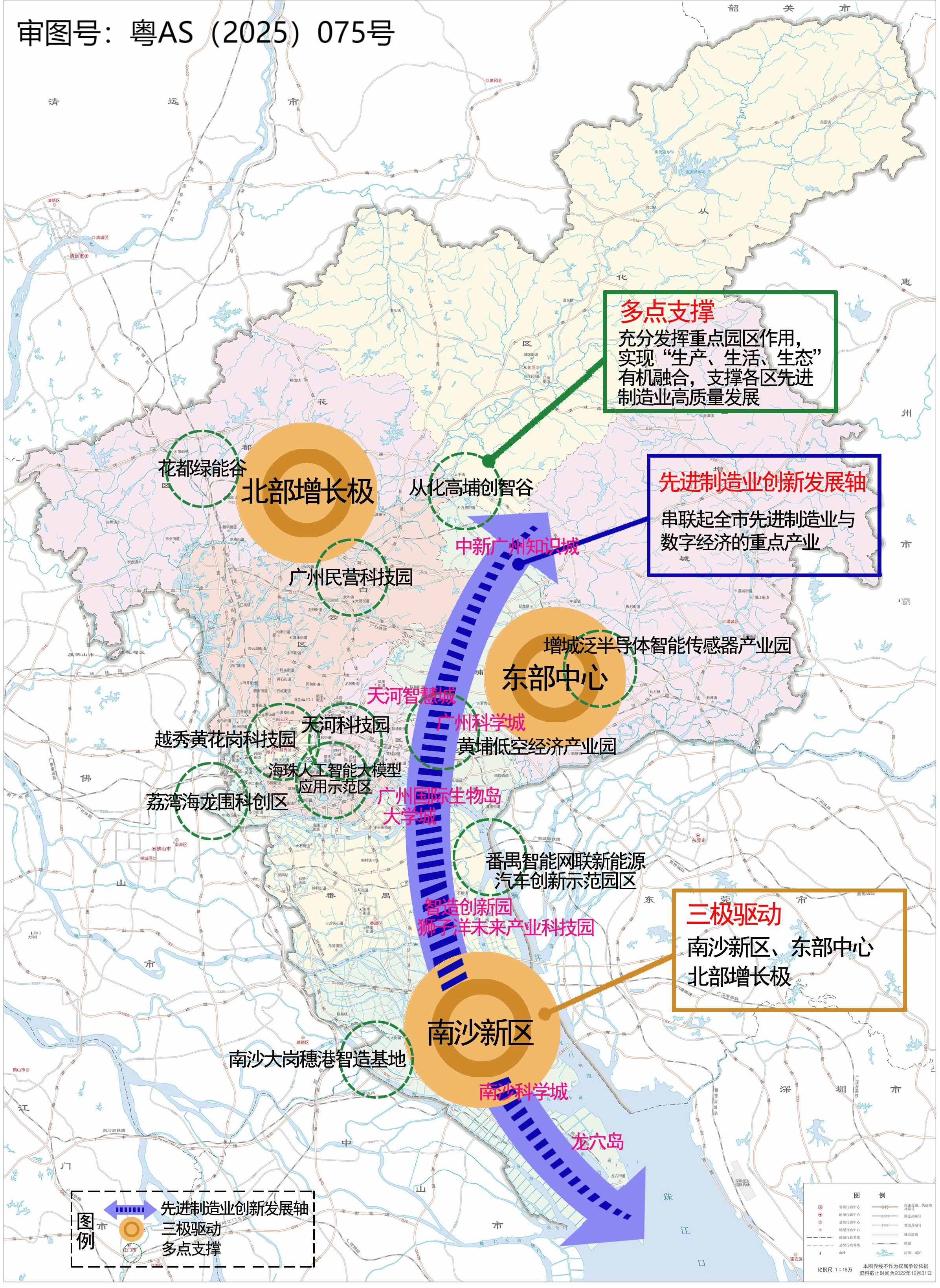
Group 1 - The core viewpoint of the news is the release of the "Guangzhou Plan for Accelerating the Construction of a Strong Advanced Manufacturing City (2024-2035)", which aims to double the industrial added value by 2035 and establish Guangzhou as a globally competitive advanced manufacturing hub [1][2] - By 2030, Guangzhou plans to build several world-class advanced manufacturing clusters and achieve significant breakthroughs in key core technologies, positioning itself at the high end of the global value chain [1][2] - The plan outlines four strategic positions for Guangzhou's advanced manufacturing development: a world-class advanced manufacturing base, a global manufacturing innovation center, a benchmark city for digital-physical integration, and a model city for new-type industrialization [1][2] Group 2 - The plan specifies development directions for emerging pillar industries, including the intelligent connected new energy vehicle sector, which aims to reach a trillion-level scale by 2035, establishing Guangzhou as a "Smart Car City" [2] - In the ultra-high-definition and new display sector, the industry scale is projected to reach 300 billion by 2035, while the intelligent equipment and robotics sector is also expected to achieve a scale of 300 billion [2] - The plan emphasizes the introduction and cultivation of leading enterprises in the semiconductor and integrated circuit fields, as well as the development of key aerospace bases in the low-altitude economy sector [2][3] Group 3 - The spatial layout of advanced manufacturing is defined by "one axis, three poles, and multiple points," with the "one axis" representing the innovation development axis that connects key national development zones [3] - The "three poles" refer to important advanced manufacturing bases in Nansha New Area, Eastern Center, and Northern Growth Pole, which will drive the transformation of manufacturing towards high-end, intelligent, and green directions [3] - The "multiple points" strategy aims to leverage key industrial platforms to create high-quality industrial clusters by linking surrounding advantageous industries [3]
广州大消息!剑指商业航天新一极
Zhong Guo Zheng Quan Bao· 2026-01-08 14:09
Core Insights - Guangzhou aims to double its industrial added value by 2035, focusing on new industrialization and developing 15 strategic industrial clusters, including six emerging pillar industries such as smart connected vehicles and biomedicine [1] - The city plans to foster five strategic leading industries, including artificial intelligence and semiconductors, while enhancing four characteristic advantageous industries like fashion consumer goods and rail transportation [1] - Guangzhou is set to explore low-altitude economy and commercial aerospace, establishing a civil unmanned aerial vehicle testing zone and developing infrastructure for drone operations [2] Group 1: Industrial Development - The plan emphasizes the cultivation of six emerging pillar industries, including smart connected vehicles and new materials, to drive industrial growth [1] - It also highlights the importance of five strategic leading industries, such as renewable energy and biomanufacturing, to support future economic development [1] - The initiative aims to create a series of demonstration applications in future industries, targeting significant growth in scale within 5 to 10 years [1] Group 2: Aerospace and Low-altitude Economy - Guangzhou will develop a civil unmanned aerial vehicle testing zone and infrastructure for drone operations, focusing on new technologies and business models in the low-altitude economy [2] - The city aims to establish a series of advanced launch vehicle industrial bases, emphasizing low-cost, high-reliability rocket technologies and satellite constellations [2] - Collaboration with new-generation information technologies like AI and 5G/6G will be promoted to enhance various industries [2] Group 3: Intelligent Transportation - The city supports the exploration of autonomous driving applications in public transportation, aiming to create world-class demonstration cases [3] - Plans include the construction of closed and open testing zones for smart connected vehicles to accelerate road testing [3] - Development of intelligent cockpit solutions and advanced driver assistance systems will be prioritized [3] Group 4: Robotics Development - Guangzhou will focus on developing prototypes of embodied robots for applications in sectors like home services and industrial manufacturing [4] - Research on intelligent models for embodied robots and the establishment of a supercomputing center for training and evaluation will be initiated [4] - The city aims to advance core components for robots, including high-precision sensors and actuators, to enhance their capabilities [4]
广州:加快建设先进制造业强市,到2035年工业增加值翻一番
Sou Hu Cai Jing· 2026-01-08 11:04
Core Viewpoint - Guangzhou aims to accelerate the construction of an advanced manufacturing city by 2035, targeting a doubling of industrial added value and focusing on the "12218" modern industrial system, integrating advanced manufacturing with modern services, and promoting digital and green transformations [2][14]. Group 1: Key Industrial Directions - The plan emphasizes the development of 15 strategic industrial clusters and six emerging pillar industries, including smart connected new energy vehicles, ultra-high-definition video and new displays, biomedicine and health, green petrochemicals and new materials, software and the internet, and intelligent equipment and robotics [2][38]. - Five strategic leading industries will be cultivated, including artificial intelligence, semiconductors and integrated circuits, new energy and new energy storage, low-altitude economy and aerospace, and biomanufacturing [3][38]. - Four characteristic advantageous industries will be strengthened, such as fashion consumer goods, rail transit, shipbuilding and marine engineering, and intelligent construction and industrialized buildings [4][38]. Group 2: Implementation Strategies - The plan outlines five major projects: industrial agglomeration, industrial innovation, intelligent manufacturing traction, integrated development, and supply chain optimization [14][34]. - Six action plans are proposed, including structural optimization, investment leap, talent attraction and cultivation, digital empowerment, spatial innovation, and element guarantee [14][34]. Group 3: Development Foundations - Guangzhou has a solid manufacturing base, being the most complete industrial city in South China, with significant advantages in technological innovation, green development, and international cooperation [19]. - The city ranks 8th globally in the "Nature Index - Research Cities" and has a robust innovation ecosystem, including numerous national and provincial manufacturing innovation centers [20][27]. Group 4: Opportunities and Challenges - The plan identifies major opportunities from national strategies, such as the manufacturing power strategy and the development of the Guangdong-Hong Kong-Macao Greater Bay Area, which enhances Guangzhou's role as a manufacturing hub [24][18]. - Challenges include the pressure from global economic downturns, the need for industrial upgrades, and competition from other metropolitan areas [28][29]. Group 5: Future Goals - By 2030, the advanced manufacturing city construction is expected to reach significant milestones, with a focus on optimizing industrial structure and enhancing quality and efficiency [36]. - By 2035, Guangzhou aims to solidify its status as an advanced manufacturing city, achieving breakthroughs in key technologies and maintaining a leading position in the global value chain [36][38].

广州经济U型回升,谁在支撑
21世纪经济报道· 2025-12-29 05:40
Core Viewpoint - Guangzhou's economy is experiencing a "U-shaped" recovery, with GDP growth projected to decline to 2.1% in 2024 before rebounding to 4.1% in 2025, driven by strategic emerging industries contributing significantly to economic growth [1][3]. Group 1: Economic Performance - In the first three quarters, the "3+5" strategic emerging industries in Guangzhou achieved an added value of 751.73 billion yuan, a year-on-year increase of 4.6%, contributing 35.2% to GDP growth [1]. - The automotive industry remains a pillar, with Guangzhou's automotive manufacturing value added declining by 2.6% year-on-year, but the decline has narrowed compared to earlier in the year [3][4]. - Guangzhou's new energy vehicle production growth accelerated, with a year-on-year increase of 20.6% in the first three quarters, significantly up from 9.5% in the first half [4]. Group 2: Industry Transformation - The automotive sector is undergoing a strategic shift towards electrification, intelligence, and internationalization, aiming to create a "trillion-yuan output value, intelligent vehicle city" by 2025 [4]. - Other traditional industries, such as home appliances and display manufacturing, are also experiencing significant growth, with the display manufacturing value added increasing by 19.4% [4][5]. - The integration of traditional manufacturing with emerging industries is crucial for Guangzhou's economic recovery, supported by policies that promote collaboration across various sectors [5]. Group 3: Emerging Industries - New projects in emerging industries are being established, including the world's first G8.6 generation printed OLED production line and a flying car production facility by XPeng [7][8]. - The low-altitude economy is thriving, with over 4,200 enterprises in the sector, and significant growth in aerospace manufacturing and civilian drone production [9]. - The establishment of unicorn and specialized enterprises in emerging sectors is vital for sustaining economic growth, with a notable increase in new registrations in fields like quantum technology exceeding 243% [10].
从技术研发到产品应用:科技创业者论道商业化拐点
2 1 Shi Ji Jing Ji Bao Dao· 2025-12-23 11:31
Core Insights - The discussion around robotics has intensified over the past two years, with a focus on commercialization and practical applications rather than just trends [1][5] - Key questions raised include the stability of systems, customer willingness to pay, and the formation of sustainable profit models [1][3] Group 1: Technology and Commercialization - The emphasis is shifting from showcasing capabilities to ensuring reliable delivery and long-term operational stability [2][3] - The path to commercialization is seen as a progression from "being able to move" to "being able to operate stably over time" [2][4] - The importance of safety and stability in early-stage applications is highlighted, with economic viability becoming a consideration only after these factors are addressed [3][4] Group 2: Business Models and Economic Viability - There is no standard answer for business models; the inflection point for commercialization emerges from product evolution and real operational data [3][4] - A clear threshold for economic viability is identified, such as achieving over 80% production efficiency in autonomous mining vehicles [4] - Companies are exploring various business models, including selling solutions versus services, with a focus on delivering clear ROI for clients [4][5] Group 3: Broader Industry Trends - The second roundtable discussion expanded the focus to low-altitude economy and aerospace, emphasizing the need for safety and reliability in these emerging technologies [5][6] - The integration of advanced technologies into existing systems is crucial for true commercialization, moving beyond mere demonstrations [5][6] - The interplay between intelligent systems and globalization is reshaping industry dynamics, with China transitioning from an "applicator" to a "leader" in key sectors [6][9] Group 4: Investment Strategies - The approach of bringing together entrepreneurs from different sectors fosters discussions on common challenges in the commercialization process [8][9] - The focus is on building systemic capabilities that encompass engineering processes, organizational abilities, and cross-scenario replication [8][9] - The investment strategy emphasizes a comprehensive understanding of technology maturity, industry conditions, and customer readiness across various applications [9]

千年商都,怎么进化为科创高地?
Ren Min Ri Bao· 2025-12-10 04:13
Group 1 - Guangzhou's total import and export volume exceeded 1 trillion yuan in the first ten months of this year, setting a historical record for the same period [2] - Guangzhou ranked sixth in the global top ten research cities, surpassing the San Francisco Bay Area [2] - The transformation of Guangzhou from a "thousand-year commercial capital" to a "highland of scientific innovation" reflects China's high-quality development [2] Group 2 - The emphasis on technological innovation as a core element of new productive forces is crucial for high-quality development [3] - The collaboration between academia and industry in projects like the deep-sea combustible ice initiative showcases the synergy of innovation [3] - Guangzhou's innovation ecosystem is supported by a significant concentration of research institutions and high-tech enterprises [3] Group 3 - The rapid growth of new business registrations in emerging sectors such as low-altitude economy and aerospace indicates a fertile ground for innovation [5] - The integration of technological and industrial innovation is accelerating the development of new productive forces across the country [5] Group 4 - High-level openness is essential for forming a new development pattern, with an emphasis on international cooperation and resource utilization [6] - Guangzhou's Nansha district has established a comprehensive service platform to enhance trade facilitation and innovation [7] Group 5 - Guangzhou's exports to the EU and ASEAN increased by 23.9% and 31.1% respectively in the first ten months, demonstrating effective market diversification [8] - The national unified market is breaking down barriers, allowing cities to enhance their advantages through expanded openness [8] Group 6 - The economic spatial structure in China is changing, with major cities and urban clusters becoming key areas for development [9] - The focus on creating new growth poles is part of a broader strategy to drive high-quality development across the nation [9] Group 7 - The collaboration among Shenzhen, Hong Kong, and Guangzhou has led to a significant rise in innovation indices, highlighting the importance of regional integration [12] - The coordinated development across different regions is essential for achieving high-quality growth in China [12]

广州蝶变,照见中国发展的信心与底气(人民观点)
Ren Min Ri Bao· 2025-12-09 22:32
Group 1 - Guangzhou's total import and export volume exceeded 1 trillion yuan in the first ten months of this year, setting a historical record for the same period [1] - Guangzhou ranked sixth in the global top ten scientific research cities, surpassing the San Francisco Bay Area [1] - The transformation of Guangzhou from a "thousand-year commercial capital" to a "highland of scientific innovation" exemplifies China's high-quality development [1] Group 2 - The integration of technology and industry innovation is crucial for developing new productive forces, with Guangzhou leading in this area [2] - New business registrations in emerging industries such as low-altitude economy, aerospace, and quantum technology in Guangzhou have all seen growth rates exceeding 100% [2] - The collaboration between academia and industry in Guangzhou is evident in projects like the deep-sea combustible ice initiative, showcasing the city's innovative capabilities [2] Group 3 - High-level openness is essential for forming a new development pattern, with Guangzhou's Nansha district establishing a comprehensive service platform to enhance trade facilitation [6] - Guangzhou's trade with the EU and ASEAN has increased by 23.9% and 31.1% respectively in the first ten months of this year, indicating successful market diversification [6] - The establishment of innovative systems in Guangdong's free trade zone has led to 45 replicable institutional innovations nationwide [6] Group 4 - The central government's emphasis on forming new growth poles highlights the importance of major cities and urban clusters in driving high-quality development [7] - Guangzhou's role as a leader in the Greater Bay Area is underscored by its innovative cluster ranking first globally, reflecting the city's collaborative strengths [9] - The integration of various regions in China is creating multiple growth poles, enhancing the overall economic development landscape [10]
从“千年商都”到“科创高地” 广州蝶变 照见中国发展的信心与底气(人民观点)
Ren Min Ri Bao· 2025-12-09 22:20
Group 1 - Guangzhou's total import and export volume exceeded 1 trillion yuan in the first ten months of this year, setting a historical record for the same period [1] - Guangzhou ranked sixth in the global top ten scientific research cities, surpassing the San Francisco Bay Area [1] - The transformation of Guangzhou from a "thousand-year commercial capital" to a "highland of scientific innovation" exemplifies China's high-quality development [1] Group 2 - The integration of technology innovation and industrial innovation is emphasized as a core element for developing new productive forces [2] - New business entities in emerging industries such as low-altitude economy, aerospace, and quantum technology have seen over 100% growth in registration this year [2] - The collaboration between academia and industry is highlighted through successful projects like the deep-sea combustible ice initiative [2] Group 3 - High-level openness is essential for forming a new development pattern, with a focus on expanding international cooperation [4][5] - Guangzhou's Nansha district has established a comprehensive service platform to enhance trade facilitation, showcasing its role as a reform pilot zone [6] - The trade volume with the EU and ASEAN has increased by 23.9% and 31.1% respectively in the first ten months of this year [6] Group 4 - The central cities and urban agglomerations are becoming the main spatial forms for carrying development factors, with a focus on creating new growth poles [7][8] - The "Shenzhen-Hong Kong-Guangzhou" innovation cluster has achieved the highest global innovation index, emphasizing regional collaboration [9] - The coordinated development across different regions is seen as a unique advantage for achieving high-quality growth [10]
乘势而上 接续推进中国式现代化建设 ——第二十届中国经济论坛综述
Ren Min Ri Bao· 2025-11-23 23:17
Core Viewpoint - The forum emphasizes the importance of high-quality development as the primary task during the "14th Five-Year Plan" period, aligning with the spirit of the 20th Central Committee's Fourth Plenary Session [2][5]. Group 1: High-Quality Development - High-quality development is identified as the main theme and primary task for the "14th Five-Year Plan" period, focusing on technological self-reliance and green transformation [2][5]. - The forum participants discussed the need for a modern industrial system and the importance of enhancing the material and technological foundation for modernization [5][6]. Group 2: Regional Development and Innovation - Guangdong is positioned as a leader in reform and opening up, with a focus on creating new advantages and breakthroughs in its development strategy [3][4]. - The integration of technology and industry is highlighted as essential for the transformation and upgrading of manufacturing in Guangdong, particularly in strategic emerging industries [6][7]. Group 3: International Cooperation and Market Integration - The forum stresses the need for China to actively engage in international cooperation and competition, enhancing its market-oriented approach and creating a favorable business environment [7][8]. - The importance of aligning with international high-standard trade rules and promoting a transparent and predictable institutional environment is emphasized [6][7]. Group 4: Technological Innovation - The necessity for companies to focus on core technology development and innovation is underscored, with examples from companies like Gree Electric Appliances showcasing advancements in key technologies [8]. - The discussion includes the role of artificial intelligence and the need for collaborative efforts in establishing standards and infrastructure to enhance competitiveness in the global market [8][9].
乘势而上 接续推进中国式现代化建设
Ren Min Ri Bao· 2025-11-23 22:20
Group 1 - The 20th China Economic Forum was held in Guangzhou, focusing on "Chinese-style modernization and the 14th Five-Year Plan economic outlook" [2] - High-quality development is emphasized as the primary task during the 14th Five-Year Plan period, with discussions on how to achieve this goal [3][4] - Guangdong is highlighted as a leader in reform and opening up, with expectations for it to drive high-quality development [3][4] Group 2 - The forum discussed the need for a new quality of productivity, emphasizing the importance of strategic emerging industries and the integration of digitalization and green transformation [5][6] - Participants stressed the importance of developing a modern industrial system and enhancing self-reliance in technology during the 14th Five-Year Plan [6][7] - The need for a favorable institutional environment for high-quality development was highlighted, including aligning with international trade rules [7][8] Group 3 - The forum underscored the importance of maintaining control over development and enhancing international cooperation and competition [8][9] - Chinese enterprises are encouraged to adopt a market-oriented approach and focus on long-term value rather than short-term gains [9][10] - The significance of mastering core technologies and promoting innovation was emphasized, with examples from various companies showcasing their advancements [9][10]
