体育场馆

Search documents
商务部、中宣部、文旅部、央行、金融监管总局、广电总局、体育总局、中国民航局、国铁集团,联合印发通知
财联社· 2026-02-02 05:23
Core Viewpoint - The article outlines the "2026 'Le Gou New Spring' Spring Festival Special Activity Plan" aimed at stimulating consumer spending during the Spring Festival by promoting various activities and incentives across multiple sectors [1][2][3]. Group 1: Activity Overview - The Spring Festival will have a 9-day holiday from February 15 to 23, 2026, with a focus on enhancing market vitality and enriching cultural life [5]. - The plan emphasizes government guidance, market leadership, and public participation, targeting core consumer needs related to family reunions and shopping [4]. Group 2: Activity Content - Culinary activities will include the "Chinese Food Fair" and "Old Brand Carnival," promoting local delicacies and festive meals, with events like food competitions and community food markets [6]. - Housing and accommodation sectors will offer promotions such as "New Spring Home Renewal" and discounts for extended stays in hotels and resorts [7]. - Transportation sectors will enhance capacity and offer special promotions for travel, including ticket discounts and improved services for travelers [8]. - Retail activities will focus on promoting local products and organizing shopping festivals, encouraging participation from various merchants and communities [9]. - Cultural and entertainment events will include film promotions, public performances, and extended hours for museums and sports venues [10]. Group 3: Support Measures - The plan encourages the implementation of reward invoices and shopping lotteries to attract consumer participation [9]. - Financial institutions are urged to collaborate with merchants to offer special promotions, including consumption red envelopes and discounts [10]. - Cross-industry collaborations are promoted, linking dining, accommodation, and entertainment sectors to enhance consumer experiences [10].


《广州市产业用地指南》公开征询意见 构建四级产业空间保障体系
Guang Zhou Ri Bao· 2025-12-10 02:14
Core Viewpoint - Guangzhou's Planning and Natural Resources Bureau, in collaboration with the Development and Reform Commission, has revised the "Guangzhou Industrial Land Guide" to optimize industrial land use and investment direction, aligning with the "12218" modern industrial system [1] Group 1: Industrial Land Guide - The guide emphasizes principles such as efficient land use, prioritizing advanced industries, and integrating flexible regulations with a focus on operational feasibility [1] - It includes a comprehensive directory of industrial guidance, layout instructions, and various land use guidelines, serving as a technical reference for social investment and industrial upgrades [1] Group 2: Encouraged and Restricted Land Use - The industrial guidance directory is designed to meet Guangzhou's industrial development needs and includes lists of encouraged and restricted land use projects [1] - Specific guidelines are provided for encouraged land use projects based on the industrial chain, site requirements, minimum land area for production lines, factory recommendations, and suggested layout areas [1] Group 3: Land Use Guidelines for Various Sectors - The industrial land guide covers 31 major categories and 179 subcategories for independent manufacturing land use [2] - The service sector land guide addresses 10 categories including technology services, professional services, modern commerce, logistics, and exhibitions [2] - Guidelines for profit-oriented social enterprises include 5 categories such as postal services, sports venues, education, healthcare, and social welfare [2] - Infrastructure land use guidelines encompass 14 categories including transportation, railways, ports, and airports [2]
国家发展改革委有关负责人回答证券时报记者提问时表示: 基础设施REITs进一步扩围 酒店、体育场馆、商办设施等纳入
Zheng Quan Shi Bao· 2025-11-27 19:30
Group 1: REITs Expansion - The National Development and Reform Commission (NDRC) is actively promoting the expansion of infrastructure REITs to include urban renewal facilities, hotels, sports venues, and commercial office facilities [1][2] - Since its launch in 2020, the REITs market has expanded to cover 12 major industries and 52 asset types, with 18 asset types from 10 industries having achieved their first issuance [2] Group 2: "Two Heavy" Construction Achievements - The NDRC has allocated 7 trillion yuan and 8 trillion yuan in special long-term bonds for 2024 and 2025, respectively, to support 1,465 and 1,459 "hard investment" projects [3] - Significant improvements in urban safety resilience have been achieved through the construction and renovation of urban underground pipelines [3] - Over 100,000 new high school seats have been created, and 15,000 hospital wards have been renovated to improve healthcare conditions [3] Group 3: Credit Repair and Humanoid Robots - The NDRC has issued the "Credit Repair Management Measures," which will take effect on April 1, 2026, addressing challenges in credit repair management [4] - The NDRC emphasizes the need to balance speed and potential bubbles in the humanoid robot industry, aiming to prevent market saturation and ensure orderly development [5] - The establishment of industry standards and evaluation systems for the humanoid robot sector is a priority, along with support for collaborative technological advancements [5]
国家发改委:基础设施REITs持续扩围 城市更新设施、酒店、体育场馆等将纳入范畴
Bei Jing Shang Bao· 2025-11-27 09:37
Core Viewpoint - The National Development and Reform Commission (NDRC) is actively promoting the expansion of infrastructure REITs to include urban renewal facilities, hotels, sports venues, and commercial office facilities, among other sectors and asset types [1] Group 1: Infrastructure REITs Expansion - The NDRC is working to broaden the scope of infrastructure REITs to more industry sectors and asset types [1] - There is a focus on enhancing collaboration with the China Securities Regulatory Commission (CSRC) to optimize the application and recommendation process for REITs [1] - The NDRC aims to dynamically improve project application requirements while ensuring risk prevention and quality control [1] Group 2: Support for the Real Economy - The initiative is designed to support more eligible projects in issuing and listing, thereby better facilitating the development of the real economy through infrastructure REITs [1]
发改委:基础设施REITs进一步扩围 扩募流程已简化
Jing Ji Guan Cha Wang· 2025-11-27 08:34
Group 1 - The National Development and Reform Commission (NDRC) is actively promoting the expansion of infrastructure REITs to include urban renewal facilities, hotels, sports venues, and commercial office facilities [1] - The NDRC aims to strengthen collaboration with the China Securities Regulatory Commission (CSRC) to optimize the application and recommendation process for REITs, ensuring quality and risk management while supporting more eligible projects [1] - New asset types for REITs issuance are being explored, including railways, ports, ultra-high voltage transmission, communication towers, market-oriented rental housing, cultural tourism, specialized markets, and elderly care facilities [1] Group 2 - Current policy focus is on urban renewal industrial parks and consumer infrastructure, with the first project being the Huaxia Jinyu Intelligent Manufacturing REIT based on urban renewal industrial parks [2] - The process for expanding REITs has been simplified, allowing for applications six months after listing instead of the previous one-year requirement, and enabling cross-industry and cross-regional integration of existing assets [2] - The approval mechanism for expansion projects has shifted to a parallel process, significantly improving efficiency, with a total scale of listed projects reaching 207 billion yuan, expected to drive over 1 trillion yuan in new investments [3]
深圳光明中心区,进阶!
Ren Min Wang· 2025-06-19 12:36
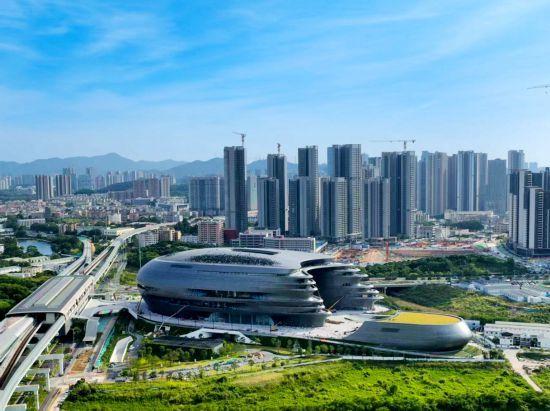
Core Viewpoint - The article highlights the rapid development and transformation of the Guangming Central District in Shenzhen, emphasizing its evolution into a vibrant urban center with significant cultural and scientific facilities, including the Shenzhen Science and Technology Museum and Guangming Science Park [1][10][20]. Group 1: Development Stages of Guangming Central District - Guangming Central District has undergone three developmental phases: the agricultural era (1.0), the industrial era (2.0), and the current scientific city era (3.0) [5][6][20]. - The district's transformation aligns with the broader urban development trajectory of Guangming, showcasing its growth from a farming area to a hub for high-end manufacturing and now to a center for scientific innovation [5][6][20]. Group 2: Infrastructure and Urban Planning - The opening of Metro Line 6 in 2020 marked the beginning of the district's metro era, enhancing connectivity and accessibility [6][10]. - The planned area of Guangming Central District is approximately 7 square kilometers, designed to integrate various functions such as headquarters, technology services, cultural exchanges, and living amenities [8][20]. - Recent infrastructure developments, including the completion of major roads and the establishment of public facilities, are set to further activate the district's spatial structure [8][10][19]. Group 3: Key Projects and Attractions - The Shenzhen Science and Technology Museum, which opened on May 1, 2023, has quickly become a major attraction, receiving nearly 150,000 visitors during the May Day holiday [10][14]. - Guangming Science Park serves as a green core and is a benchmark project for high-quality urban development, with its first phase already popular among residents [12][14]. - The Guangming Sports Center is under construction and will be designed to host international sports events, enhancing the district's cultural and recreational offerings [16][17]. Group 4: Educational and Healthcare Developments - The district is enhancing its educational and healthcare infrastructure, with several new schools and medical facilities already operational or under construction [19][20]. - The presence of high-quality educational institutions and medical resources is expected to attract more residents and contribute to the overall development of Guangming Central District [19][20]. Group 5: Future Prospects and Strategic Importance - Guangming Central District is recognized as a key urban function center in Shenzhen's overall spatial planning, indicating its strategic importance in driving technological innovation and industrial development [20][21]. - The district's focus on ecological, scientific, and cultural elements aims to create a sustainable and livable urban environment, enhancing its appeal to residents and businesses alike [21][25].