
工业资源

Search documents
国金证券:躁动与变化,维持做多思路
Xin Lang Cai Jing· 2026-01-04 08:36
Group 1: Market Overview - Global risk assets have maintained a steady upward trend in a low volatility environment, while commodity prices have risen with increased volatility [1][7] - The Hong Kong stock market has shown particularly strong performance, leading among major global indices, driven by the spillover of US dollar liquidity and industrial catalysts [1][7] - High volatility in asset prices has been observed in the commodity market, indicating a fragile low inventory environment [1][7] Group 2: Long-term Perspective - Industrial metal values relative to US financial assets and broad money supply are at a 20-year low, indicating that physical assets are undervalued [8] - Future demand shocks from industrial changes and supply-side trade policy shifts, combined with low inventory and monetary easing, may amplify asset price volatility [8] - AI investment and the global manufacturing cycle recovery are key drivers for commodity markets in the medium term [8] Group 3: Economic Fundamentals - The latest manufacturing PMI for December exceeded expectations, indicating positive changes in the economic fundamentals [9] - Production has shown an unseasonal increase, with improvements in production, procurement, and business expectations, alongside a rise in inventory indices [9] - New domestic demand expansion policies are being implemented, including a "trade-in" policy for consumer goods and a significant investment plan of approximately 295 billion yuan to stabilize investment [9] Group 4: Seasonal Market Trends - Historical data shows a clear seasonal effect in market performance at year-end, with December typically favoring large-cap value stocks [11] - The current market rebound began in late November, coinciding with a downward trend in the US dollar index, aligning with the recovery of global risk assets [11] - The "spring rally" may already be underway, with high trading volumes in popular sectors reflecting increased risk appetite [11] Group 5: Changing Market Dynamics - The internal driving logic of the market is changing, with domestic economic data and early policy implementations acting as new catalysts [12] - The reliance on marginal improvements in overseas liquidity may not be sustainable, leading to a focus on assets with clearer fundamental signals and lower volatility [12] - Recommended investment areas include industrial resource products aligned with AI investment and global manufacturing recovery, as well as sectors benefiting from domestic consumption recovery [12][5]

国金证券:新的主线正在浮出水面 把握当下切换窗口期
Di Yi Cai Jing· 2025-12-30 00:25
Core Viewpoint - The new investment themes for 2026 are emerging in the commodity market, real industry chain, and foreign exchange market, driven by a scenario where investment exceeds consumption, leading to increased physical consumption across various manufacturing sectors [1] Group 1: Investment Opportunities - Focus on AI investments and the recovery of global manufacturing, particularly in industrial resource products such as copper, aluminum, tin, lithium, crude oil, and oil transportation [1] - Attention to China's equipment export chain, which has global comparative advantages and is confirmed at the bottom of the cycle, including power grid equipment, energy storage, lithium batteries, photovoltaics, engineering machinery, and commercial vehicles [1] - Identify domestic manufacturing sectors that are showing signs of bottom reversal, such as chemicals (dyeing, coal chemicals, pesticides, polyurethane, titanium dioxide) and wafer manufacturing [1] Group 2: Consumer Recovery - Capture the recovery in consumption driven by inbound tourism and rising household income, focusing on sectors like aviation, hotels, duty-free shops, and food and beverages [1] Group 3: Non-Banking Financial Sector - Benefit from the expansion of the capital market and the bottoming out of long-term asset returns, particularly in non-bank financial sectors such as insurance and brokerage [1]
国金策略:新的变化正在出现,未来结构上的信号可能比总量更加清晰
Sou Hu Cai Jing· 2025-12-07 11:00
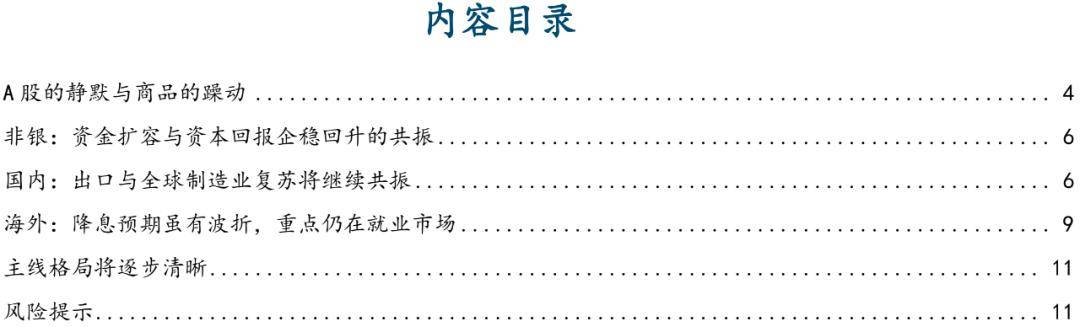
Group 1 - The A-share market is experiencing a period of low trading volume and volatility, with a significant decrease in trading activity and market sentiment due to the lack of new economic or financial data and the upcoming key policy meetings [2][10] - In contrast to the A-share market's stagnation, commodity prices, particularly silver and copper, have seen strong increases, driven by low inventory levels and changing demand dynamics influenced by new industries and policy shifts [2][13] Group 2 - Recent changes in the financial market include a relaxation of constraints on non-bank financial institutions, which is expected to bring more incremental capital into the market and benefit the long-term asset side of non-bank institutions as A-share earnings recover [3][19] - Historical data suggests that after previous relaxations of risk factors for insurance companies and increased leverage for brokerages, the market has performed well, indicating potential for excess returns in the non-bank sector compared to the overall market [3][21] Group 3 - Positive marginal changes in external demand are emerging, with significant improvements in new export orders and related indicators, suggesting a rebound in China's export growth [4][22] - Long-term trends indicate that the onset of a U.S. interest rate cut cycle typically leads to a loosening of global liquidity, which can stimulate foreign direct investment and trade demand, benefiting China's exports [4][24] Group 4 - Despite some fluctuations in overseas interest rate cut expectations, the focus remains on the U.S. labor market, which is currently weak, with recent data showing job losses and high unemployment rates [5][37] - The market anticipates that even if there are short-term fluctuations in the interest rate cut pace, the overall trend towards lower rates is likely to continue, supporting global investment and manufacturing recovery [5][42] Group 5 - The A-share market's current low trading volume and cooling sentiment may lead to clearer structural signals in the future, with potential benefits from the relaxation of constraints on non-bank institutions and the recovery of overall A-share earnings [6][48] - Recommendations for investment include focusing on industrial resource chains, non-bank capital expansion, China's equipment exports, and sectors benefiting from increased consumer spending as capital flows back into the market [6][48]

A股策略周报20251207:新的变化正在到来-20251207
SINOLINK SECURITIES· 2025-12-07 09:24
Group 1: A-shares and Commodity Markets - The A-share market is experiencing a significant reduction in trading volume, with the average turnover rate dropping to the lowest level since July 2023, indicating a cooling in market activity [3][15] - In contrast, commodity markets, particularly metals like silver and copper, are witnessing strong price increases due to historically low inventory levels, which reflect the industry's adaptation to a relatively stable policy environment [3][18] - The recent surge in commodity prices is attributed to the low inventory situation and the potential for new demand driven by emerging industries and policy changes, challenging traditional static supply-demand pricing perspectives [3][18] Group 2: Financial Market Changes - Recent changes in the financial market include a reduction in risk factors for insurance companies and discussions about expanding capital space and leverage limits for brokerages, which may lead to increased market liquidity [4][32] - Historical data suggests that past relaxations of risk factors and leverage policies have resulted in positive market performance, with non-bank financial institutions outperforming the overall A-share market [4][32] Group 3: Domestic Economic Fundamentals - There are positive signs in the domestic economy, particularly in exports, with the November manufacturing PMI showing significant improvement in new export orders, indicating a potential rebound in China's export growth [5][33] - The recovery in external demand is supported by rising export growth rates in South Korea and increased container throughput at major Chinese ports, suggesting a broader recovery in global trade [5][33] Group 4: Global Economic Outlook - The expectation of a shift to a looser global liquidity environment as the Federal Reserve enters a rate-cutting cycle is anticipated to boost foreign direct investment (FDI) and global trade demand [6][36] - Emerging markets, particularly in Africa and ASEAN, are beginning to see increased FDI inflows, which are expected to contribute to China's export growth [5][36][37] Group 5: Interest Rate Expectations - Recent dovish comments from Federal Reserve officials have led to a rise in December rate cut expectations, although the employment market remains a critical concern, with recent data showing a decline in job numbers [6][52][60] - The market is currently pricing in a higher likelihood of rate cuts in 2026 compared to previous forecasts, indicating a more optimistic outlook for monetary policy adjustments [6][57]