智慧文旅

Search documents
促进民营经济高质量发展|搭平台破壁垒,三秦大地涌动创新潮
Ke Ji Ri Bao· 2026-02-11 05:53
Core Viewpoint - The article highlights the significant progress made by Shaanxi Province in supporting the development of the private economy, aiming for a historic increase in its value-added contribution to exceed 50.3% by 2025, thereby playing a crucial role in the province's overall economic landscape [1] Group 1: Policy Initiatives - Shaanxi has prioritized the private economy, with provincial leaders actively engaging in discussions and problem-solving for private enterprises, resulting in the efficient resolution of 326 business challenges through a closed-loop response mechanism [2] - The province has published a comprehensive "Support Policy Handbook" for private enterprises, containing 225 policies that are easily accessible and user-friendly, allowing businesses to find benefits akin to looking up a dictionary [2] - Financial relief measures have been implemented, including a 50% reduction in taxes and fees for small and micro enterprises, creating a market space of nearly 700 billion yuan for small businesses through government procurement [2] Group 2: Innovation and Development - Shaanxi is transforming enterprises from "bystanders" to "innovation partners" by identifying and promoting application scenarios across various sectors, with a total investment of nearly 900 million yuan [4] - The "Chang'an Twelve Hours: Joy of the City" project exemplifies this approach, investing 300 million yuan to create a cutting-edge cultural and technological performance complex, providing clear business opportunities for private enterprises in digital creativity and smart hardware [4] Group 3: Financial Support - To address financing challenges for private and small enterprises, Shaanxi has introduced a combination of "fiscal interest subsidies" and "credit empowerment," with the provincial government providing up to 3.5 percentage points in loan interest subsidies for new projects in manufacturing and high-tech sectors, mobilizing over 23 billion yuan in bank funds [5] - The "Qin Xin Rong" platform has aggregated 120 million credit records, assisting nearly 380,000 businesses in securing over 440 billion yuan in loans, significantly lowering financing barriers [5] Group 4: Systemic Reform and Ecosystem - The support for the private economy in Shaanxi is shifting from traditional management and support to deeper levels of empowerment and co-development, inviting broader societal participation to transform technological and industrial advantages into tangible growth [6]
非遗承古韵 科技赋新篇
Xin Lang Cai Jing· 2026-01-12 23:10
Core Insights - The event "Cultural and Tourism Public Service Product Exchange Exhibition" was held in Nanning, showcasing cultural and creative products from 14 cities in Guangxi, with participation from 43 cultural enterprises and organizations [3][4] - The integration of technology, such as AI and interactive experiences, was a highlight, enhancing traditional cultural tourism and attracting significant public engagement [3][5] - The event facilitated a platform for cultural and tourism integration, promoting high-quality development in Guangxi's cultural tourism sector [5] Group 1 - The exhibition featured traditional cultural items like Zhuang brocade bookmarks, sugar painting, and Chinese knots, which drew large crowds [3] - The AI technology experience area included attractions like robotic dogs and holographic digital humans, which engaged many visitors [3] - Online participation reached 50,000 viewers, demonstrating effective online and offline interaction [3] Group 2 - A thematic lecture on "AI + Cultural Creation" was presented, along with discussions on the application of AI tools in grassroots cultural creation [4] - The event included a business roadshow where service providers showcased AI solutions for public cultural services and smart tourism [4] - The event's innovative format combined traditional markets with smart technology, providing immersive cultural experiences [5]


专精特新第一城,为什么是深圳
21世纪经济报道· 2025-12-26 03:06
Core Viewpoint - Shenzhen has emerged as a vibrant hub for technological innovation, supported by a comprehensive financial service system that covers the entire lifecycle of enterprises, enhancing their growth and development [1][2][13]. Financial Support System - Shenzhen's financial support for technology enterprises includes innovative products like "Tengfei Loan," "Technology Startup Pass," and "Cross-Border Loan," which cater to the financing needs from the seed stage to growth [5][8][10]. - As of October 2025, the balance of technology loans in Shenzhen has exceeded 2.2 trillion yuan, with the issuance of technology innovation bonds ranking among the top in the country [2][13]. Innovative Financial Products - "Tengfei Loan" incorporates future revenue sharing into credit relationships, allowing banks to provide longer-term loans to high-growth tech companies without diluting their equity [5][6]. - "Technology Startup Pass" utilizes data from social security, tax, and intellectual property to identify potential tech enterprises, enabling banks to lend earlier and in smaller amounts [6][7]. - "Cross-Border Loan" facilitates rapid financing for growing enterprises lacking collateral by leveraging a collaborative model among local credit platforms, government financing institutions, and banks [8][10]. Ecosystem Optimization - Shenzhen is building a collaborative "technology-industry-finance" ecosystem, enhancing the "stock-loan-bond-insurance-exchange" linkage to support tech innovation [10][12]. - The "Kowloon Technology Innovation Cooperation Zone" promotes cross-border collaboration and has attracted over 200 high-end research projects and 1.5 million researchers [11][12]. - The "Thousand Billion Financing Plan" in Nanshan District aims to alleviate financing difficulties for tech enterprises by establishing a multi-tiered risk-sharing mechanism [11][12]. Conclusion - The combination of innovative financial products and a supportive ecosystem positions Shenzhen as a leader in nurturing specialized and innovative enterprises, with a financial service system that acts as a "co-builder" and "companion" throughout the innovation process [13].

如何培育服务消费新增长点?学者建议:强化需求侧支撑能力
Nan Fang Du Shi Bao· 2025-12-15 09:26
Core Viewpoint - The development of service consumption is crucial for optimizing economic structure and improving people's livelihoods, as emphasized by the Central Committee's recommendations and the recent Central Economic Work Conference [1][2]. Group 1: Current State of Service Consumption - Service consumption in China is experiencing rapid expansion and structural transformation, with a shift from survival-based to development and enjoyment-oriented consumption [2]. - In 2024, service consumption in China is projected to account for 46.1% of total consumption, significantly lower than the United States at 68.5% and South Korea at 58.9% [2]. - Challenges such as urban-rural development imbalance and insufficient high-end supply hinder the full release of service consumption potential [2]. Group 2: Supply-Side Structural Reform - Service enterprises should innovate service content by utilizing big data and AI to capture changing consumer trends [4]. - Three innovation models are highlighted: cultural IP-based services, technology-enabled smart services, and cross-industry integrated services [4][5]. - Establishing a service innovation protection mechanism is essential to encourage continuous innovation among enterprises [5]. Group 3: Policy and Institutional Environment Optimization - Implementing a negative list system for market access can eliminate hidden barriers and promote new business models [6]. - A "sandbox regulatory" mechanism is proposed to allow for cautious innovation in new service areas [6]. - A comprehensive statistical monitoring system for service consumption is necessary to support policy formulation [6]. Group 4: Demand-Side Support Enhancement - Improving residents' consumption capacity through wage growth mechanisms and tax system enhancements is crucial [8]. - The introduction of service consumption vouchers, particularly in sectors like elderly care and tourism, is recommended to stimulate demand [8]. - Enhancing the consumer environment by establishing credit systems and improving dispute resolution mechanisms is essential [8]. Group 5: New Business Models and New Formats - The development of the digital service economy is encouraged, with a focus on online education, internet healthcare, and smart tourism [9]. - Promoting the sharing economy in sectors like accommodation and transportation can foster new service models [10]. Group 6: Talent and Standards Development - A multi-level talent cultivation system is needed to support the service industry, including the establishment of new service management programs in higher education [11]. - Developing national and industry standards for emerging service sectors is critical to enhance service quality [11].

立林科技:从深耕地产到文旅拓新,以科技生态赋能旅居新体验
Xin Lang Cai Jing· 2025-12-03 13:21
Core Insights - The article emphasizes the strategic shift of the company towards the cultural and tourism sector, leveraging its 30 years of experience in real estate technology to create a new ecosystem of "technology + service + experience" in travel and living [1][26] - The cultural and tourism industry is experiencing significant growth, with domestic travel in China reaching 4.891 billion trips in 2023, a 93.3% increase year-on-year, indicating a vast market opportunity for the company [1][26] Industry Opportunities - The real estate sector is transitioning to a stock competition phase, necessitating developers to expand into the broader accommodation ecosystem [1][26] - The cultural tourism industry is benefiting from both policy and consumer demand, with the "smart tourism" initiative included in the 14th Five-Year Plan, highlighting a trillion-level market potential [1][26] Company Background - The company has over 30 years of experience in intelligent technology, with a national presence of 37 subsidiaries and over 200 offices, serving more than 40 million users and holding over 20% market share [2][27] - It has developed a comprehensive capability system covering smart hardware, IoT platforms, and full-cycle services, which aligns well with the smart needs of the cultural tourism sector [2][27] Market Demand - The demand for diverse and high-quality experiences is reshaping the cultural tourism market, with significant growth in wellness and social hotels, indicating consumers' willingness to pay for unique experiences [3][28] - The aging population is driving a 22% increase in travel orders for seniors in 2024 compared to 2023, reflecting a growing demand for wellness and leisure travel [3][28] Business Focus - The company is targeting three key areas: seamless check-in solutions for hotels, smart room services for various hotel types, and integrated health monitoring systems for wellness hotels [4][29][5] - The approach aims to enhance customer experience throughout the entire stay process, from check-in to check-out [7][31] Ecosystem Collaboration - To address industry challenges such as fragmented procurement and inconsistent standards, the company has formed a smart travel industry alliance with various brands to provide integrated solutions [8][32] - This alliance aims to streamline procurement processes and enhance operational efficiency through a unified service model [8][32] Competitive Advantages - The company leverages its digital operation service platform to facilitate collaboration across IoT, internet, and service networks, allowing for rapid deployment in the cultural tourism sector [33] - With over 500 intellectual property rights and high-end research resources, the company maintains a strong technological edge in the market [33] Resource Strength - The company has established strong relationships with over 60% of the top 100 real estate companies, which serve as initial deployment scenarios for its cultural tourism solutions [9][34] - A nationwide service network ensures quick project implementation and localized support [12][37] - The extensive user base provides insights into consumer needs, allowing for tailored solutions [15][40] Service Model - The company offers a comprehensive service model that includes customized pre-sale solutions, rapid deployment during the sale, and 24-hour operational support post-sale [16][41] - The travel service experience is enhanced through technology, providing seamless interactions at every stage of the customer journey [16][41] Procurement Strategy - The alliance facilitates bulk procurement of core hardware, simplifying the procurement process and reducing costs [17][42] - The company supports flexible customization options for clients, allowing for tailored solutions that meet specific market demands [17][42] Value Proposition - The company aims to enhance consumer experiences through smart services and health guarantees, aligning with its mission to provide a five-star living experience [18][43] - It positions itself as a core partner in the broader accommodation ecosystem, helping clients achieve operational efficiency and value enhancement [19][44] Future Outlook - The company plans to deepen its focus on the cultural tourism sector, aiming for sustainable growth and enhanced brand influence in the market [22][47] - It will continue to integrate its core business areas to achieve synergistic effects and drive innovation in technology and services [24][48]

祥源文旅:首次回购约210万股
Mei Ri Jing Ji Xin Wen· 2025-11-21 11:24
Summary of Key Points Core Viewpoint - Xiangyuan Cultural Tourism announced a share buyback of approximately 2.1 million shares, representing 0.2% of the company's total equity, at an average price of approximately 7.46 CNY per share, totaling 15.6261 million CNY in expenditure [1][1][1] Financial Performance - For the year 2024, the revenue composition of Xiangyuan Cultural Tourism is as follows: - Tourism scenic area business accounts for 63.03% - Smart cultural tourism project hardware and software integration and digital operation and technical services account for 12.43% - Tea sales account for 8.36% - Animation and its derivative businesses account for 7.07% - Hotel services account for 6.6% [1][1][1] Market Position - As of the report, the market capitalization of Xiangyuan Cultural Tourism is 7.6 billion CNY [1][1][1]

豪尔赛创始人被“判三缓四罚300万元”,36岁儿子此前已接班,股价刚涨停
Mei Ri Jing Ji Xin Wen· 2025-11-16 10:55
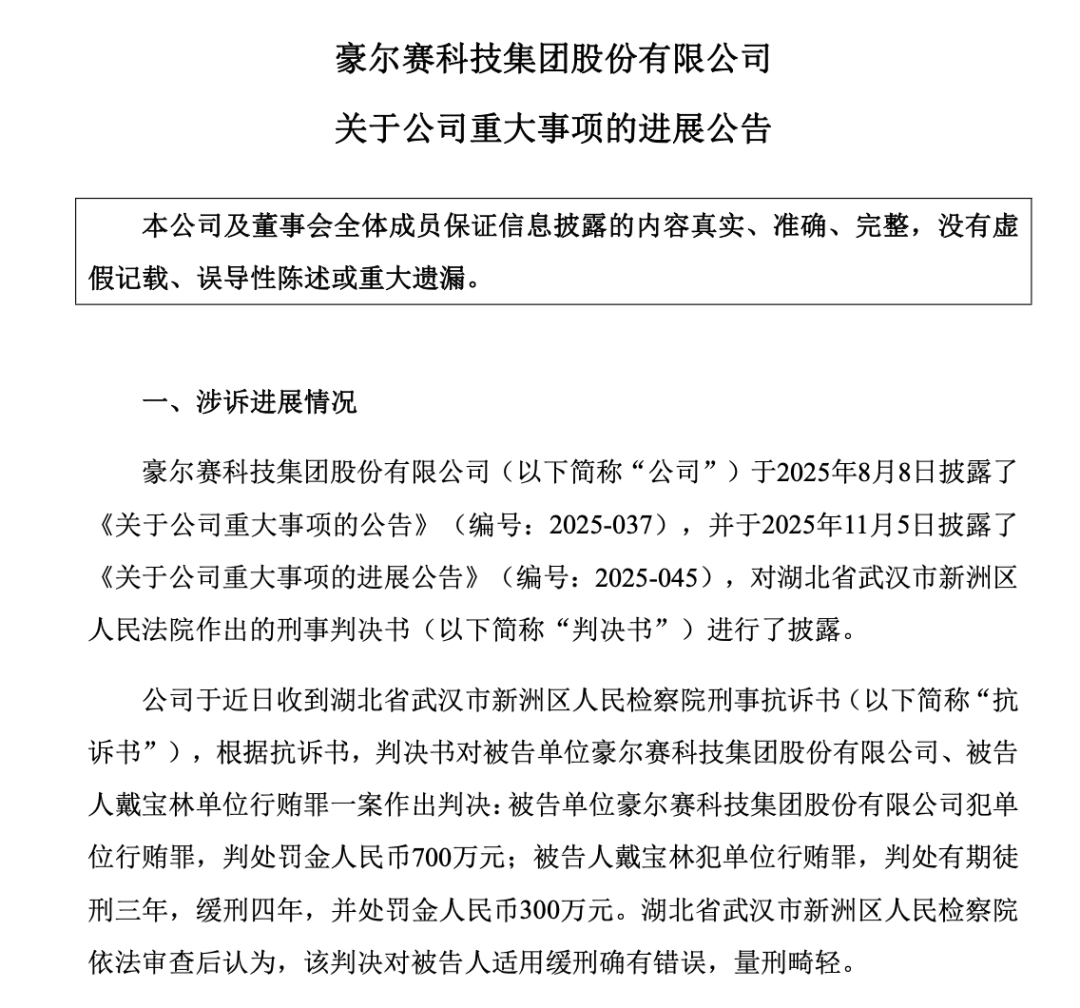
Core Viewpoint - Haosai Technology Group Co., Ltd. is facing legal challenges due to a criminal appeal filed by the People's Procuratorate of Xinzhou District, Wuhan, regarding a bribery case involving the company and its former chairman Dai Baolin [1][4]. Legal Proceedings - The company was fined 7 million RMB for unit bribery, while Dai Baolin received a three-year prison sentence with a four-year probation and a fine of 3 million RMB [1][4]. - The court's final ruling remains uncertain due to the ongoing appeal process initiated by the procuratorate, which argues that the initial sentence was too lenient [1]. Financial Impact - The fines and the amount to be returned to the state total approximately 28.52 million RMB, which represents 15.90% of the company's most recent audited net profit attributable to shareholders [5]. - The company reported a net profit of -26.31 million RMB for the first three quarters of 2025, a decline of 523.96% year-on-year [10][11]. Stock Performance - Haosai's stock has shown significant volatility, with a recent price of 19.17 RMB, reflecting a 44% increase over the past month and a 67% increase year-to-date [7]. - The company went public on October 28, 2019, with an initial offering price of 23.66 RMB per share, but has since experienced a decline in stock value [7]. Management Changes - Following legal issues, Dai Baolin resigned from his positions as chairman and general manager, with his son Dai Congqi taking over as the new chairman [6].

002963,犯单位行贿罪,被罚没超2800万,创始人被判缓刑
Mei Ri Jing Ji Xin Wen· 2025-11-05 22:26
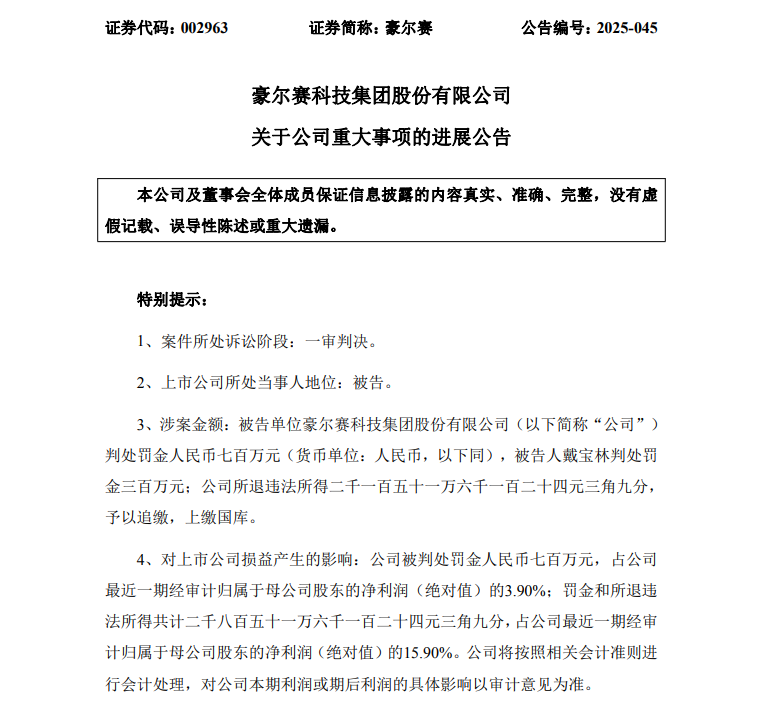
Core Points - The company, Haosai, has been fined over 28 million yuan due to a bribery case involving its founder, Dai Baolin, who received a three-year prison sentence with a four-year suspension [2][4] - Haosai has acknowledged the situation and committed to enhancing internal controls and improving information disclosure quality [4] - The company has faced significant financial challenges, with a continuous decline in revenue and net profit since its IPO in 2019 [5][6] Legal Issues - Haosai was found guilty of corporate bribery, resulting in a fine of 7 million yuan for the company and 3 million yuan for Dai Baolin [2] - The case was initiated by the Wuhan New District Supervisory Committee, which began an investigation into Dai Baolin in December 2024 [4] Management Changes - Dai Baolin resigned from his positions as chairman and CEO due to reaching retirement age, and his son, Dai Congqi, has taken over as the new chairman [5] - Dai Baolin's annual salary for 2024 was reported to be 1.2052 million yuan [5] Financial Performance - Haosai's revenue for the first three quarters of 2025 was approximately 265 million yuan, representing a nearly 30% decline year-on-year [6] - The company has reported net losses for four consecutive years from 2021 to 2024, with losses of 9.511 million yuan, 169 million yuan, 46.2 million yuan, and 109 million yuan respectively [5][6] - Despite poor financial performance, Haosai's stock price has increased significantly, with a rise of over 24% in October and over 47% year-to-date [7]
祥源文旅:10月24日召开董事会会议
Mei Ri Jing Ji Xin Wen· 2025-10-24 11:19
Group 1 - The core point of the article is that Xiangyuan Cultural Tourism (SH 600576) announced the cancellation of its supervisory board and the revision of its articles of association during a board meeting held on October 24, 2025 [1] - The company's revenue composition for the year 2024 is as follows: tourism scenic area business accounts for 63.03%, smart cultural tourism project hardware and software integration and digital operation and technical services account for 12.43%, tea sales account for 8.36%, animation and its derivative businesses account for 7.07%, and hotel services account for 6.6% [1] - As of the report date, the market capitalization of Xiangyuan Cultural Tourism is 7.6 billion yuan [1]
“黑科技”释放消费升级新动能
Sou Hu Cai Jing· 2025-10-17 17:09
Core Viewpoint - The digital economy is significantly transforming daily life in Guizhou, enabling residents to easily complete various tasks such as travel booking, shopping, and government services through mobile devices, enhancing the quality of life and stimulating new consumption potential [1][4]. Digital Infrastructure - Guizhou has achieved full 5G network coverage in administrative villages, with over 99.9% mobile network coverage in natural villages, laying a solid foundation for digital consumption [4]. - The provincial government launched the "Colorful Guizhou Happy Shopping" campaign during the National Day and Mid-Autumn Festival, distributing consumption vouchers and offering discounts to consumers [4]. Consumer Trends - The retail sales of communication equipment in Guizhou are projected to grow over 30% year-on-year by mid-2025, with basic software development increasing by over 100%, indicating a strong support for consumption driven by digital industries [5]. - Digital technology is making shopping more convenient, with residents enjoying the benefits of online shopping and quick delivery services [5]. Smart Tourism - The "AI Tour of Xijiang" experience center has become a popular attraction, offering AI photography and smart ticketing services that enhance the visitor experience [7]. - The virtual assistant "Huang Xiaoxi" provides comprehensive travel services through a WeChat mini-program, making it easier for tourists to plan their trips [7]. - Innovative projects like the "Red Ribbon" initiative use immersive digital technology to create engaging new consumption scenarios for tourists [7][8]. Daily Life Applications - Big data applications in healthcare and government services are enhancing convenience for residents, such as the "24/7 Government Service Station" and "smart photo examination machines" that streamline processes [12]. - These innovations save time for citizens, allowing them to focus on enjoying life rather than running errands, thereby releasing consumer potential and improving quality of life [12].