
智能康养

Search documents
这个“10万亿”,意味着什么?
Ren Min Ri Bao· 2026-01-19 09:23
Group 1: Overall Electricity Consumption - In 2025, China's total electricity consumption is expected to exceed 10 trillion kilowatt-hours for the first time, which is more than double the annual electricity consumption of the United States and higher than the combined total of the EU, Russia, India, and Japan [1] - The electricity consumption in 2025 will be nearly double that of 2015, reflecting a unique growth rate among major global economies [1] Group 2: Industrial Electricity Consumption - By 2025, the secondary industry is projected to consume 66,366 billion kilowatt-hours, accounting for approximately 64% of total electricity consumption, maintaining its status as the primary sector [2] - The demand for electricity in high-value-added and technology-intensive industries is increasing, with significant growth in sectors like semiconductor manufacturing and artificial intelligence [2][3] - The electricity consumption in the computer, communication, and other electronic equipment manufacturing sectors is expected to surpass 50 billion kilowatt-hours for the first time, overtaking traditional industries like steel and chemicals [2] Group 3: Service Sector Electricity Consumption - The tertiary industry is anticipated to consume nearly 2 trillion kilowatt-hours in 2025, with a year-on-year growth of 8.2%, representing about 19.2% of total electricity consumption [3] - The rapid growth of the data industry, particularly in big data and cloud computing, is a significant driver of electricity consumption in regions like Guizhou [3] Group 4: Electrification and Energy Efficiency - The electrification rate of end-use energy is approximately 30%, which is higher than that of major developed economies, contributing to increased electricity consumption [4] - Investments in smart irrigation systems and rural electrification projects are enhancing energy efficiency and supporting agricultural electricity needs [5] Group 5: Power Supply and Infrastructure - China's power generation capacity accounts for one-third of the global total, with over 95% of coal-fired power plants achieving ultra-low emissions [6][7] - The construction of extensive ultra-high voltage transmission lines is facilitating the transfer of clean energy from western regions to eastern load centers, enhancing the reliability of electricity supply [7] - The national electricity market is evolving, with a significant increase in market transaction volumes, reflecting a more dynamic and integrated electricity supply system [8] Group 6: Future Outlook - The anticipated electricity consumption of 10 trillion kilowatt-hours signifies an upgrade in power supply capabilities and reflects the ongoing transformation of the Chinese economy towards higher quality and sustainability [9]
人民日报丨2025年全社会用电量超10万亿千瓦时,意味着什么?
国家能源局· 2026-01-19 07:39
Core Viewpoint - The article highlights that by 2025, China's total electricity consumption will exceed 10 trillion kilowatt-hours for the first time, marking a significant milestone in global energy consumption trends [3][4]. Group 1: Electricity Consumption Growth - In 2025, China's total electricity consumption is projected to reach 10.3682 trillion kilowatt-hours, more than double that of the United States and higher than the combined consumption of the EU, Russia, India, and Japan [3]. - The electricity consumption in 2025 will be nearly double that of 2015, showcasing an unprecedented growth rate among major economies [4]. Group 2: Industrial and Sectoral Changes - The second industry is expected to consume 66,366 billion kilowatt-hours, accounting for approximately 64% of total electricity consumption, with significant contributions from high-value-added and technology-intensive sectors [5]. - The demand for electricity in the semiconductor industry is surging, with companies like Huahong Semiconductor reporting over a 43% year-on-year increase in electricity consumption due to rising production needs [5]. - The third industry will see electricity consumption nearing 2 trillion kilowatt-hours, with a year-on-year growth of 8.2%, driven by sectors like electric vehicle charging and information technology services [6]. Group 3: Electrification and Energy Efficiency - The electrification rate of end-use energy is around 30%, surpassing that of major developed economies, which is contributing to increased electricity consumption [7]. - Investments in smart irrigation systems and rural electrification projects are enhancing agricultural productivity and electricity demand in rural areas [7][8]. Group 4: Power Supply and Infrastructure - China has the world's largest power supply system, with renewable energy sources accounting for over one-third of total electricity generation, and wind and solar capacity surpassing that of coal [9]. - The construction of ultra-high voltage transmission lines is facilitating the transfer of clean energy from resource-rich western regions to eastern load centers, enhancing the reliability of electricity supply [10]. - The national electricity market is evolving, with a significant increase in market transaction volumes, reflecting a more dynamic and responsive electricity supply system [11].


这个“10万亿”,意味着什么
Ren Min Ri Bao· 2026-01-19 02:42
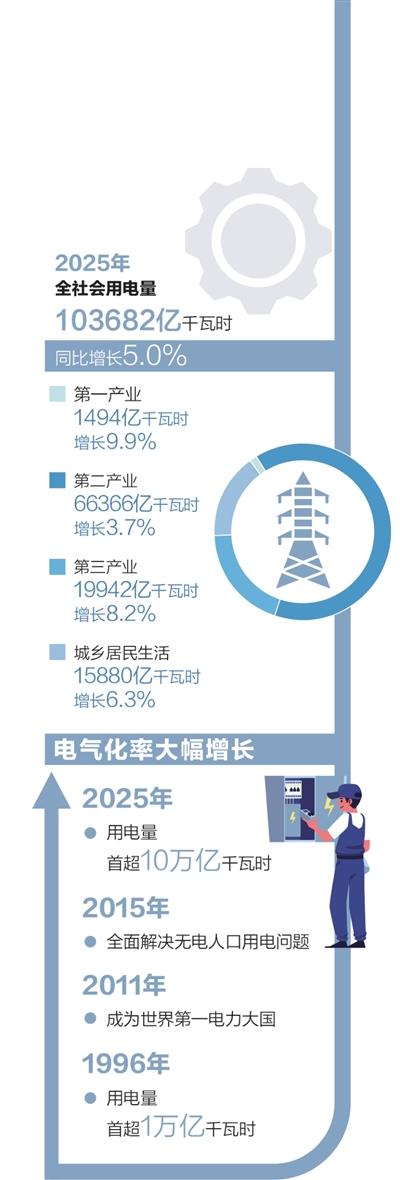
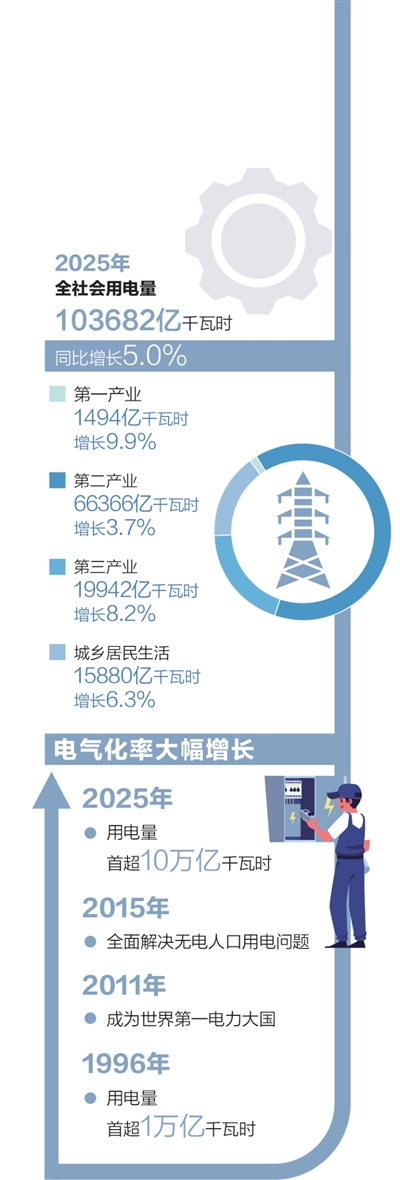
Core Insights - In 2025, China's total electricity consumption will exceed 10 trillion kilowatt-hours for the first time, marking a significant milestone in global energy consumption [2][11] - This consumption level is more than double that of the United States and surpasses the total consumption of the EU, Russia, India, and Japan combined [2] - The growth in electricity consumption reflects China's robust manufacturing capabilities and enhanced energy security [2] Electricity Consumption by Sector - The total electricity consumption in 2025 is projected to be 10,368.2 billion kilowatt-hours, with the primary industry consuming 149.4 billion kilowatt-hours (up 9.9%), the secondary industry 66,366 billion kilowatt-hours (up 3.7%), and the tertiary industry 19,942 billion kilowatt-hours (up 8.2%) [1][3] - The secondary industry remains the largest consumer, accounting for approximately 64% of total consumption, with significant growth in high-value and technology-intensive sectors [3][4] - The tertiary industry is also a key driver of electricity consumption, with notable growth in data centers and information technology services [4] Electrification and Energy Efficiency - The electrification rate of end-use energy is around 30%, which is higher than that of major developed economies, contributing to increased electricity consumption [6][5] - Rural electrification efforts have led to a narrowing gap in electricity consumption between urban and rural residents, supported by significant investments in rural power infrastructure [6][5] Renewable Energy and Power Supply - China has the world's largest power supply system, with renewable energy sources like wind and solar surpassing traditional coal power in installed capacity [8][9] - The country has made substantial investments in clean energy and grid infrastructure, with over 46 ultra-high voltage projects completed to enhance energy distribution [9][10] - The national electricity market has seen a significant increase in trading volume, reflecting a more dynamic and integrated energy market [10] Industry Trends - The shift towards high-end, intelligent, and green development is evident, with new electricity growth points emerging from high-tech manufacturing and renewable energy sectors [4][3] - The demand for electricity in the artificial intelligence sector and data centers is driving substantial increases in consumption, particularly in regions like Zhejiang and Jiangsu [3][4] Conclusion - The anticipated growth in electricity consumption to over 10 trillion kilowatt-hours by 2025 signifies not only an upgrade in power supply capabilities but also a transition towards a more modern and efficient economy [11]
这个“10万亿” 意味着什么
Ren Min Ri Bao· 2026-01-19 01:37
Core Insights - In 2025, China's total electricity consumption is projected to exceed 10 trillion kilowatt-hours for the first time globally, reflecting significant economic growth and energy security improvements [2][10] Group 1: Electricity Consumption Growth - China's electricity consumption in 2025 is expected to reach 10,368.2 billion kilowatt-hours, more than double that of the United States and surpassing the total consumption of the EU, Russia, India, and Japan combined [2] - The electricity consumption in 2025 will be nearly double that of 2015, showcasing an unprecedented growth rate among major economies [2][3] Group 2: Industrial and Sectoral Changes - The secondary industry is projected to consume 66,366 billion kilowatt-hours, accounting for approximately 64% of total consumption, with significant contributions from high-value-added and technology-intensive sectors [3] - The electricity consumption in the computer, communication, and other electronic device manufacturing sectors is expected to exceed 50 billion kilowatt-hours, surpassing traditional industries like steel and chemicals [3][4] - The third industry is anticipated to consume nearly 2 trillion kilowatt-hours, with a year-on-year growth of 8.2%, driven by sectors such as electric vehicle charging and information technology services [4] Group 3: Electrification and Energy Efficiency - The electrification rate of end-use energy is around 30%, which is higher than that of major developed economies, contributing to increased electricity consumption [5] - Smart irrigation systems in agriculture have improved efficiency by approximately 65%, indicating advancements in energy use in traditional sectors [6] Group 4: Power Supply and Infrastructure - China has the world's largest power supply system, with renewable energy sources accounting for over one-third of total electricity generation, and wind and solar capacity surpassing thermal power for the first time [7][8] - The construction of ultra-high voltage transmission lines has strengthened the energy supply network, facilitating the transfer of clean energy from western regions to eastern load centers [8][9] - The national electricity market has seen a significant increase in transaction volume, doubling from 10.7 trillion kilowatt-hours to 23.8 trillion kilowatt-hours, now accounting for over 60% of total electricity consumption [9]
全球首次,2025年我国全社会用电量超10万亿千瓦时——这个“10万亿”,意味着什么(经济新方位)
Ren Min Ri Bao· 2026-01-19 01:33
Core Insights - In 2025, China's total electricity consumption is projected to exceed 10 trillion kilowatt-hours for the first time, marking a significant milestone in global energy consumption [3][4] - The growth in electricity consumption reflects China's status as a manufacturing powerhouse and indicates a substantial improvement in energy security [3][4] Group 1: Electricity Consumption Growth - Total electricity consumption in 2025 is expected to reach 10,368.2 billion kilowatt-hours, a year-on-year increase of 5.0% [3] - The first industry will consume 149.4 billion kilowatt-hours, growing by 9.9% [3] - The second industry will account for 66,366 billion kilowatt-hours, with a growth rate of 3.7% [3] - The third industry will consume 19,942 billion kilowatt-hours, reflecting an 8.2% increase [3] - Urban and rural residents' electricity consumption will reach 15,880 billion kilowatt-hours, growing by 6.3% [3] Group 2: Industrial and Sectoral Changes - The second industry remains the primary electricity consumer, accounting for approximately 64% of total consumption [4] - High-value-added and technology-intensive industries are driving new electricity consumption growth, with semiconductor manufacturing seeing a significant increase [4][5] - The third industry is becoming a crucial driver of electricity consumption, with sectors like data centers and electric vehicle charging services experiencing rapid growth [5][7] Group 3: Electrification and Energy Efficiency - The electrification rate of end-use energy is around 30%, surpassing that of major developed economies [7] - Investments in smart irrigation systems and rural electrification projects are enhancing energy efficiency and supporting agricultural electricity needs [7][8] - The development of electric heating and high-temperature heat pumps in industrial sectors is contributing to energy transition [8] Group 4: Power Supply and Infrastructure - China has the world's largest power supply system, with renewable energy sources like wind and solar surpassing traditional coal power [9][10] - The construction of ultra-high voltage transmission lines is facilitating the transfer of clean energy from resource-rich regions to consumption centers [10] - The national electricity market is evolving, with significant increases in electricity trading volumes, reflecting a more dynamic and integrated energy market [11]
全球首次,2025年我国全社会用电量超10万亿千瓦时—— 这个“10万亿”,意味着什么(经济新方位)
Ren Min Ri Bao· 2026-01-18 22:05
Group 1 - In 2025, China's total electricity consumption is projected to exceed 10 trillion kilowatt-hours for the first time, which is more than double the annual electricity consumption of the United States and higher than the combined total of the EU, Russia, India, and Japan [1] - The electricity consumption growth reflects China's status as a manufacturing powerhouse and indicates a significant improvement in energy security [1] - The electricity consumption in the secondary industry is expected to reach 66,366 billion kilowatt-hours, accounting for approximately 64% of total consumption, with a notable shift towards high-value-added and technology-intensive industries [2] Group 2 - The demand for electricity in the semiconductor industry is surging, with companies like Huahong Semiconductor reporting over 43% year-on-year growth in electricity consumption due to increased production [2] - The electricity consumption in the computer, communication, and other electronic equipment manufacturing sectors is projected to surpass 50 billion kilowatt-hours for the first time, overtaking traditional industries like steel and chemicals [2] - The third industry is also contributing significantly to electricity consumption, with a projected growth of 8.2% year-on-year, reaching nearly 2 trillion kilowatt-hours by 2025 [3] Group 3 - The electrification rate of end-use energy in China is around 30%, which is higher than that of major developed economies, contributing to increased electricity consumption [4] - The implementation of smart irrigation systems in agriculture has improved efficiency by approximately 65%, showcasing the impact of electrification on traditional sectors [5] - The gap in electricity consumption between urban and rural residents is gradually narrowing, supported by significant investments in rural power grid upgrades [5] Group 4 - China's power supply system is the largest globally, with renewable energy sources like wind and solar surpassing thermal power for the first time [6] - The country has built the world's largest clean coal power supply system, with over 95% of coal power units meeting ultra-low emissions standards [6] - The construction of high-voltage transmission lines has strengthened the electricity grid, facilitating the transfer of clean energy from resource-rich regions to consumption centers [7] Group 5 - The establishment of a unified national electricity market has significantly increased electricity trading volume, doubling from 10.7 trillion kilowatt-hours to 23.8 trillion kilowatt-hours since the 13th Five-Year Plan [8] - The electricity market's role as a regulator and price guide has been enhanced, contributing to the efficient allocation of resources [8] - The energy sector is actively promoting a new energy system and advancing green and low-carbon transitions, supporting high-quality development of renewable energy [8]
打造银发经济“理想沃土”
Su Zhou Ri Bao· 2026-01-10 00:55
Group 1 - The "Silver Economy" in Suzhou is being promoted as a "trillion-dollar blue ocean" opportunity, aiming to attract talent and investment through strategic initiatives and collaboration with various sectors [1][2] - Suzhou has established a high-quality development mechanism led by the municipal government, involving 27 departments, and has set up a 1 billion yuan fund for the elderly care industry [2] - The city has identified nearly 20,000 key enterprises in the silver economy, covering 10 industrial chains, and is developing specialized parks and laboratories to foster innovation and collaboration [2][3] Group 2 - The "Silver Age 18" initiative has been launched to create a platform for collaboration among government, enterprises, and educational institutions, facilitating partnerships and projects in the silver economy [3] - Local companies, such as Suzhou Hengersida Medical Technology Co., are benefiting from government support, with significant sales and partnerships established in the elderly care sector [3][4] - Technological empowerment is a key feature of Suzhou's silver economy, with innovative products being developed to enhance elderly care and rehabilitation [4][5] Group 3 - A demonstration center for elderly care technology has been established, attracting over 20 smart manufacturing companies to collaborate on product testing and optimization [5][6] - The center provides a platform for companies to develop and refine age-appropriate products through real-world testing and feedback [5][6] - The center aims to become a benchmark for technological innovation and humanistic care in the region and potentially nationwide [6] Group 4 - The "Silver Economy Innovation and Entrepreneurship Competition" held in Suzhou attracted nearly 200 projects from across the country, showcasing the city's commitment to fostering innovation in this sector [7][8] - Companies like Shanghai Midsida Medical Technology Co. have successfully established operations in Suzhou, benefiting from the city's efficient business environment and support for the elderly care industry [8][9] - The rapid establishment of new companies in Suzhou highlights the city's ability to facilitate the transition from innovative ideas to industrial implementation in the silver economy [9]
科技焕新艾灸 掘金蓝海市场——华远创新(香港)艾宝艾灸机器人的破局与领航
Xin Lang Cai Jing· 2025-12-22 04:58
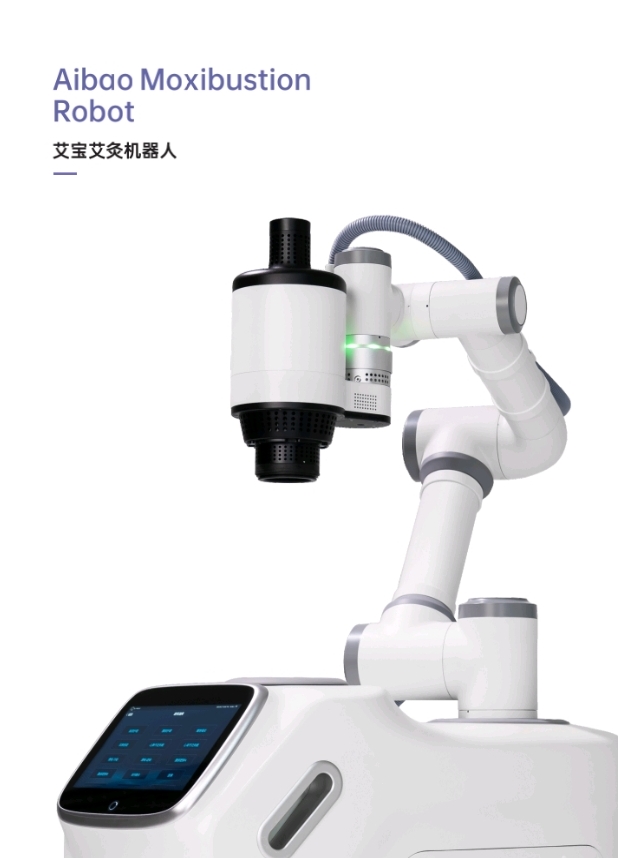
Core Insights - The article highlights the launch of the AiBao Moxibustion Robot by Huayuan Innovation (Hong Kong), which integrates traditional moxibustion practices with advanced technology to address modern health concerns and enhance user experience [1][4]. Product Innovation - The AiBao Moxibustion Robot represents a comprehensive upgrade of traditional moxibustion, addressing consumer pain points by combining the essence of traditional Chinese medicine with smart technology [4]. - Key features include an automatic smoke-free design, deep penetration heating technology, an intelligent acupoint positioning system, real-time temperature and distance control, and a large treatment head for efficient and comfortable use [4][5]. - The product is designed to be user-friendly, making moxibustion accessible to a wider audience, including office workers, the elderly, and health enthusiasts [4]. Market Potential - The launch of the AiBao Moxibustion Robot coincides with the rapid growth of the health and wellness market, particularly in the smart health sector, driven by factors such as an aging population and increasing health awareness [9]. - The electronic moxibustion device market in China reached 5 billion yuan in 2023, with a compound annual growth rate exceeding 20%, projected to exceed 15 billion yuan by 2030 [9]. - The home health care segment is identified as a core growth driver, with sales of home health products growing over 50% annually, indicating a strong demand for convenient and personalized health solutions [9]. Strategic Positioning - Huayuan Innovation (Hong Kong) has established a first-mover advantage in the burgeoning market by leveraging the AiBao Moxibustion Robot's unique positioning that combines traditional and technological elements [12]. - The company is strategically positioned in the home health care sector, catering to diverse consumer needs and application scenarios while continuously investing in research and development to expand product capabilities [12][13]. - The market landscape is evolving, with applications of smart moxibustion extending beyond homes to include traditional Chinese medicine clinics and rehabilitation centers, as well as expanding into international markets [10].

四中全会精神解读·市场最前沿丨告别“失能的尴尬”,看智慧康养新升级
Xin Hua She· 2025-11-24 10:45
Core Insights - The article highlights the advancements in smart caregiving technology, particularly focusing on the introduction of intelligent nursing robots that assist in the care of disabled elderly individuals, thereby improving their quality of life and dignity [1][3][4]. Group 1: Technological Innovations - The intelligent nursing robot, designed to assist with the toileting needs of disabled individuals, operates autonomously upon detecting urine, significantly reducing the physical and emotional burden on caregivers [1][3]. - The integration of real-time monitoring systems in the next generation of nursing robots will allow caregivers to track vital health data such as heart rate and blood oxygen levels via mobile devices, enhancing the precision and convenience of care [3][5]. Group 2: Market Opportunities - The aging population in China, with over 40 million disabled or semi-disabled elderly individuals, presents a significant market opportunity for the caregiving industry [3][6]. - The implementation of long-term care insurance (LTCI) across various cities, including Nantong, is expected to increase accessibility to smart caregiving products, with price reductions exceeding 30% for certain technologies [3][4]. Group 3: Industry Trends - The convergence of technology and caregiving is seen as a response to the challenges posed by an aging population, leading to an evolution in the caregiving sector that emphasizes dignity and quality of life for the elderly [5][6]. - The ongoing development of various smart caregiving devices, such as exoskeleton robots and AI-assisted feeding systems, indicates a trend towards more sophisticated and precise caregiving solutions [5][6].

西湖:文新康养e家 提供一站式为老服务
Hang Zhou Ri Bao· 2025-10-31 02:49
Core Viewpoint - The "Warm Neighbor Market" event in Xihu District integrates AI technology with traditional elder care culture, providing a one-stop service for elderly residents [1] Group 1: Event Highlights - The event featured multiple AI smart elderly care companies, showcasing products that combine technology with elder care [1] - Interactive experiences included a "robot dog" that danced and engaged with seniors, and a "pulse diagnosis device" that provided personalized health recommendations using AI [1] - The event attracted significant participation, with seniors expressing surprise and delight at the availability of such technology in their community [1] Group 2: Community Engagement - The venue also hosted "nine scene check-in" activities, allowing seniors to familiarize themselves with future community health and wellness facilities [1] - Activities included calligraphy, painting, dancing, and exercise, promoting an engaging and active lifestyle for the elderly [1] - The local government highlighted that the 康养e家 has been recognized as one of the first experience points for elderly care lifestyle in Xihu District, with plans to enhance services based on resident needs [1]