电力装备等

Search documents
“人工智能+制造”重要部署来了!万字文件,信息量极大
Shang Hai Zheng Quan Bao· 2026-01-07 12:07
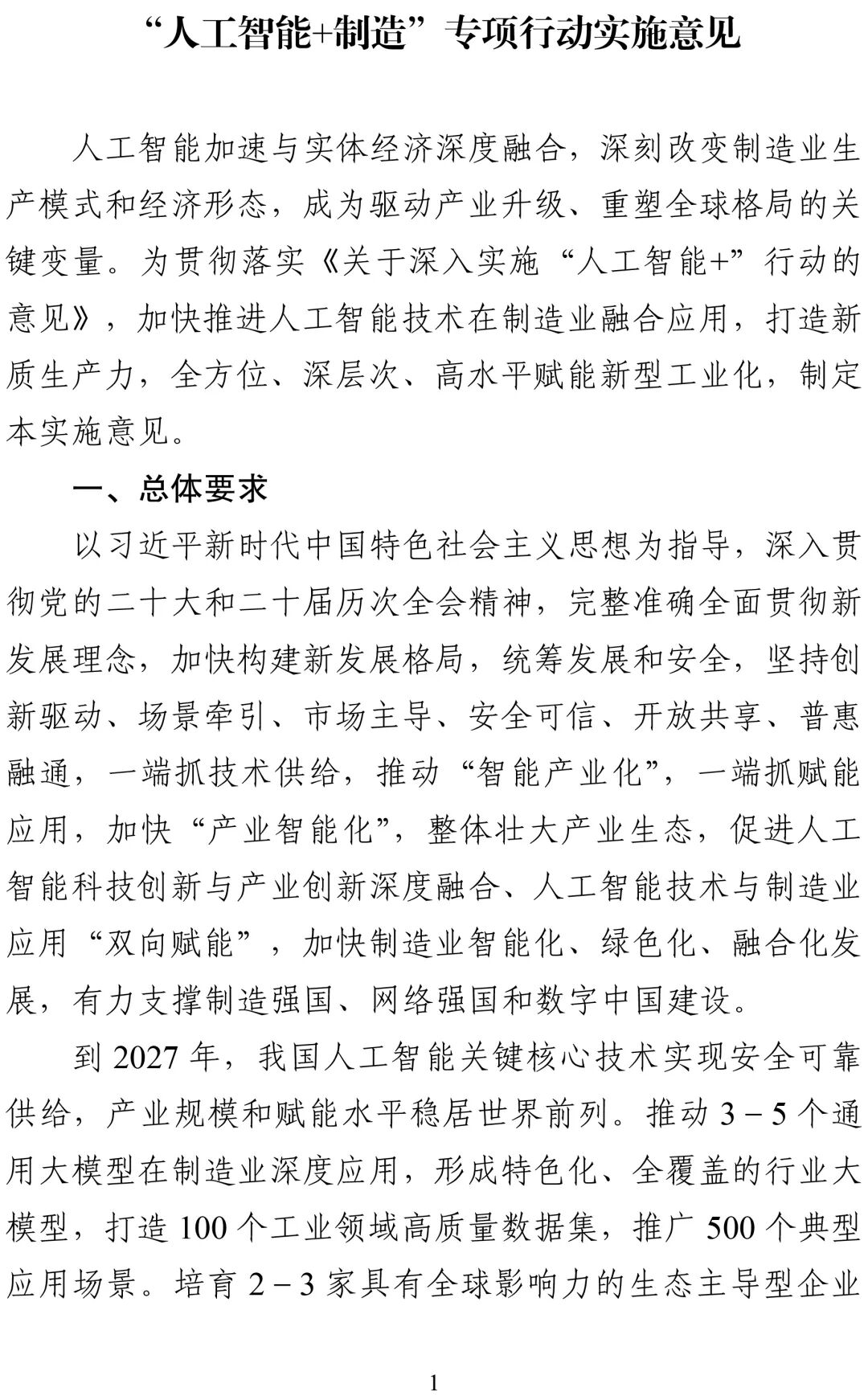
Core Viewpoint - The "Artificial Intelligence + Manufacturing" Special Action Implementation Opinion aims to enhance China's AI capabilities in manufacturing by 2027, focusing on developing core technologies, promoting large models, and creating high-quality data sets and application scenarios [1][4]. Group 1: AI Technology Development - By 2027, China aims to achieve secure and reliable supply of key AI technologies, maintaining a leading position in industry scale and empowerment levels [1][4]. - The initiative includes the promotion of 3-5 general large models in manufacturing, the creation of 100 high-quality industrial data sets, and the promotion of 500 typical application scenarios [1][4]. - Support for the development of intelligent chips and core technologies such as high-end training chips and AI servers is emphasized [2][4]. Group 2: Industry Model and Data Management - The plan includes the development of high-performance algorithm models tailored to the real-time, reliability, and safety needs of the manufacturing sector [2][5]. - Establishing a chief data officer system in enterprises to enhance data management capabilities is a key focus [6][7]. - The initiative aims to create a public service platform for models, providing high-level models and supporting tools [6]. Group 3: Application and Transformation - The program promotes AI empowerment in key manufacturing sectors, including raw materials, equipment manufacturing, consumer goods, and software services [8][9]. - It encourages the deep integration of AI technologies into all processes of manufacturing, from design to production and marketing [10][11]. - The initiative aims to enhance the readiness of manufacturing enterprises for AI applications, providing guidelines for implementation [11][12]. Group 4: Ecosystem and Talent Development - The establishment of a national AI innovation center and key laboratories in the AI field is planned to enhance the supply of common technologies [17][19]. - The initiative supports the cultivation of AI talent through educational programs and training platforms [21][22]. - It emphasizes the importance of creating a collaborative ecosystem among AI companies, manufacturing enterprises, and service providers [19][20]. Group 5: Safety and International Cooperation - Enhancing safety measures in AI applications, including data security and risk management, is a priority [22][24]. - The initiative encourages international cooperation in AI, promoting Chinese AI solutions globally [25][26]. - It aims to establish a comprehensive policy support system to facilitate the development of AI in manufacturing [27].

特别策划丨“保持制造业合理比重”的深远意义与实现路径
Sou Hu Cai Jing· 2025-12-04 05:48
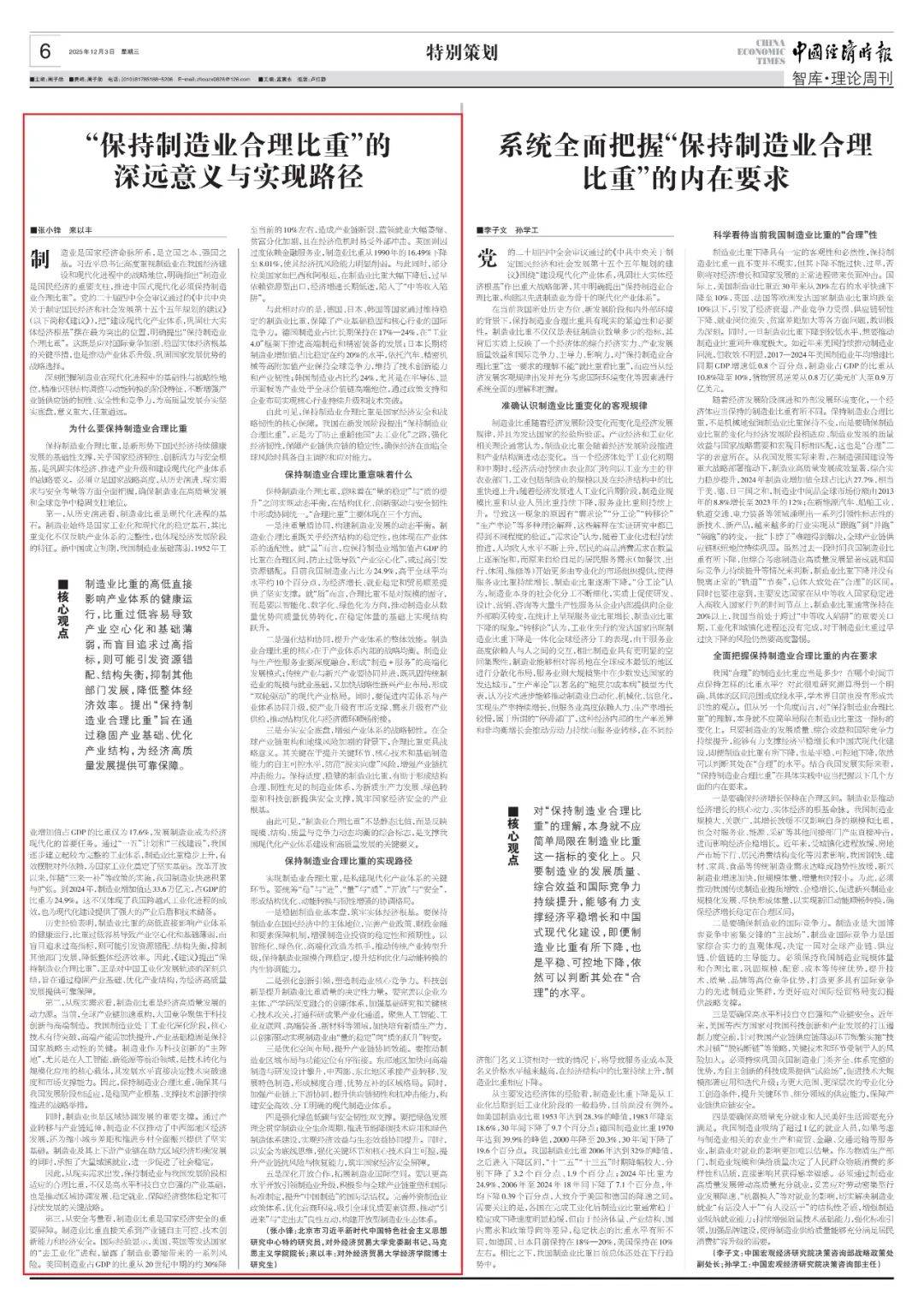
Core Viewpoint - The proportion of manufacturing directly impacts the health of the industrial system, with too low a ratio leading to hollowing out and weakness, while blindly pursuing a high ratio may cause resource misallocation and structural imbalance, ultimately reducing overall economic efficiency. The aim of "maintaining a reasonable proportion of manufacturing" is to stabilize the industrial foundation and optimize the industrial structure, providing reliable support for high-quality economic development [2][5][10]. Historical Perspective - Manufacturing is the cornerstone of modernization, with its proportion reflecting the integrity of the industrial system and the characteristics of economic development stages. In 1952, the industrial added value accounted for only 17.6% of GDP, making the development of manufacturing a primary task for economic modernization. By 2024, the added value of manufacturing is expected to reach 33.6 trillion yuan, with a GDP proportion of 24.9%, demonstrating the effectiveness of China's leapfrog industrialization [4][3][13]. Current Needs - The proportion of manufacturing is a driving force for high-quality economic development. As global industrial chains undergo rapid restructuring, major power competition focuses on technological innovation and high-end manufacturing. The manufacturing sector is crucial for technological innovation, especially in fields like artificial intelligence and new energy, and its development level directly influences the speed of technological breakthroughs and market support [5][6][15]. Regional Development - Manufacturing supports regional coordinated development by promoting industrial transfer and chain extension, aiding economic growth in central and western regions, and providing a solid foundation for narrowing urban-rural gaps and advancing rural revitalization. It also plays a significant role in job creation, further enhancing social stability [6][15]. Economic Security - The proportion of manufacturing is a critical barrier to national economic security, directly related to the autonomy of the industrial chain, technological innovation capabilities, and overall economic safety. Historical experiences from countries like the U.S. and the U.K. show that deindustrialization can lead to significant risks, including industrial chain disruptions and increased inequality. In contrast, countries like Germany, Japan, and South Korea maintain stable manufacturing proportions to ensure robust industrial foundations and international competitiveness [7][16][15]. Definition of Reasonable Proportion - Maintaining a reasonable proportion of manufacturing means achieving a dynamic balance between "quantity stability" and "quality improvement," focusing on structural optimization, innovation-driven growth, and safety resilience. The current manufacturing proportion in China is 24.9%, which is about 10 percentage points higher than the global average, providing solid support for economic growth, employment stability, and trade surplus [8][10][17]. Implementation Pathways - To achieve a reasonable manufacturing proportion, it is essential to stabilize the manufacturing base, enhance core competitiveness through innovation, optimize spatial layout, and strengthen green and safety resilience. This involves maintaining the manufacturing sector's dominant position in the economy, improving investment stability, and promoting traditional industry upgrades while fostering new manufacturing sectors [11][18][19].
政治局会议将如何影响你所关心的“价格”
李迅雷金融与投资· 2025-07-30 15:50
Economic Policy and Market Outlook - The Politburo meeting on July 30 provided a framework for economic development over the next five years and set the stage for the second half of 2023's economic policies [1] - The absence of explicit mentions of "real estate" in the recent meeting indicates a shift in focus, although the need to stabilize the housing market remains critical [3] - The meeting emphasized maintaining liquidity and promoting a decline in comprehensive financing costs, suggesting a potential for interest rate cuts in the future [2] Stock Market Dynamics - The Shanghai Composite Index has rebounded over 30% since last year, indicating a positive trend in the stock market, which the meeting aims to consolidate [4][5] - The effectiveness of measures taken by the Central Huijin Investment Ltd. and other entities in stabilizing the stock market has been acknowledged, but further support from fundamental economic conditions is necessary for continued growth [5] Commodity Prices and Supply Chain Management - Recent rebounds in commodity prices are contingent on supply-demand dynamics, with the government focusing on regulating excessive competition rather than merely raising prices [6][7] - The meeting highlighted the need for capacity management in key industries, including photovoltaic, cement, and automotive sectors, to ensure sustainable growth [6] Macro Policy Adjustments - The macroeconomic policy has shifted towards increased investment in consumer spending and improving living standards, with a notable rise in government leverage [8] - The government's ability to implement counter-cyclical policies is crucial for boosting confidence and stimulating demand in the face of economic contraction [8]
工信部:钢铁、有色、石化等十大重点行业稳增长工作方案即将出台
中国有色金属工业协会硅业分会· 2025-07-21 01:35
Core Viewpoint - The Ministry of Industry and Information Technology (MIIT) is focusing on stabilizing growth in key industries, promoting digital transformation, and enhancing the integration of technology and industry to drive economic development. Group 1: Industry Growth Plans - The MIIT is set to release growth stabilization plans for ten key industries, including steel, non-ferrous metals, petrochemicals, and building materials, emphasizing structural adjustments and the elimination of outdated production capacity [1] - Recent announcements indicate that growth stabilization plans for machinery, automotive, and power equipment industries will also be issued soon, aimed at enhancing quality supply capabilities and optimizing the industry development environment [5] Group 2: Digital Transformation and AI Integration - Over 100 AI-enabled devices, such as AI smartphones, computers, and glasses, have emerged, contributing to new economic growth points [2] - The digital industry achieved a business revenue growth of 9.3% year-on-year in the first half of the year, an increase of 3.4 percentage points compared to the same period last year [6] - The MIIT plans to issue digital transformation implementation plans for industries like textiles, light industry, food, and pharmaceuticals, focusing on 82 typical scenarios for intelligent transformation [7] Group 3: Technological Innovation and Future Industries - The MIIT is promoting the collaborative empowerment of industrial internet and artificial intelligence, while accelerating the research and development of 6G technology [4] - The ministry aims to foster high-level digital transformation service providers and encourage enterprises to shift towards a "product + service" model [9] - Future industries such as humanoid robots, the metaverse, and brain-computer interfaces are being prioritized for innovation and development [12] Group 4: Support for SMEs - The MIIT will conduct special actions to address the issue of overdue payments to small and medium-sized enterprises (SMEs), aiming to alleviate their financial burdens [10] - Plans are underway to establish the second phase of the National SME Development Fund to attract more social capital for long-term investments in hard technology [15] Group 5: Quality Development and Standards - The MIIT is committed to implementing high-quality development plans for the copper, aluminum, and gold industries, focusing on effective supply and demand coordination [14] - The ministry will accelerate the establishment of a digital transformation standard system to promote high-quality standards for new technologies and products [9]